Security concerns in Web ERP

Manoj Jhawar
MBA 2nd year
12125027
Overview
• ERP is experiencing the transformation that
will make it much more intelligent,
collaborative, web enabled, highly integrated
may become wireless
• ERP solutions worked upon common use of
distributed application which causes security
problems
Security issues
•
•
•
•
•
•

Physical Security
Transmission Security
Storage Security
Access Security
Data Security
Application Security
Several security problems are
•
•
•
•
•
•
•

Resource protection
Data confidentiality
Data integrity
Authentication of user
Non repudiation of transaction
Reliability of user
Anonymity of user
ERP Architecture
• Integration—various components are integrated and
seamless data flow occurs between components to
collaborate as a single function.
• Flexible—system is flexible, compatible and expandable
with the old systems, changes to the business processes
and strategies are easy to accomplish.
• Real-time—different components works in online, real time
and batch processing modes should be presented.
• Componentization—different business functional
requirement are designed as different components.
• Tailorable—system should be simply configured according
to the enterprise’s requirements.
3 tier Architecture
•

•

•

1. Front layer of Presentation Layer:
A combined Graphical User Interface
(GUI) or any browser that collects
data, generates requests, and
proceeds the results back to the user.
2. Middle layer of Application:
Application programs that collects
the requirements from the
Presentation layer and further routes
the request based on the business
function, rules or logic.
3. Database Layer (Back): Data Base
Management Systems that manages
the business and operational data
throughout the entire enterprise.
Current security solutions in ERP
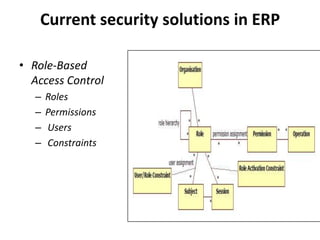
• Role-Based
Access Control
–
–
–
–

Roles
Permissions
Users
Constraints
Security in SAP/R3
• Authorization object- This represents the authorization concept and
consists of some authorization fields.
• Authorization- This is an instance of one authorization object and defines
permitted value range of each authorization field of the authorization
object.
• Authorization profile- This contains some authorizations which are
assigned to the user by an administrator.
• Authorization check- This is used to protect the transactions or data we
choose and is embedded in program logic. When authorization check is
performed then authorization profile will be used for comparing the
required values needed to run the specific transaction.
• User master record- This enables the users to log on to R/3 system and
grant limited entry to the transactions and data.
• Profile generator- This is the component which helps the administrators
create, generate, and assign authorization profiles using activity groups
and user
Diagram of SAP R/3 Authorization
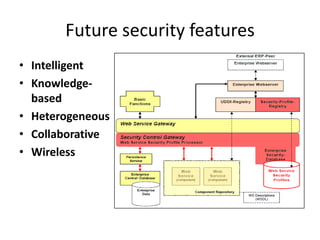
Open security Model
•
•

•

1. XML encryption 2. XML
signature 3. SAMLconfiguration parameters.
Constructing a new security
layer and connecting it into
the
already
existing
architecture,
requires
considering
different
provision
of
individual
security needs
Appropriate profile processor
is able to audit all incoming
messages
for
security
fulfillments on the own
security profile and also to
extend all outgoing messages
according to the security
policy of remote peer.
Future security features
• Intelligent
• Knowledgebased
• Heterogeneous
• Collaborative
• Wireless
Conclusion
• Existing security solutions like RBAC or SAP R/3 are based on
the features of the current ERP system and since ERP reveals
more and more new features that may be supported in the
future, present security mechanism needs to be retrofitted
and new security issues have to be identified
• In open security model proposed above we see that the
division of transport data and content is the key-note area
of the introduced security model
• The prefixed article builds an open architecture which will
not only considers the integration of existing security
standards such as XML encryption or XML signature or SAML
but will also aids future developments like Trusted Platforms

Security concerns in web erp

  • 1.
    Security concerns inWeb ERP Manoj Jhawar MBA 2nd year 12125027
  • 2.
    Overview • ERP isexperiencing the transformation that will make it much more intelligent, collaborative, web enabled, highly integrated may become wireless • ERP solutions worked upon common use of distributed application which causes security problems
  • 3.
    Security issues • • • • • • Physical Security TransmissionSecurity Storage Security Access Security Data Security Application Security
  • 4.
    Several security problemsare • • • • • • • Resource protection Data confidentiality Data integrity Authentication of user Non repudiation of transaction Reliability of user Anonymity of user
  • 5.
    ERP Architecture • Integration—variouscomponents are integrated and seamless data flow occurs between components to collaborate as a single function. • Flexible—system is flexible, compatible and expandable with the old systems, changes to the business processes and strategies are easy to accomplish. • Real-time—different components works in online, real time and batch processing modes should be presented. • Componentization—different business functional requirement are designed as different components. • Tailorable—system should be simply configured according to the enterprise’s requirements.
  • 6.
    3 tier Architecture • • • 1.Front layer of Presentation Layer: A combined Graphical User Interface (GUI) or any browser that collects data, generates requests, and proceeds the results back to the user. 2. Middle layer of Application: Application programs that collects the requirements from the Presentation layer and further routes the request based on the business function, rules or logic. 3. Database Layer (Back): Data Base Management Systems that manages the business and operational data throughout the entire enterprise.
  • 7.
    Current security solutionsin ERP • Role-Based Access Control – – – – Roles Permissions Users Constraints
  • 8.
    Security in SAP/R3 •Authorization object- This represents the authorization concept and consists of some authorization fields. • Authorization- This is an instance of one authorization object and defines permitted value range of each authorization field of the authorization object. • Authorization profile- This contains some authorizations which are assigned to the user by an administrator. • Authorization check- This is used to protect the transactions or data we choose and is embedded in program logic. When authorization check is performed then authorization profile will be used for comparing the required values needed to run the specific transaction. • User master record- This enables the users to log on to R/3 system and grant limited entry to the transactions and data. • Profile generator- This is the component which helps the administrators create, generate, and assign authorization profiles using activity groups and user
  • 9.
    Diagram of SAPR/3 Authorization
  • 10.
    Open security Model • • • 1.XML encryption 2. XML signature 3. SAMLconfiguration parameters. Constructing a new security layer and connecting it into the already existing architecture, requires considering different provision of individual security needs Appropriate profile processor is able to audit all incoming messages for security fulfillments on the own security profile and also to extend all outgoing messages according to the security policy of remote peer.
  • 11.
    Future security features •Intelligent • Knowledgebased • Heterogeneous • Collaborative • Wireless
  • 12.
    Conclusion • Existing securitysolutions like RBAC or SAP R/3 are based on the features of the current ERP system and since ERP reveals more and more new features that may be supported in the future, present security mechanism needs to be retrofitted and new security issues have to be identified • In open security model proposed above we see that the division of transport data and content is the key-note area of the introduced security model • The prefixed article builds an open architecture which will not only considers the integration of existing security standards such as XML encryption or XML signature or SAML but will also aids future developments like Trusted Platforms