Security Challenges
in Emerging
Technologies
Praveen Joseph Vackayil
CISSP, PCI QSA cert., CCNA, ISO 27001 LA, MS - Warwick, BE
DISCLAIMER
Ground Rules
• Questions are welcome
• Share your knowledge
• Mobile phones – you know
what to do
Session Objectives
• Exploratory look at emergent technologies
• Identification of associated security
challenges
• Bottom-line:
Incite the thought process on upcoming
challenges and opportunities in information
security.
Session Plan
•The Evolution of Information
Security
•4 Emerging Areas of Technology
and Associated Security
Challenges
So Let’s Go
The Evolution of Information
Security
C
I
A
Quick Reminder
• The fundamental objective of information security is to
protect the C, I and A of data.
However, it wasn’t always this way.
The Shifting Focus of
Information Security
• The early days of data security focused primarily on
Confidentiality of Data
• Cryptography dates back to around 2000 B.C. in Egypt when
encrypted hieroglyphic messages were etched on tombs
The Shifting Focus of
Information Security
• Military applications of cryptography were developed in the
1800s.
• Cryptography was extensively used to encrypt tactical
communications during World Wars I and II.
Can you Identify This Machine?
The Shifting Focus of
Information Security
• With the computing era, the way people use information in
their daily lives evolved.
And with it, so did information security.
1944 Today
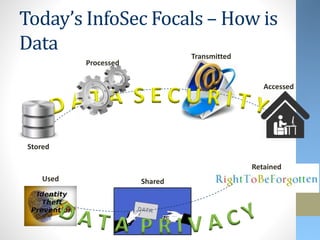
Today’s InfoSec Focals – How is
Data Transmitted
Accessed
Shared
Retained
Used
Stored
Processed
What Does The Future Hold?
Wearables
Self Driving Cars 3D Printing
What This All Means
• The same trend from the 60s and 70s is repeating itself.
• Just like how computers spread out from a few offices to the
common man, advanced technology is becoming cheaper and
easily available.
From Greater Pervasiveness to
Greater Power
• Technology’s control over a common man’s life is increasing.
• Today we use mobile phones to keep us connected, and
process information.
• Tomorrow, we will use technology to drive our cars to work.
Shift in the Goal of Information
Security
• Today, the end objective of information security is mainly to
protect assets like
• money
• trade secrets
• business productivity
• organizations’ reputations, etc.
In future, the end objective will shift towards the protection
of
• Human Life
Example Scenario
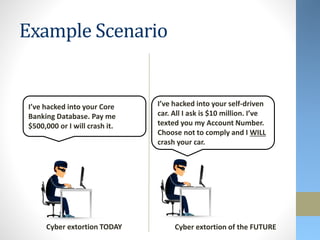
I’ve hacked into your Core
Banking Database. Pay me
$500,000 or I will crash it.
I’ve hacked into your self-driven
car. All I ask is $10 million. I’ve
texted you my Account Number.
Choose not to comply and I WILL
crash your car.
Cyber extortion TODAY Cyber extortion of the FUTURE
4 Emergent Technologies and
Their Security Challenges
Discussion Plan
• Review of 4 Emergent Technologies
Robotics
3D Printing
The Internet of Things
Wearables
Robotics
Robots Have Been Around A
Very Long Time
First Robot Ever Made:
Archytas’ Bird
• Steam powered wooden bird
• Dates back to 360 BC
• First known attempt at
automation
First Industrial Robot
• 1961 – General Motors developed
a robot to move hot car parts into a
cooling liquid
Robotics: Applications Today
• Industrial Applications:
• Factories – manufacture of cars,
packaging material, processed
foods, etc.
• Automation of repetitive tasks
with high precision
• Medical Applications:
• Robotic surgery allows doctors
to control and automate
complex procedures with high
precision, sometimes even
remotely.
Military Applications of
Robotics • TALON
• Built by a company called Foster-
Miller
• Most common military robot in use
• Can travel through sand, water, and
snow.
• Has Audio-visual listening devices and
a mechanical arm
• Primarily used in search and rescue
operations. Was used in 911.
• Controlled remotely by a human.
Upcoming versions of TALON will include a weapons system
holding guns and grenade launchers.
What Are The Security
Implications?
• End-Points – ie the
equipment at the
doctor’s end or at the
patient’s end is
compromised. This is
less common since the
end-points are usually
physically guarded.
• Network Attacks – the
channel of
communication
between the doctor and
patient is compromised.
This is more common.
Ref: http://arxiv.org/pdf/1504.04339v2.pdf
Consider a Tele-Robotic Surgery. How can it be attacked?
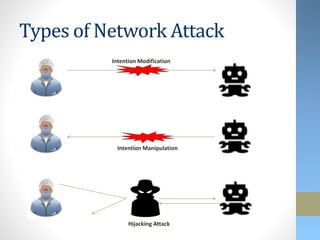
Types of Network Attack
Intention Modification
Intention Manipulation
Hijacking Attack
How Bad Can It Get?
• The above was just one example, but it
can be extrapolated to other scenarios
where robots are used.
• Most robots today are not entirely
autonomous – ie. they must be instructed
by a human entity over a communication
channel.
• If this process is compromised, the impact
can be death and/or serious physical
damage.
Recent Events
Ref: http://time.com/3944181/robot-kills-man-volkswagen-
plant/
Security Approach
• Go Back to the Basics
• Strong encryption of the network link between
the Operator and the Operated Device.
• Use secure communication protocols like TLS
v1.3 and above, SSH, WPA2, etc.
• Strong authentication of source and
destination IPs
• Harden the end-point devices
• Perform network and app level pen-testing
3D Printing
What Is It?
Technology that allows you to fabricate three
dimensional objects using plastic, metal, ceramics,
powders, liquids, or even living cells provided you
have a blueprint of the object created with CAD
software.
3D Printing has been around
since the late 80s. Since 2006,
the technology has started to
become cheaper and more
accessible.
You Will Need A 3D Printer and
a “.stl” Template
http://www.thingiverse.com
3D printing is also called Stereolithography and the CAD templates are created in the
.stl format.
Applications
• Automobile Manufacture
Manufacture and testing of
prototypes and auto
parts/components
• Medical Sector
Manufacture of low cost prosthetic
limbs, dental implants and even living
tissue.
• Defence, Education, etc.
3D Printed Weapons?
• Defense Distributed is an open source company that provides .stl designs for
3D printed firearms – for FREE.
3D Printed Weapons?
• Plastic 3D printed guns can actually be used to fire rounds.
• Liberator 3D is a functioning 3D printed gun developed by Defense
Distributed.
• Plastic guns – don’t show up under a metal detector scan. So this means
everyone with a 3D Printer can create and own an invisible weapon.
Ref:
https://www.youtube.com/watch?feature=player_embedded&v=drPz6n6UXQY
3D Printed ATM Skimmers
• An ATM skimmer fits into an ATM card
slot and can capture Track data from a
swiped credit/debit card.
• A pinhole camera/ keypad overlay
captures the PIN as it is keyed in by the
cardholder
• This is transmitted wirelessly to criminals
located within a 100m range of the ATM.
• Unless cardholders are alert, the
skimmer will pass off as a genuine part of
the ATM itself.
• 3D printing allows ATM skimmer devices
to be made faster, more accurately and
efficiently by crooks.
How About Your Car Keys?
• All it takes is a few photographs of a key to
create the .stl design and 3D print a
duplicate set.
• Burglars, car thieves, etc. are jumping at
the opportunities.
What’s Next?
•There are 6 million parts that go
into a Boeing 747. What if
tomorrow one of those is a 3D
printed fake?
•Counterfeit coins
•Fake ID Cards ???
And By The Way…
• The world’s first fully 3D printed car is on its way out in 2016.
• LocalMotors is working on a road-ready model.
Solutions?
•The technology is still evolving
•Regulation and Legislation is yet
to catch up with ethical, legal,
privacy and security challenges.
•It is going to be difficult to predict,
let alone prevent the mis-use of
this technology.
Wearables
Recognize This?
Casio CFX-400 Calculator Watch. 1995.
How Do We Understand
Wearables?
What’s Common to All Wearables
,
which are carried either of
a user’s body.
What’s Different
Primary Function of the device
• Smart Glasses- Augmented
Reality Device
• Smart Watch - Makes calls,
plays music, etc.
• Smart Pills – monitor health
stats
Device Capability
• Does it have a camera?
• Can it make calls?
• Is it online?
• Does it keep you alive?
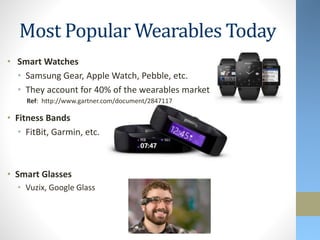
Most Popular Wearables Today
• Smart Watches
• Samsung Gear, Apple Watch, Pebble, etc.
• They account for 40% of the wearables market
• Fitness Bands
• FitBit, Garmin, etc.
• Smart Glasses
• Vuzix, Google Glass
Ref: http://www.gartner.com/document/2847117
The Security Challenge with
Wearables
I. For a Personal User – Data
Privacy is the primary concern
with Wearables
II. At an Organizational Level –
Data Security is the key concern
I. Personal Users: The Privacy
Challenge
• Wearable technology is still evolving.
• The primary design focus is more on
functionality and less on privacy.
• Imagine the data available to a stalker who
has hacked into your fitness band:
• Location of your house
• Places you frequent the most
• Your sleep patterns
• Your food habits
• Your exercise habits
• Your health data: heart rate, BP, etc.
Security vs Functionality
• We all know the Google Glass story. A host of great new
features… but privacy??
Eye Tracking Feature Recording Feature
What you see – Glass sees. People that you see – Glass
sees (and can record).
Ref: https://www.youtube.com/watch?t=85&v=9c6W4CCU9M4
Come Jan 2015, Google eventually had to pull the plug on Glass
II. Organizational Context –
Security Challenge
The primary challenge with allowing wearables within an
office workspace is Data Security
Mobile phones have already changed the
security landscape within organizations. How
hard is it to take pictures of your screen using a
mobile camera?
The main issue with wearables is they make it
difficult to find out when they are used to steal
data - taking pictures at the blink of an eye, for
instance.
The Next Level of Wearables
•Implantables
•Ingestibles
Implantables
Jiya Bavishi's auditory brainstem implant is helping her hear
sounds for the first time.
Auditory Brain-Stem
Implant consists of a
i. mic attached to the
ear and
ii. a sensor implanted in
the brain
to process sound signals
in hearing impaired
patients.
Ref: http://www.npr.org/sections/health-shots/2015/06/01/410065053/new-hearing-technology-brings-sound-to-a-litte-
girl
Ingestibles
• The Pill communicates with a
wearable sensor on the skin
called a Patch.
• The technology will track the
patient’s physiological stats
about medication ingestion,
heart rate, activity, rest, and skin
temperature
• The digital health information
can be viewed on a synced
Mobile/Tablet.
Ref: proteus.com
Proteus, a company specializing in Digital Medicine, has received FDA
approval for its Digital Pills – sensors which can be swallowed by a patient.
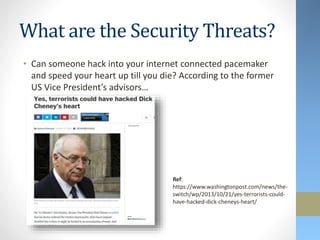
What are the Security Threats?
• Can someone hack into your internet connected pacemaker
and speed your heart up till you die? According to the former
US Vice President’s advisors…
Ref:
https://www.washingtonpost.com/news/the-
switch/wp/2013/10/21/yes-terrorists-could-
have-hacked-dick-cheneys-heart/
Securing Wearable Technology
Manufacturers of Wearable Technology
• Manufacturers are being pushed by security researchers to look at
security and privacy at the design stage of their devices.
• Devices must anticipate and inform users of privacy compromises they
will make at every stage of using a device
Organizations/Work Places
• Organizations must understand the risks introduced by allowing
wearables within their premises.
• A risk assessment must be done to identify controls ranging from
restricted permission to use these devices to fully denying access
End-Users:
• Users must be aware that privacy will be compromised when they use a
wearable device.
• Children and senior citizens are more vulnerable.
The Internet of Things
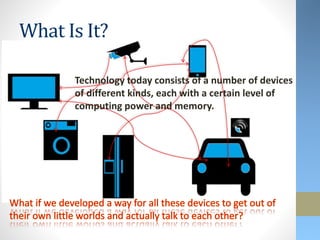
What Is It?
Technology today consists of a number of devices
of different kinds, each with a certain level of
computing power and memory.
The IoT is a
ecosystem of
hardware and embedded
within which data can be
and
How Do We Define the IoT?
Interesting Statistic
• The IoT s is projected to consist of 30 billion connected
“things” by 2020.
Ref: IDC
The world’s human population is projected to be almost 8
billion by 2020.
Ref: United Nations Population Fund
What This Means
The Big Challenge – Securing
the IoT
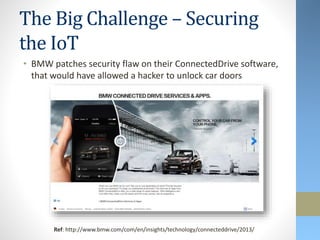
• BMW patches security flaw on their ConnectedDrive software,
that would have allowed a hacker to unlock car doors
Ref: http://www.bmw.com/com/en/insights/technology/connecteddrive/2013/
The Big Challenge – Securing
the IoT
Jul 22, 2015: Hack moving Jeep. Switch off engine.
Ref: http://www.cbc.ca/news/technology/hackers-kill-engine-of-moving-jeep-on-highway-in-security-demo-
1.3162944
The Challenges are Many
• Complexity
A heterogeneous network means devices on the IoT are
different, with unique designs, software, operating
protocols, etc. Where does a security attempt even begin?
• Uniform Standards
On the IoT, we will need to develop a uniform standard for
devices to communicate. A uniform standard/protocol
makes the IoT that much easier to hack into.
• Monitoring
Currently, organizations have SOCs with IPS/DLP, etc. Who
will monitor the IoT network?
IBM Model for the IoT
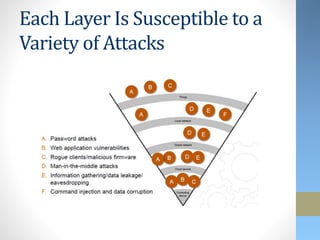
Each Layer Is Susceptible to a
Variety of Attacks
• Recommends a holistic approach
• Focus not only on securing the Device, but also,
• The IoT Environment it operates in
• It looks at:
• The Device
• The Cloud
• The Mobile Application
• Network Interfaces
• Software
• Use of Encryption
• Use of Authentication
• Physical Security
• USB Ports
Ref: OWASP Internet of Things Top Ten
OWASP – Internet of Things
Top Ten
THANK YOU
&
STAY IN TOUCH
Linkedin.com/in/vackayil
Praveen.jvc@gmail.com

Security Challenges in Emerging Technologies

  • 1.
    Security Challenges in Emerging Technologies PraveenJoseph Vackayil CISSP, PCI QSA cert., CCNA, ISO 27001 LA, MS - Warwick, BE
  • 2.
  • 3.
    Ground Rules • Questionsare welcome • Share your knowledge • Mobile phones – you know what to do
  • 4.
    Session Objectives • Exploratorylook at emergent technologies • Identification of associated security challenges • Bottom-line: Incite the thought process on upcoming challenges and opportunities in information security.
  • 5.
    Session Plan •The Evolutionof Information Security •4 Emerging Areas of Technology and Associated Security Challenges
  • 6.
  • 7.
    The Evolution ofInformation Security
  • 8.
    C I A Quick Reminder • Thefundamental objective of information security is to protect the C, I and A of data. However, it wasn’t always this way.
  • 9.
    The Shifting Focusof Information Security • The early days of data security focused primarily on Confidentiality of Data • Cryptography dates back to around 2000 B.C. in Egypt when encrypted hieroglyphic messages were etched on tombs
  • 10.
    The Shifting Focusof Information Security • Military applications of cryptography were developed in the 1800s. • Cryptography was extensively used to encrypt tactical communications during World Wars I and II. Can you Identify This Machine?
  • 11.
    The Shifting Focusof Information Security • With the computing era, the way people use information in their daily lives evolved. And with it, so did information security. 1944 Today
  • 12.
    Today’s InfoSec Focals– How is Data Transmitted Accessed Shared Retained Used Stored Processed
  • 13.
    What Does TheFuture Hold? Wearables Self Driving Cars 3D Printing
  • 14.
    What This AllMeans • The same trend from the 60s and 70s is repeating itself. • Just like how computers spread out from a few offices to the common man, advanced technology is becoming cheaper and easily available.
  • 15.
    From Greater Pervasivenessto Greater Power • Technology’s control over a common man’s life is increasing. • Today we use mobile phones to keep us connected, and process information. • Tomorrow, we will use technology to drive our cars to work.
  • 16.
    Shift in theGoal of Information Security • Today, the end objective of information security is mainly to protect assets like • money • trade secrets • business productivity • organizations’ reputations, etc. In future, the end objective will shift towards the protection of • Human Life
  • 17.
    Example Scenario I’ve hackedinto your Core Banking Database. Pay me $500,000 or I will crash it. I’ve hacked into your self-driven car. All I ask is $10 million. I’ve texted you my Account Number. Choose not to comply and I WILL crash your car. Cyber extortion TODAY Cyber extortion of the FUTURE
  • 18.
    4 Emergent Technologiesand Their Security Challenges
  • 19.
    Discussion Plan • Reviewof 4 Emergent Technologies Robotics 3D Printing The Internet of Things Wearables
  • 20.
  • 21.
    Robots Have BeenAround A Very Long Time First Robot Ever Made: Archytas’ Bird • Steam powered wooden bird • Dates back to 360 BC • First known attempt at automation First Industrial Robot • 1961 – General Motors developed a robot to move hot car parts into a cooling liquid
  • 22.
    Robotics: Applications Today •Industrial Applications: • Factories – manufacture of cars, packaging material, processed foods, etc. • Automation of repetitive tasks with high precision • Medical Applications: • Robotic surgery allows doctors to control and automate complex procedures with high precision, sometimes even remotely.
  • 23.
    Military Applications of Robotics• TALON • Built by a company called Foster- Miller • Most common military robot in use • Can travel through sand, water, and snow. • Has Audio-visual listening devices and a mechanical arm • Primarily used in search and rescue operations. Was used in 911. • Controlled remotely by a human. Upcoming versions of TALON will include a weapons system holding guns and grenade launchers.
  • 24.
    What Are TheSecurity Implications? • End-Points – ie the equipment at the doctor’s end or at the patient’s end is compromised. This is less common since the end-points are usually physically guarded. • Network Attacks – the channel of communication between the doctor and patient is compromised. This is more common. Ref: http://arxiv.org/pdf/1504.04339v2.pdf Consider a Tele-Robotic Surgery. How can it be attacked?
  • 25.
    Types of NetworkAttack Intention Modification Intention Manipulation Hijacking Attack
  • 26.
    How Bad CanIt Get? • The above was just one example, but it can be extrapolated to other scenarios where robots are used. • Most robots today are not entirely autonomous – ie. they must be instructed by a human entity over a communication channel. • If this process is compromised, the impact can be death and/or serious physical damage.
  • 27.
  • 28.
    Security Approach • GoBack to the Basics • Strong encryption of the network link between the Operator and the Operated Device. • Use secure communication protocols like TLS v1.3 and above, SSH, WPA2, etc. • Strong authentication of source and destination IPs • Harden the end-point devices • Perform network and app level pen-testing
  • 29.
  • 30.
    What Is It? Technologythat allows you to fabricate three dimensional objects using plastic, metal, ceramics, powders, liquids, or even living cells provided you have a blueprint of the object created with CAD software. 3D Printing has been around since the late 80s. Since 2006, the technology has started to become cheaper and more accessible.
  • 31.
    You Will NeedA 3D Printer and a “.stl” Template http://www.thingiverse.com 3D printing is also called Stereolithography and the CAD templates are created in the .stl format.
  • 32.
    Applications • Automobile Manufacture Manufactureand testing of prototypes and auto parts/components • Medical Sector Manufacture of low cost prosthetic limbs, dental implants and even living tissue. • Defence, Education, etc.
  • 33.
    3D Printed Weapons? •Defense Distributed is an open source company that provides .stl designs for 3D printed firearms – for FREE.
  • 34.
    3D Printed Weapons? •Plastic 3D printed guns can actually be used to fire rounds. • Liberator 3D is a functioning 3D printed gun developed by Defense Distributed. • Plastic guns – don’t show up under a metal detector scan. So this means everyone with a 3D Printer can create and own an invisible weapon. Ref: https://www.youtube.com/watch?feature=player_embedded&v=drPz6n6UXQY
  • 35.
    3D Printed ATMSkimmers • An ATM skimmer fits into an ATM card slot and can capture Track data from a swiped credit/debit card. • A pinhole camera/ keypad overlay captures the PIN as it is keyed in by the cardholder • This is transmitted wirelessly to criminals located within a 100m range of the ATM. • Unless cardholders are alert, the skimmer will pass off as a genuine part of the ATM itself. • 3D printing allows ATM skimmer devices to be made faster, more accurately and efficiently by crooks.
  • 36.
    How About YourCar Keys? • All it takes is a few photographs of a key to create the .stl design and 3D print a duplicate set. • Burglars, car thieves, etc. are jumping at the opportunities.
  • 37.
    What’s Next? •There are6 million parts that go into a Boeing 747. What if tomorrow one of those is a 3D printed fake? •Counterfeit coins •Fake ID Cards ???
  • 38.
    And By TheWay… • The world’s first fully 3D printed car is on its way out in 2016. • LocalMotors is working on a road-ready model.
  • 39.
    Solutions? •The technology isstill evolving •Regulation and Legislation is yet to catch up with ethical, legal, privacy and security challenges. •It is going to be difficult to predict, let alone prevent the mis-use of this technology.
  • 40.
  • 41.
    Recognize This? Casio CFX-400Calculator Watch. 1995.
  • 42.
    How Do WeUnderstand Wearables? What’s Common to All Wearables , which are carried either of a user’s body. What’s Different Primary Function of the device • Smart Glasses- Augmented Reality Device • Smart Watch - Makes calls, plays music, etc. • Smart Pills – monitor health stats Device Capability • Does it have a camera? • Can it make calls? • Is it online? • Does it keep you alive?
  • 43.
    Most Popular WearablesToday • Smart Watches • Samsung Gear, Apple Watch, Pebble, etc. • They account for 40% of the wearables market • Fitness Bands • FitBit, Garmin, etc. • Smart Glasses • Vuzix, Google Glass Ref: http://www.gartner.com/document/2847117
  • 44.
    The Security Challengewith Wearables I. For a Personal User – Data Privacy is the primary concern with Wearables II. At an Organizational Level – Data Security is the key concern
  • 45.
    I. Personal Users:The Privacy Challenge • Wearable technology is still evolving. • The primary design focus is more on functionality and less on privacy. • Imagine the data available to a stalker who has hacked into your fitness band: • Location of your house • Places you frequent the most • Your sleep patterns • Your food habits • Your exercise habits • Your health data: heart rate, BP, etc.
  • 46.
    Security vs Functionality •We all know the Google Glass story. A host of great new features… but privacy?? Eye Tracking Feature Recording Feature What you see – Glass sees. People that you see – Glass sees (and can record). Ref: https://www.youtube.com/watch?t=85&v=9c6W4CCU9M4 Come Jan 2015, Google eventually had to pull the plug on Glass
  • 47.
    II. Organizational Context– Security Challenge The primary challenge with allowing wearables within an office workspace is Data Security Mobile phones have already changed the security landscape within organizations. How hard is it to take pictures of your screen using a mobile camera? The main issue with wearables is they make it difficult to find out when they are used to steal data - taking pictures at the blink of an eye, for instance.
  • 48.
    The Next Levelof Wearables •Implantables •Ingestibles
  • 49.
    Implantables Jiya Bavishi's auditorybrainstem implant is helping her hear sounds for the first time. Auditory Brain-Stem Implant consists of a i. mic attached to the ear and ii. a sensor implanted in the brain to process sound signals in hearing impaired patients. Ref: http://www.npr.org/sections/health-shots/2015/06/01/410065053/new-hearing-technology-brings-sound-to-a-litte- girl
  • 50.
    Ingestibles • The Pillcommunicates with a wearable sensor on the skin called a Patch. • The technology will track the patient’s physiological stats about medication ingestion, heart rate, activity, rest, and skin temperature • The digital health information can be viewed on a synced Mobile/Tablet. Ref: proteus.com Proteus, a company specializing in Digital Medicine, has received FDA approval for its Digital Pills – sensors which can be swallowed by a patient.
  • 51.
    What are theSecurity Threats? • Can someone hack into your internet connected pacemaker and speed your heart up till you die? According to the former US Vice President’s advisors… Ref: https://www.washingtonpost.com/news/the- switch/wp/2013/10/21/yes-terrorists-could- have-hacked-dick-cheneys-heart/
  • 52.
    Securing Wearable Technology Manufacturersof Wearable Technology • Manufacturers are being pushed by security researchers to look at security and privacy at the design stage of their devices. • Devices must anticipate and inform users of privacy compromises they will make at every stage of using a device Organizations/Work Places • Organizations must understand the risks introduced by allowing wearables within their premises. • A risk assessment must be done to identify controls ranging from restricted permission to use these devices to fully denying access End-Users: • Users must be aware that privacy will be compromised when they use a wearable device. • Children and senior citizens are more vulnerable.
  • 53.
  • 54.
    What Is It? Technologytoday consists of a number of devices of different kinds, each with a certain level of computing power and memory.
  • 55.
    The IoT isa ecosystem of hardware and embedded within which data can be and How Do We Define the IoT?
  • 56.
    Interesting Statistic • TheIoT s is projected to consist of 30 billion connected “things” by 2020. Ref: IDC The world’s human population is projected to be almost 8 billion by 2020. Ref: United Nations Population Fund
  • 57.
  • 58.
    The Big Challenge– Securing the IoT • BMW patches security flaw on their ConnectedDrive software, that would have allowed a hacker to unlock car doors Ref: http://www.bmw.com/com/en/insights/technology/connecteddrive/2013/
  • 59.
    The Big Challenge– Securing the IoT Jul 22, 2015: Hack moving Jeep. Switch off engine. Ref: http://www.cbc.ca/news/technology/hackers-kill-engine-of-moving-jeep-on-highway-in-security-demo- 1.3162944
  • 60.
    The Challenges areMany • Complexity A heterogeneous network means devices on the IoT are different, with unique designs, software, operating protocols, etc. Where does a security attempt even begin? • Uniform Standards On the IoT, we will need to develop a uniform standard for devices to communicate. A uniform standard/protocol makes the IoT that much easier to hack into. • Monitoring Currently, organizations have SOCs with IPS/DLP, etc. Who will monitor the IoT network?
  • 61.
  • 62.
    Each Layer IsSusceptible to a Variety of Attacks
  • 63.
    • Recommends aholistic approach • Focus not only on securing the Device, but also, • The IoT Environment it operates in • It looks at: • The Device • The Cloud • The Mobile Application • Network Interfaces • Software • Use of Encryption • Use of Authentication • Physical Security • USB Ports Ref: OWASP Internet of Things Top Ten OWASP – Internet of Things Top Ten
  • 64.
    THANK YOU & STAY INTOUCH Linkedin.com/in/vackayil Praveen.jvc@gmail.com

Editor's Notes

  • #12 Early 60s The core asset was the computer and not so much the data it processed. Information protection was achieved mainly through the control of physical access to computers. Skilled users of the computers were few Computers were not networked. Two parallel developments from the 80s onwards: Increasing dependence on computers – which means an organization CANNOT operate efficiently without some reliance (extensive in most cases) on a technology platform. Increasing simplicity of computing. Today, people don’t need any specific skills to learn to use a mobile phone, for instance. Computing is becoming intuition driven, so as to enable greater adoption. With more and more sensitive data being put on a computer, the primary asset has become the information, and with cheaper availability of computers, the computer has become a secondary asset – more like a primary asset container.
  • #13 Give explanation of each case – stored, processed, transmitted, work from home, Google Right to be Forgotten, Misuse of data for identity thefts, sharing of data with third parties (Main reason why Myntra is going mobile, Facebook acquired WhatsApp for 19 billion USD) - It is undoubtedly true that a mobile is a far more personal device than a desktop and ergo, it knows a lot more about you than your desktop. Everything from your location to your social circle to your waking and other habits & preferences. PII, SPI available on a smartphone: - Mobile Number - Email ID - Location - Travel updates - Contacts (Phone nos) - Text messages (SMS and WhatsApp) - Photos taken with mobile camera - Call Data (most called persons, average time spent per day on calls, etc.) - Browsing habits (most frequented websites)
  • #26 Types of Network Attack: Intention Modification A man-in-the-middle attacker modifies the surgeon’s messages to the robot. Intention Manipulation A man in the middle modifies feedback messages originating from a robot. A surgeon’s messages (and his/her intent) are not modified Hijacking Attack A man in the middle takes control of the robot, causing it to ignore the intentions of a surgeon, and to instead perform other, potentially harmful actions. These attacks can also be done discreetly to avoid detection.
  • #58 You are involved in a car crash. Sensors in your car detect the collision and deploy your air bags. Using your car’s navigation system, the nearest hospital is identified The emergency helpline number is found on Google and a call is triggered from your phone (which of course is linked to your car via Bluetooth) to this emergency number. A shrill alarm is sounded off from your car, to alert passers-by. Meantime, your car’s sensors have already sent warning messages to the nearest set of traffic lights, alerting incoming vehicles to slow down.
  • #61 Simple iPhone game app - 10,000 lines of code Average Car software – 100 million lines of code