RESEARCH BULLETIN
SEPTEMBER 24, 2021
RESERVE BANK OF INDIA
Beacon Trusteeship Limited 1
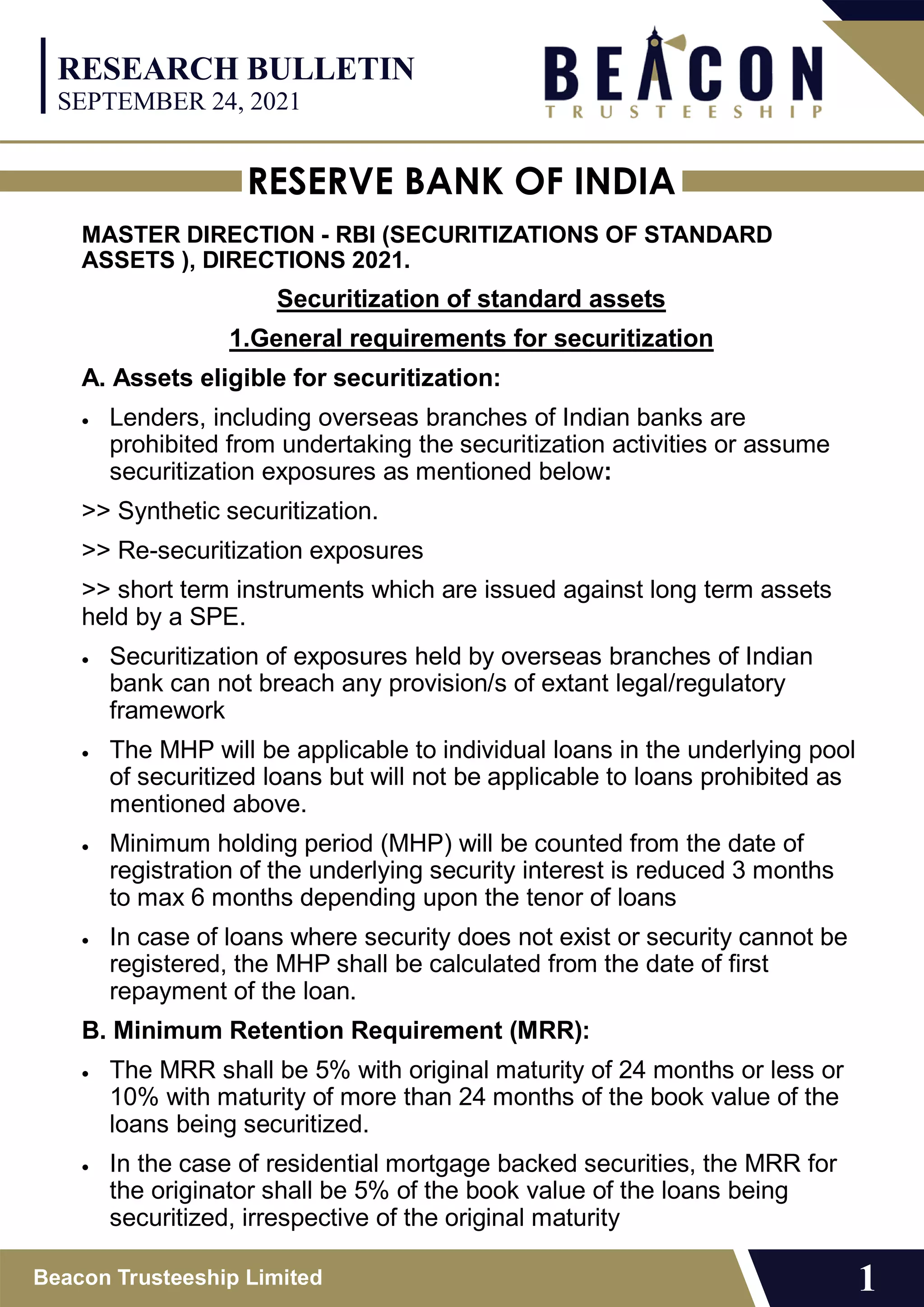
MASTER DIRECTION - RBI (SECURITIZATIONS OF STANDARD
ASSETS ), DIRECTIONS 2021.
Securitization of standard assets
1.General requirements for securitization
A. Assets eligible for securitization:
 Lenders, including overseas branches of Indian banks are
prohibited from undertaking the securitization activities or assume
securitization exposures as mentioned below:
>> Synthetic securitization.
>> Re-securitization exposures
>> short term instruments which are issued against long term assets
held by a SPE.
 Securitization of exposures held by overseas branches of Indian
bank can not breach any provision/s of extant legal/regulatory
framework
 The MHP will be applicable to individual loans in the underlying pool
of securitized loans but will not be applicable to loans prohibited as
mentioned above.
 Minimum holding period (MHP) will be counted from the date of
registration of the underlying security interest is reduced 3 months
to max 6 months depending upon the tenor of loans
 In case of loans where security does not exist or security cannot be
registered, the MHP shall be calculated from the date of first
repayment of the loan.
B. Minimum Retention Requirement (MRR):
 The MRR shall be 5% with original maturity of 24 months or less or
10% with maturity of more than 24 months of the book value of the
loans being securitized.
 In the case of residential mortgage backed securities, the MRR for
the originator shall be 5% of the book value of the loans being
securitized, irrespective of the original maturity
RESERVE BANK OF INDIA
Beacon Trusteeship Limited 2
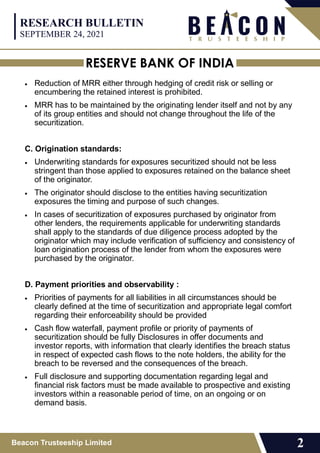
 Reduction of MRR either through hedging of credit risk or selling or
encumbering the retained interest is prohibited.
 MRR has to be maintained by the originating lender itself and not by any
of its group entities and should not change throughout the life of the
securitization.
C. Origination standards:
 Underwriting standards for exposures securitized should not be less
stringent than those applied to exposures retained on the balance sheet
of the originator.
 The originator should disclose to the entities having securitization
exposures the timing and purpose of such changes.
 In cases of securitization of exposures purchased by originator from
other lenders, the requirements applicable for underwriting standards
shall apply to the standards of due diligence process adopted by the
originator which may include verification of sufficiency and consistency of
loan origination process of the lender from whom the exposures were
purchased by the originator.
D. Payment priorities and observability :
 Priorities of payments for all liabilities in all circumstances should be
clearly defined at the time of securitization and appropriate legal comfort
regarding their enforceability should be provided
 Cash flow waterfall, payment profile or priority of payments of
securitization should be fully Disclosures in offer documents and
investor reports, with information that clearly identifies the breach status
in respect of expected cash flows to the note holders, the ability for the
breach to be reversed and the consequences of the breach.
 Full disclosure and supporting documentation regarding legal and
financial risk factors must be made available to prospective and existing
investors within a reasonable period of time, on an ongoing or on
demand basis.
RESEARCH BULLETIN
SEPTEMBER 24, 2021
RESERVE BANK OF INDIA
Beacon Trusteeship Limited 3
D. Limit on Total Retained Exposures by Originators:
 The total exposure of an originator to the securitization exposures
belonging to a particular securitization structure or scheme should
not exceed 20%.
F. Issuance and listing :
 The minimum ticket size for issuance of securitization notes shall be
INR 1 crore.
 Any offer of securitization notes to fifty or more persons in an
issuance is required to be listed in terms of SEBI (Issue and Listing
of Securitized Debt Instruments and Security Receipts) Regulations,
2008.
G. Conditions to be satisfied by the special purpose entity :
 The SPE has to meet certain criteria to enable the originator to
apply the guidelines on capital adequacy and other aspects in these
directions with respect to securitization exposure as mentioned
below:
>> The SPE and the trustee should not resemble in name or imply any
connection or relationship with the originator of the assets in its title or
name.
>>The originator should not have any ownership, proprietary , share
capital or beneficial interest in the SPE.
>> If SPE is set up as a trust, then the originator cannot exercise
control, directly or indirectly over them nor have any ownership,
proprietary or beneficial interest in the trustees.
>> The trust deed should not provide for any discretion to the trustee
as to the manner of disposal and management or application of the
trust property and the investors should be empowered in the trust deed
to change the trustee at any point of time to protect their interest.
RESEARCH BULLETIN
SEPTEMBER 24, 2021
RESERVE BANK OF INDIA
Beacon Trusteeship Limited 4
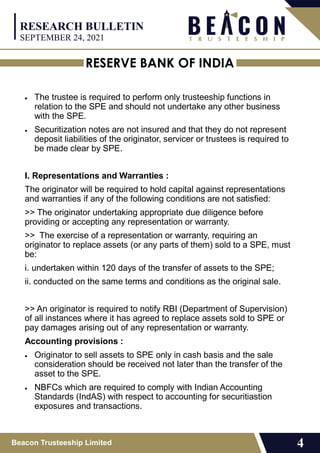
 The trustee is required to perform only trusteeship functions in
relation to the SPE and should not undertake any other business
with the SPE.
 Securitization notes are not insured and that they do not represent
deposit liabilities of the originator, servicer or trustees is required to
be made clear by SPE.
I. Representations and Warranties :
The originator will be required to hold capital against representations
and warranties if any of the following conditions are not satisfied:
>> The originator undertaking appropriate due diligence before
providing or accepting any representation or warranty.
>> The exercise of a representation or warranty, requiring an
originator to replace assets (or any parts of them) sold to a SPE, must
be:
i. undertaken within 120 days of the transfer of assets to the SPE;
ii. conducted on the same terms and conditions as the original sale.
>> An originator is required to notify RBI (Department of Supervision)
of all instances where it has agreed to replace assets sold to SPE or
pay damages arising out of any representation or warranty.
Accounting provisions :
 Originator to sell assets to SPE only in cash basis and the sale
consideration should be received not later than the transfer of the
asset to the SPE.
 NBFCs which are required to comply with Indian Accounting
Standards (IndAS) with respect to accounting for securitiastion
exposures and transactions.
RESEARCH BULLETIN
SEPTEMBER 24, 2021
RESERVE BANK OF INDIA
Beacon Trusteeship Limited 5
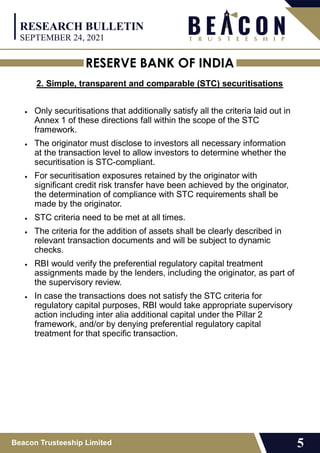
2. Simple, transparent and comparable (STC) securitisations
 Only securitisations that additionally satisfy all the criteria laid out in
Annex 1 of these directions fall within the scope of the STC
framework.
 The originator must disclose to investors all necessary information
at the transaction level to allow investors to determine whether the
securitisation is STC-compliant.
 For securitisation exposures retained by the originator with
significant credit risk transfer have been achieved by the originator,
the determination of compliance with STC requirements shall be
made by the originator.
 STC criteria need to be met at all times.
 The criteria for the addition of assets shall be clearly described in
relevant transaction documents and will be subject to dynamic
checks.
 RBI would verify the preferential regulatory capital treatment
assignments made by the lenders, including the originator, as part of
the supervisory review.
 In case the transactions does not satisfy the STC criteria for
regulatory capital purposes, RBI would take appropriate supervisory
action including inter alia additional capital under the Pillar 2
framework, and/or by denying preferential regulatory capital
treatment for that specific transaction.
RESEARCH BULLETIN
SEPTEMBER 24, 2021
RESERVE BANK OF INDIA
Beacon Trusteeship Limited 6
3. Provision of facilities supporting securitisation structures
A. General conditions:
 Lenders and the entities other than lenders may provide supporting
facilities such as credit enhancement facilities, liquidity facilities,
underwriting facilities and servicing facilities.
 Facilities provided by the facility provider should satisfy the following
conditions:
>> Provisions of the facility to be distinct from other facility and
documented separately
>> The facility is provided on an 'arm's length basis’ on market terms
and conditions and limited to a specified amount and duration.
>> The SPE and/or investors in the securitisation notes issued by the
SPE have the clear right to select an alternative party to provide the
facility subject to compliance of instructions in this direction
B. Credit enhancement facilities :
 Credit enhancement facilities include all arrangements that could
result in a facility provider absorbing losses of the investors in a
securitisation transaction. Such facilities may be provided by both
originators and third parties.
 The facility provider providing credit enhancement facilities should
ensure that the following conditions :
>>Credit enhancement facility should be provided only at the initiation
of the securitisation transaction
>> Extended credit enhancement at the initiation of the securitisation
transaction should be available to the SPE during the entire life of the
securitisation notes
>> Any utilization / draw down of the credit enhancement to be
immediately written-off by debit to the profit and loss account by facility
provider
RESEARCH BULLETIN
SEPTEMBER 24, 2021
RESERVE BANK OF INDIA
Beacon Trusteeship Limited 7
C. Reset of credit enhancements :
 Resets can be applied to external forms of credit enhancements,
which is in first or second loss position.
 Reset by the credit enhancement provider subject to the conditions
enumerated below:
>> All the outstanding tranches of securitisation notes should be re-
rated (other than equity tranches).
>> The reset of credit enhancement would be subject to the consent of
the investors in the securitisation notes.
>> In case such a contractual clause was not available originally,
reset of credit enhancement may be carried out subject to the consent
of all investors of outstanding securitisation notes.
>> For all securitisations other than residential mortgage backed-
securitisations, at the time of first reset, at least 50% of the total
principal amount assigned at the time of initiation of the securitisation
transaction must have been amortised.
>> For residential mortgage-backed securitisations, at the time of first
reset, at least 25% of the total principal amount assigned at the time of
initiation of the securitisation transaction must have been amortised.
D. Liquidity facilities :
 A liquidity facility should meet all of the following conditions to guard
against the possibility of the facility functioning as a form of credit
enhancement and/ or credit support:
>> Documentation for the facility must clearly define the circumstances
under which the facility may or may not be drawn on.
>> Facility should be drawn be capable of being drawn only where
there is a sufficient level of non-defaulted assets to cover drawings not
be drawn for the purpose of :
RESEARCH BULLETIN
SEPTEMBER 24, 2021
RESERVE BANK OF INDIA
Beacon Trusteeship Limited 8
 Providing credit enhancement;
 covering losses of the SPE;
 Serving as a permanent revolving funding.
 covering any losses incurred in the underlying pool of exposures
prior to a draw down.
 Facility should be provided to SPE and not directly to the investors.
E. Underwriting facilities :
 An originator or a third-party service provider may act as an
underwriter for the issue of securitisation notes by SPE and treat the
facility as an underwriting facility for capital adequacy purposes
subject to the following conditions:
>> The underwriting is exercisable only when the SPE cannot issue
securitisation notes into the market at a price equal to or above the
benchmark predetermined in the underwriting agreement.
>> An originator may underwrite only investment grade senior notes
issued by the SPE.
F. Servicing Facilities :
 A facility provider performing the role of a service provider for a
proprietary or a third-party securitisation transaction should ensure
that the following conditions are fulfilled:
>> service provider to remit funds to the SPE or investors only it has
received funds generated from the underlying assets
>> The service provider should remit all the cashflows arising from the
underlying loans forming part of the securitised pools to the SPE as
per the agreed mechanism, irrespective of any retained interest in the
securitisation transaction in other capacities
RESEARCH BULLETIN
SEPTEMBER 24, 2021
RESERVE BANK OF INDIA
Beacon Trusteeship Limited 9
4. Requirements to be met by lenders who are investors in
securitisation exposures
1.Due Diligence:
 For the overseas branches of Indian lenders, they should not invest
or assume exposure to securitisation positions in other jurisdictions
which have not laid down any MRR. Regarding MHP, the overseas
branches of Indian lenders operating in jurisdictions which do not
have regulations related to MHP, may comply with regulations
prescribed in those jurisdictions.
 .Lenders should be able to access performance information on the
underlying pools on an ongoing basis
 Lenders should have a thorough understanding of all structural
features of a securitisation transaction that would materially impact
the performance of their exposures to the transaction
 Lenders are required to analyse and record the following while
taking the decision regarding a securitisation exposure:
>> the reputation of the originators
>> loss experience in earlier securitisations of the originators or any
frauds committed by the underlying borrowers
>> The statements and disclosures made by the originators.
B. Stress testing :
 Lenders to perform their own stress tests appropriate to their
securitisation positions.
C. Credit monitoring and valuation :
 Lender to have policies detailing valuation of the securitization
notes approved by the board including model used for valuation,
assumptions.
 Lenders are required to monitor the performance information on the
exposures underlying their securitisation positions and take
appropriate action in a timely manner.
RESEARCH BULLETIN
SEPTEMBER 24, 2021
RESERVE BANK OF INDIA
Beacon Trusteeship Limited 10
5. Capital requirements for securitisation exposures
A. General conditions:
 Lenders must maintain capital against all securitisation exposure
amounts and the exposure must be treated as retained exposure
and not a fresh exposure during capital computation.
 Lender shall measure the exposure amount of its off-balance
exposure as per “Master Circular – Basel III Capital Regulations”
for credit risk mitigants.
 In all circumstances if one exposure overlaps another the lender will
preclude any loss for the lender on another exposure by fulfilling its
obligations.
B. De recognition of transferred assets for the purpose of capital
adequacy :
 An originator has to maintain capital against the exposures
transferred to a SPE and must be recognised as an advance, unless
atleast the following conditions are satisfied:
>>For the purpose of this sub-clause, retention of servicing rights in
respect of the transferred exposures would not constitute control by
the originator over the transferred exposures
>> The securitisation notes issued by the SPE are not obligations of
the originator and the holders have the right to pledge or trade them
without any restriction, unless imposed by statutory retention
requirement .
>>The yield to investors may change consequent to changes in the
benchmark to which the underlying loans are linked.
>>The originator to obtain legal opinion that the transfer of exposures
to a special purpose entity satisfies the above conditions if the
exposures are to be excluded from the calculation of risk weighted
assets.
RESEARCH BULLETIN
SEPTEMBER 24, 2021
RESERVE BANK OF INDIA
Beacon Trusteeship Limited 11
C. Approaches for computation of risk weighted assets :
 Lenders to apply Securitisation External Ratings Based approach
(SEC-ERBA) for calculation of risk weighted assets for credit risk of
securitisation exposures. For unrated securitisation exposures,
lender shall maintain capital charge equal to the actual exposure.
 A lender to hold capital against all of the underlying exposures at a
minimum associated with the securitisation transaction as if they
had not been securitised.
D. Determination of attachment point (A) and detachment point
(D) :
 Over-collateralisation and funded reserve accounts must be
recognised as tranches during the calculation of attachment and
detachment points.
 Unfunded reserve accounts to be funded from future receipts from
the underlying exposures and assets not providing credit
enhancement related to these instruments not to be included in the
above calculation of A and D.
E. Treatment by banks (including small finance banks) of credit
risk mitigation for securitisation exposures :
 Banks may recognise credit protection purchased on a securitisation
exposure when calculating capital requirements subject to “Master
Circular – Basel III Capital Regulations” dated July 1, 2015.
 Capital requirements to be calculated when a bank provides full (or
pro rata) credit protection to a securitisation exposure.
RESEARCH BULLETIN
SEPTEMBER 24, 2021
RESERVE BANK OF INDIA
Beacon Trusteeship Limited 12
G. Securitisation – External Ratings Based Approach (SEC-ERBA
 Securitisation exposures that are externally rated, risk-weighted
assets under the securitisation external ratings-based approach
(SEC-ERBA) will be determined by multiplying securitisation
exposure amounts by the appropriate risk weights.
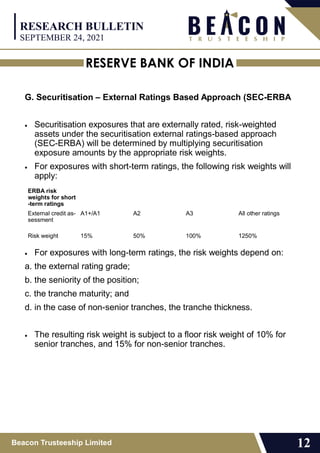
 For exposures with short-term ratings, the following risk weights will
apply:
 For exposures with long-term ratings, the risk weights depend on:
a. the external rating grade;
b. the seniority of the position;
c. the tranche maturity; and
d. in the case of non-senior tranches, the tranche thickness.
 The resulting risk weight is subject to a floor risk weight of 10% for
senior tranches, and 15% for non-senior tranches.
ERBA risk
weights for short
-term ratings
External credit as-
sessment
A1+/A1 A2 A3 All other ratings
Risk weight 15% 50% 100% 1250%
RESEARCH BULLETIN
SEPTEMBER 24, 2021
RESERVE BANK OF INDIA
Beacon Trusteeship Limited 13
6. Disclosures
A. Disclosures to be made in Servicer/Investor/Trustee Report:
 The originator(s) should disclose to investors the weighted average
holding period of the assets securitised and the level of their MRR in
the securitisation.
 Investors to have access to all materially relevant data that are
necessary to conduct comprehensive and well-informed stress tests
on the cash flows and collateral values supporting the underlying
exposures.
 The disclosure of MHP and MRR should be publicly available and
documented appropriately.
 The aforesaid disclosures can be made in the format given in Annex
2 and should be made separately for each securitisation transaction
throughout the life of the transaction.
B. Disclosures to be made in Notes to Accounts :
 Notes to Annual Accounts of the originators should indicate the
outstanding amount of securitised assets as per books of the SPEs
and should be made in the format given in Annex 3.
C. Reporting of Transactions to the Reserve Bank :
 The originator must also submit the details of the securitisation
transactions undertaken, including the details of the securitisation
notes issued, to the Reserve Bank on a quarterly basis
RESEARCH BULLETIN
SEPTEMBER 24, 2021
RESERVE BANK OF INDIA
Beacon Trusteeship Limited 14
OUR ANALYSIS:
 These directions will enable securitization of certain loans which
were earlier not permissible.
 Reduced minimum holding period (MHP) would help increase the
stock of eligible loans available with originators on an immediate
basis.
 These directions would increase the securitization volume in near
terms.
 The concept of simple, transparent and comparable (STC)
Securitization could signal a shift in the long run.
 STC will lead to a deepening of the Indian securitization market with
greater transparency and robust disclosure practices.
 Appropriate due diligence can provide investors with sufficient
information on an asset class which can permit meaningful
evaluation by them.
 Documented disclosure can help investors to fully understand the
terms, conditions, legal and commercial information prior to
investing in a new offering and investment decisions.
RESEARCH BULLETIN
SEPTEMBER 24, 2021

Securitization (standard of assets)

  • 1.
    RESEARCH BULLETIN SEPTEMBER 24,2021 RESERVE BANK OF INDIA Beacon Trusteeship Limited 1 MASTER DIRECTION - RBI (SECURITIZATIONS OF STANDARD ASSETS ), DIRECTIONS 2021. Securitization of standard assets 1.General requirements for securitization A. Assets eligible for securitization:  Lenders, including overseas branches of Indian banks are prohibited from undertaking the securitization activities or assume securitization exposures as mentioned below: >> Synthetic securitization. >> Re-securitization exposures >> short term instruments which are issued against long term assets held by a SPE.  Securitization of exposures held by overseas branches of Indian bank can not breach any provision/s of extant legal/regulatory framework  The MHP will be applicable to individual loans in the underlying pool of securitized loans but will not be applicable to loans prohibited as mentioned above.  Minimum holding period (MHP) will be counted from the date of registration of the underlying security interest is reduced 3 months to max 6 months depending upon the tenor of loans  In case of loans where security does not exist or security cannot be registered, the MHP shall be calculated from the date of first repayment of the loan. B. Minimum Retention Requirement (MRR):  The MRR shall be 5% with original maturity of 24 months or less or 10% with maturity of more than 24 months of the book value of the loans being securitized.  In the case of residential mortgage backed securities, the MRR for the originator shall be 5% of the book value of the loans being securitized, irrespective of the original maturity
  • 2.
    RESERVE BANK OFINDIA Beacon Trusteeship Limited 2  Reduction of MRR either through hedging of credit risk or selling or encumbering the retained interest is prohibited.  MRR has to be maintained by the originating lender itself and not by any of its group entities and should not change throughout the life of the securitization. C. Origination standards:  Underwriting standards for exposures securitized should not be less stringent than those applied to exposures retained on the balance sheet of the originator.  The originator should disclose to the entities having securitization exposures the timing and purpose of such changes.  In cases of securitization of exposures purchased by originator from other lenders, the requirements applicable for underwriting standards shall apply to the standards of due diligence process adopted by the originator which may include verification of sufficiency and consistency of loan origination process of the lender from whom the exposures were purchased by the originator. D. Payment priorities and observability :  Priorities of payments for all liabilities in all circumstances should be clearly defined at the time of securitization and appropriate legal comfort regarding their enforceability should be provided  Cash flow waterfall, payment profile or priority of payments of securitization should be fully Disclosures in offer documents and investor reports, with information that clearly identifies the breach status in respect of expected cash flows to the note holders, the ability for the breach to be reversed and the consequences of the breach.  Full disclosure and supporting documentation regarding legal and financial risk factors must be made available to prospective and existing investors within a reasonable period of time, on an ongoing or on demand basis. RESEARCH BULLETIN SEPTEMBER 24, 2021
  • 3.
    RESERVE BANK OFINDIA Beacon Trusteeship Limited 3 D. Limit on Total Retained Exposures by Originators:  The total exposure of an originator to the securitization exposures belonging to a particular securitization structure or scheme should not exceed 20%. F. Issuance and listing :  The minimum ticket size for issuance of securitization notes shall be INR 1 crore.  Any offer of securitization notes to fifty or more persons in an issuance is required to be listed in terms of SEBI (Issue and Listing of Securitized Debt Instruments and Security Receipts) Regulations, 2008. G. Conditions to be satisfied by the special purpose entity :  The SPE has to meet certain criteria to enable the originator to apply the guidelines on capital adequacy and other aspects in these directions with respect to securitization exposure as mentioned below: >> The SPE and the trustee should not resemble in name or imply any connection or relationship with the originator of the assets in its title or name. >>The originator should not have any ownership, proprietary , share capital or beneficial interest in the SPE. >> If SPE is set up as a trust, then the originator cannot exercise control, directly or indirectly over them nor have any ownership, proprietary or beneficial interest in the trustees. >> The trust deed should not provide for any discretion to the trustee as to the manner of disposal and management or application of the trust property and the investors should be empowered in the trust deed to change the trustee at any point of time to protect their interest. RESEARCH BULLETIN SEPTEMBER 24, 2021
  • 4.
    RESERVE BANK OFINDIA Beacon Trusteeship Limited 4  The trustee is required to perform only trusteeship functions in relation to the SPE and should not undertake any other business with the SPE.  Securitization notes are not insured and that they do not represent deposit liabilities of the originator, servicer or trustees is required to be made clear by SPE. I. Representations and Warranties : The originator will be required to hold capital against representations and warranties if any of the following conditions are not satisfied: >> The originator undertaking appropriate due diligence before providing or accepting any representation or warranty. >> The exercise of a representation or warranty, requiring an originator to replace assets (or any parts of them) sold to a SPE, must be: i. undertaken within 120 days of the transfer of assets to the SPE; ii. conducted on the same terms and conditions as the original sale. >> An originator is required to notify RBI (Department of Supervision) of all instances where it has agreed to replace assets sold to SPE or pay damages arising out of any representation or warranty. Accounting provisions :  Originator to sell assets to SPE only in cash basis and the sale consideration should be received not later than the transfer of the asset to the SPE.  NBFCs which are required to comply with Indian Accounting Standards (IndAS) with respect to accounting for securitiastion exposures and transactions. RESEARCH BULLETIN SEPTEMBER 24, 2021
  • 5.
    RESERVE BANK OFINDIA Beacon Trusteeship Limited 5 2. Simple, transparent and comparable (STC) securitisations  Only securitisations that additionally satisfy all the criteria laid out in Annex 1 of these directions fall within the scope of the STC framework.  The originator must disclose to investors all necessary information at the transaction level to allow investors to determine whether the securitisation is STC-compliant.  For securitisation exposures retained by the originator with significant credit risk transfer have been achieved by the originator, the determination of compliance with STC requirements shall be made by the originator.  STC criteria need to be met at all times.  The criteria for the addition of assets shall be clearly described in relevant transaction documents and will be subject to dynamic checks.  RBI would verify the preferential regulatory capital treatment assignments made by the lenders, including the originator, as part of the supervisory review.  In case the transactions does not satisfy the STC criteria for regulatory capital purposes, RBI would take appropriate supervisory action including inter alia additional capital under the Pillar 2 framework, and/or by denying preferential regulatory capital treatment for that specific transaction. RESEARCH BULLETIN SEPTEMBER 24, 2021
  • 6.
    RESERVE BANK OFINDIA Beacon Trusteeship Limited 6 3. Provision of facilities supporting securitisation structures A. General conditions:  Lenders and the entities other than lenders may provide supporting facilities such as credit enhancement facilities, liquidity facilities, underwriting facilities and servicing facilities.  Facilities provided by the facility provider should satisfy the following conditions: >> Provisions of the facility to be distinct from other facility and documented separately >> The facility is provided on an 'arm's length basis’ on market terms and conditions and limited to a specified amount and duration. >> The SPE and/or investors in the securitisation notes issued by the SPE have the clear right to select an alternative party to provide the facility subject to compliance of instructions in this direction B. Credit enhancement facilities :  Credit enhancement facilities include all arrangements that could result in a facility provider absorbing losses of the investors in a securitisation transaction. Such facilities may be provided by both originators and third parties.  The facility provider providing credit enhancement facilities should ensure that the following conditions : >>Credit enhancement facility should be provided only at the initiation of the securitisation transaction >> Extended credit enhancement at the initiation of the securitisation transaction should be available to the SPE during the entire life of the securitisation notes >> Any utilization / draw down of the credit enhancement to be immediately written-off by debit to the profit and loss account by facility provider RESEARCH BULLETIN SEPTEMBER 24, 2021
  • 7.
    RESERVE BANK OFINDIA Beacon Trusteeship Limited 7 C. Reset of credit enhancements :  Resets can be applied to external forms of credit enhancements, which is in first or second loss position.  Reset by the credit enhancement provider subject to the conditions enumerated below: >> All the outstanding tranches of securitisation notes should be re- rated (other than equity tranches). >> The reset of credit enhancement would be subject to the consent of the investors in the securitisation notes. >> In case such a contractual clause was not available originally, reset of credit enhancement may be carried out subject to the consent of all investors of outstanding securitisation notes. >> For all securitisations other than residential mortgage backed- securitisations, at the time of first reset, at least 50% of the total principal amount assigned at the time of initiation of the securitisation transaction must have been amortised. >> For residential mortgage-backed securitisations, at the time of first reset, at least 25% of the total principal amount assigned at the time of initiation of the securitisation transaction must have been amortised. D. Liquidity facilities :  A liquidity facility should meet all of the following conditions to guard against the possibility of the facility functioning as a form of credit enhancement and/ or credit support: >> Documentation for the facility must clearly define the circumstances under which the facility may or may not be drawn on. >> Facility should be drawn be capable of being drawn only where there is a sufficient level of non-defaulted assets to cover drawings not be drawn for the purpose of : RESEARCH BULLETIN SEPTEMBER 24, 2021
  • 8.
    RESERVE BANK OFINDIA Beacon Trusteeship Limited 8  Providing credit enhancement;  covering losses of the SPE;  Serving as a permanent revolving funding.  covering any losses incurred in the underlying pool of exposures prior to a draw down.  Facility should be provided to SPE and not directly to the investors. E. Underwriting facilities :  An originator or a third-party service provider may act as an underwriter for the issue of securitisation notes by SPE and treat the facility as an underwriting facility for capital adequacy purposes subject to the following conditions: >> The underwriting is exercisable only when the SPE cannot issue securitisation notes into the market at a price equal to or above the benchmark predetermined in the underwriting agreement. >> An originator may underwrite only investment grade senior notes issued by the SPE. F. Servicing Facilities :  A facility provider performing the role of a service provider for a proprietary or a third-party securitisation transaction should ensure that the following conditions are fulfilled: >> service provider to remit funds to the SPE or investors only it has received funds generated from the underlying assets >> The service provider should remit all the cashflows arising from the underlying loans forming part of the securitised pools to the SPE as per the agreed mechanism, irrespective of any retained interest in the securitisation transaction in other capacities RESEARCH BULLETIN SEPTEMBER 24, 2021
  • 9.
    RESERVE BANK OFINDIA Beacon Trusteeship Limited 9 4. Requirements to be met by lenders who are investors in securitisation exposures 1.Due Diligence:  For the overseas branches of Indian lenders, they should not invest or assume exposure to securitisation positions in other jurisdictions which have not laid down any MRR. Regarding MHP, the overseas branches of Indian lenders operating in jurisdictions which do not have regulations related to MHP, may comply with regulations prescribed in those jurisdictions.  .Lenders should be able to access performance information on the underlying pools on an ongoing basis  Lenders should have a thorough understanding of all structural features of a securitisation transaction that would materially impact the performance of their exposures to the transaction  Lenders are required to analyse and record the following while taking the decision regarding a securitisation exposure: >> the reputation of the originators >> loss experience in earlier securitisations of the originators or any frauds committed by the underlying borrowers >> The statements and disclosures made by the originators. B. Stress testing :  Lenders to perform their own stress tests appropriate to their securitisation positions. C. Credit monitoring and valuation :  Lender to have policies detailing valuation of the securitization notes approved by the board including model used for valuation, assumptions.  Lenders are required to monitor the performance information on the exposures underlying their securitisation positions and take appropriate action in a timely manner. RESEARCH BULLETIN SEPTEMBER 24, 2021
  • 10.
    RESERVE BANK OFINDIA Beacon Trusteeship Limited 10 5. Capital requirements for securitisation exposures A. General conditions:  Lenders must maintain capital against all securitisation exposure amounts and the exposure must be treated as retained exposure and not a fresh exposure during capital computation.  Lender shall measure the exposure amount of its off-balance exposure as per “Master Circular – Basel III Capital Regulations” for credit risk mitigants.  In all circumstances if one exposure overlaps another the lender will preclude any loss for the lender on another exposure by fulfilling its obligations. B. De recognition of transferred assets for the purpose of capital adequacy :  An originator has to maintain capital against the exposures transferred to a SPE and must be recognised as an advance, unless atleast the following conditions are satisfied: >>For the purpose of this sub-clause, retention of servicing rights in respect of the transferred exposures would not constitute control by the originator over the transferred exposures >> The securitisation notes issued by the SPE are not obligations of the originator and the holders have the right to pledge or trade them without any restriction, unless imposed by statutory retention requirement . >>The yield to investors may change consequent to changes in the benchmark to which the underlying loans are linked. >>The originator to obtain legal opinion that the transfer of exposures to a special purpose entity satisfies the above conditions if the exposures are to be excluded from the calculation of risk weighted assets. RESEARCH BULLETIN SEPTEMBER 24, 2021
  • 11.
    RESERVE BANK OFINDIA Beacon Trusteeship Limited 11 C. Approaches for computation of risk weighted assets :  Lenders to apply Securitisation External Ratings Based approach (SEC-ERBA) for calculation of risk weighted assets for credit risk of securitisation exposures. For unrated securitisation exposures, lender shall maintain capital charge equal to the actual exposure.  A lender to hold capital against all of the underlying exposures at a minimum associated with the securitisation transaction as if they had not been securitised. D. Determination of attachment point (A) and detachment point (D) :  Over-collateralisation and funded reserve accounts must be recognised as tranches during the calculation of attachment and detachment points.  Unfunded reserve accounts to be funded from future receipts from the underlying exposures and assets not providing credit enhancement related to these instruments not to be included in the above calculation of A and D. E. Treatment by banks (including small finance banks) of credit risk mitigation for securitisation exposures :  Banks may recognise credit protection purchased on a securitisation exposure when calculating capital requirements subject to “Master Circular – Basel III Capital Regulations” dated July 1, 2015.  Capital requirements to be calculated when a bank provides full (or pro rata) credit protection to a securitisation exposure. RESEARCH BULLETIN SEPTEMBER 24, 2021
  • 12.
    RESERVE BANK OFINDIA Beacon Trusteeship Limited 12 G. Securitisation – External Ratings Based Approach (SEC-ERBA  Securitisation exposures that are externally rated, risk-weighted assets under the securitisation external ratings-based approach (SEC-ERBA) will be determined by multiplying securitisation exposure amounts by the appropriate risk weights.  For exposures with short-term ratings, the following risk weights will apply:  For exposures with long-term ratings, the risk weights depend on: a. the external rating grade; b. the seniority of the position; c. the tranche maturity; and d. in the case of non-senior tranches, the tranche thickness.  The resulting risk weight is subject to a floor risk weight of 10% for senior tranches, and 15% for non-senior tranches. ERBA risk weights for short -term ratings External credit as- sessment A1+/A1 A2 A3 All other ratings Risk weight 15% 50% 100% 1250% RESEARCH BULLETIN SEPTEMBER 24, 2021
  • 13.
    RESERVE BANK OFINDIA Beacon Trusteeship Limited 13 6. Disclosures A. Disclosures to be made in Servicer/Investor/Trustee Report:  The originator(s) should disclose to investors the weighted average holding period of the assets securitised and the level of their MRR in the securitisation.  Investors to have access to all materially relevant data that are necessary to conduct comprehensive and well-informed stress tests on the cash flows and collateral values supporting the underlying exposures.  The disclosure of MHP and MRR should be publicly available and documented appropriately.  The aforesaid disclosures can be made in the format given in Annex 2 and should be made separately for each securitisation transaction throughout the life of the transaction. B. Disclosures to be made in Notes to Accounts :  Notes to Annual Accounts of the originators should indicate the outstanding amount of securitised assets as per books of the SPEs and should be made in the format given in Annex 3. C. Reporting of Transactions to the Reserve Bank :  The originator must also submit the details of the securitisation transactions undertaken, including the details of the securitisation notes issued, to the Reserve Bank on a quarterly basis RESEARCH BULLETIN SEPTEMBER 24, 2021
  • 14.
    RESERVE BANK OFINDIA Beacon Trusteeship Limited 14 OUR ANALYSIS:  These directions will enable securitization of certain loans which were earlier not permissible.  Reduced minimum holding period (MHP) would help increase the stock of eligible loans available with originators on an immediate basis.  These directions would increase the securitization volume in near terms.  The concept of simple, transparent and comparable (STC) Securitization could signal a shift in the long run.  STC will lead to a deepening of the Indian securitization market with greater transparency and robust disclosure practices.  Appropriate due diligence can provide investors with sufficient information on an asset class which can permit meaningful evaluation by them.  Documented disclosure can help investors to fully understand the terms, conditions, legal and commercial information prior to investing in a new offering and investment decisions. RESEARCH BULLETIN SEPTEMBER 24, 2021