ANALYSIS AND
EVALUATION
OF RECENT PERFORMANCE OF
NON BANKING
FINANCIAL COMPANIES (NBFCS)
(September 2021)
 The aggregate credit extended by NBFCs as at
the end of September 2021 stood at 27.4 lakh Cr.
 40% of the loan deployment was made to
industry constituting the largest segment of the
credit portfolio.
 Government owned NBFCs had a dominant
position in the NBFC space.
 It accounted for 48.6% of the aggregate credit
extended and 81% of the credit to the industries
sector.
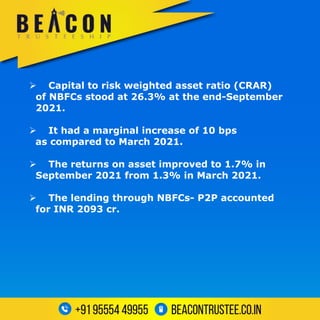
 Capital to risk weighted asset ratio (CRAR)
of NBFCs stood at 26.3% at the end-September
2021.
 It had a marginal increase of 10 bps
as compared to March 2021.
 The returns on asset improved to 1.7% in
September 2021 from 1.3% in March 2021.
 The lending through NBFCs- P2P accounted
for INR 2093 cr.
 Gross non-performing assets (GNPA) ratio
which had a downfall in September 2020.
 It rose to reach 6.5% as at the end of
September 2021.
 The industries sector which forms the
largest share of NBFC exposure, rose from
6.7% in March 2021 to 7.9% in September
2021.
 Borrowings constituted almost two-thirds
of NBFC’s sources of funds.
 These were mainly in the form of
debentures (41%) and bank borrowings
(31%).
 Commercial paper accounted for (3.1%)
a minor share.
 Mutual funds were the single largest
subscribers to the debentures issued by
NBFCs, followed by insurance companies
and banks.
 A stress test was conducted for assessing
the resilience of the NBFC sector to credit risk
shocks.
 A sample of 191 NBFCs were taken under
two scenarios
 Medium and high risk which involved
increase in GNPA ratio of the sector by 1 SD
and 2 SD.
 In case of a high risk shock of 2 SD increase
in the GNPA ratio, the CRAR of the sector
would decline by 30 bps to 26.3% with no
impact in the case of a 1 SD shock.
 The CRAR was above the minimum
regulatory requirement of 15% in both
scenarios.
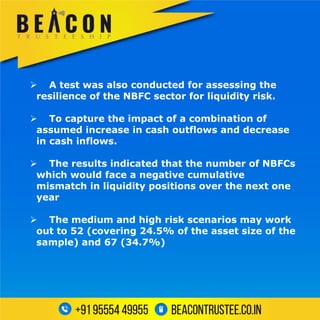
 A test was also conducted for assessing the
resilience of the NBFC sector for liquidity risk.
 To capture the impact of a combination of
assumed increase in cash outflows and decrease
in cash inflows.
 The results indicated that the number of NBFCs
which would face a negative cumulative
mismatch in liquidity positions over the next one
year
 The medium and high risk scenarios may work
out to 52 (covering 24.5% of the asset size of the
sample) and 67 (34.7%)

Nbfc performance

  • 1.
    ANALYSIS AND EVALUATION OF RECENTPERFORMANCE OF NON BANKING FINANCIAL COMPANIES (NBFCS) (September 2021)
  • 2.
     The aggregatecredit extended by NBFCs as at the end of September 2021 stood at 27.4 lakh Cr.  40% of the loan deployment was made to industry constituting the largest segment of the credit portfolio.  Government owned NBFCs had a dominant position in the NBFC space.  It accounted for 48.6% of the aggregate credit extended and 81% of the credit to the industries sector.
  • 3.
     Capital torisk weighted asset ratio (CRAR) of NBFCs stood at 26.3% at the end-September 2021.  It had a marginal increase of 10 bps as compared to March 2021.  The returns on asset improved to 1.7% in September 2021 from 1.3% in March 2021.  The lending through NBFCs- P2P accounted for INR 2093 cr.
  • 4.
     Gross non-performingassets (GNPA) ratio which had a downfall in September 2020.  It rose to reach 6.5% as at the end of September 2021.  The industries sector which forms the largest share of NBFC exposure, rose from 6.7% in March 2021 to 7.9% in September 2021.
  • 5.
     Borrowings constitutedalmost two-thirds of NBFC’s sources of funds.  These were mainly in the form of debentures (41%) and bank borrowings (31%).  Commercial paper accounted for (3.1%) a minor share.  Mutual funds were the single largest subscribers to the debentures issued by NBFCs, followed by insurance companies and banks.
  • 6.
     A stresstest was conducted for assessing the resilience of the NBFC sector to credit risk shocks.  A sample of 191 NBFCs were taken under two scenarios  Medium and high risk which involved increase in GNPA ratio of the sector by 1 SD and 2 SD.  In case of a high risk shock of 2 SD increase in the GNPA ratio, the CRAR of the sector would decline by 30 bps to 26.3% with no impact in the case of a 1 SD shock.  The CRAR was above the minimum regulatory requirement of 15% in both scenarios.
  • 7.
     A testwas also conducted for assessing the resilience of the NBFC sector for liquidity risk.  To capture the impact of a combination of assumed increase in cash outflows and decrease in cash inflows.  The results indicated that the number of NBFCs which would face a negative cumulative mismatch in liquidity positions over the next one year  The medium and high risk scenarios may work out to 52 (covering 24.5% of the asset size of the sample) and 67 (34.7%)