
Securing Systems: Still Crazy
After All These Years
Scan the QR code for handouts, or
email sawaba@zip.sh with
TacticalEdge2019 as the subject.
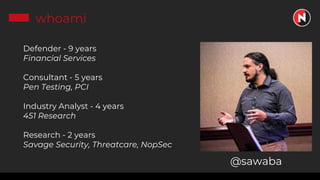
whoami
Defender - 9 years
Financial Services
Consultant - 5 years
Pen Testing, PCI
Industry Analyst - 4 years
451 Research
Research - 2 years
Savage Security, Threatcare, NopSec
@sawaba
3
Why is it so hard to secure systems?
Can the cycle of stress and worry be broken?
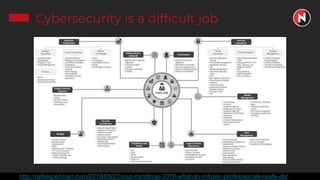
Cybersecurity is a difficult job
http://rafeeqrehman.com/2018/05/21/ciso-mindmap-2018-what-do-infosec-professionals-really-do/
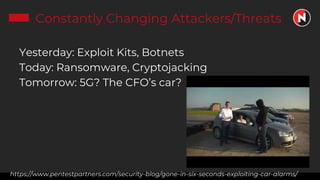
Constantly Changing Attackers/Threats
Yesterday: Exploit Kits, Botnets
Today: Ransomware, Cryptojacking
Tomorrow: 5G? The CFO’s car?
https://www.pentestpartners.com/security-blog/gone-in-six-seconds-exploiting-car-alarms/
Emerging Technologies
We still haven’t solved BYOD
yet!
But now we have:
• cloud
• IoT
• privacy frameworks (e.g.
GDPR)
• SaaS versions of everything
• cryptomining
• supply chain tampering...
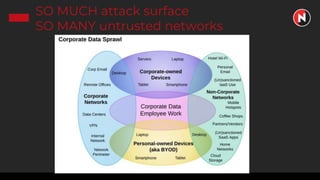
SO MUCH attack surface
SO MANY untrusted networks
No real ‘guide’ to maturity
We’re largely making it up as we go...
So many types of devices, apps, systems
Database servers
Email servers
Storage (SAN) systems
MDM/EMM
SAP CRM/HCM/BI-BW
SAP HANA
Internal Web Apps
AWS
Azure
SaaS providers
Apache, IIS, DNN, PHP
Windows 7, 10 endpoints
MacOS endpoints
iPads
iPhones
Chromebooks
Android Phones
Windows Servers (2008,
2008R2, 2012, 2012R2, 2016)
Printers
Print Servers
Security Products
Backup Servers/Systems
Firewalls
Routers
Switches
Load balancers
Wireless LAN infrastructure
Telecom Servers
VOIP equipment
Telepresence Systems
Time Clocks
IP Cameras
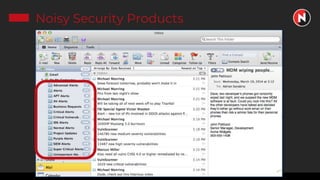
Noisy Security Products
Inherited Problems and Challenges
• Lack of support from board, executives, IT...
• Employee retention
• Abandoned projects
• Poorly planned purchases
• Legacy systems
• Regulatory deadlines
• Broken products and processes
• Many more!
13
What can we do?
Where do we start?
Help!
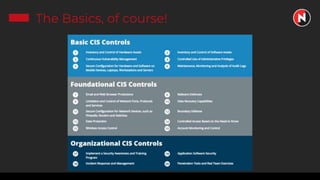
The Basics, of course!
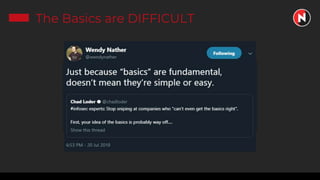
The Basics are DIFFICULT
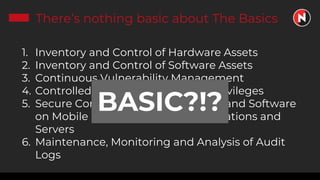
There’s nothing basic about The Basics
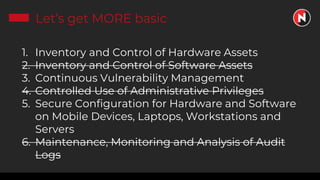
1. Inventory and Control of Hardware Assets
2. Inventory and Control of Software Assets
3. Continuous Vulnerability Management
4. Controlled Use of Administrative Privileges
5. Secure Configuration for Hardware and Software
on Mobile Devices, Laptops, Workstations and
Servers
6. Maintenance, Monitoring and Analysis of Audit
Logs
BASIC?!?
Let’s get MORE basic
1. Inventory and Control of Hardware Assets
2. Inventory and Control of Software Assets
3. Continuous Vulnerability Management
4. Controlled Use of Administrative Privileges
5. Secure Configuration for Hardware and Software
on Mobile Devices, Laptops, Workstations and
Servers
6. Maintenance, Monitoring and Analysis of Audit
Logs
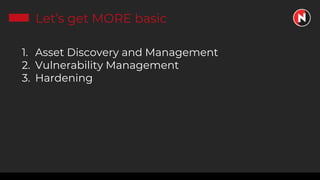
Let’s get MORE basic
1. Asset Discovery and Management
2. Vulnerability Management
3. Hardening
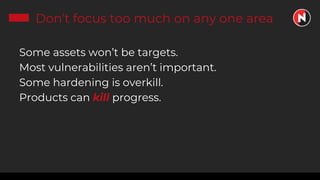
Don’t focus too much on any one area
Some assets won’t be targets.
Most vulnerabilities aren’t important.
Some hardening is overkill.
Products can kill progress.
20
Asset Discovery and Management
You must know what you have before you can protect it
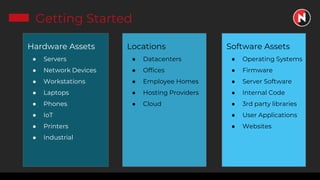
Getting Started
Hardware Assets
● Servers
● Network Devices
● Workstations
● Laptops
● Phones
● IoT
● Printers
● Industrial
Locations
● Datacenters
● Offices
● Employee Homes
● Hosting Providers
● Cloud
Software Assets
● Operating Systems
● Firmware
● Server Software
● Internal Code
● 3rd party libraries
● User Applications
● Websites
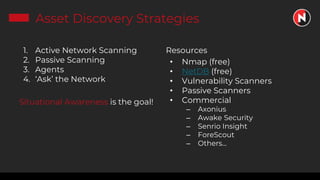
Asset Discovery Strategies
1. Active Network Scanning
2. Passive Scanning
3. Agents
4. ‘Ask’ the Network
Situational Awareness is the goal!
Resources
• Nmap (free)
• NetDB (free)
• Vulnerability Scanners
• Passive Scanners
• Commercial
– Axonius
– Awake Security
– Senrio Insight
– ForeScout
– Others...
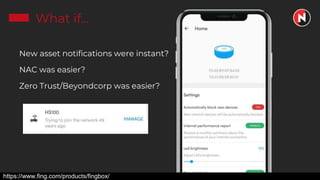
What if...
New asset notifications were instant?
NAC was easier?
Zero Trust/Beyondcorp was easier?
https://www.fing.com/products/fingbox/
24
Addressing Vulnerability Fatigue
If everything is critical, nothing can be critical
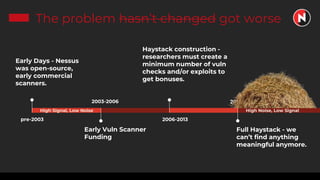
The problem hasn’t changed got worse
2006-2013
Haystack construction -
researchers must create a
minimum number of vuln
checks and/or exploits to
get bonuses.
2013 -
Full Haystack - we
can’t find anything
meaningful anymore.
pre-2003
Early Days - Nessus
was open-source,
early commercial
scanners.
2003-2006
Early Vuln Scanner
Funding
High Signal, Low Noise High Noise, Low Signal
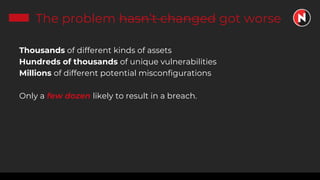
The problem hasn’t changed got worse
Thousands of different kinds of assets
Hundreds of thousands of unique vulnerabilities
Millions of different potential misconfigurations
Only a few dozen likely to result in a breach.
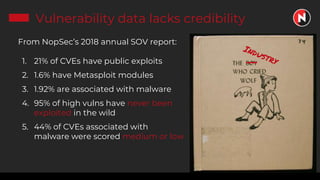
Vulnerability data lacks credibility
From NopSec’s 2018 annual SOV report:
1. 21% of CVEs have public exploits
2. 1.6% have Metasploit modules
3. 1.92% are associated with malware
4. 95% of high vulns have never been
exploited in the wild
5. 44% of CVEs associated with
malware were scored medium or low
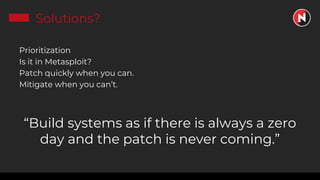
Solutions?
Prioritization
Is it in Metasploit?
Patch quickly when you can.
Mitigate when you can’t.
“Build systems as if there is always a zero
day and the patch is never coming.”
29
Hardening
What if a few simple changes could stop most attacks?
How important is hardening?
SO IMPORTANT!
It costs you nothing.
It stops most of the attacks.
It doesn’t stop zero-day attacks.
You probably shouldn’t be worrying about zero-day attacks.
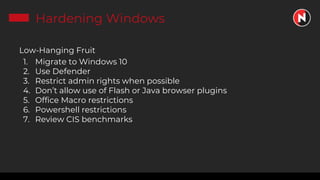
Hardening Windows
Low-Hanging Fruit
1. Migrate to Windows 10
2. Use Defender
3. Restrict admin rights when possible
4. Don’t allow use of Flash or Java browser plugins
5. Office Macro restrictions
6. Powershell restrictions
7. Review CIS benchmarks
Hardening, what’s the goal?
Perfection
Survivability
Durability
Resilience
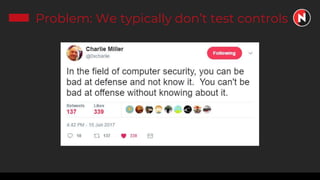
Problem: We typically don’t test controls
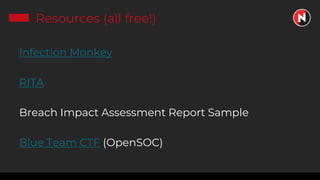
Resources (all free!)
Infection Monkey
RITA
Breach Impact Assessment Report Sample
Blue Team CTF (OpenSOC)
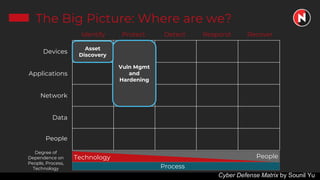
The Big Picture: Where are we?
Applications
Devices
Network
Data
People
Identify RecoverRespondDetectProtect
Process
Technology People
Degree of
Dependence on
People, Process,
Technology
Cyber Defense Matrix by Sounil Yu
Vuln Mgmt
and
Hardening
Asset
Discovery
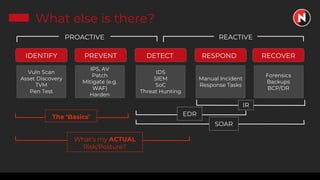
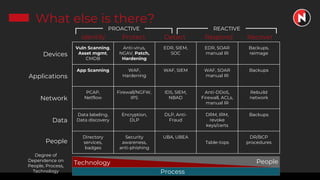
What else is there?
Vuln Scan
Asset Discovery
TVM
Pen Test
IDENTIFY PREVENT DETECT RESPOND RECOVER
EDR
PROACTIVE REACTIVE
IPS, AV
Patch
Mitigate (e.g.
WAF)
Harden
IDS
SIEM
SoC
Threat Hunting
Manual Incident
Response Tasks
Forensics
Backups
BCP/DR
IR
SOAR
What’s my ACTUAL
Risk/Posture?
The ‘Basics’
What else is there?
Vuln Scanning,
Asset mgmt,
CMDB
Anti-virus,
NGAV, Patch,
Hardening
EDR, SIEM,
SOC
EDR, SOAR
manual IR
Backups,
reimage
App Scanning WAF,
Hardening
WAF, SIEM WAF, SOAR
manual IR
Backups
PCAP,
Netflow
Firewall/NGFW,
IPS
IDS, SIEM,
NBAD
Anti-DDoS,
Firewall, ACLs,
manual IR
Rebuild
network
Data labeling,
Data discovery
Encryption,
DLP
DLP, Anti-
Fraud
DRM, IRM,
revoke
keys/certs
Backups
Directory
services,
badges
Security
awareness,
anti-phishing
UBA, UBEA
Table-tops
DR/BCP
procedures
Applications
Devices
Network
Data
People
Identify RecoverRespondDetectProtect
Process
Technology People
Degree of
Dependence on
People, Process,
Technology
PROACTIVE REACTIVE
38
Perspective and Positivity
Choose to see and approach things differently
Change your perspective
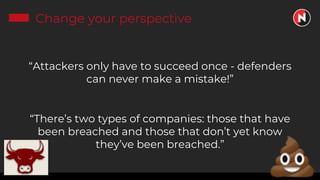
“Attackers only have to succeed once - defenders
can never make a mistake!”
“There’s two types of companies: those that have
been breached and those that don’t yet know
they’ve been breached.”
Change your perspective
Use events or scenarios to drive security, not
checklists
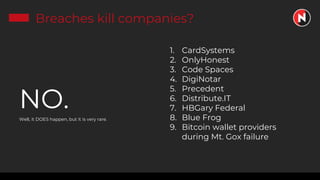
Breaches kill companies?
NO.Well, it DOES happen, but it is very rare.
1. CardSystems
2. OnlyHonest
3. Code Spaces
4. DigiNotar
5. Precedent
6. Distribute.IT
7. HBGary Federal
8. Blue Frog
9. Bitcoin wallet providers
during Mt. Gox failure
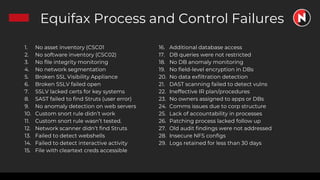
Equifax Process and Control Failures
1. No asset inventory (CSC01
2. No software inventory (CSC02)
3. No file integrity monitoring
4. No network segmentation
5. Broken SSL Visibility Appliance
6. Broken SSLV failed open
7. SSLV lacked certs for key systems
8. SAST failed to find Struts (user error)
9. No anomaly detection on web servers
10. Custom snort rule didn’t work
11. Custom snort rule wasn’t tested.
12. Network scanner didn’t find Struts
13. Failed to detect webshells
14. Failed to detect interactive activity
15. File with cleartext creds accessible
16. Additional database access
17. DB queries were not restricted
18. No DB anomaly monitoring
19. No field-level encryption in DBs
20. No data exfiltration detection
21. DAST scanning failed to detect vulns
22. Ineffective IR plan/procedures
23. No owners assigned to apps or DBs
24. Comms issues due to corp structure
25. Lack of accountability in processes
26. Patching process lacked follow up
27. Old audit findings were not addressed
28. Insecure NFS configs
29. Logs retained for less than 30 days
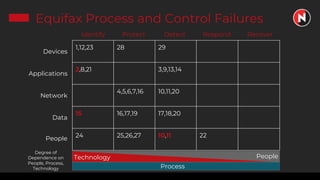
Equifax Process and Control Failures
1,12,23 28 29
2,8,21 3,9,13,14
4,5,6,7,16 10,11,20
15 16,17,19 17,18,20
24 25,26,27 10,11 22
Applications
Devices
Network
Data
People
Identify RecoverRespondDetectProtect
Process
Technology People
Degree of
Dependence on
People, Process,
Technology
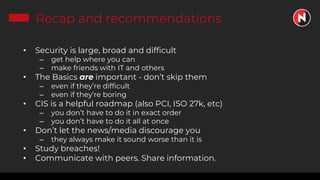
Recap and recommendations
• Security is large, broad and difficult
– get help where you can
– make friends with IT and others
• The Basics are important - don’t skip them
– even if they’re difficult
– even if they’re boring
• CIS is a helpful roadmap (also PCI, ISO 27k, etc)
– you don’t have to do it in exact order
– you don’t have to do it all at once
• Don’t let the news/media discourage you
– they always make it sound worse than it is
• Study breaches!
• Communicate with peers. Share information.
What to do after this presentation?
1. Think of events and scenarios you want to prevent
2. How do you simulate them?
3. Discuss them. Do tabletop exercises.
4. Create a roadmap with goals for processes
5. Don’t worry about all “The Basics” - go after low-hanging fruit first
Bonus Resources!
Breach Impact Report Sample
CISO Mind Map
CISO Guide to Working with Startups
Scan the QR code for handouts
OR email sawaba@zip.sh with TacticalEdge2019 as the subject.
PREGUNTAS?
asanabria@nopsec.com
@sawaba

Securing Systems - Still Crazy After All These Years

  • 1.
    Securing Systems: StillCrazy After All These Years Scan the QR code for handouts, or email sawaba@zip.sh with TacticalEdge2019 as the subject.
  • 2.
    whoami Defender - 9years Financial Services Consultant - 5 years Pen Testing, PCI Industry Analyst - 4 years 451 Research Research - 2 years Savage Security, Threatcare, NopSec @sawaba
  • 3.
    3 Why is itso hard to secure systems? Can the cycle of stress and worry be broken?
  • 4.
    Cybersecurity is adifficult job http://rafeeqrehman.com/2018/05/21/ciso-mindmap-2018-what-do-infosec-professionals-really-do/
  • 5.
    Constantly Changing Attackers/Threats Yesterday:Exploit Kits, Botnets Today: Ransomware, Cryptojacking Tomorrow: 5G? The CFO’s car? https://www.pentestpartners.com/security-blog/gone-in-six-seconds-exploiting-car-alarms/
  • 6.
    Emerging Technologies We stillhaven’t solved BYOD yet! But now we have: • cloud • IoT • privacy frameworks (e.g. GDPR) • SaaS versions of everything • cryptomining • supply chain tampering...
  • 7.
    SO MUCH attacksurface SO MANY untrusted networks
  • 8.
    No real ‘guide’to maturity We’re largely making it up as we go...
  • 9.
    So many typesof devices, apps, systems Database servers Email servers Storage (SAN) systems MDM/EMM SAP CRM/HCM/BI-BW SAP HANA Internal Web Apps AWS Azure SaaS providers Apache, IIS, DNN, PHP Windows 7, 10 endpoints MacOS endpoints iPads iPhones Chromebooks Android Phones Windows Servers (2008, 2008R2, 2012, 2012R2, 2016) Printers Print Servers Security Products Backup Servers/Systems Firewalls Routers Switches Load balancers Wireless LAN infrastructure Telecom Servers VOIP equipment Telepresence Systems Time Clocks IP Cameras
  • 10.
  • 11.
    Inherited Problems andChallenges • Lack of support from board, executives, IT... • Employee retention • Abandoned projects • Poorly planned purchases • Legacy systems • Regulatory deadlines • Broken products and processes • Many more!
  • 13.
    13 What can wedo? Where do we start? Help!
  • 14.
  • 15.
    The Basics areDIFFICULT
  • 16.
    There’s nothing basicabout The Basics 1. Inventory and Control of Hardware Assets 2. Inventory and Control of Software Assets 3. Continuous Vulnerability Management 4. Controlled Use of Administrative Privileges 5. Secure Configuration for Hardware and Software on Mobile Devices, Laptops, Workstations and Servers 6. Maintenance, Monitoring and Analysis of Audit Logs BASIC?!?
  • 17.
    Let’s get MOREbasic 1. Inventory and Control of Hardware Assets 2. Inventory and Control of Software Assets 3. Continuous Vulnerability Management 4. Controlled Use of Administrative Privileges 5. Secure Configuration for Hardware and Software on Mobile Devices, Laptops, Workstations and Servers 6. Maintenance, Monitoring and Analysis of Audit Logs
  • 18.
    Let’s get MOREbasic 1. Asset Discovery and Management 2. Vulnerability Management 3. Hardening
  • 19.
    Don’t focus toomuch on any one area Some assets won’t be targets. Most vulnerabilities aren’t important. Some hardening is overkill. Products can kill progress.
  • 20.
    20 Asset Discovery andManagement You must know what you have before you can protect it
  • 21.
    Getting Started Hardware Assets ●Servers ● Network Devices ● Workstations ● Laptops ● Phones ● IoT ● Printers ● Industrial Locations ● Datacenters ● Offices ● Employee Homes ● Hosting Providers ● Cloud Software Assets ● Operating Systems ● Firmware ● Server Software ● Internal Code ● 3rd party libraries ● User Applications ● Websites
  • 22.
    Asset Discovery Strategies 1.Active Network Scanning 2. Passive Scanning 3. Agents 4. ‘Ask’ the Network Situational Awareness is the goal! Resources • Nmap (free) • NetDB (free) • Vulnerability Scanners • Passive Scanners • Commercial – Axonius – Awake Security – Senrio Insight – ForeScout – Others...
  • 23.
    What if... New assetnotifications were instant? NAC was easier? Zero Trust/Beyondcorp was easier? https://www.fing.com/products/fingbox/
  • 24.
    24 Addressing Vulnerability Fatigue Ifeverything is critical, nothing can be critical
  • 25.
    The problem hasn’tchanged got worse 2006-2013 Haystack construction - researchers must create a minimum number of vuln checks and/or exploits to get bonuses. 2013 - Full Haystack - we can’t find anything meaningful anymore. pre-2003 Early Days - Nessus was open-source, early commercial scanners. 2003-2006 Early Vuln Scanner Funding High Signal, Low Noise High Noise, Low Signal
  • 26.
    The problem hasn’tchanged got worse Thousands of different kinds of assets Hundreds of thousands of unique vulnerabilities Millions of different potential misconfigurations Only a few dozen likely to result in a breach.
  • 27.
    Vulnerability data lackscredibility From NopSec’s 2018 annual SOV report: 1. 21% of CVEs have public exploits 2. 1.6% have Metasploit modules 3. 1.92% are associated with malware 4. 95% of high vulns have never been exploited in the wild 5. 44% of CVEs associated with malware were scored medium or low
  • 28.
    Solutions? Prioritization Is it inMetasploit? Patch quickly when you can. Mitigate when you can’t. “Build systems as if there is always a zero day and the patch is never coming.”
  • 29.
    29 Hardening What if afew simple changes could stop most attacks?
  • 30.
    How important ishardening? SO IMPORTANT! It costs you nothing. It stops most of the attacks. It doesn’t stop zero-day attacks. You probably shouldn’t be worrying about zero-day attacks.
  • 31.
    Hardening Windows Low-Hanging Fruit 1.Migrate to Windows 10 2. Use Defender 3. Restrict admin rights when possible 4. Don’t allow use of Flash or Java browser plugins 5. Office Macro restrictions 6. Powershell restrictions 7. Review CIS benchmarks
  • 32.
    Hardening, what’s thegoal? Perfection Survivability Durability Resilience
  • 33.
    Problem: We typicallydon’t test controls
  • 34.
    Resources (all free!) InfectionMonkey RITA Breach Impact Assessment Report Sample Blue Team CTF (OpenSOC)
  • 35.
    The Big Picture:Where are we? Applications Devices Network Data People Identify RecoverRespondDetectProtect Process Technology People Degree of Dependence on People, Process, Technology Cyber Defense Matrix by Sounil Yu Vuln Mgmt and Hardening Asset Discovery
  • 36.
    What else isthere? Vuln Scan Asset Discovery TVM Pen Test IDENTIFY PREVENT DETECT RESPOND RECOVER EDR PROACTIVE REACTIVE IPS, AV Patch Mitigate (e.g. WAF) Harden IDS SIEM SoC Threat Hunting Manual Incident Response Tasks Forensics Backups BCP/DR IR SOAR What’s my ACTUAL Risk/Posture? The ‘Basics’
  • 37.
    What else isthere? Vuln Scanning, Asset mgmt, CMDB Anti-virus, NGAV, Patch, Hardening EDR, SIEM, SOC EDR, SOAR manual IR Backups, reimage App Scanning WAF, Hardening WAF, SIEM WAF, SOAR manual IR Backups PCAP, Netflow Firewall/NGFW, IPS IDS, SIEM, NBAD Anti-DDoS, Firewall, ACLs, manual IR Rebuild network Data labeling, Data discovery Encryption, DLP DLP, Anti- Fraud DRM, IRM, revoke keys/certs Backups Directory services, badges Security awareness, anti-phishing UBA, UBEA Table-tops DR/BCP procedures Applications Devices Network Data People Identify RecoverRespondDetectProtect Process Technology People Degree of Dependence on People, Process, Technology PROACTIVE REACTIVE
  • 38.
    38 Perspective and Positivity Chooseto see and approach things differently
  • 39.
    Change your perspective “Attackersonly have to succeed once - defenders can never make a mistake!” “There’s two types of companies: those that have been breached and those that don’t yet know they’ve been breached.”
  • 40.
    Change your perspective Useevents or scenarios to drive security, not checklists
  • 41.
    Breaches kill companies? NO.Well,it DOES happen, but it is very rare. 1. CardSystems 2. OnlyHonest 3. Code Spaces 4. DigiNotar 5. Precedent 6. Distribute.IT 7. HBGary Federal 8. Blue Frog 9. Bitcoin wallet providers during Mt. Gox failure
  • 42.
    Equifax Process andControl Failures 1. No asset inventory (CSC01 2. No software inventory (CSC02) 3. No file integrity monitoring 4. No network segmentation 5. Broken SSL Visibility Appliance 6. Broken SSLV failed open 7. SSLV lacked certs for key systems 8. SAST failed to find Struts (user error) 9. No anomaly detection on web servers 10. Custom snort rule didn’t work 11. Custom snort rule wasn’t tested. 12. Network scanner didn’t find Struts 13. Failed to detect webshells 14. Failed to detect interactive activity 15. File with cleartext creds accessible 16. Additional database access 17. DB queries were not restricted 18. No DB anomaly monitoring 19. No field-level encryption in DBs 20. No data exfiltration detection 21. DAST scanning failed to detect vulns 22. Ineffective IR plan/procedures 23. No owners assigned to apps or DBs 24. Comms issues due to corp structure 25. Lack of accountability in processes 26. Patching process lacked follow up 27. Old audit findings were not addressed 28. Insecure NFS configs 29. Logs retained for less than 30 days
  • 43.
    Equifax Process andControl Failures 1,12,23 28 29 2,8,21 3,9,13,14 4,5,6,7,16 10,11,20 15 16,17,19 17,18,20 24 25,26,27 10,11 22 Applications Devices Network Data People Identify RecoverRespondDetectProtect Process Technology People Degree of Dependence on People, Process, Technology
  • 44.
    Recap and recommendations •Security is large, broad and difficult – get help where you can – make friends with IT and others • The Basics are important - don’t skip them – even if they’re difficult – even if they’re boring • CIS is a helpful roadmap (also PCI, ISO 27k, etc) – you don’t have to do it in exact order – you don’t have to do it all at once • Don’t let the news/media discourage you – they always make it sound worse than it is • Study breaches! • Communicate with peers. Share information.
  • 45.
    What to doafter this presentation? 1. Think of events and scenarios you want to prevent 2. How do you simulate them? 3. Discuss them. Do tabletop exercises. 4. Create a roadmap with goals for processes 5. Don’t worry about all “The Basics” - go after low-hanging fruit first
  • 46.
    Bonus Resources! Breach ImpactReport Sample CISO Mind Map CISO Guide to Working with Startups Scan the QR code for handouts OR email sawaba@zip.sh with TacticalEdge2019 as the subject.
  • 47.