SecureDroid:  An  Android  Security  
Framework  Extension  for  Context-­‐‑
Aware  policy  Enforcement	
V.Arena, V. Catania,
G. La Torre, S. Monteleone
Department of Electrical,
Electronics and Computer
Engineering
University of Catania - Italy
PRISM  2013,  International  Conference  on  Privacy  and  Security  in  Mobile  Systems	
June  24-­‐‑27,  2013  Atlantic  City,  NJ,  USA	
	
F. Ricciato
Innovation and Industry
Relations
Telecom Italia S.p.A. - Italy
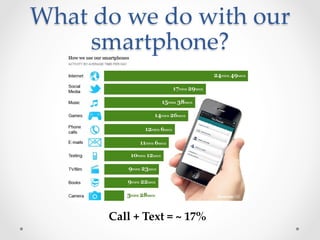
What  do  we  do  with  our  
smartphone?	
Call  +  Text  =  ~  17%
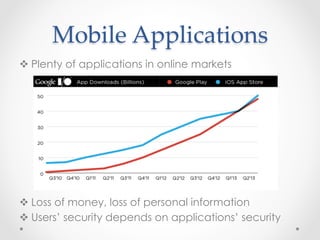
Mobile  Applications	
v Plenty of applications in online markets
v Loss of money, loss of personal information
v Users’ security depends on applications’ security
Applications’  Security  in  
Mobile  OSs	
v Apple – App Store
v Microsoft – Windows Phone Store
v Google – Google Play
v Applications are signed and must specify permissions
v User consent
v Isolation
v Once an application has been installed it gets access
to required permissions until it will be uninstalled
Google’s  guideline  about  
application’s  security	
Android has no mechanism for granting
permissions dynamically (at run-time)
because it complicates the user
experience to the detriment of security
PARTIALLY  TRUE  …
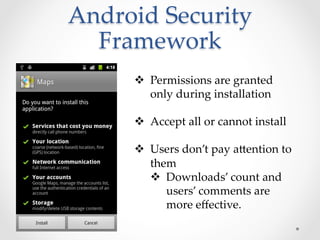
Android  Security  
Framework	
v  Permissions  are  granted  
only  during  installation	
v  Accept  all  or  cannot  install	
v  Users  don’t  pay  aXention  to  
them	
v  Downloads’  count  and  
users’  comments  are  
more  effective.
Android  Security  
Framework	
Android’s security framework checks for permissions
when one of the following situations occurs.
v An application wants to access to a particular
functionality protected by a permission (e.g. GPS
information),
v An application tries to start an activity of another
application,
v Both when an application sends and receives
broadcasts,
v An application tries to access and operate on a
content provider and
v When binding to or starting a service.
SecureDroid	
v Extends Android Security Framework
v  Standard security control still remains
v  Compatible with applications from market
Provides the possibility to:
v Check custom policies at runtime
v Specify policies after an application has been
installed
v Use context information as policy’s constraints
v Allow multiple parties to set policies
v Handle policy enforcement: PolicyDenyException
User’s  Context	
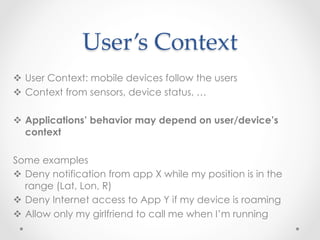
v  User Context: mobile devices follow the users
v  Context from sensors, device status, …
v  Applications’ behavior may depend on user/device’s
context
Some examples
v  Deny notification from app X while my position is in the
range (Lat, Lon, R)
v  Deny Internet access to App Y if my device is roaming
v  Allow only my girlfriend to call me when I’m running
Policy  Model	
	
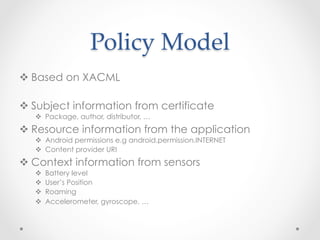
v Based on XACML
v Subject information from certificate
v  Package, author, distributor, …
v Resource information from the application
v  Android permissions e.g android.permission.INTERNET
v  Content provider URI
v Context information from sensors
v  Battery level
v  User’s Position
v  Roaming
v  Accelerometer, gyroscope, …
Policy	
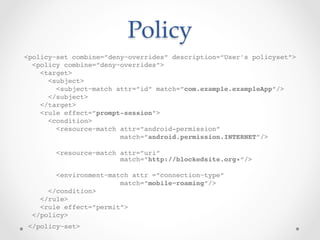
<policy−set combine=”deny−overrides” description=“User’s policyset”> "
<policy combine=”deny−overrides”> "
<target> "
<subject> "
<subject−match attr=”id” match=”com.example.exampleApp”/> "
</subject>"
</target> "
<rule effect=”prompt-session”>"
<condition> "
<resource−match attr=”android-permission” "
match=”android.permission.INTERNET”/>"
"
<resource−match attr=”uri”

match=”http://blockedsite.org∗”/>"
"
<environment−match attr =”connection−type” "
match=”mobile−roaming”/> "
</condition> "
</rule> "
<rule effect=”permit”> "
</policy> "
</policy−set>
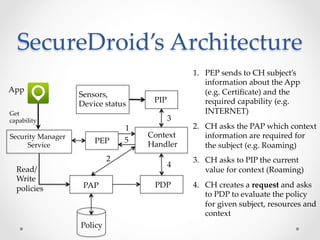
SecureDroid’s  Architecture	
Get  
capability	
1.  PEP  sends  to  CH  subject’s  
information  about  the  App  
(e.g.  Certificate)  and  the  
required  capability  (e.g.  
INTERNET)	
2.  CH  asks  the  PAP  which  context  
information  are  required  for  
the  subject  (e.g.  Roaming)	
3.  CH  asks  to  PIP  the  current  
value  for  context  (Roaming)	
4.  CH  creates  a  request  and  asks  
to  PDP  to  evaluate  the  policy  
for  given  subject,  resources  and  
context	
App	
PEP	
PAP	
Security  Manager  	
                    Service	
Context	
Handler	
Policy	
PDP	
PIP	
Sensors,  	
Device  status	
1	
2	
3	
4	
5	
Read/	
Write	
policies
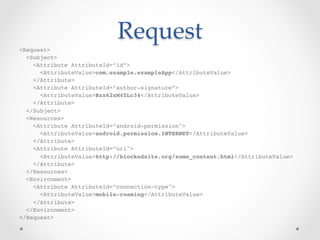
Request	
Request 
Subject
Attribute AttributeId=”id”
AttributeValuecom.example.exampleApp/AttributeValue
/Attribute
Attribute AttributeId=”author-signature”
AttributeValueBzx62xM45Lc34/AttributeValue
/Attribute
/Subject
Resources 
Attribute AttributeId=”android-permission 
AttributeValueandroid.permission.INTERNET/AttributeValue 
/Attribute
Attribute AttributeId=”uri 
AttributeValuehttp://blockedsite.org/some_content.html/AttributeValue
/Attribute
/Resources
Environment
Attribute AttributeId=”connection-type 
AttributeValuemobile-roaming/AttributeValue
/Attribute 
/Environment
/Request
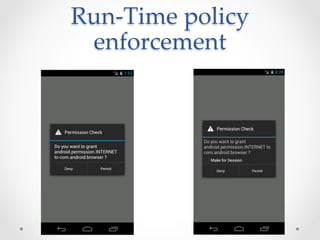
Run-­‐‑Time  policy  
enforcement
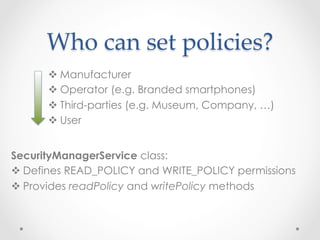
Who  can  set  policies?	
v Manufacturer
v Operator (e.g. Branded smartphones)
v Third-parties (e.g. Museum, Company, …)
v User
SecurityManagerService class:
v Defines READ_POLICY and WRITE_POLICY permissions
v Provides readPolicy and writePolicy methods
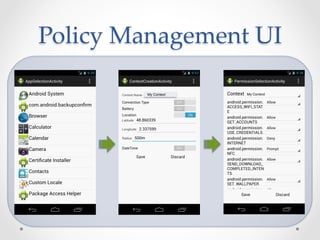
Policy  Management  UI	
My Context
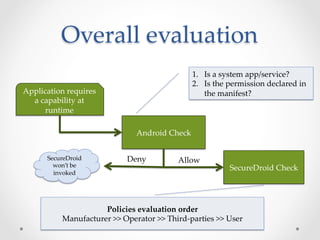
Overall  evaluation	
Android  Check	
SecureDroid  Check	
Application  requires  
a  capability  at  
runtime	
1.  Is  a  system  app/service?	
2.  Is  the  permission  declared  in  
the  manifest?	
Policies  evaluation  order	
Manufacturer    Operator    Third-­‐‑parties    User	
Allow	
Deny	
SecureDroid  
won’t  be  
invoked
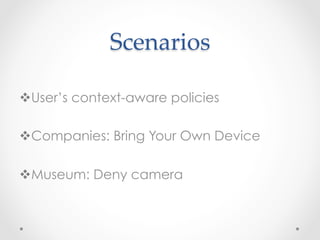
Scenarios	
v User’s context-aware policies
v Companies: Bring Your Own Device
v Museum: Deny camera
Conclusions  and    
Future  Works	
Our contribute: SecureDroid
v Acts at system level: platform extension
v Enforces context-aware policies at runtime
v Allows multiple parties to set policies
Future Work
v Analysis of user-experience in dealing with Policy
Management UI
v  Improve context selection
v Help users in choosing policies
v  Similar applications  Similar policy in similar context
Thanks  for  your  aXention!	
Giuseppe  La  Torre	
PhD  Student	
University  of  Catania  (ITALY)	
giuseppe.latorre@dieei.unict.it	
Q

SecureDroid: An Android Security Framework Extension for Context-Aware policy Enforcement

  • 1.
    SecureDroid:  An  Android Security   Framework  Extension  for  Context-­‐‑ Aware  policy  Enforcement V.Arena, V. Catania, G. La Torre, S. Monteleone Department of Electrical, Electronics and Computer Engineering University of Catania - Italy PRISM  2013,  International  Conference  on  Privacy  and  Security  in  Mobile  Systems June  24-­‐‑27,  2013  Atlantic  City,  NJ,  USA F. Ricciato Innovation and Industry Relations Telecom Italia S.p.A. - Italy
  • 2.
    What  do  we do  with  our   smartphone? Call  +  Text  =  ~  17%
  • 3.
    Mobile  Applications v Plenty ofapplications in online markets v Loss of money, loss of personal information v Users’ security depends on applications’ security
  • 4.
    Applications’  Security  in  Mobile  OSs v Apple – App Store v Microsoft – Windows Phone Store v Google – Google Play v Applications are signed and must specify permissions v User consent v Isolation v Once an application has been installed it gets access to required permissions until it will be uninstalled
  • 5.
    Google’s  guideline  about  application’s  security Android has no mechanism for granting permissions dynamically (at run-time) because it complicates the user experience to the detriment of security PARTIALLY  TRUE  …
  • 6.
    Android  Security   Framework v Permissions  are  granted   only  during  installation v  Accept  all  or  cannot  install v  Users  don’t  pay  aXention  to   them v  Downloads’  count  and   users’  comments  are   more  effective.
  • 7.
    Android  Security   Framework Android’ssecurity framework checks for permissions when one of the following situations occurs. v An application wants to access to a particular functionality protected by a permission (e.g. GPS information), v An application tries to start an activity of another application, v Both when an application sends and receives broadcasts, v An application tries to access and operate on a content provider and v When binding to or starting a service.
  • 8.
    SecureDroid v Extends Android SecurityFramework v  Standard security control still remains v  Compatible with applications from market Provides the possibility to: v Check custom policies at runtime v Specify policies after an application has been installed v Use context information as policy’s constraints v Allow multiple parties to set policies v Handle policy enforcement: PolicyDenyException
  • 9.
    User’s  Context v  UserContext: mobile devices follow the users v  Context from sensors, device status, … v  Applications’ behavior may depend on user/device’s context Some examples v  Deny notification from app X while my position is in the range (Lat, Lon, R) v  Deny Internet access to App Y if my device is roaming v  Allow only my girlfriend to call me when I’m running
  • 10.
    Policy  Model v Based onXACML v Subject information from certificate v  Package, author, distributor, … v Resource information from the application v  Android permissions e.g android.permission.INTERNET v  Content provider URI v Context information from sensors v  Battery level v  User’s Position v  Roaming v  Accelerometer, gyroscope, …
  • 11.
    Policy <policy−set combine=”deny−overrides” description=“User’spolicyset”> " <policy combine=”deny−overrides”> " <target> " <subject> " <subject−match attr=”id” match=”com.example.exampleApp”/> " </subject>" </target> " <rule effect=”prompt-session”>" <condition> " <resource−match attr=”android-permission” " match=”android.permission.INTERNET”/>" " <resource−match attr=”uri”
 match=”http://blockedsite.org∗”/>" " <environment−match attr =”connection−type” " match=”mobile−roaming”/> " </condition> " </rule> " <rule effect=”permit”> " </policy> " </policy−set>
  • 12.
    SecureDroid’s  Architecture Get   capability 1. PEP  sends  to  CH  subject’s   information  about  the  App   (e.g.  Certificate)  and  the   required  capability  (e.g.   INTERNET) 2.  CH  asks  the  PAP  which  context   information  are  required  for   the  subject  (e.g.  Roaming) 3.  CH  asks  to  PIP  the  current   value  for  context  (Roaming) 4.  CH  creates  a  request  and  asks   to  PDP  to  evaluate  the  policy   for  given  subject,  resources  and   context App PEP PAP Security  Manager                      Service Context Handler Policy PDP PIP Sensors,   Device  status 1 2 3 4 5 Read/ Write policies
  • 13.
    Request Request Subject Attribute AttributeId=”id” AttributeValuecom.example.exampleApp/AttributeValue /Attribute AttributeAttributeId=”author-signature” AttributeValueBzx62xM45Lc34/AttributeValue /Attribute /Subject Resources Attribute AttributeId=”android-permission AttributeValueandroid.permission.INTERNET/AttributeValue /Attribute Attribute AttributeId=”uri AttributeValuehttp://blockedsite.org/some_content.html/AttributeValue /Attribute /Resources Environment Attribute AttributeId=”connection-type AttributeValuemobile-roaming/AttributeValue /Attribute /Environment /Request
  • 14.
  • 15.
    Who  can  set policies? v Manufacturer v Operator (e.g. Branded smartphones) v Third-parties (e.g. Museum, Company, …) v User SecurityManagerService class: v Defines READ_POLICY and WRITE_POLICY permissions v Provides readPolicy and writePolicy methods
  • 16.
  • 17.
    Overall  evaluation Android  Check SecureDroid Check Application  requires   a  capability  at   runtime 1.  Is  a  system  app/service? 2.  Is  the  permission  declared  in   the  manifest? Policies  evaluation  order Manufacturer    Operator    Third-­‐‑parties    User Allow Deny SecureDroid   won’t  be   invoked
  • 18.
    Scenarios v User’s context-aware policies v Companies:Bring Your Own Device v Museum: Deny camera
  • 19.
    Conclusions  and    Future  Works Our contribute: SecureDroid v Acts at system level: platform extension v Enforces context-aware policies at runtime v Allows multiple parties to set policies Future Work v Analysis of user-experience in dealing with Policy Management UI v  Improve context selection v Help users in choosing policies v  Similar applications Similar policy in similar context
  • 20.
    Thanks  for  your aXention! Giuseppe  La  Torre PhD  Student University  of  Catania  (ITALY) giuseppe.latorre@dieei.unict.it Q