Controlling
Access to
Sensitive
Resources
Access
Control
Controlling
Access to
Sensitive
Resources
Access in Controlled Based on
Different Factors
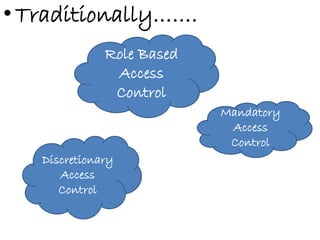
•Traditionally…….
Role Based
Access
Control
Mandatory
Access
Control
Discretionary
Access
Control
L
I
M
I
T
A
T
I
O
N
S
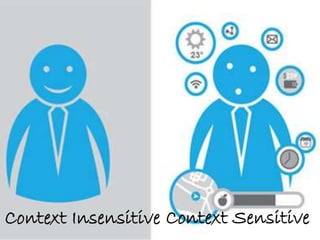
Context
insensitive
Static
Coarse
grained
Pre-
defined
Context Insensitive Context Sensitive
Context Matters
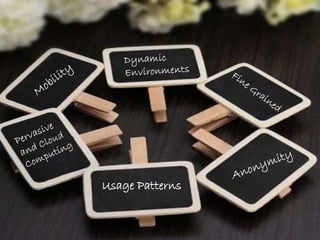
Usage Patterns
Context Based
Access Control
Model
Related Work
• Context Aware Access Control
(extensions built on top of a
context insensitive model)
• Context Based Access Control
(inherently context
sensitive)
Role Based Access Control
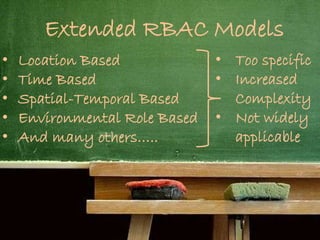
Extended RBAC Models
• Location Based
• Time Based
• Spatial-Temporal Based
• Environmental Role Based
• And many others…..
• Too specific
• Increased
Complexity
• Not widely
applicable
Step 1: Role Engineering
Step 2: Permission
Assignment to Roles
Step 3: Role Assignment
to Users
Role Engineering
Role Activation and
Deactivation
RBAC’s Limitation
Role Explosion
RBAC’s Limitation
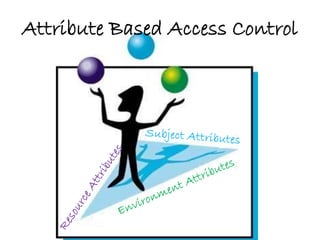
Attribute Based Access Control
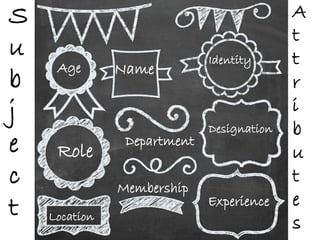
S
u
b
j
e
c
t
A
t
t
r
i
b
u
t
e
s
Age Name
Identity
Role
Department
Designation
Location
Membership
Experience
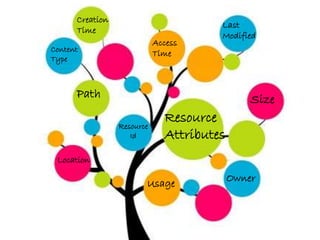
Resource
Attributes
Size
Creation
Time
Last
Modified
Path
Location
Usage
Access
TimeContent
Type
Resource
Id
Owner
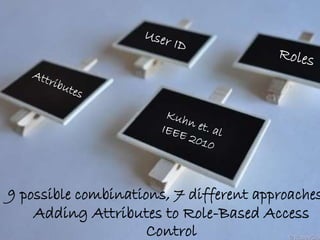
9 possible combinations, 7 different approaches
Adding Attributes to Role-Based Access
Control
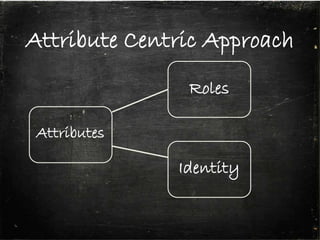
Attribute Centric Approach
Attributes
Roles
Identity
References[1] Hu, Vincent C., et al. "Guide to attribute based access control (ABAC) definition
and considerations (draft)." NIST Special Publication 800 (2013): 162.
[2] Hulsebosch, R. J., et al. "Context sensitive access control." Proceedings of the
tenth ACM symposium on Access control models and technologies. ACM, 2005.
[3] Zhang, Guangsen, and Manish Parashar. "Context-aware dynamic access
control for pervasive applications." Proceedings of the Communication Networks and
Distributed Systems Modeling and Simulation Conference. 2004.
[4] Covington, Michael J., and Manoj R. Sastry. "A contextual attribute-based
access control model." On the Move to Meaningful Internet Systems 2006: OTM 2006
Workshops. Springer Berlin Heidelberg, 2006.
[5] Kulkarni, Devdatta, and Anand Tripathi. "Context-aware role-based access
control in pervasive computing systems." Proceedings of the 13th ACM symposium on
Access control models and technologies. ACM, 2008.
[6] Martin, Hervé. "A generalized context-based access control model for pervasive
environments." Proceedings of the 2nd SIGSPATIAL ACM GIS 2009 International
Workshop on Security and Privacy in GIS and LBS. ACM, 2009.
[7] Ferraiolo, David F., et al. "Proposed NIST standard for role-based access
control." ACM Transactions on Information and System Security (TISSEC) 4.3 (2001):
224-274.
References[8] Hansen, Frode, and Vladimir Oleshchuk. "SRBAC: A spatial role-based access
control model for mobile systems." Proceedings of the 7th Nordic Workshop on Secure IT
Systems (NORDSEC’03). 2003.
[9] Covington, Michael J., et al. "Securing context-aware applications using
environment roles." Proceedings of the sixth ACM symposium on Access control models
and technologies. ACM, 2001.
[10] Ray, Indrakshi, Mahendra Kumar, and Lijun Yu. "LRBAC: a location-aware
role-based access control model." Information Systems Security. Springer Berlin
Heidelberg, 2006. 147-161.
[11] Ray, Indrakshi, and Manachai Toahchoodee. "A spatio-temporal role-based
access control model." Data and Applications Security XXI. Springer Berlin Heidelberg,
2007. 211-226.
[12] Kuhn, D. Richard, Edward J. Coyne, and Timothy R. Weil. "Adding attributes
to role-based access control." Computer 43.6 (2010): 79-81.
[13] Kim, Young-Gab, et al. "Context-aware access control mechanism for ubiquitous
applications." Advances in Web Intelligence. Springer Berlin Heidelberg, 2005. 236-242.
[14] Shen, Hai-bo, and Fan Hong. "An attribute-based access control model for web
services." Parallel and Distributed Computing, Applications and Technologies, 2006.
PDCAT'06. Seventh International Conference on. IEEE, 2006.
[15] Al-Muhtadi, Jalal, et al. "Cerberus: a context-aware security scheme for smart
spaces." Pervasive Computing and Communications, 2003.(PerCom 2003). Proceedings of
the First IEEE International Conference on. IEEE, 2003.
Access control
Access control

Access control

Editor's Notes

  • #2 The topic of our paper is “XACML Profile for Attribute-Centric Context Based Access Control” and our group members include Arjumand Fatima and Sara Qamar. Our work was a little bit different from what most of you have done because you people presented survey on different topics but we actually proposed a solution based on the existing work done by other researchers.
  • #4 So what is access control? Access control can be defined in simple terms as “controlling access to sensitive resources” which means that instead of allowing everyone to do everything, only legitimate people should be allowed to perform legitimate operations.
  • #5 After defining access control, the next question that comes in our mind is that how is access actually controlled? How access control actually works?
  • #6 In actual access is controlled based on different factors such as identity, user roles or attributes etc. different access control models have been proposed which consider different decision factors and hence are termed according to these factors.
  • #7 Traditionally, access control lists (ACLs), identity based access control (IBAC) and role based access control (RBAC) models were the most common ways used to control access. However, each one of them had certain limitations.
  • #8 These limitations include but are not limited to the following. All these models or mechanisms are context insensitive. If you are not sure about what exactly is meant by context insensitivity, wait a bit we’ll come to this shortly. Secondly, they were suitable for static environments in which all the relevant information was available before hand. Thirdly, they generally provide coarse grained access control and are thus not suitable for situations where fine grained authorization is required. Fourthly, they require pre-defined users or roles to be available for controlling access. These requirements may not be clear in dynamically changing environments.
  • #9 In today’s dynamically changing environments, contextual information plays an important role in making access control decisions. But what actually context is? What is meant by contextual information? And why should we really consider it an important factor? Context can be used to define a specific situation by capturing the environmental settings in which an event occurs. These environmental settings may include who is requesting access from where and when and how is he/she trying to make the request etc.
  • #10 Context sensitivity makes our applications much more powerful and closer to real life situations. Without considering contextual information, we only consider a user or a resource but with contextual information we consider a number of other factors such as time of day, specific date and day, location, temperature, operating system, type of application, network parameters, usage patterns and so on. Considering these factors make our access control decisions much more accurate and flexible and allow fine grained authorization.
  • #11 Based on the requirements of diverse applications of today related to computing paradigms such as cloud computing and pervasive computing, and considering the requirements of a flexible access control model as identified by various researchers in the past, we consider a model which is applicable in Dynamically changing environments, Allows fine grained access control, Ensures user anonymity and does not require prior identification or authentication of users, Considers usage characteristics of users and resources, Considers user and resource mobility And hence, is applicable to pervasive and cloud computing applications.
  • #12 So based on all these requirements we propose a “Context Based Access Control Model.” For simplicity, we ignore the term “Attribute – Centric” and we’ll discuss it shortly. So till now we have established the need of context based access control and we hope you are clear about it. Next question may come to your mind that isn’t it already implemented or at least considered by researchers in the past? Yes, it isn’t a novel concept and has been under consideration of researchers for around a decade. Now your next question would probably something like “if it’s already available what’s new? What is our novel contribution?” we’ll explain our contribution shortly after explaining what has already been done in the past.
  • #13 Existing work done by various researchers can be broadly classified as Context Aware Access Control Context Based Access Control Context Aware Access Control covers the solutions which are an extension of existing access control models which were actually context insensitive but were extended or enhanced to deal with contextual information. These extensions were mostly made on the core RBAC model as defined by NIST. If you want to know what RBAC is? Don’t worry we will explain it further. Context Based Access Control. This category includes access control solutions that are inherently context sensitive and consider contextual attributes as a fundamental factor for making access control decisions. Our proposed solution is a Context Based Access Control Model. We’ll explain our model in detail in the next section.
  • #14 Context Aware Access Control solutions proposed previously were mostly based on Role Based Access Control Model. As the name specifies, RBAC model controls access based on the organizational roles.
  • #15 In the past various researchers proposed different extensions to the core RBAC model proposed by NIST. A few of these extensions included Location Based RBAC Time Based RBAC Spatial-Temporal Based RBAC Environmental RBAC And similarly many others….. However, all these proposed solutions had some common problems. They were too specific because each of these models was focused on considering a specific contextual parameter such as time or location or environment etc. In trying to add context awareness to RBAC model, things became too complex. These solutions were not widely applicable as they focused on solving problems related to a specific domain only.
  • #16 The core RBAC model proposed by NIST can be considered as a 3 step process. The first step is role engineering which involves identifying the appropriate roles in a system or organization.
  • #17 Second step in RBAC is assigning permissions to these roles based on the requirements of access control.
  • #18 The third step is assigning these previously identified roles to users. We discussed these 3 steps with you in order to demonstrate the complexity and pre-processing involved in using RBAC model.
  • #19 This may become a costly and time consuming process if the management hierarchy is not well defined. RBAC is most appropriate for an enterprise setup in which well-defined and disjoint roles can be identified. It may become inappropriate in situations where users cannot be identified or predicted before hand.
  • #20 Apart from the role engineering and permission assignment steps, roles further need to be activated and deactivated from time to time. Failure to activate and deactivate these roles may result in unauthorized access to sensitive resources. Consider for example, I have been working in SEECS as a RA from 9am to 5pm and then studying from 5.30pm to 8.30pm. Following an RBAC approach, the RA role should be activated from 9am to 5pm and deactivated otherwise. Similarly student role should be activated only from 5.30pm to 8.30pm.
  • #21 Consider there is a role manager. All the people working under a designation “manager” are assigned that role. But after some time the organization feels that there is a difference in the responsibilities of managers working in the evening shift from those working in the morning. So instead of one manager role, two roles are now required i.e. manager_morning, manager_evening. Then sometime later the organization feels that managers working in different regions may have different rights. The roles are further increased e.g. manager_morning_north, manager_morning_south, manager_evening_north and so on. Hence, as the requirements become more and more clarified, the identified roles may increase to such an extent that their management becomes too complex and costly. This results in role explosion.
  • #22 A relatively newer model for controlling access is known as Attribute Based Access Control (ABAC) Model. This model controls access based on the attributes of Subject, Resource as well as Environment. This provides a greater flexibility for making access control decisions as compared to traditional methods which were mostly subject-centric and did not consider resource or environment as the primary factor.
  • #23 Examples of Subject Attributes include but are not limited to a unique identity, may be non-unique name, age, role, department, designation, location, membership and experience etc. It must be noted that the identity as well as roles are merely attributes in this model as compared to the only factor for controlling access in IBAC and RBAC models respectively.
  • #24 Examples of resource attributes include but are not limited to the unique resource identity and various other non-unique attributes such as size, content, path, access time, creation time, last modification time, location, resource owned by, content type and so on.
  • #25 Environment attributes can be considered as the information which is independent of both subject and resource but are required for controlling access to resources. Examples may include but are not limited to time, date, day, month, year, season, temperature, weather conditions, occurrence of some specific event such as cycling race or spring festival, presence of some specific location such as on a picnic spot or sea view.
  • #26 In 2010, an IEEE publication by kuhn et. al. presented “Adding attributes to role based access control”. In their work, they presented 9 possible ways of combining the user/subject identity, roles and other attributes to control access. Resultantly, 7 different approaches can be used for this purpose. Previously, work has been done on one of these approaches namely role centric approach.
  • #27 One of those 7 possible ways was termed as attribute centric approach. It considers user/subject identity and roles as mere attributes for controlling access to sensitive resources. We found this approach to be the most appropriate for designing a Context Based Access Control Model.
  • #28 We reviewed these papers during our effort to propose the presented model.