
“If I were a dictator, religion and state would be separate. I swear
by my religion. I will die for it. But it is my personal affair. The
state has nothing to do with it. The state would look after your
secular welfare, health, communications, foreign
relations, currency and so on, but not your or my religion. That is
everybody's personal concern!”
― Mahatma Gandhi

1
What is secularism?

2
Secularism is the concept that government
or other entities should exist separately
from religion and / or religious beliefs

3
U.S.A
 United States of America - The United States does not have

an official religion at either the federal or state level.
 The First Amendment to the United States Constitution is

written as "Congress shall make no law respecting an
establishment of religion, or prohibiting the free exercise
thereof; or abridging the freedom of speech, or of the press;
or the right of the people peaceably to assemble, and to
petition the Government for a redress of grievances" and is
held to be applied to the state via the Fourteenth
Amendment.
 Furthermore, Article Six of the United States Constitution
prohibits the use of any religious test as qualification for
any public office
4
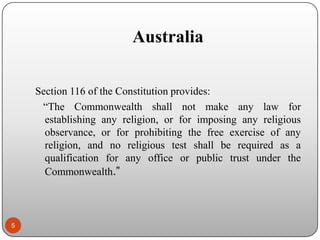
Australia
Section 116 of the Constitution provides:
“The Commonwealth shall not make any law for
establishing any religion, or for imposing any religious
observance, or for prohibiting the free exercise of any
religion, and no religious test shall be required as a
qualification for any office or public trust under the
Commonwealth.”

5
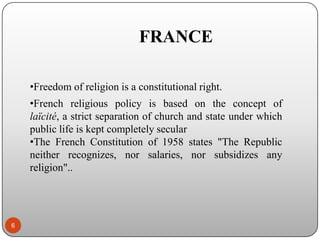
FRANCE
•Freedom of religion is a constitutional right.
•French religious policy is based on the concept of
laïcité, a strict separation of church and state under which
public life is kept completely secular
•The French Constitution of 1958 states "The Republic
neither recognizes, nor salaries, nor subsidizes any
religion"..

6
FORMER SECULAR STATES
Bangladesh (1971-1977) - "Secularism" is one of the fundamental
principles that drove the Bengali nationalist movement and
subsequent Bangladesh Liberation War which led to the creation
of Bangladesh, which had been founded as a democratic secular
nation-state.
 The term Secularity had been induced into the original
Constitution of Bangladesh in 1972 as one of the Four State
Principles, the others being Democracy, Nationalism and
Socialism.
 After the dramatic assassination in 1975 of President Sheikh
Mujibur Rahman, the country's founder, secularism would be
condemned by subsequent military regimes and be eventually
removed from the constitution by President Ziaur Rahman in 1977
by replacing the word "Secularity" with "Absolutue trust and faith
in the Almighty Allah shall be the basis of all actions".
7
FORMER SECULAR STATES
 Iran (1925-1979) - Iran became a secular state in 1925 after

Reza Pahlavi was installed as Shah. However, Islam was reinstituted as the state religion in December 1979 following
the Iranian Revolution and the adoption of a new
constitution.
 Iraq (1932–1968) - Iraq became a secular state in 1932 after
independence. However, Islam was instituted as the state
religion of Iraq in 1968 following the adoption of a new Iraqi
constitution.
8
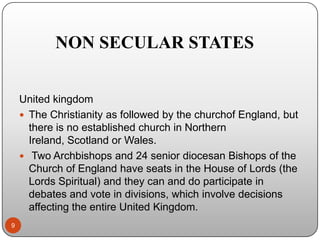
NON SECULAR STATES
United kingdom
 The Christianity as followed by the churchof England, but
there is no established church in Northern
Ireland, Scotland or Wales.
 Two Archbishops and 24 senior diocesan Bishops of the
Church of England have seats in the House of Lords (the
Lords Spiritual) and they can and do participate in
debates and vote in divisions, which involve decisions
affecting the entire United Kingdom.
9
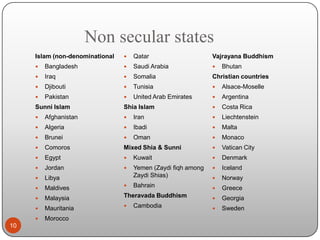
Non secular states
Islam (non-denominational



Qatar

Vajrayana Buddhism



Bangladesh



Saudi Arabia





Iraq



Somalia

Christian countries



Djibouti



Tunisia



Alsace-Moselle



Pakistan



United Arab Emirates



Argentina

Shia Islam



Costa Rica

Sunni Islam

Bhutan





Iran



Liechtenstein



Algeria



Ibadi



Malta



Brunei



Oman



Monaco



Comoros

Mixed Shia & Sunni



Vatican City



Egypt



Kuwait



Denmark



Jordan



Iceland

Libya

Yemen (Zaydi fiqh among
Zaydi Shias)







Norway



Maldives



Greece



Malaysia



Georgia



Mauritania



Sweden



10

Afghanistan

Morocco



Bahrain

Theravada Buddhism


Cambodia
THANK YOU
11

Secularism-international perspective

  • 1.
    “If I werea dictator, religion and state would be separate. I swear by my religion. I will die for it. But it is my personal affair. The state has nothing to do with it. The state would look after your secular welfare, health, communications, foreign relations, currency and so on, but not your or my religion. That is everybody's personal concern!” ― Mahatma Gandhi 1
  • 2.
  • 3.
    Secularism is theconcept that government or other entities should exist separately from religion and / or religious beliefs 3
  • 4.
    U.S.A  United Statesof America - The United States does not have an official religion at either the federal or state level.  The First Amendment to the United States Constitution is written as "Congress shall make no law respecting an establishment of religion, or prohibiting the free exercise thereof; or abridging the freedom of speech, or of the press; or the right of the people peaceably to assemble, and to petition the Government for a redress of grievances" and is held to be applied to the state via the Fourteenth Amendment.  Furthermore, Article Six of the United States Constitution prohibits the use of any religious test as qualification for any public office 4
  • 5.
    Australia Section 116 ofthe Constitution provides: “The Commonwealth shall not make any law for establishing any religion, or for imposing any religious observance, or for prohibiting the free exercise of any religion, and no religious test shall be required as a qualification for any office or public trust under the Commonwealth.” 5
  • 6.
    FRANCE •Freedom of religionis a constitutional right. •French religious policy is based on the concept of laïcité, a strict separation of church and state under which public life is kept completely secular •The French Constitution of 1958 states "The Republic neither recognizes, nor salaries, nor subsidizes any religion".. 6
  • 7.
    FORMER SECULAR STATES Bangladesh(1971-1977) - "Secularism" is one of the fundamental principles that drove the Bengali nationalist movement and subsequent Bangladesh Liberation War which led to the creation of Bangladesh, which had been founded as a democratic secular nation-state.  The term Secularity had been induced into the original Constitution of Bangladesh in 1972 as one of the Four State Principles, the others being Democracy, Nationalism and Socialism.  After the dramatic assassination in 1975 of President Sheikh Mujibur Rahman, the country's founder, secularism would be condemned by subsequent military regimes and be eventually removed from the constitution by President Ziaur Rahman in 1977 by replacing the word "Secularity" with "Absolutue trust and faith in the Almighty Allah shall be the basis of all actions". 7
  • 8.
    FORMER SECULAR STATES Iran (1925-1979) - Iran became a secular state in 1925 after Reza Pahlavi was installed as Shah. However, Islam was reinstituted as the state religion in December 1979 following the Iranian Revolution and the adoption of a new constitution.  Iraq (1932–1968) - Iraq became a secular state in 1932 after independence. However, Islam was instituted as the state religion of Iraq in 1968 following the adoption of a new Iraqi constitution. 8
  • 9.
    NON SECULAR STATES Unitedkingdom  The Christianity as followed by the churchof England, but there is no established church in Northern Ireland, Scotland or Wales.  Two Archbishops and 24 senior diocesan Bishops of the Church of England have seats in the House of Lords (the Lords Spiritual) and they can and do participate in debates and vote in divisions, which involve decisions affecting the entire United Kingdom. 9
  • 10.
    Non secular states Islam(non-denominational  Qatar Vajrayana Buddhism  Bangladesh  Saudi Arabia   Iraq  Somalia Christian countries  Djibouti  Tunisia  Alsace-Moselle  Pakistan  United Arab Emirates  Argentina Shia Islam  Costa Rica Sunni Islam Bhutan   Iran  Liechtenstein  Algeria  Ibadi  Malta  Brunei  Oman  Monaco  Comoros Mixed Shia & Sunni  Vatican City  Egypt  Kuwait  Denmark  Jordan  Iceland Libya Yemen (Zaydi fiqh among Zaydi Shias)    Norway  Maldives  Greece  Malaysia  Georgia  Mauritania  Sweden  10 Afghanistan Morocco  Bahrain Theravada Buddhism  Cambodia
  • 11.