
REASONABLE SECURITY PRACTICES AND PROCEDURES AND
SENSITIVE PERSONAL DATA OR INFORMATION RULES, 2011
Under
The (Indian) Information Technology Act, 2000
By
Vijay Pal Dalmia, Advocate
Partner & Head of Intellectual Property & Information Technology Laws Practice
 Enacted in the year 2000 and was implemented w.e.f. 17th October,
2000.
 Important features of this Act :
 Recognition to e-transactions, digital signatures, electronic
records etc. and also recognise their evidentiary value.
 Lists out various computer crimes which are technological in
nature.
 However, this Act, originally, did not contain any provision for data
protection.
INFORMATION TECHNOLOGY ACT,
2000
 The IT Act, 2002 was amended in the year 2008.
 Section 43A and Section 72A were added by the
amendment Act for protection of personal data and
information.
 Both these provisions are penal in nature, civil and
criminal respectively.
THE INFORMATION TECHNOLOGY
(AMENDMENT) ACT, 2008
 Ministry Of Communications And Information Technology (Department Of
Information Technology) promulgated these rules (IT Rules 2011), under
Section 87 (2)(ob) read with Section 43A.
 IT Rules, 2011 came in force on 11th April, 2011.
 The Government has come up with further clarifications w.r.t. these Rules
by a Press Note Dated 24th
August, 2011 to avoid ambiguities
(http://mit.gov.in/sites/upload_files/dit/files/PressNote_25811.pdf)
 Non Compliance of these rules would lead to invocation of Section 43A
of The IT Act, 2008 and liability to pay compensation, limits of which
have not been fixed.
REASONABLE SECURITY PRACTICES AND
PROCEDURES AND SENSITIVE PERSONAL
DATA OR INFORMATION) RULES , 2011
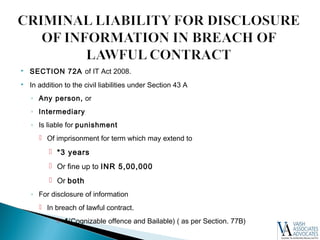
 SECTION 72A of IT Act 2008.
 In addition to the civil liabilities under Section 43 A
◦ Any person, or
◦ Intermediary
◦ Is liable for punishment
 Of imprisonment for term which may extend to
 *3 years
 Or fine up to INR 5,00,000
 Or both
◦ For disclosure of information
 In breach of lawful contract.
 *(Cognizable offence and Bailable) ( as per Section. 77B)
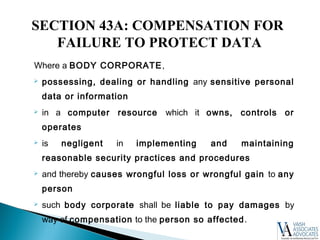
Where a BODY CORPORATE,
 possessing, dealing or handling any sensitive personal
data or information
 in a computer resource which it owns, controls or
operates
 is negligent in implementing and maintaining
reasonable security practices and procedures
 and thereby causes wrongful loss or wrongful gain to any
person
 such body corporate shall be liable to pay damages by
way of compensation to the person so affected.
SECTION 43A: COMPENSATION FOR
FAILURE TO PROTECT DATA
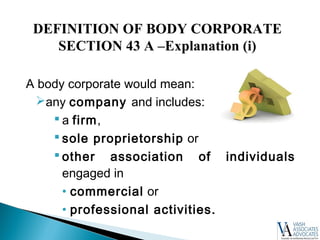
A body corporate would mean:
any company and includes:
 a firm,
 sole proprietorship or
 other association of individuals
engaged in
• commercial or
• professional activities.
DEFINITION OF BODY CORPORATE
SECTION 43 A –Explanation (i)
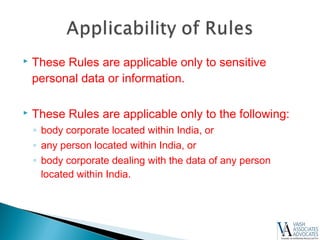
 These Rules are applicable only to sensitive
personal data or information.
 These Rules are applicable only to the following:
◦ body corporate located within India, or
◦ any person located within India, or
◦ body corporate dealing with the data of any person
located within India.
Sensitive personal data or information of a ‘person’ means such
‘personal information’ which consists of information relating to:
1. Password;
2. Financial information such as:
 Bank account or,
 Credit card or debit card or,
 Other payment instrument details
3. Physical, physiological and mental health condition;
4. Sexual orientation;
Contd…
SENSITIVE PERSONAL DATA OR
INFORMATION:
RULE 3, IT RULES, 2011
5. Biometric information;
6. Any detail relating to the above clauses
 as provided to body corporate
 for providing service; and
7. Any of the information received under above clauses by body
corporate for
 processing,
 stored or
 processed
under a lawful contract or otherwise
SENSITIVE PERSONAL DATA OR
INFORMATION
RULE 3 OF THE IT RULES, 2011
Following information is not regarded as sensitive personal data or
information:
1. Information freely available or accessible in public domain or,
2. Information furnished under the Right to Information Act,
2005 (RTI) or
3. Information furnished under any other law for the time being in
force.
EXCEPTIONS:
 Any information that relates to a
 ‘natural person’
 which either directly or indirectly, in combination with other information
available or likely to be available with a body corporate,
 is capable of identifying such person.
PERSONAL INFORMATION:
RULE 2 , IT RULES, 2011
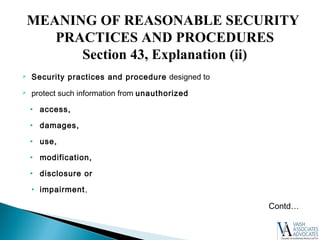
 Security practices and procedure designed to
 protect such information from unauthorized
• access,
• damages,
• use,
• modification,
• disclosure or
• impairment,
Contd…
MEANING OF REASONABLE SECURITY
PRACTICES AND PROCEDURES
Section 43, Explanation (ii)
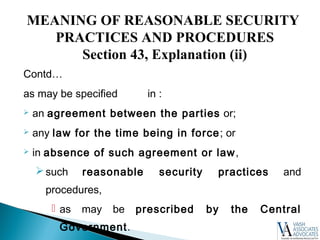
Contd…
as may be specified in :
 an agreement between the parties or;
 any law for the time being in force; or
 in absence of such agreement or law,
such reasonable security practices and
procedures,
 as may be prescribed by the Central
Government.
MEANING OF REASONABLE SECURITY
PRACTICES AND PROCEDURES
Section 43, Explanation (ii)
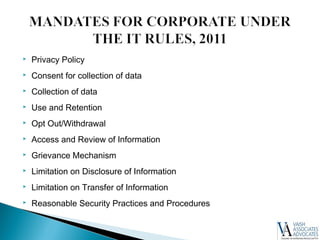
 Privacy Policy
 Consent for collection of data
 Collection of data
 Use and Retention
 Opt Out/Withdrawal
 Access and Review of Information
 Grievance Mechanism
 Limitation on Disclosure of Information
 Limitation on Transfer of Information
 Reasonable Security Practices and Procedures
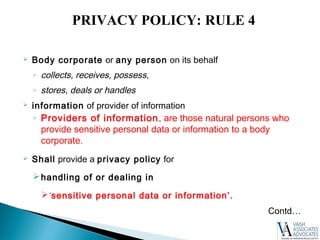
 Body corporate or any person on its behalf
◦ collects, receives, possess,
◦ stores, deals or handles
 information of provider of information
◦ Providers of information, are those natural persons who
provide sensitive personal data or information to a body
corporate.
 Shall provide a privacy policy for
handling of or dealing in
‘sensitive personal data or information’.
Contd…
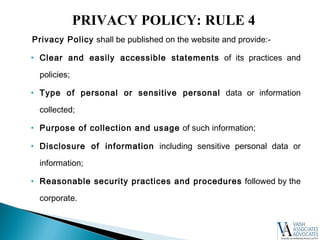
PRIVACY POLICY: RULE 4
Privacy Policy shall be published on the website and provide:-
• Clear and easily accessible statements of its practices and
policies;
• Type of personal or sensitive personal data or information
collected;
• Purpose of collection and usage of such information;
• Disclosure of information including sensitive personal data or
information;
• Reasonable security practices and procedures followed by the
corporate.
PRIVACY POLICY: RULE 4
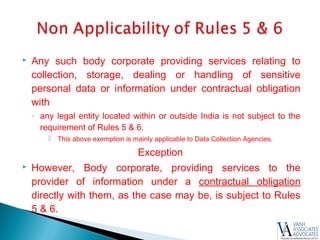
 Any such body corporate providing services relating to
collection, storage, dealing or handling of sensitive
personal data or information under contractual obligation
with
◦ any legal entity located within or outside India is not subject to the
requirement of Rules 5 & 6.
 This above exemption is mainly applicable to Data Collection Agencies.
Exception
 However, Body corporate, providing services to the
provider of information under a contractual obligation
directly with them, as the case may be, is subject to Rules
5 & 6.
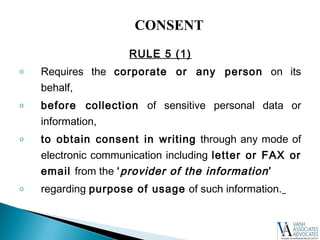
RULE 5 (1)
o Requires the corporate or any person on its
behalf,
o before collection of sensitive personal data or
information,
o to obtain consent in writing through any mode of
electronic communication including letter or FAX or
email from the ‘provider of the information’
o regarding purpose of usage of such information.
CONSENT
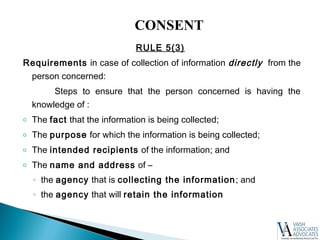
RULE 5(3)
Requirements in case of collection of information directly from the
person concerned:
Steps to ensure that the person concerned is having the
knowledge of :
o The fact that the information is being collected;
o The purpose for which the information is being collected;
o The intended recipients of the information; and
o The name and address of –
◦ the agency that is collecting the information; and
◦ the agency that will retain the information
CONSENT
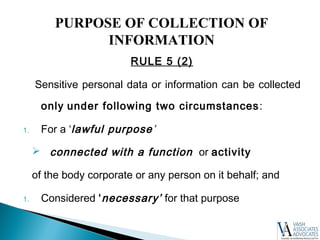
RULE 5 (2)
Sensitive personal data or information can be collected
only under following two circumstances:
1. For a ‘lawful purpose’
 connected with a function or activity
of the body corporate or any person on it behalf; and
1. Considered ‘necessary’ for that purpose
PURPOSE OF COLLECTION OF
INFORMATION
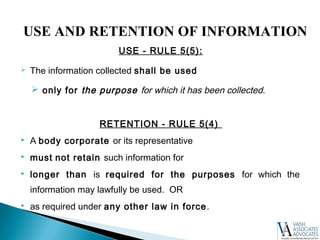
USE - RULE 5(5):
 The information collected shall be used
 only for the purpose for which it has been collected.
RETENTION - RULE 5(4)
 A body corporate or its representative
 must not retain such information for
 longer than is required for the purposes for which the
information may lawfully be used. OR
 as required under any other law in force.
USE AND RETENTION OF INFORMATION
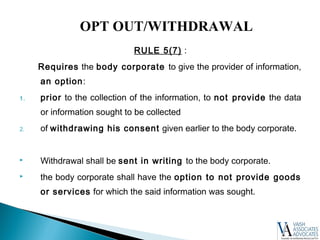
RULE 5(7) :
Requires the body corporate to give the provider of information,
an option:
1. prior to the collection of the information, to not provide the data
or information sought to be collected
2. of withdrawing his consent given earlier to the body corporate.
 Withdrawal shall be sent in writing to the body corporate.
 the body corporate shall have the option to not provide goods
or services for which the said information was sought.
OPT OUT/WITHDRAWAL
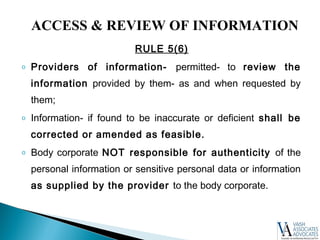
RULE 5(6)
o Providers of information- permitted- to review the
information provided by them- as and when requested by
them;
o Information- if found to be inaccurate or deficient shall be
corrected or amended as feasible.
o Body corporate NOT responsible for authenticity of the
personal information or sensitive personal data or information
as supplied by the provider to the body corporate.
ACCESS & REVIEW OF INFORMATION
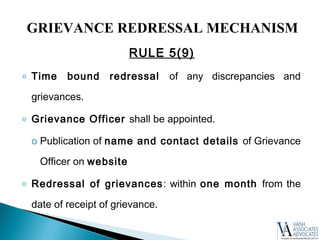
RULE 5(9)
o Time bound redressal of any discrepancies and
grievances.
o Grievance Officer shall be appointed.
o Publication of name and contact details of Grievance
Officer on website
o Redressal of grievances: within one month from the
date of receipt of grievance.
GRIEVANCE REDRESSAL MECHANISM
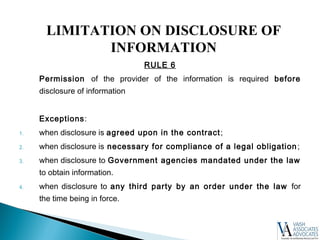
RULE 6
Permission of the provider of the information is required before
disclosure of information
Exceptions:
1. when disclosure is agreed upon in the contract;
2. when disclosure is necessary for compliance of a legal obligation;
3. when disclosure to Government agencies mandated under the law
to obtain information.
4. when disclosure to any third party by an order under the law for
the time being in force.
LIMITATION ON DISCLOSURE OF
INFORMATION
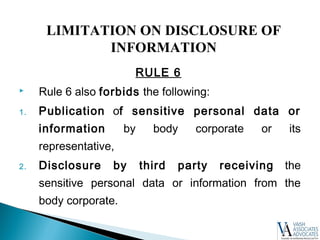
RULE 6
 Rule 6 also forbids the following:
1. Publication of sensitive personal data or
information by body corporate or its
representative,
2. Disclosure by third party receiving the
sensitive personal data or information from the
body corporate.
LIMITATION ON DISCLOSURE OF
INFORMATION
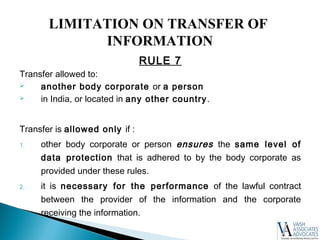
RULE 7
Transfer allowed to:
 another body corporate or a person
 in India, or located in any other country.
Transfer is allowed only if :
1. other body corporate or person ensures the same level of
data protection that is adhered to by the body corporate as
provided under these rules.
2. it is necessary for the performance of the lawful contract
between the provider of the information and the corporate
receiving the information.
LIMITATION ON TRANSFER OF
INFORMATION
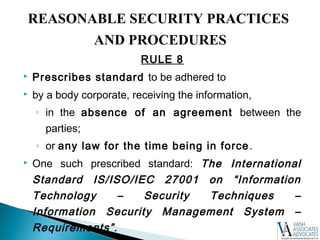
RULE 8
 Prescribes standard to be adhered to
 by a body corporate, receiving the information,
◦ in the absence of an agreement between the
parties;
◦ or any law for the time being in force.
 One such prescribed standard: The International
Standard IS/ISO/IEC 27001 on “Information
Technology – Security Techniques –
Information Security Management System –
Requirements”.
REASONABLE SECURITY PRACTICES
AND PROCEDURES
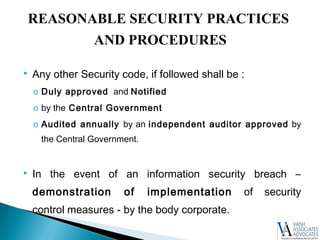
 Any other Security code, if followed shall be :
o Duly approved and Notified
o by the Central Government
o Audited annually by an independent auditor approved by
the Central Government.
 In the event of an information security breach –
demonstration of implementation of security
control measures - by the body corporate.
REASONABLE SECURITY PRACTICES
AND PROCEDURES
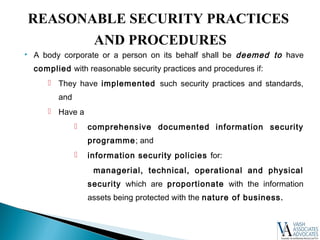
 A body corporate or a person on its behalf shall be deemed to have
complied with reasonable security practices and procedures if:
 They have implemented such security practices and standards,
and
 Have a
 comprehensive documented information security
programme; and
 information security policies for:
managerial, technical, operational and physical
security which are proportionate with the information
assets being protected with the nature of business.
REASONABLE SECURITY PRACTICES
AND PROCEDURES
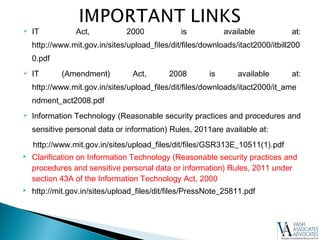
 IT Act, 2000 is available at:
http://www.mit.gov.in/sites/upload_files/dit/files/downloads/itact2000/itbill200
0.pdf
 IT (Amendment) Act, 2008 is available at:
http://www.mit.gov.in/sites/upload_files/dit/files/downloads/itact2000/it_ame
ndment_act2008.pdf
 Information Technology (Reasonable security practices and procedures and
sensitive personal data or information) Rules, 2011are available at:
http://www.mit.gov.in/sites/upload_files/dit/files/GSR313E_10511(1).pdf
 Clarification on Information Technology (Reasonable security practices and
procedures and sensitive personal data or information) Rules, 2011 under
section 43A of the Information Technology Act, 2000
 http://mit.gov.in/sites/upload_files/dit/files/PressNote_25811.pdf
THANK YOUTHANK YOU
Vaish Associates Advocates
Celebrating 43 years of professional excellence
1st
& 11th
Floors Mohan Dev Building 13, Tolstoy Marg New Delhiǀ ǀ ǀ
110001 (India)
Phone: +91 11 42492532 (Direct) Phone: +91 11 42492525 (Board)
Mobile: +91 9810081079
Fax: +91 11 23320484
Email: vpdalmia@vaishlaw.com
www.vaishlaw.com
Intellectual Property & Information Technology Laws Division
New Delhi Mumbai Bangalore Gurgaon

Reasonable security practices and procedures and sensitive personal data or information rules 2012-presentation

  • 1.
    REASONABLE SECURITY PRACTICESAND PROCEDURES AND SENSITIVE PERSONAL DATA OR INFORMATION RULES, 2011 Under The (Indian) Information Technology Act, 2000 By Vijay Pal Dalmia, Advocate Partner & Head of Intellectual Property & Information Technology Laws Practice
  • 2.
     Enacted inthe year 2000 and was implemented w.e.f. 17th October, 2000.  Important features of this Act :  Recognition to e-transactions, digital signatures, electronic records etc. and also recognise their evidentiary value.  Lists out various computer crimes which are technological in nature.  However, this Act, originally, did not contain any provision for data protection. INFORMATION TECHNOLOGY ACT, 2000
  • 3.
     The ITAct, 2002 was amended in the year 2008.  Section 43A and Section 72A were added by the amendment Act for protection of personal data and information.  Both these provisions are penal in nature, civil and criminal respectively. THE INFORMATION TECHNOLOGY (AMENDMENT) ACT, 2008
  • 4.
     Ministry OfCommunications And Information Technology (Department Of Information Technology) promulgated these rules (IT Rules 2011), under Section 87 (2)(ob) read with Section 43A.  IT Rules, 2011 came in force on 11th April, 2011.  The Government has come up with further clarifications w.r.t. these Rules by a Press Note Dated 24th August, 2011 to avoid ambiguities (http://mit.gov.in/sites/upload_files/dit/files/PressNote_25811.pdf)  Non Compliance of these rules would lead to invocation of Section 43A of The IT Act, 2008 and liability to pay compensation, limits of which have not been fixed. REASONABLE SECURITY PRACTICES AND PROCEDURES AND SENSITIVE PERSONAL DATA OR INFORMATION) RULES , 2011
  • 5.
     SECTION 72Aof IT Act 2008.  In addition to the civil liabilities under Section 43 A ◦ Any person, or ◦ Intermediary ◦ Is liable for punishment  Of imprisonment for term which may extend to  *3 years  Or fine up to INR 5,00,000  Or both ◦ For disclosure of information  In breach of lawful contract.  *(Cognizable offence and Bailable) ( as per Section. 77B)
  • 6.
    Where a BODYCORPORATE,  possessing, dealing or handling any sensitive personal data or information  in a computer resource which it owns, controls or operates  is negligent in implementing and maintaining reasonable security practices and procedures  and thereby causes wrongful loss or wrongful gain to any person  such body corporate shall be liable to pay damages by way of compensation to the person so affected. SECTION 43A: COMPENSATION FOR FAILURE TO PROTECT DATA
  • 7.
    A body corporatewould mean: any company and includes:  a firm,  sole proprietorship or  other association of individuals engaged in • commercial or • professional activities. DEFINITION OF BODY CORPORATE SECTION 43 A –Explanation (i)
  • 8.
     These Rulesare applicable only to sensitive personal data or information.  These Rules are applicable only to the following: ◦ body corporate located within India, or ◦ any person located within India, or ◦ body corporate dealing with the data of any person located within India.
  • 9.
    Sensitive personal dataor information of a ‘person’ means such ‘personal information’ which consists of information relating to: 1. Password; 2. Financial information such as:  Bank account or,  Credit card or debit card or,  Other payment instrument details 3. Physical, physiological and mental health condition; 4. Sexual orientation; Contd… SENSITIVE PERSONAL DATA OR INFORMATION: RULE 3, IT RULES, 2011
  • 10.
    5. Biometric information; 6.Any detail relating to the above clauses  as provided to body corporate  for providing service; and 7. Any of the information received under above clauses by body corporate for  processing,  stored or  processed under a lawful contract or otherwise SENSITIVE PERSONAL DATA OR INFORMATION RULE 3 OF THE IT RULES, 2011
  • 11.
    Following information isnot regarded as sensitive personal data or information: 1. Information freely available or accessible in public domain or, 2. Information furnished under the Right to Information Act, 2005 (RTI) or 3. Information furnished under any other law for the time being in force. EXCEPTIONS:
  • 12.
     Any informationthat relates to a  ‘natural person’  which either directly or indirectly, in combination with other information available or likely to be available with a body corporate,  is capable of identifying such person. PERSONAL INFORMATION: RULE 2 , IT RULES, 2011
  • 13.
     Security practicesand procedure designed to  protect such information from unauthorized • access, • damages, • use, • modification, • disclosure or • impairment, Contd… MEANING OF REASONABLE SECURITY PRACTICES AND PROCEDURES Section 43, Explanation (ii)
  • 14.
    Contd… as may bespecified in :  an agreement between the parties or;  any law for the time being in force; or  in absence of such agreement or law, such reasonable security practices and procedures,  as may be prescribed by the Central Government. MEANING OF REASONABLE SECURITY PRACTICES AND PROCEDURES Section 43, Explanation (ii)
  • 15.
     Privacy Policy Consent for collection of data  Collection of data  Use and Retention  Opt Out/Withdrawal  Access and Review of Information  Grievance Mechanism  Limitation on Disclosure of Information  Limitation on Transfer of Information  Reasonable Security Practices and Procedures
  • 16.
     Body corporateor any person on its behalf ◦ collects, receives, possess, ◦ stores, deals or handles  information of provider of information ◦ Providers of information, are those natural persons who provide sensitive personal data or information to a body corporate.  Shall provide a privacy policy for handling of or dealing in ‘sensitive personal data or information’. Contd… PRIVACY POLICY: RULE 4
  • 17.
    Privacy Policy shallbe published on the website and provide:- • Clear and easily accessible statements of its practices and policies; • Type of personal or sensitive personal data or information collected; • Purpose of collection and usage of such information; • Disclosure of information including sensitive personal data or information; • Reasonable security practices and procedures followed by the corporate. PRIVACY POLICY: RULE 4
  • 18.
     Any suchbody corporate providing services relating to collection, storage, dealing or handling of sensitive personal data or information under contractual obligation with ◦ any legal entity located within or outside India is not subject to the requirement of Rules 5 & 6.  This above exemption is mainly applicable to Data Collection Agencies. Exception  However, Body corporate, providing services to the provider of information under a contractual obligation directly with them, as the case may be, is subject to Rules 5 & 6.
  • 19.
    RULE 5 (1) oRequires the corporate or any person on its behalf, o before collection of sensitive personal data or information, o to obtain consent in writing through any mode of electronic communication including letter or FAX or email from the ‘provider of the information’ o regarding purpose of usage of such information. CONSENT
  • 20.
    RULE 5(3) Requirements incase of collection of information directly from the person concerned: Steps to ensure that the person concerned is having the knowledge of : o The fact that the information is being collected; o The purpose for which the information is being collected; o The intended recipients of the information; and o The name and address of – ◦ the agency that is collecting the information; and ◦ the agency that will retain the information CONSENT
  • 21.
    RULE 5 (2) Sensitivepersonal data or information can be collected only under following two circumstances: 1. For a ‘lawful purpose’  connected with a function or activity of the body corporate or any person on it behalf; and 1. Considered ‘necessary’ for that purpose PURPOSE OF COLLECTION OF INFORMATION
  • 22.
    USE - RULE5(5):  The information collected shall be used  only for the purpose for which it has been collected. RETENTION - RULE 5(4)  A body corporate or its representative  must not retain such information for  longer than is required for the purposes for which the information may lawfully be used. OR  as required under any other law in force. USE AND RETENTION OF INFORMATION
  • 23.
    RULE 5(7) : Requiresthe body corporate to give the provider of information, an option: 1. prior to the collection of the information, to not provide the data or information sought to be collected 2. of withdrawing his consent given earlier to the body corporate.  Withdrawal shall be sent in writing to the body corporate.  the body corporate shall have the option to not provide goods or services for which the said information was sought. OPT OUT/WITHDRAWAL
  • 24.
    RULE 5(6) o Providersof information- permitted- to review the information provided by them- as and when requested by them; o Information- if found to be inaccurate or deficient shall be corrected or amended as feasible. o Body corporate NOT responsible for authenticity of the personal information or sensitive personal data or information as supplied by the provider to the body corporate. ACCESS & REVIEW OF INFORMATION
  • 25.
    RULE 5(9) o Timebound redressal of any discrepancies and grievances. o Grievance Officer shall be appointed. o Publication of name and contact details of Grievance Officer on website o Redressal of grievances: within one month from the date of receipt of grievance. GRIEVANCE REDRESSAL MECHANISM
  • 26.
    RULE 6 Permission ofthe provider of the information is required before disclosure of information Exceptions: 1. when disclosure is agreed upon in the contract; 2. when disclosure is necessary for compliance of a legal obligation; 3. when disclosure to Government agencies mandated under the law to obtain information. 4. when disclosure to any third party by an order under the law for the time being in force. LIMITATION ON DISCLOSURE OF INFORMATION
  • 27.
    RULE 6  Rule6 also forbids the following: 1. Publication of sensitive personal data or information by body corporate or its representative, 2. Disclosure by third party receiving the sensitive personal data or information from the body corporate. LIMITATION ON DISCLOSURE OF INFORMATION
  • 28.
    RULE 7 Transfer allowedto:  another body corporate or a person  in India, or located in any other country. Transfer is allowed only if : 1. other body corporate or person ensures the same level of data protection that is adhered to by the body corporate as provided under these rules. 2. it is necessary for the performance of the lawful contract between the provider of the information and the corporate receiving the information. LIMITATION ON TRANSFER OF INFORMATION
  • 29.
    RULE 8  Prescribesstandard to be adhered to  by a body corporate, receiving the information, ◦ in the absence of an agreement between the parties; ◦ or any law for the time being in force.  One such prescribed standard: The International Standard IS/ISO/IEC 27001 on “Information Technology – Security Techniques – Information Security Management System – Requirements”. REASONABLE SECURITY PRACTICES AND PROCEDURES
  • 30.
     Any otherSecurity code, if followed shall be : o Duly approved and Notified o by the Central Government o Audited annually by an independent auditor approved by the Central Government.  In the event of an information security breach – demonstration of implementation of security control measures - by the body corporate. REASONABLE SECURITY PRACTICES AND PROCEDURES
  • 31.
     A bodycorporate or a person on its behalf shall be deemed to have complied with reasonable security practices and procedures if:  They have implemented such security practices and standards, and  Have a  comprehensive documented information security programme; and  information security policies for: managerial, technical, operational and physical security which are proportionate with the information assets being protected with the nature of business. REASONABLE SECURITY PRACTICES AND PROCEDURES
  • 32.
     IT Act,2000 is available at: http://www.mit.gov.in/sites/upload_files/dit/files/downloads/itact2000/itbill200 0.pdf  IT (Amendment) Act, 2008 is available at: http://www.mit.gov.in/sites/upload_files/dit/files/downloads/itact2000/it_ame ndment_act2008.pdf  Information Technology (Reasonable security practices and procedures and sensitive personal data or information) Rules, 2011are available at: http://www.mit.gov.in/sites/upload_files/dit/files/GSR313E_10511(1).pdf  Clarification on Information Technology (Reasonable security practices and procedures and sensitive personal data or information) Rules, 2011 under section 43A of the Information Technology Act, 2000  http://mit.gov.in/sites/upload_files/dit/files/PressNote_25811.pdf
  • 33.
    THANK YOUTHANK YOU VaishAssociates Advocates Celebrating 43 years of professional excellence 1st & 11th Floors Mohan Dev Building 13, Tolstoy Marg New Delhiǀ ǀ ǀ 110001 (India) Phone: +91 11 42492532 (Direct) Phone: +91 11 42492525 (Board) Mobile: +91 9810081079 Fax: +91 11 23320484 Email: vpdalmia@vaishlaw.com www.vaishlaw.com Intellectual Property & Information Technology Laws Division New Delhi Mumbai Bangalore Gurgaon