MULTISTAGE SEPARATION
PROCESSES
CHE 452
ENG. AMAL MAGDY
SECTION (2)
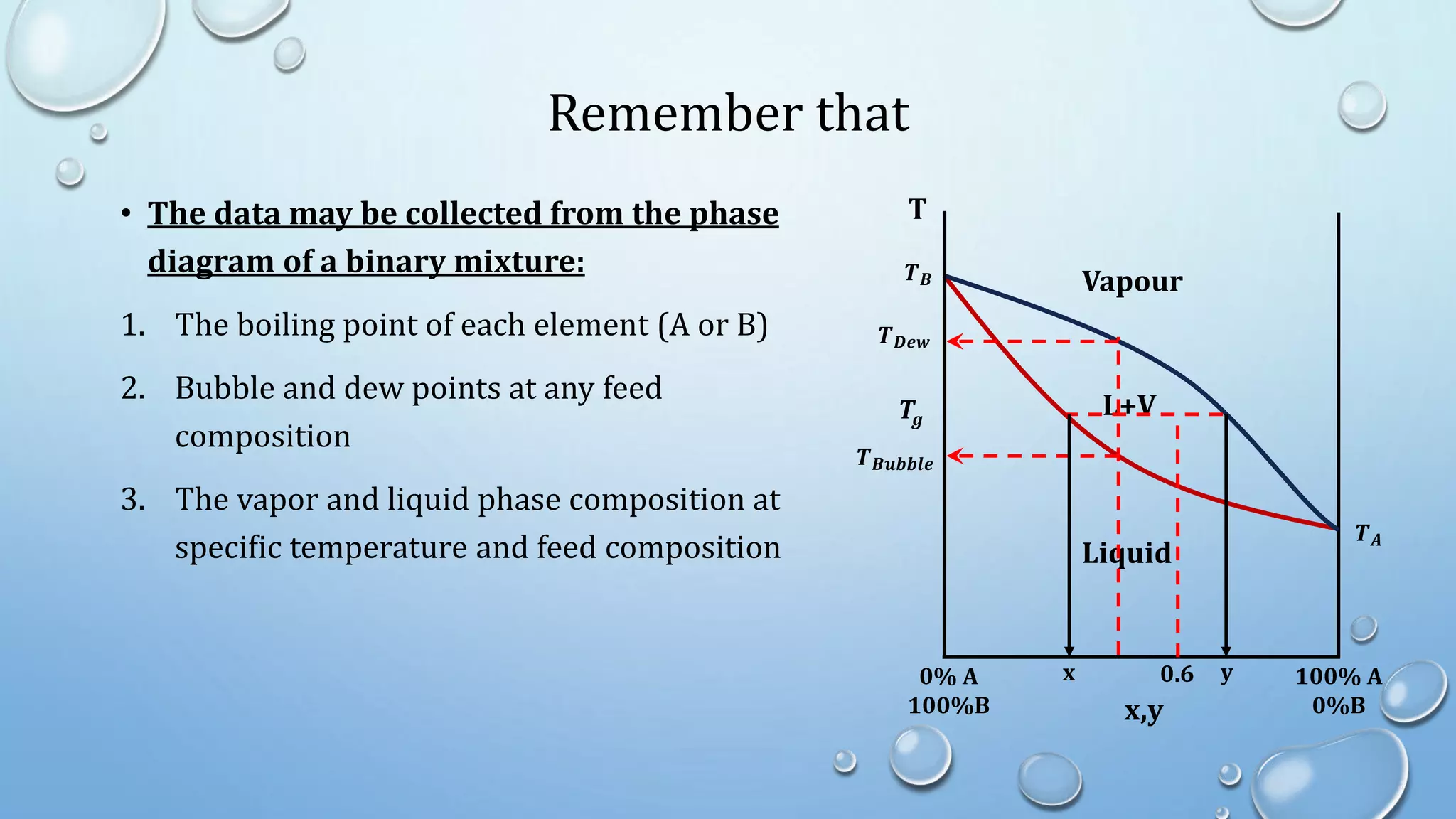
Remember that
• The data may be collected from the phase
diagram of a binary mixture:
1. The boiling point of each element (A or B)
2. Bubble and dew points at any feed
composition
3. The vapor and liquid phase composition at
specific temperature and feed composition
T
x,y
Liquid
L+V
100% A
0%B
0% A
100%B
Vapour
𝑻𝑩
𝑻𝑨
𝑻𝑩𝒖𝒃𝒃𝒍𝒆
𝑻𝑫𝒆𝒘
0.6 y
x
Tg
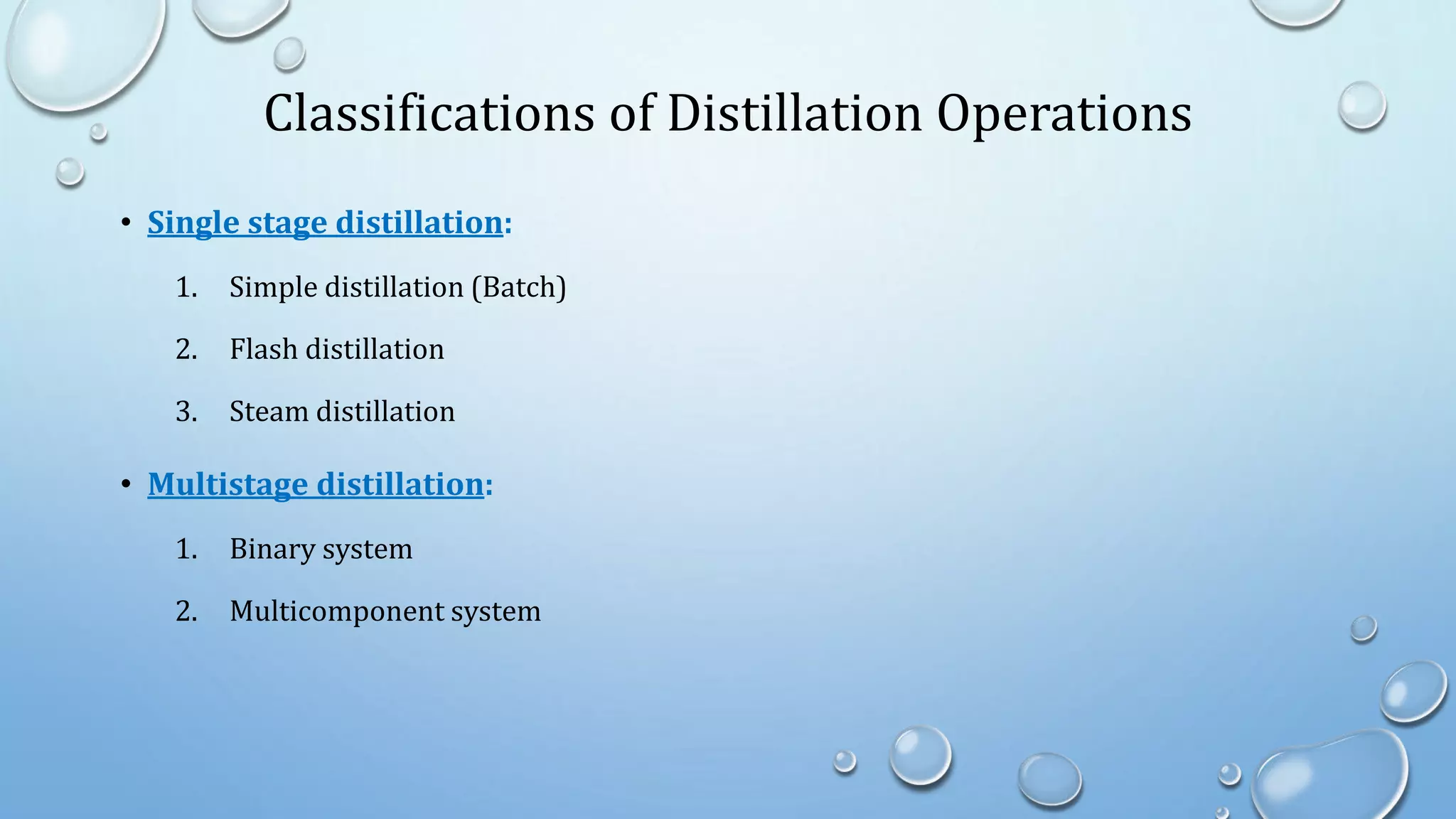
Classifications of Distillation Operations
• Single stage distillation:
1. Simple distillation (Batch)
2. Flash distillation
3. Steam distillation
• Multistage distillation:
1. Binary system
2. Multicomponent system
Simple Distillation
• The simple distillation system consists of:
F : Feed & 𝑥𝑓 : feed composition
D : Distillate & 𝑦𝐷 : distillate composition
W : Residual & 𝑥𝑤 : residual composition
For binary systems:
• Overall Material Balance (OMB)
F = W + D
• Component Material Balance (CMB)
𝑭. 𝒙𝒇 = 𝑾. 𝒙𝒘 +𝑫. 𝒚𝑫
D, yD
F, xf
W, xw
Simple Distillation
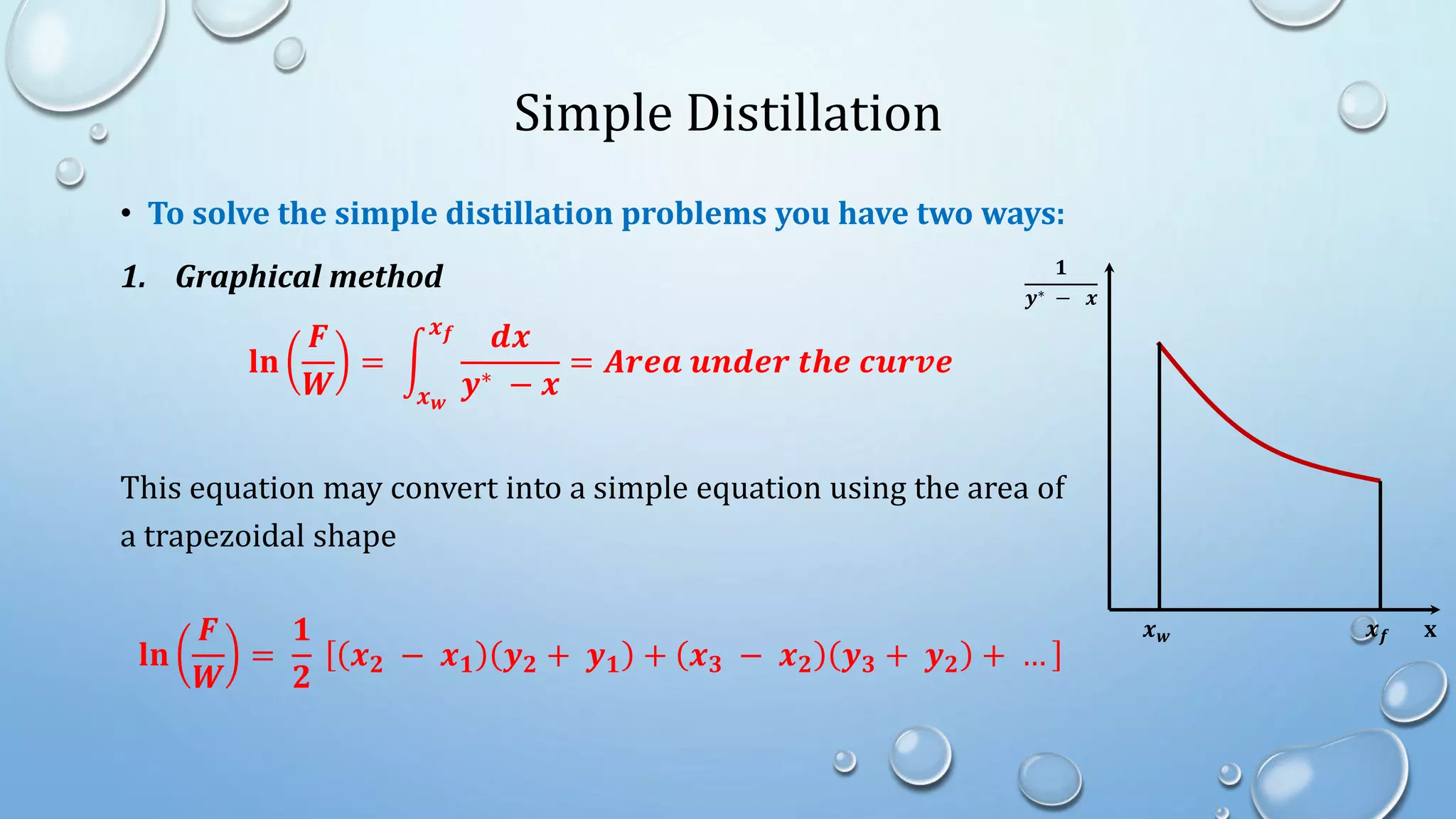
• To solve the simple distillation problems you have two ways:
1. Graphical method
𝐥𝐧
𝑭
𝑾
=
𝒙𝒘
𝒙𝒇 𝒅𝒙
𝒚∗ − 𝒙
= 𝑨𝒓𝒆𝒂 𝒖𝒏𝒅𝒆𝒓 𝒕𝒉𝒆 𝒄𝒖𝒓𝒗𝒆
This equation may convert into a simple equation using the area of
a trapezoidal shape
𝐥𝐧
𝑭
𝑾
=
𝟏
𝟐
𝒙𝟐 − 𝒙𝟏 𝒚𝟐 + 𝒚𝟏 + 𝒙𝟑 − 𝒙𝟐 𝒚𝟑 + 𝒚𝟐 + …
𝟏
𝒚∗ − 𝒙
x
𝒙𝒇
𝒙𝒘
Simple Distillation
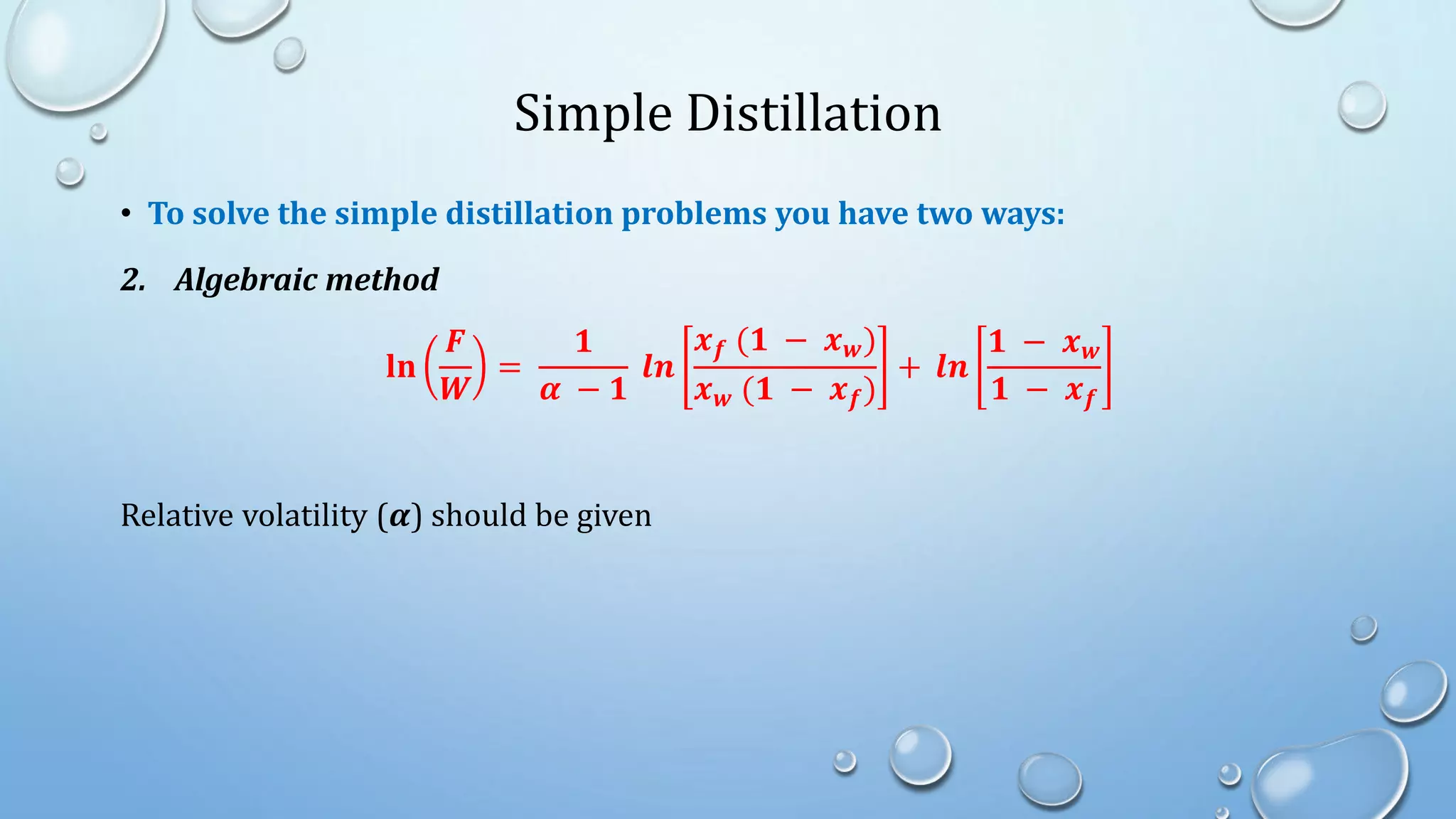
• To solve the simple distillation problems you have two ways:
2. Algebraic method
𝐥𝐧
𝑭
𝑾
=
𝟏
𝜶 − 𝟏
𝒍𝒏
𝒙𝒇 (𝟏 − 𝒙𝒘)
𝒙𝒘 (𝟏 − 𝒙𝒇)
+ 𝒍𝒏
𝟏 − 𝒙𝒘
𝟏 − 𝒙𝒇
Relative volatility (𝜶) should be given
SHEET (2)
Example (1)
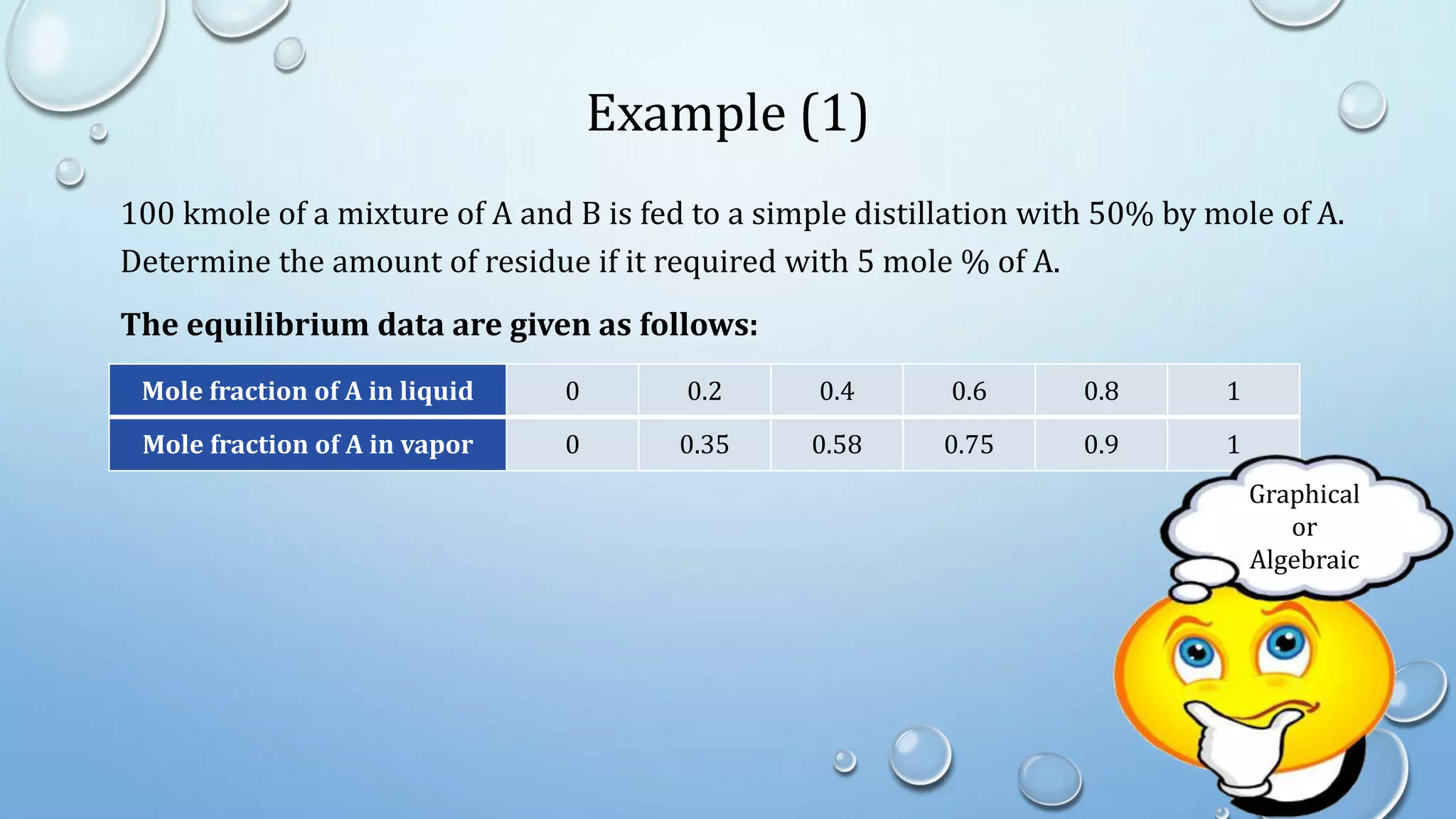
100 kmole of a mixture of A and B is fed to a simple distillation with 50% by mole of A.
Determine the amount of residue if it required with 5 mole % of A.
The equilibrium data are given as follows:
Mole fraction of A in liquid 0 0.2 0.4 0.6 0.8 1
Mole fraction of A in vapor 0 0.35 0.58 0.75 0.9 1
Graphical
or
Algebraic
Solution (1)
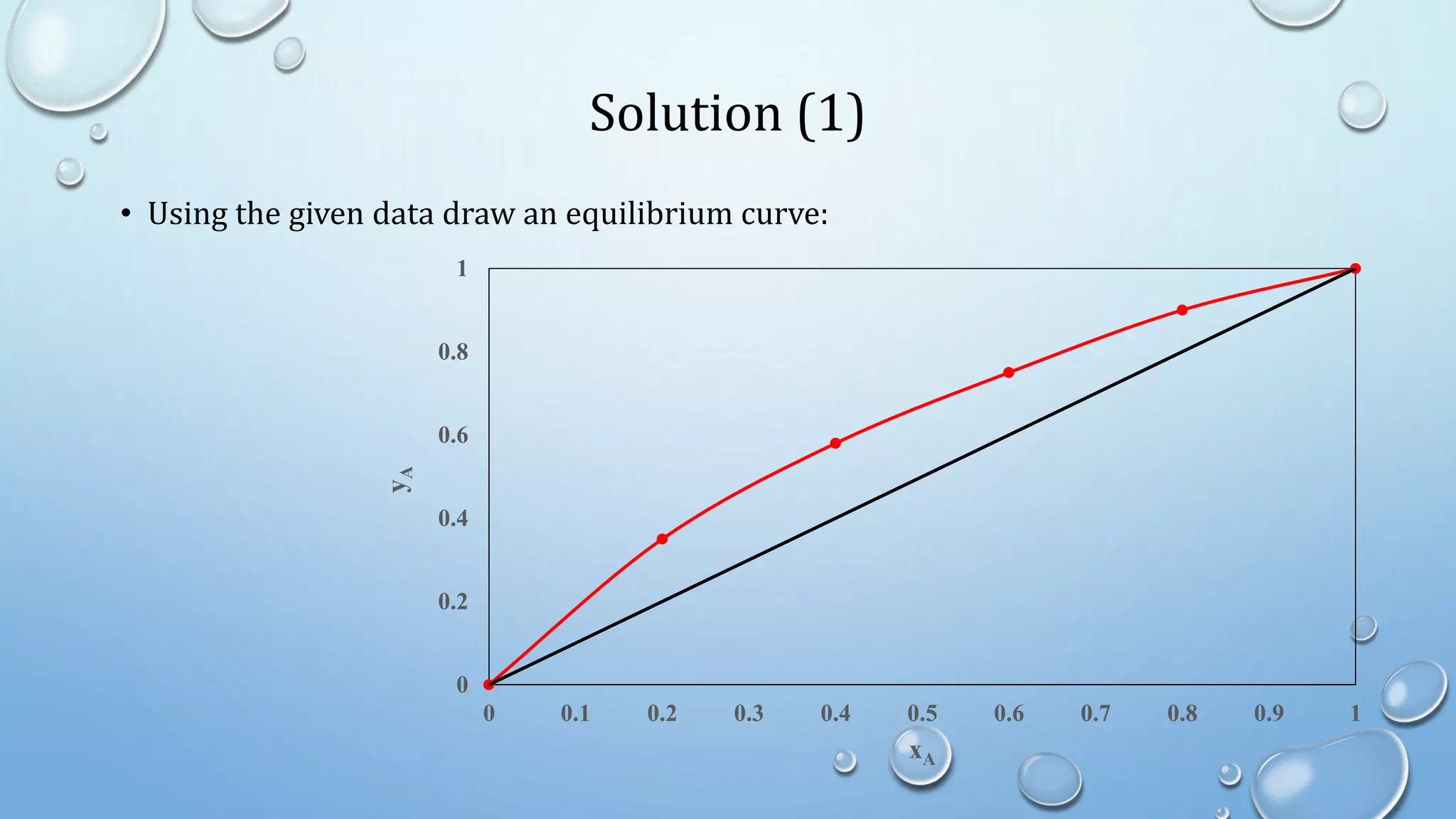
• Using the given data draw an equilibrium curve:
0
0.2
0.4
0.6
0.8
1
0 0.1 0.2 0.3 0.4 0.5 0.6 0.7 0.8 0.9 1
y
A
xA
Solution (1)
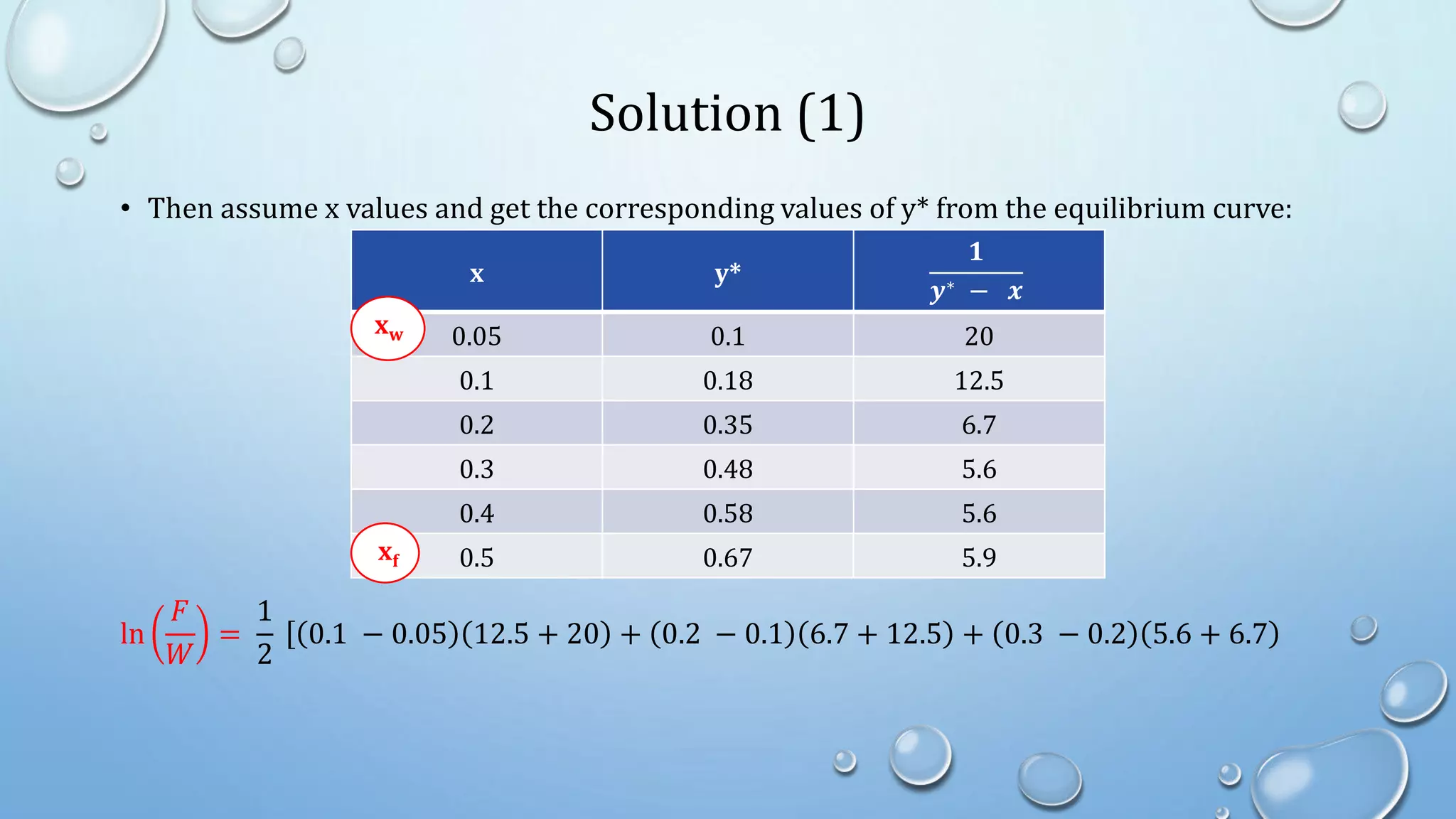
• Then assume x values and get the corresponding values of y* from the equilibrium curve:
ln
𝐹
𝑊
=
1
2
0.1 − 0.05 12.5 + 20 + 0.2 − 0.1 6.7 + 12.5 + 0.3 − 0.2 5.6 + 6.7
x y*
𝟏
𝒚∗ − 𝒙
0.05 0.1 20
0.1 0.18 12.5
0.2 0.35 6.7
0.3 0.48 5.6
0.4 0.58 5.6
0.5 0.67 5.9
xw
xf
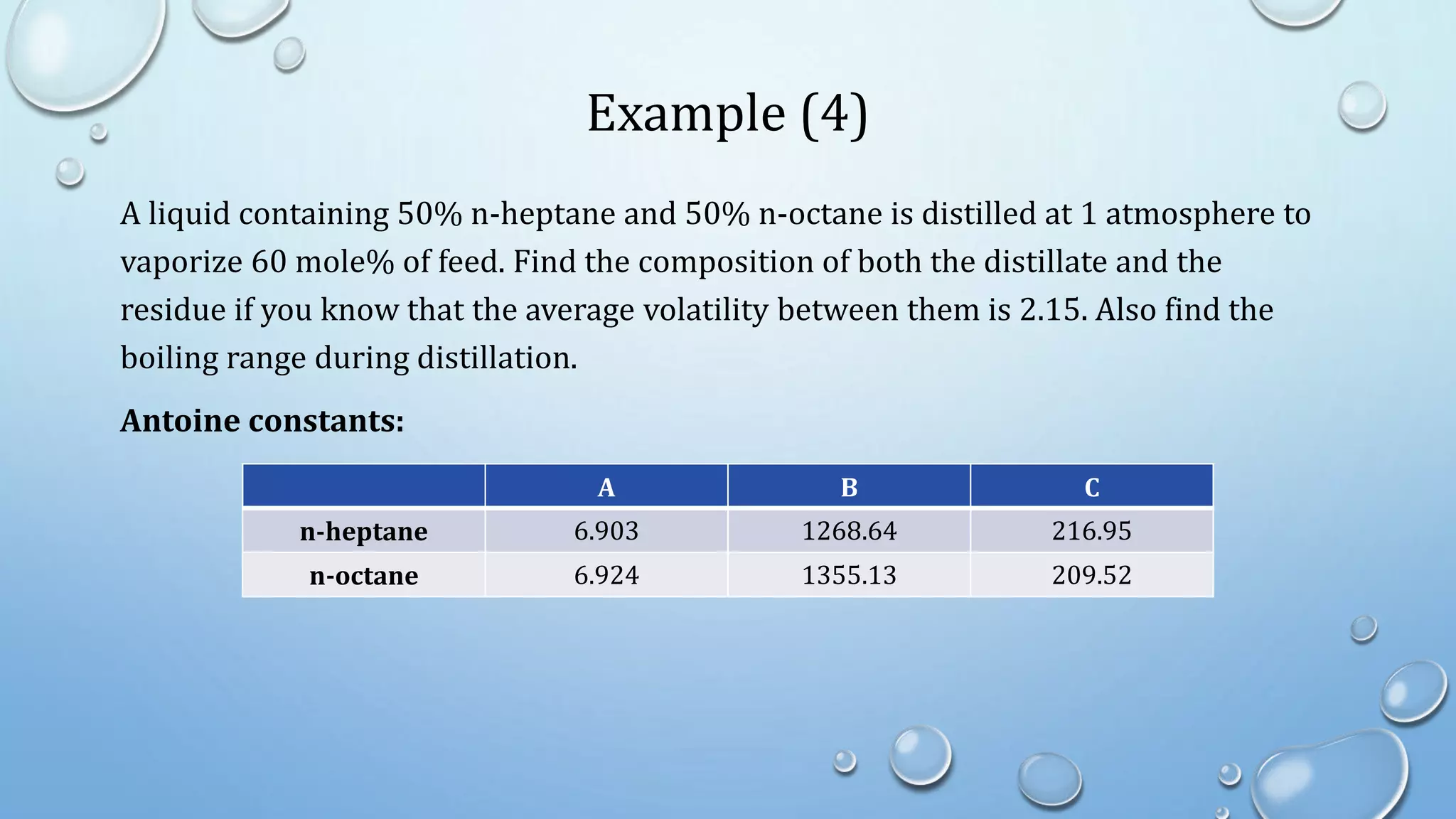
Example (4)
A liquid containing 50% n-heptane and 50% n-octane is distilled at 1 atmosphere to
vaporize 60 mole% of feed. Find the composition of both the distillate and the
residue if you know that the average volatility between them is 2.15. Also find the
boiling range during distillation.
Antoine constants:
A B C
n-heptane 6.903 1268.64 216.95
n-octane 6.924 1355.13 209.52
Solution (4)
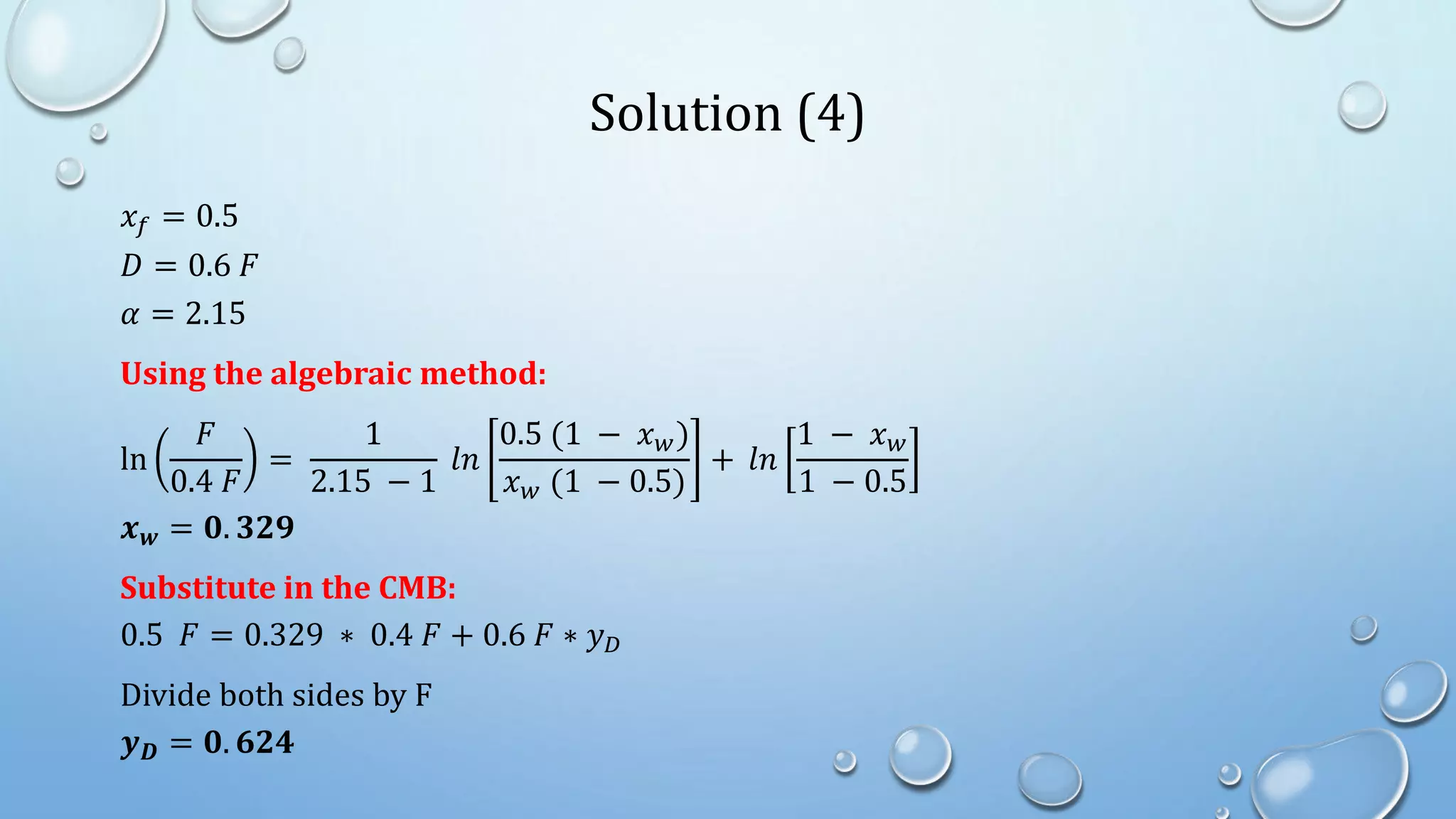
𝑥𝑓 = 0.5
𝐷 = 0.6 𝐹
𝛼 = 2.15
Using the algebraic method:
ln
𝐹
0.4 𝐹
=
1
2.15 − 1
𝑙𝑛
0.5 (1 − 𝑥𝑤)
𝑥𝑤 (1 − 0.5)
+ 𝑙𝑛
1 − 𝑥𝑤
1 − 0.5
𝒙𝒘 = 𝟎. 𝟑𝟐𝟗
Substitute in the CMB:
0.5 𝐹 = 0.329 ∗ 0.4 𝐹 + 0.6 𝐹 ∗ 𝑦𝐷
Divide both sides by F
𝒚𝑫 = 𝟎. 𝟔𝟐𝟒
Solution (4)
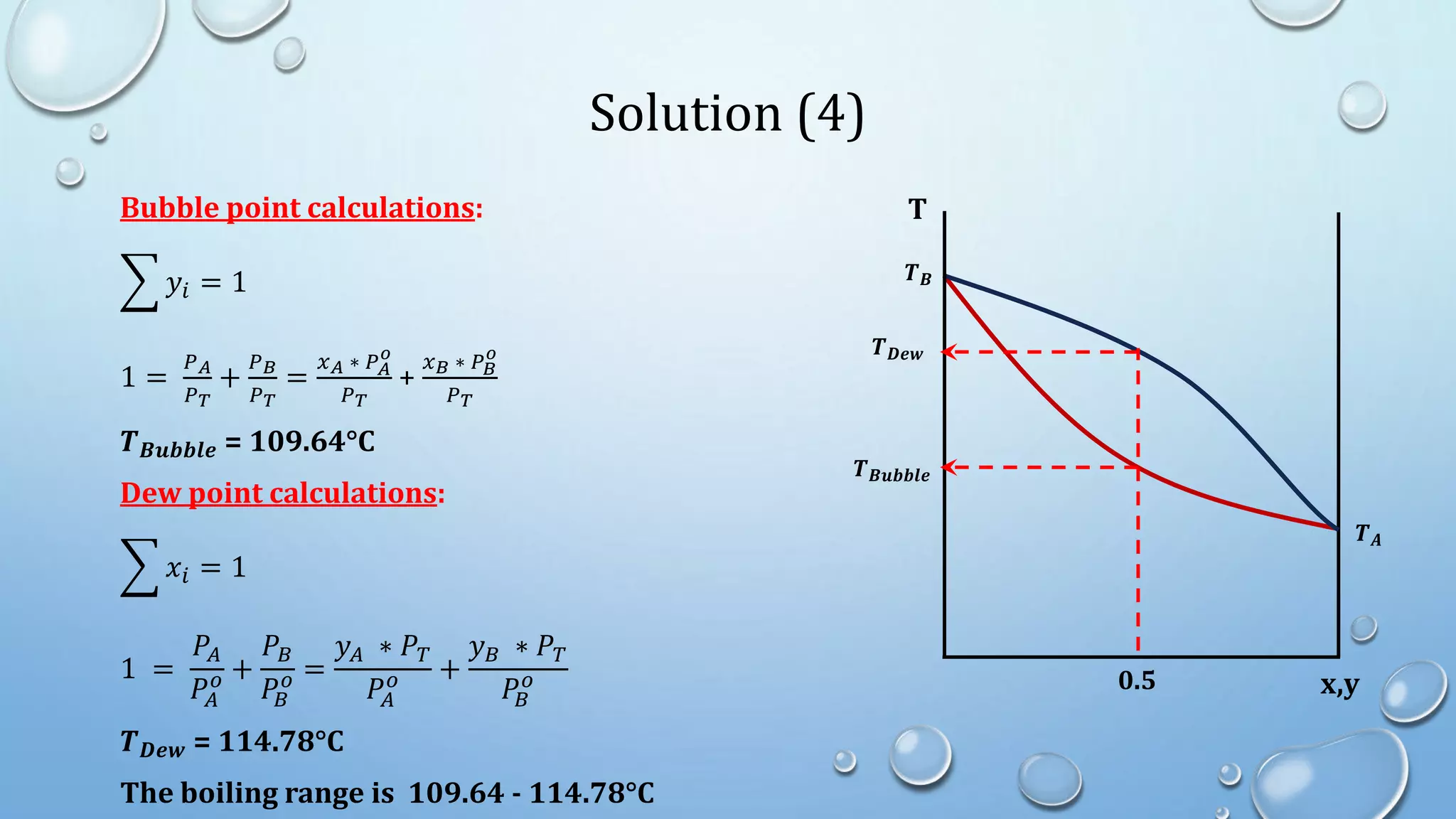
Bubble point calculations:
𝑦𝑖 = 1
1 =
𝑃𝐴
𝑃𝑇
+
𝑃𝐵
𝑃𝑇
=
𝑥𝐴 ∗ 𝑃𝐴
𝑜
𝑃𝑇
+
𝑥𝐵 ∗ 𝑃𝐵
𝑜
𝑃𝑇
𝑻𝑩𝒖𝒃𝒃𝒍𝒆 = 109.64°C
Dew point calculations:
𝑥𝑖 = 1
1 =
𝑃𝐴
𝑃𝐴
𝑜 +
𝑃𝐵
𝑃𝐵
𝑜 =
𝑦𝐴 ∗ 𝑃𝑇
𝑃𝐴
𝑜 +
𝑦𝐵 ∗ 𝑃𝑇
𝑃𝐵
𝑜
𝑻𝑫𝒆𝒘 = 114.78°C
The boiling range is 109.64 - 114.78°C
T
x,y
𝑻𝑩
𝑻𝑨
𝑻𝑩𝒖𝒃𝒃𝒍𝒆
𝑻𝑫𝒆𝒘
0.5
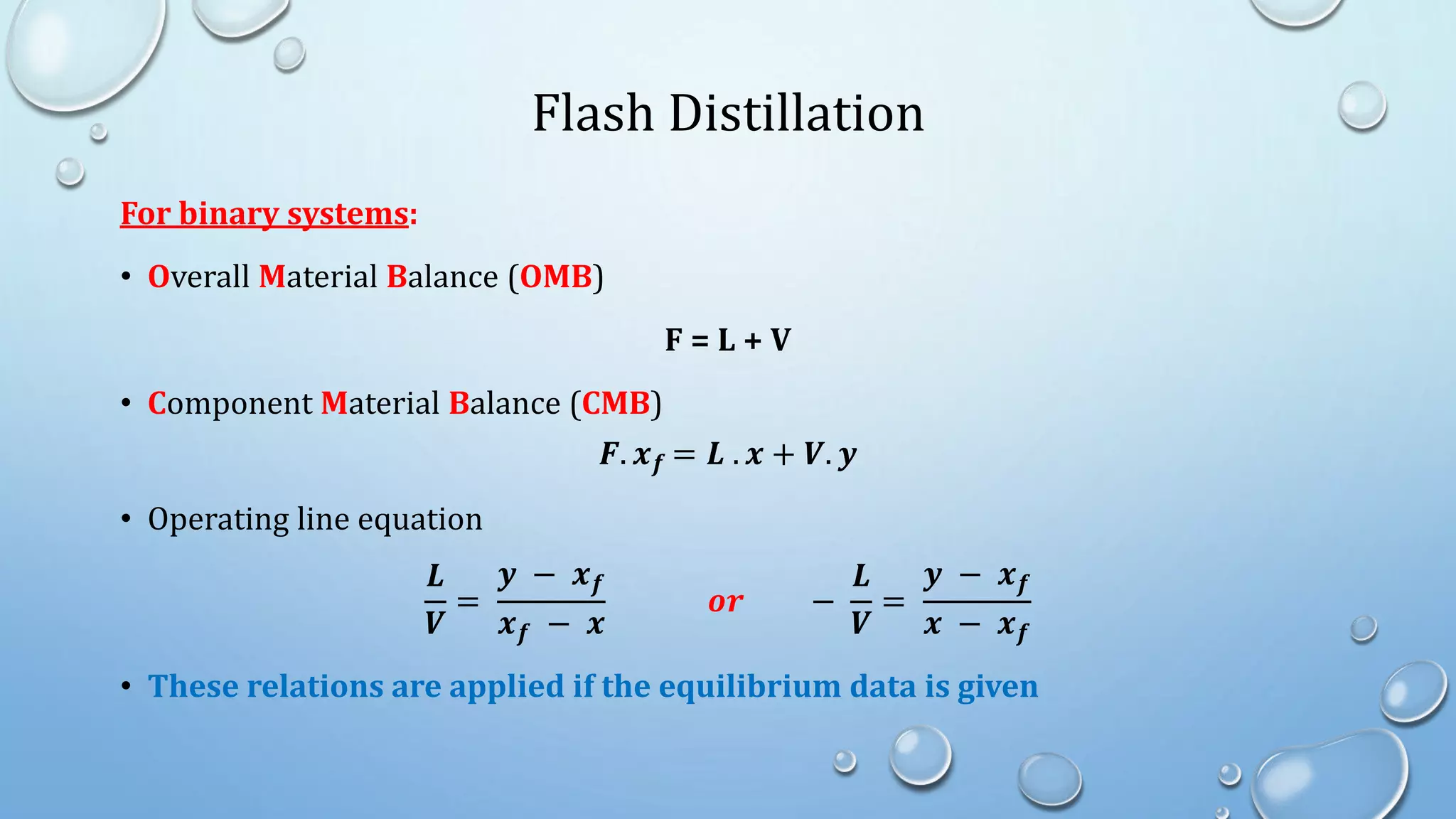
Flash Distillation
For binary systems:
• Overall Material Balance (OMB)
F = L + V
• Component Material Balance (CMB)
𝑭. 𝒙𝒇 = 𝑳 . 𝒙 + 𝑽. 𝒚
• Operating line equation
𝑳
𝑽
=
𝒚 − 𝒙𝒇
𝒙𝒇 − 𝒙
𝒐𝒓 −
𝑳
𝑽
=
𝒚 − 𝒙𝒇
𝒙 − 𝒙𝒇
• These relations are applied if the equilibrium data is given
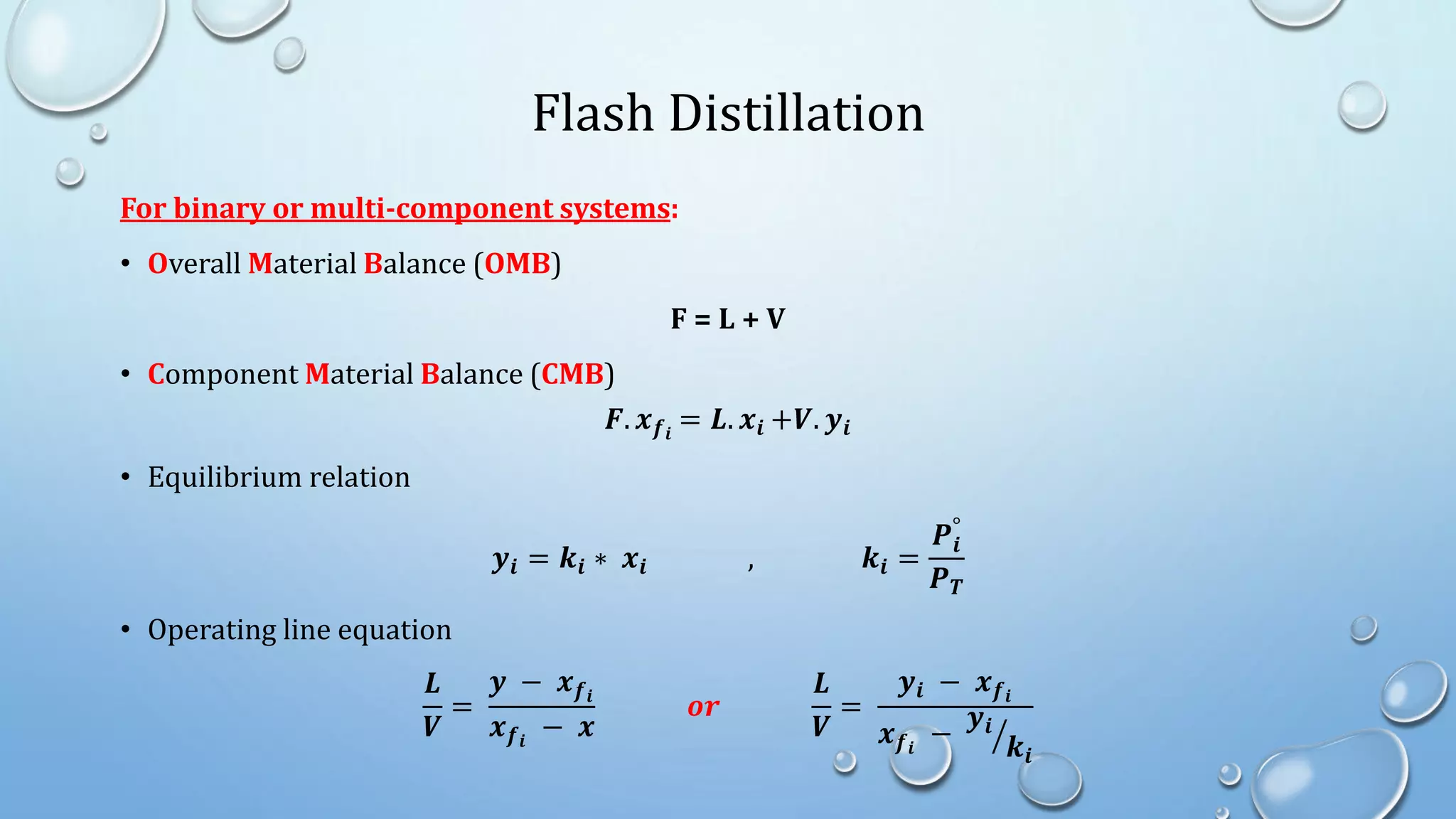
Flash Distillation
For binary or multi-component systems:
• Overall Material Balance (OMB)
F = L + V
• Component Material Balance (CMB)
𝑭. 𝒙𝒇𝒊
= 𝑳. 𝒙𝒊 +𝑽. 𝒚𝒊
• Equilibrium relation
𝒚𝒊 = 𝒌𝒊 ∗ 𝒙𝒊 , 𝒌𝒊 =
𝑷𝒊
°
𝑷𝑻
• Operating line equation
𝑳
𝑽
=
𝒚 − 𝒙𝒇𝒊
𝒙𝒇𝒊
− 𝒙
𝒐𝒓
𝑳
𝑽
=
𝒚𝒊 − 𝒙𝒇𝒊
𝒙𝒇𝒊
−
𝒚𝒊
𝒌𝒊
Flash Distillation
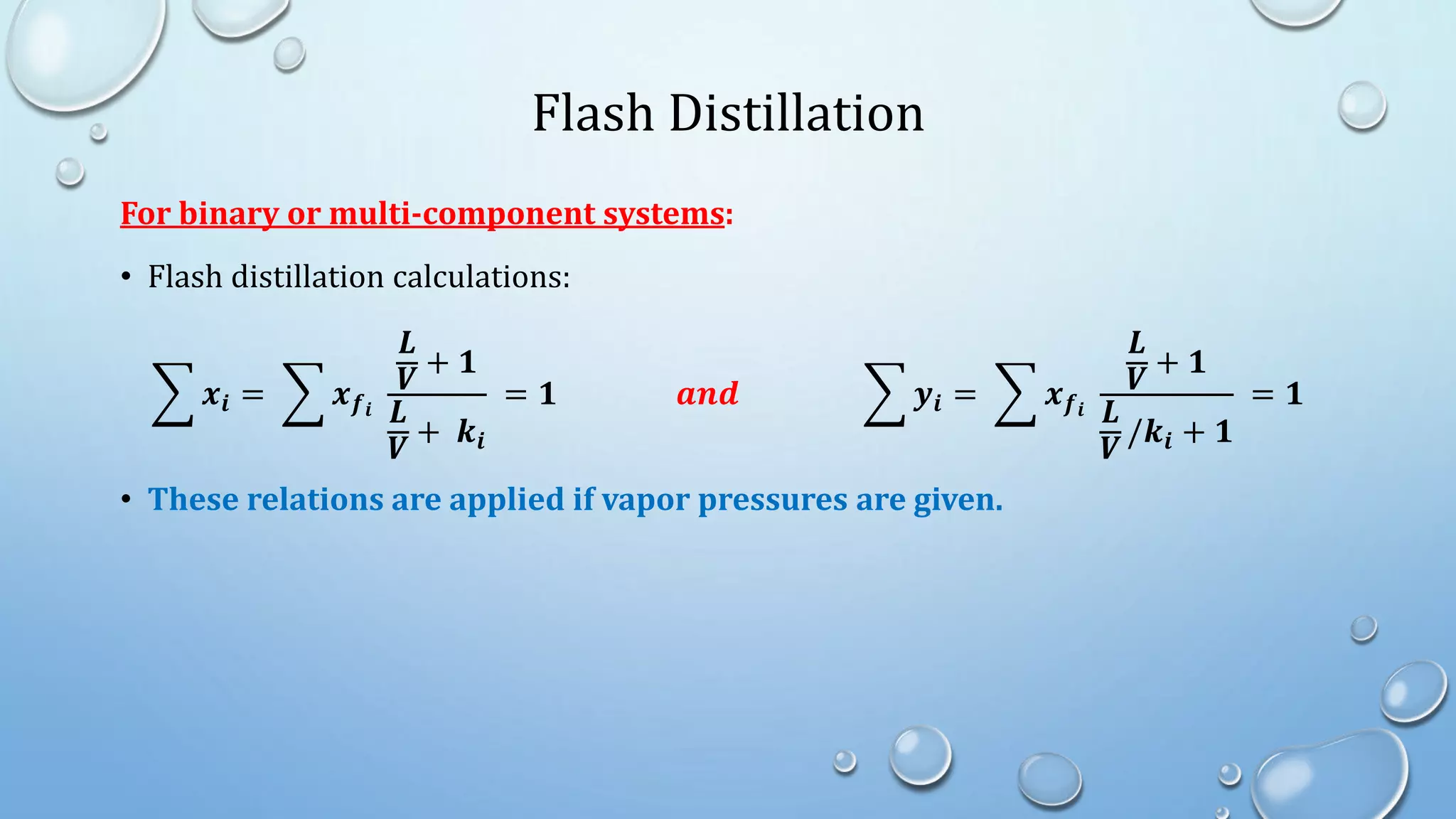
For binary or multi-component systems:
• Flash distillation calculations:
𝒙𝒊 = 𝒙𝒇𝒊
𝑳
𝑽
+ 𝟏
𝑳
𝑽
+ 𝒌𝒊
= 𝟏 𝒂𝒏𝒅 𝒚𝒊 = 𝒙𝒇𝒊
𝑳
𝑽
+ 𝟏
𝑳
𝑽
/𝒌𝒊 + 𝟏
= 𝟏
• These relations are applied if vapor pressures are given.
Flash Distillation
For binary or multi-component systems:
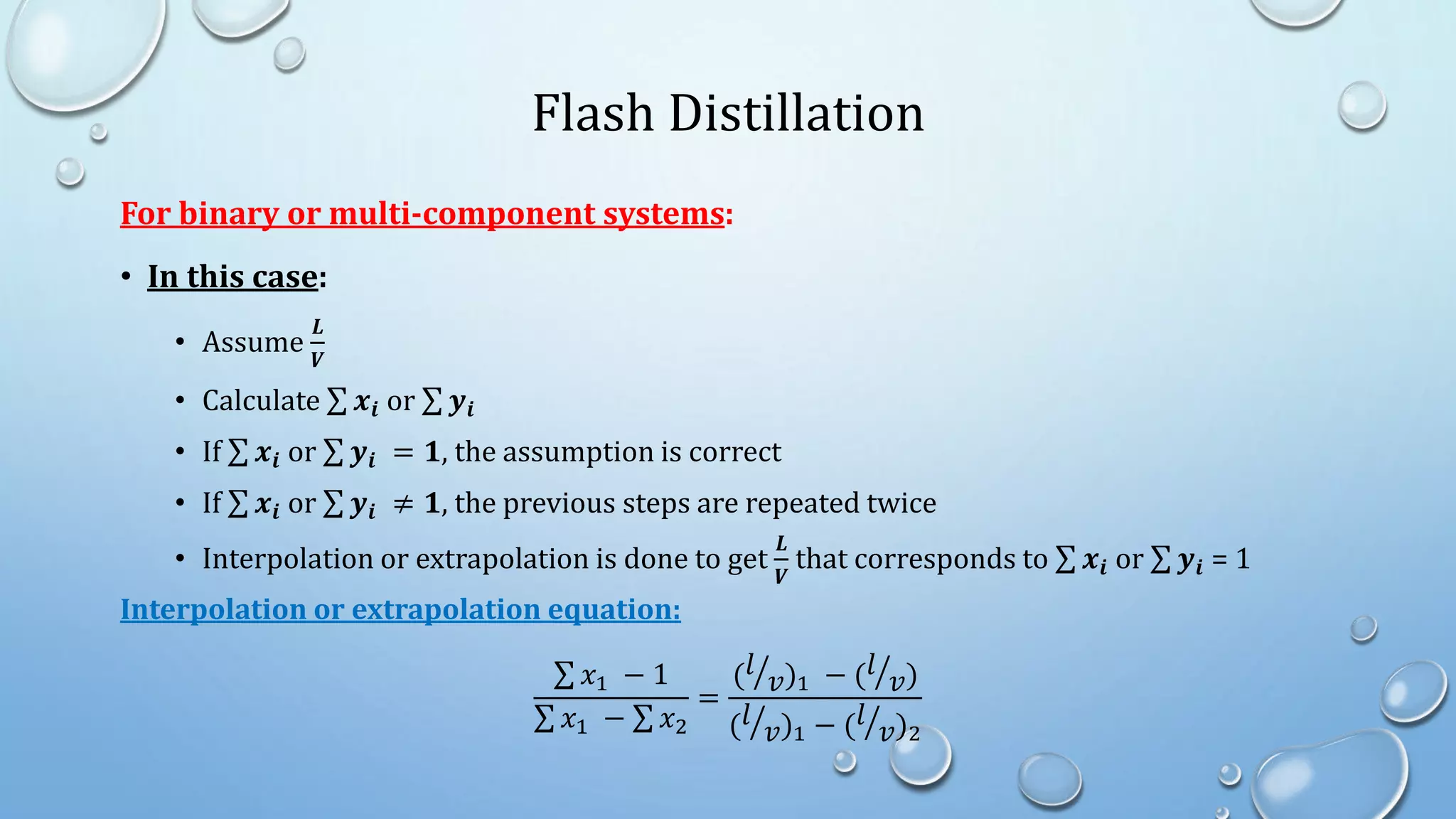
• In this case:
• Assume
𝑳
𝑽
• Calculate 𝒙𝒊 or 𝒚𝒊
• If 𝒙𝒊 or 𝒚𝒊 = 𝟏, the assumption is correct
• If 𝒙𝒊 or 𝒚𝒊 ≠ 𝟏, the previous steps are repeated twice
• Interpolation or extrapolation is done to get
𝑳
𝑽
that corresponds to 𝒙𝒊 or 𝒚𝒊 = 1
Interpolation or extrapolation equation:
𝑥1 − 1
𝑥1 − 𝑥2
=
(𝑙
𝑣)1 − (𝑙
𝑣)
(𝑙
𝑣)1 − (𝑙
𝑣)2
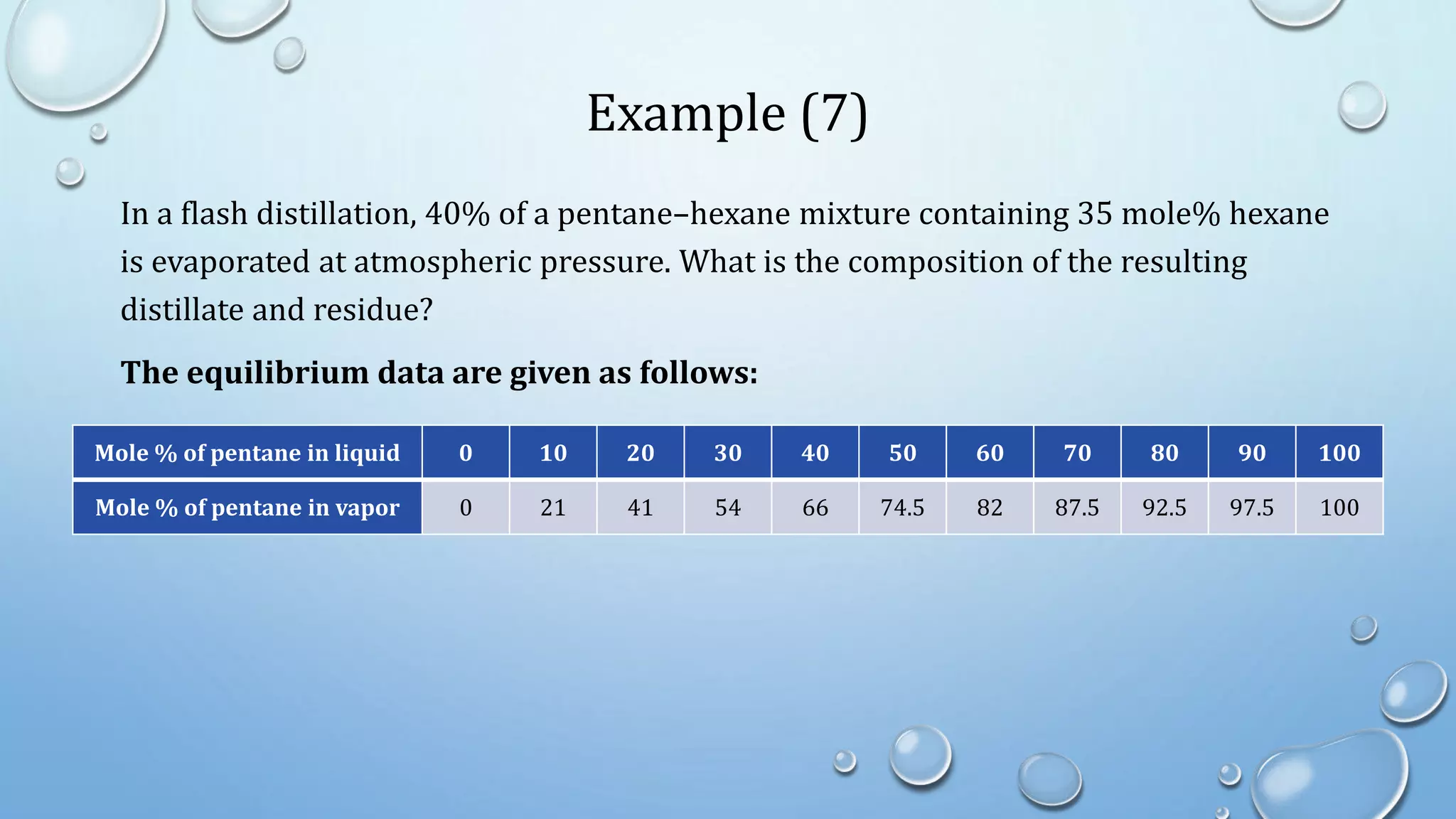
Example (7)
In a flash distillation, 40% of a pentane–hexane mixture containing 35 mole% hexane
is evaporated at atmospheric pressure. What is the composition of the resulting
distillate and residue?
The equilibrium data are given as follows:
Mole % of pentane in liquid 0 10 20 30 40 50 60 70 80 90 100
Mole % of pentane in vapor 0 21 41 54 66 74.5 82 87.5 92.5 97.5 100
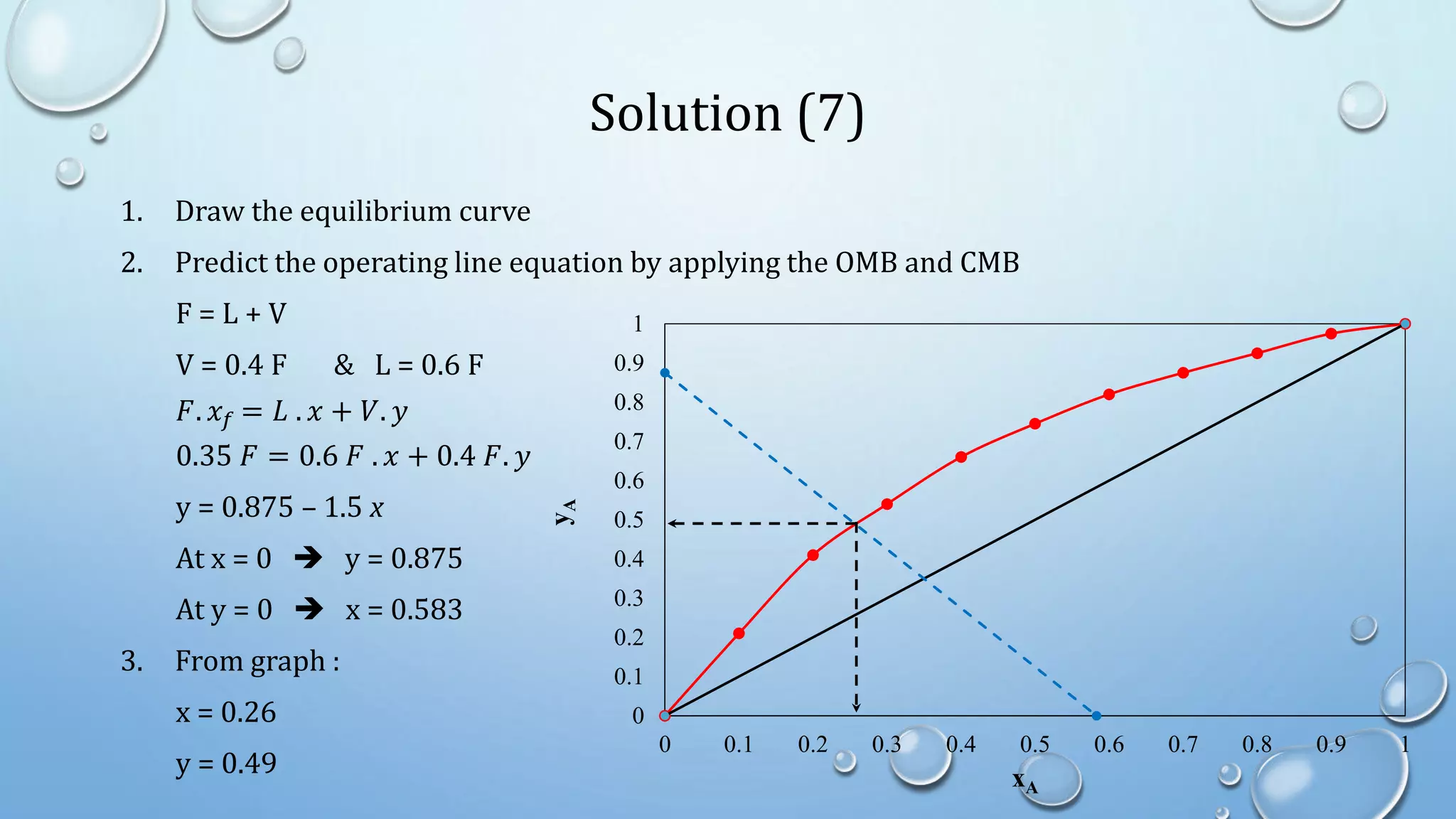
Solution (7)
1. Draw the equilibrium curve
2. Predict the operating line equation by applying the OMB and CMB
F = L + V
V = 0.4 F & L = 0.6 F
𝐹. 𝑥𝑓 = 𝐿 . 𝑥 + 𝑉. 𝑦
0.35 𝐹 = 0.6 𝐹 . 𝑥 + 0.4 𝐹. 𝑦
y = 0.875 – 1.5 x
At x = 0  y = 0.875
At y = 0  x = 0.583
3. From graph :
x = 0.26
y = 0.49
0
0.1
0.2
0.3
0.4
0.5
0.6
0.7
0.8
0.9
1
0 0.1 0.2 0.3 0.4 0.5 0.6 0.7 0.8 0.9 1
y
A
xA
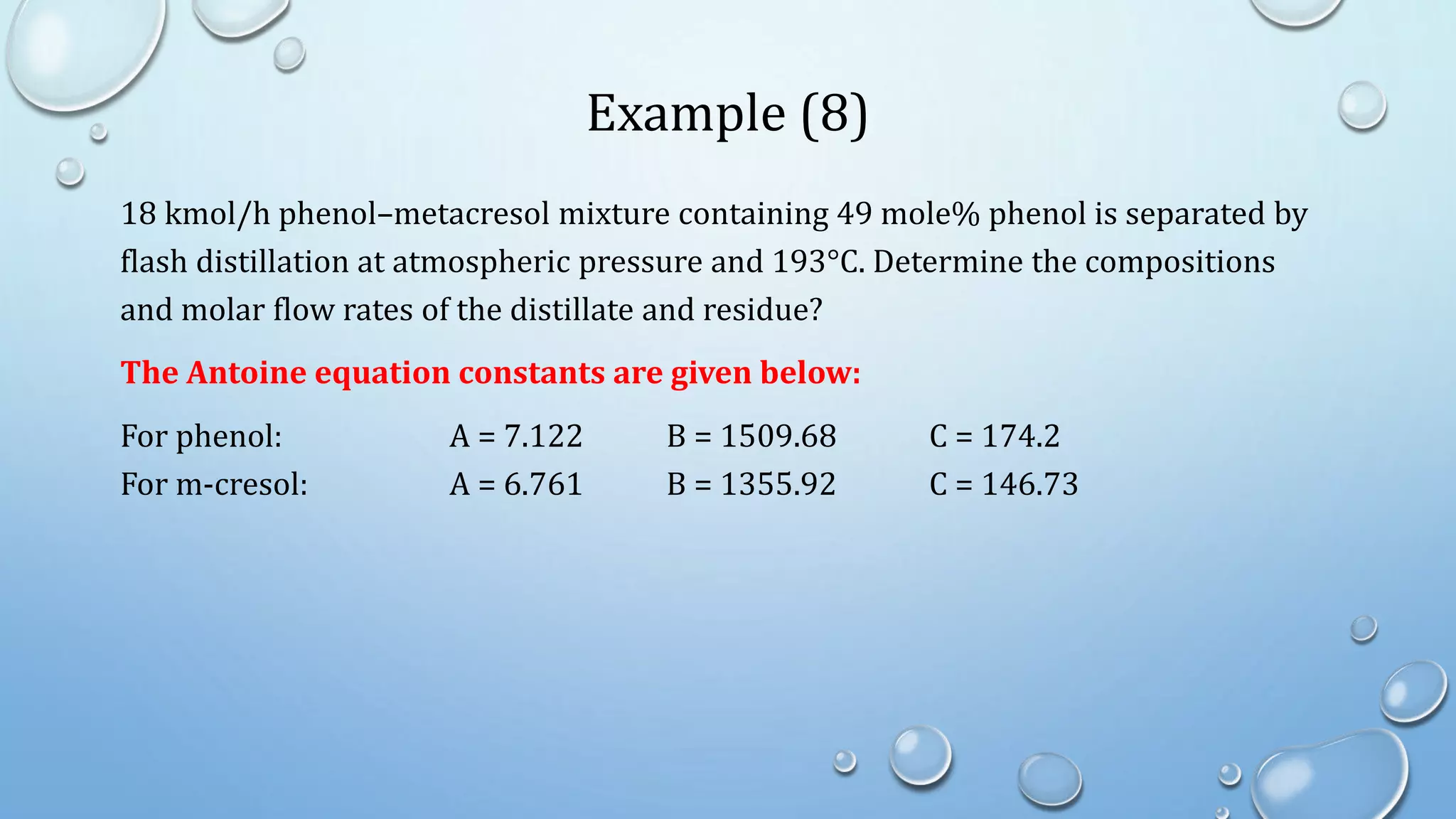
Example (8)
18 kmol/h phenol–metacresol mixture containing 49 mole% phenol is separated by
flash distillation at atmospheric pressure and 193°C. Determine the compositions
and molar flow rates of the distillate and residue?
The Antoine equation constants are given below:
For phenol: A = 7.122 B = 1509.68 C = 174.2
For m-cresol: A = 6.761 B = 1355.92 C = 146.73
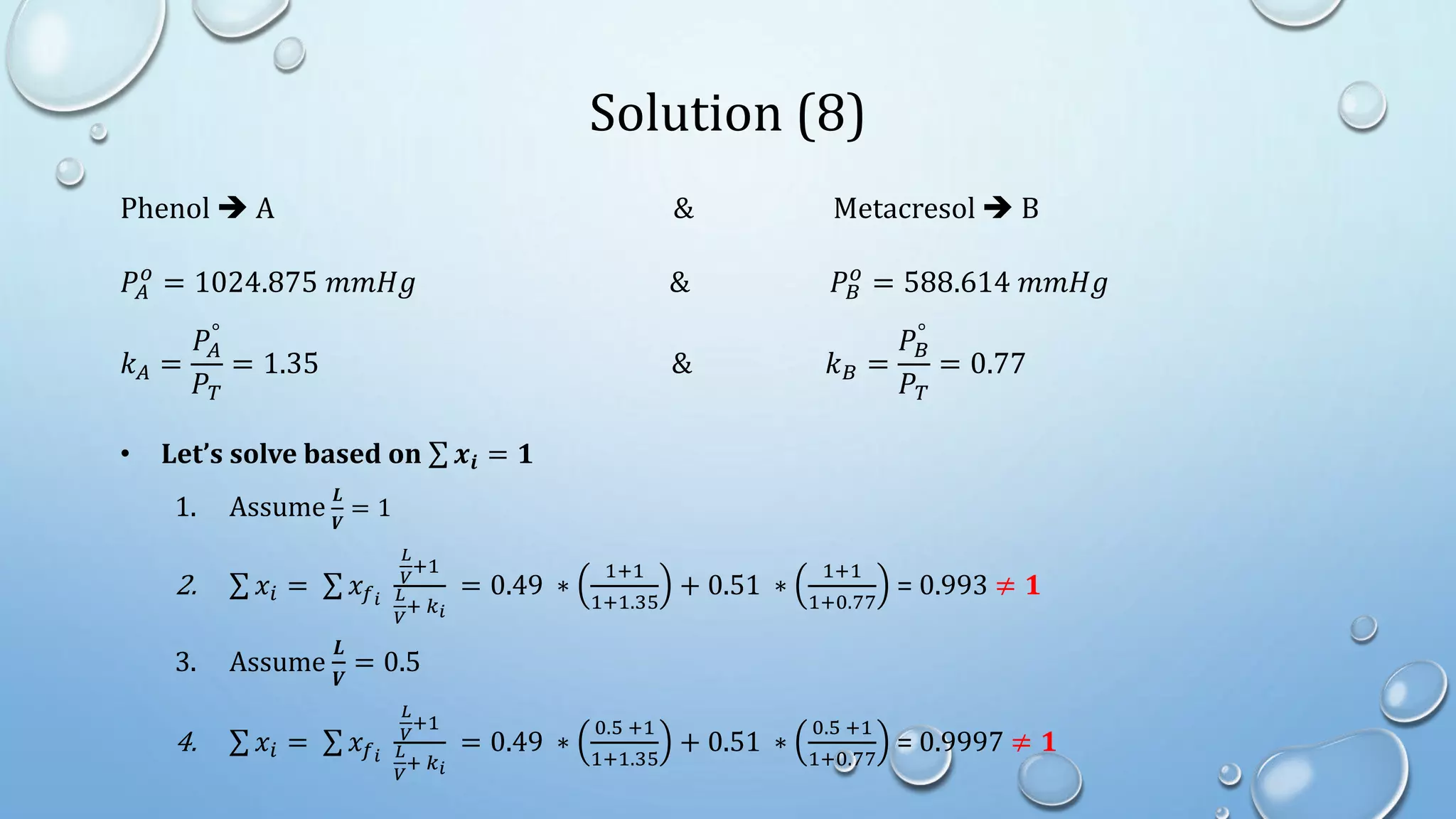
Solution (8)
Phenol  A & Metacresol  B
𝑃𝐴
𝑜
= 1024.875 𝑚𝑚𝐻𝑔 & 𝑃𝐵
𝑜
= 588.614 𝑚𝑚𝐻𝑔
𝑘𝐴 =
𝑃𝐴
°
𝑃𝑇
= 1.35 & 𝑘𝐵 =
𝑃𝐵
°
𝑃𝑇
= 0.77
• Let’s solve based on 𝒙𝒊 = 𝟏
1. Assume
𝑳
𝑽
= 1
2. 𝑥𝑖 = 𝑥𝑓𝑖
𝐿
𝑉
+1
𝐿
𝑉
+ 𝑘𝑖
= 0.49 ∗
1+1
1+1.35
+ 0.51 ∗
1+1
1+0.77
= 0.993 ≠ 𝟏
3. Assume
𝑳
𝑽
= 0.5
4. 𝑥𝑖 = 𝑥𝑓𝑖
𝐿
𝑉
+1
𝐿
𝑉
+ 𝑘𝑖
= 0.49 ∗
0.5 +1
1+1.35
+ 0.51 ∗
0.5 +1
1+0.77
= 0.9997 ≠ 𝟏
Solution (8)
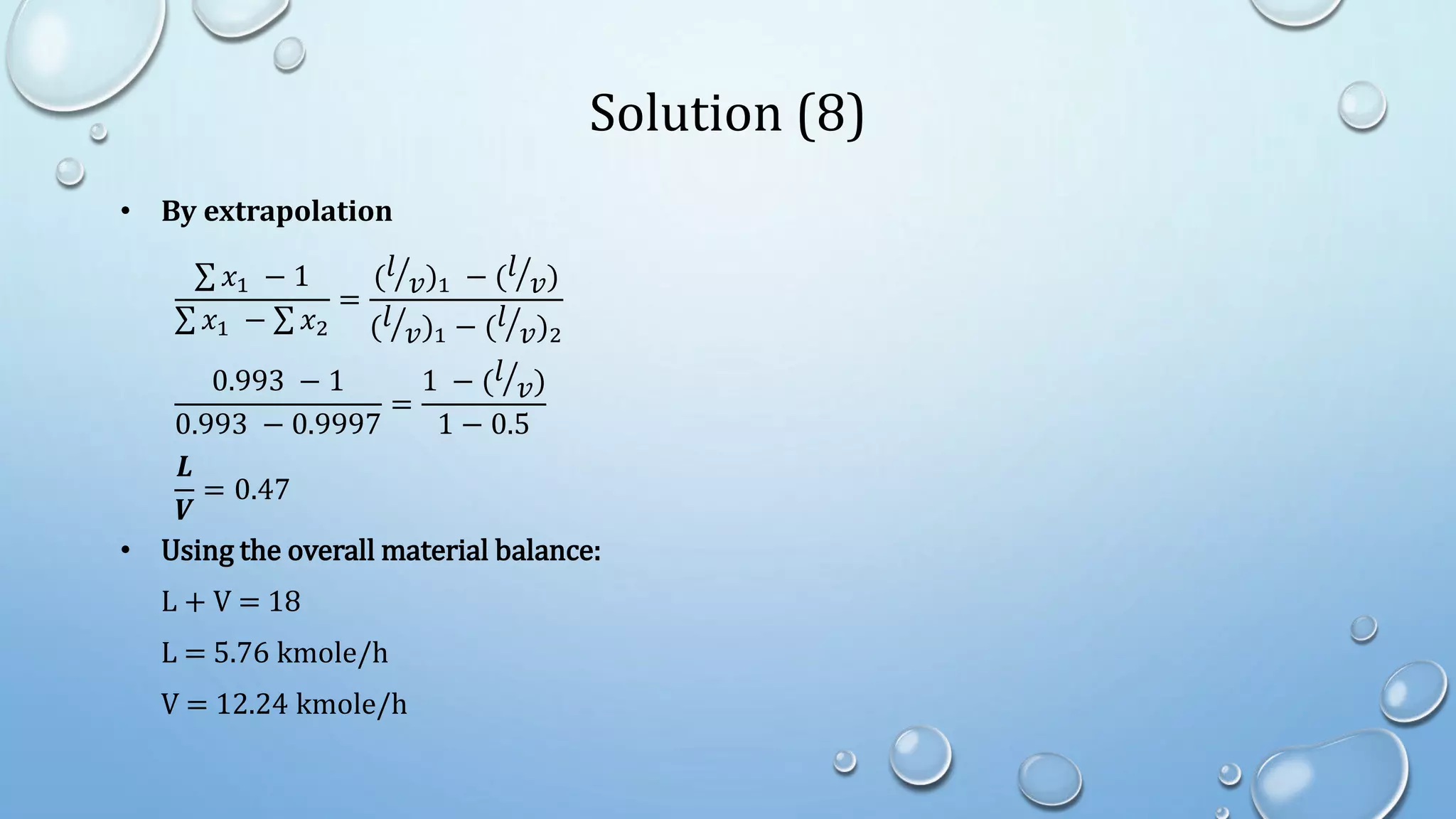
• By extrapolation
𝑥1 − 1
𝑥1 − 𝑥2
=
(𝑙
𝑣)1 − (𝑙
𝑣)
(𝑙
𝑣)1 − (𝑙
𝑣)2
0.993 − 1
0.993 − 0.9997
=
1 − (𝑙
𝑣)
1 − 0.5
𝑳
𝑽
= 0.47
• Using the overall material balance:
L + V = 18
L = 5.76 kmole/h
V = 12.24 kmole/h
Solution (8)
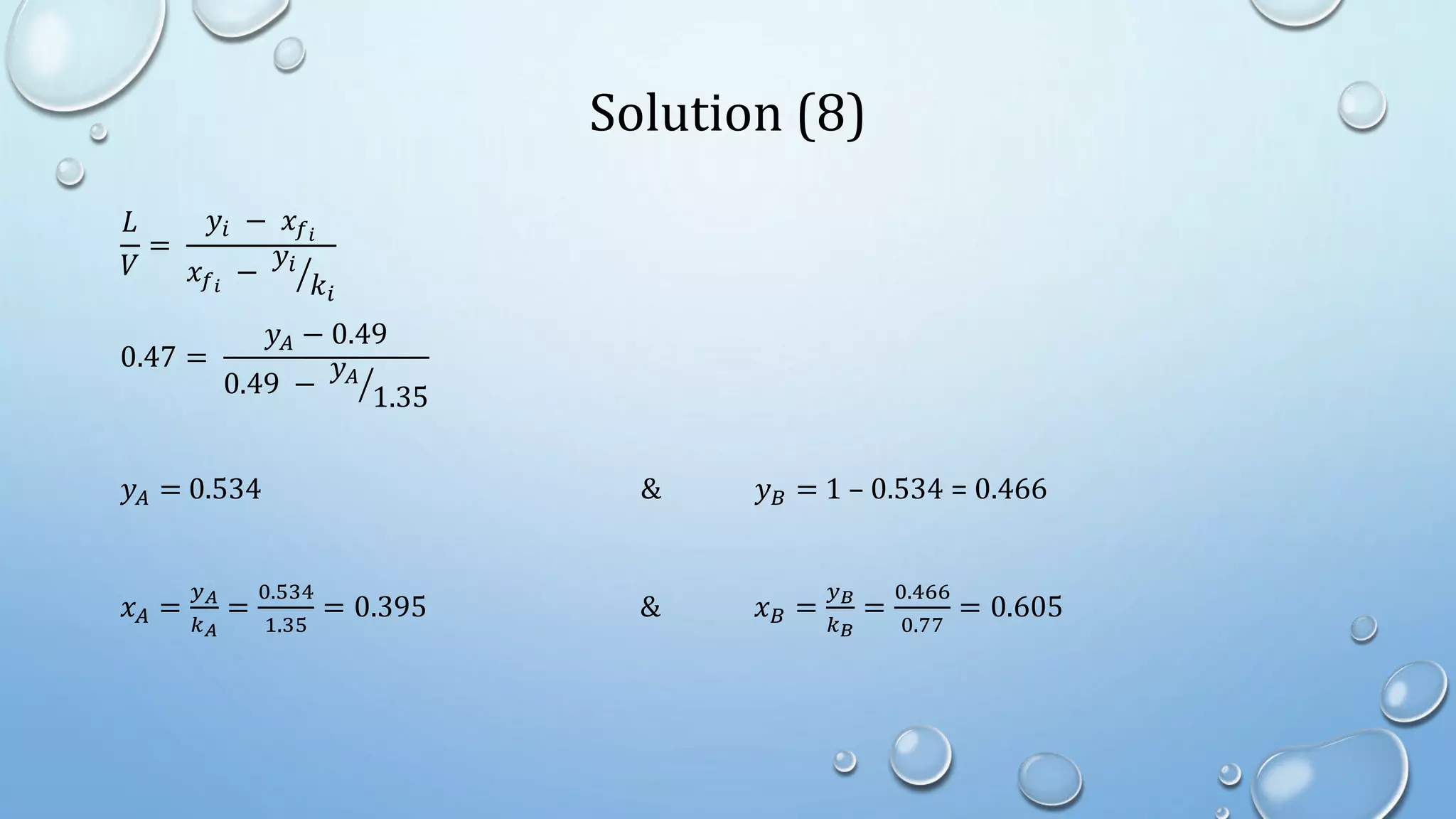
𝐿
𝑉
=
𝑦𝑖 − 𝑥𝑓𝑖
𝑥𝑓𝑖
−
𝑦𝑖
𝑘𝑖
0.47 =
𝑦𝐴 − 0.49
0.49 −
𝑦𝐴
1.35
𝑦𝐴 = 0.534 & 𝑦𝐵 = 1 – 0.534 = 0.466
𝑥𝐴 =
𝑦𝐴
𝑘𝐴
=
0.534
1.35
= 0.395 & 𝑥𝐵 =
𝑦𝐵
𝑘𝐵
=
0.466
0.77
= 0.605
Section 2   multistage separation processes

Section 2 multistage separation processes

  • 1.
  • 2.
    Remember that • Thedata may be collected from the phase diagram of a binary mixture: 1. The boiling point of each element (A or B) 2. Bubble and dew points at any feed composition 3. The vapor and liquid phase composition at specific temperature and feed composition T x,y Liquid L+V 100% A 0%B 0% A 100%B Vapour 𝑻𝑩 𝑻𝑨 𝑻𝑩𝒖𝒃𝒃𝒍𝒆 𝑻𝑫𝒆𝒘 0.6 y x Tg
  • 3.
    Classifications of DistillationOperations • Single stage distillation: 1. Simple distillation (Batch) 2. Flash distillation 3. Steam distillation • Multistage distillation: 1. Binary system 2. Multicomponent system
  • 4.
    Simple Distillation • Thesimple distillation system consists of: F : Feed & 𝑥𝑓 : feed composition D : Distillate & 𝑦𝐷 : distillate composition W : Residual & 𝑥𝑤 : residual composition For binary systems: • Overall Material Balance (OMB) F = W + D • Component Material Balance (CMB) 𝑭. 𝒙𝒇 = 𝑾. 𝒙𝒘 +𝑫. 𝒚𝑫 D, yD F, xf W, xw
  • 5.
    Simple Distillation • Tosolve the simple distillation problems you have two ways: 1. Graphical method 𝐥𝐧 𝑭 𝑾 = 𝒙𝒘 𝒙𝒇 𝒅𝒙 𝒚∗ − 𝒙 = 𝑨𝒓𝒆𝒂 𝒖𝒏𝒅𝒆𝒓 𝒕𝒉𝒆 𝒄𝒖𝒓𝒗𝒆 This equation may convert into a simple equation using the area of a trapezoidal shape 𝐥𝐧 𝑭 𝑾 = 𝟏 𝟐 𝒙𝟐 − 𝒙𝟏 𝒚𝟐 + 𝒚𝟏 + 𝒙𝟑 − 𝒙𝟐 𝒚𝟑 + 𝒚𝟐 + … 𝟏 𝒚∗ − 𝒙 x 𝒙𝒇 𝒙𝒘
  • 6.
    Simple Distillation • Tosolve the simple distillation problems you have two ways: 2. Algebraic method 𝐥𝐧 𝑭 𝑾 = 𝟏 𝜶 − 𝟏 𝒍𝒏 𝒙𝒇 (𝟏 − 𝒙𝒘) 𝒙𝒘 (𝟏 − 𝒙𝒇) + 𝒍𝒏 𝟏 − 𝒙𝒘 𝟏 − 𝒙𝒇 Relative volatility (𝜶) should be given
  • 7.
  • 8.
    Example (1) 100 kmoleof a mixture of A and B is fed to a simple distillation with 50% by mole of A. Determine the amount of residue if it required with 5 mole % of A. The equilibrium data are given as follows: Mole fraction of A in liquid 0 0.2 0.4 0.6 0.8 1 Mole fraction of A in vapor 0 0.35 0.58 0.75 0.9 1 Graphical or Algebraic
  • 9.
    Solution (1) • Usingthe given data draw an equilibrium curve: 0 0.2 0.4 0.6 0.8 1 0 0.1 0.2 0.3 0.4 0.5 0.6 0.7 0.8 0.9 1 y A xA
  • 10.
    Solution (1) • Thenassume x values and get the corresponding values of y* from the equilibrium curve: ln 𝐹 𝑊 = 1 2 0.1 − 0.05 12.5 + 20 + 0.2 − 0.1 6.7 + 12.5 + 0.3 − 0.2 5.6 + 6.7 x y* 𝟏 𝒚∗ − 𝒙 0.05 0.1 20 0.1 0.18 12.5 0.2 0.35 6.7 0.3 0.48 5.6 0.4 0.58 5.6 0.5 0.67 5.9 xw xf
  • 11.
    Example (4) A liquidcontaining 50% n-heptane and 50% n-octane is distilled at 1 atmosphere to vaporize 60 mole% of feed. Find the composition of both the distillate and the residue if you know that the average volatility between them is 2.15. Also find the boiling range during distillation. Antoine constants: A B C n-heptane 6.903 1268.64 216.95 n-octane 6.924 1355.13 209.52
  • 12.
    Solution (4) 𝑥𝑓 =0.5 𝐷 = 0.6 𝐹 𝛼 = 2.15 Using the algebraic method: ln 𝐹 0.4 𝐹 = 1 2.15 − 1 𝑙𝑛 0.5 (1 − 𝑥𝑤) 𝑥𝑤 (1 − 0.5) + 𝑙𝑛 1 − 𝑥𝑤 1 − 0.5 𝒙𝒘 = 𝟎. 𝟑𝟐𝟗 Substitute in the CMB: 0.5 𝐹 = 0.329 ∗ 0.4 𝐹 + 0.6 𝐹 ∗ 𝑦𝐷 Divide both sides by F 𝒚𝑫 = 𝟎. 𝟔𝟐𝟒
  • 13.
    Solution (4) Bubble pointcalculations: 𝑦𝑖 = 1 1 = 𝑃𝐴 𝑃𝑇 + 𝑃𝐵 𝑃𝑇 = 𝑥𝐴 ∗ 𝑃𝐴 𝑜 𝑃𝑇 + 𝑥𝐵 ∗ 𝑃𝐵 𝑜 𝑃𝑇 𝑻𝑩𝒖𝒃𝒃𝒍𝒆 = 109.64°C Dew point calculations: 𝑥𝑖 = 1 1 = 𝑃𝐴 𝑃𝐴 𝑜 + 𝑃𝐵 𝑃𝐵 𝑜 = 𝑦𝐴 ∗ 𝑃𝑇 𝑃𝐴 𝑜 + 𝑦𝐵 ∗ 𝑃𝑇 𝑃𝐵 𝑜 𝑻𝑫𝒆𝒘 = 114.78°C The boiling range is 109.64 - 114.78°C T x,y 𝑻𝑩 𝑻𝑨 𝑻𝑩𝒖𝒃𝒃𝒍𝒆 𝑻𝑫𝒆𝒘 0.5
  • 14.
    Flash Distillation For binarysystems: • Overall Material Balance (OMB) F = L + V • Component Material Balance (CMB) 𝑭. 𝒙𝒇 = 𝑳 . 𝒙 + 𝑽. 𝒚 • Operating line equation 𝑳 𝑽 = 𝒚 − 𝒙𝒇 𝒙𝒇 − 𝒙 𝒐𝒓 − 𝑳 𝑽 = 𝒚 − 𝒙𝒇 𝒙 − 𝒙𝒇 • These relations are applied if the equilibrium data is given
  • 15.
    Flash Distillation For binaryor multi-component systems: • Overall Material Balance (OMB) F = L + V • Component Material Balance (CMB) 𝑭. 𝒙𝒇𝒊 = 𝑳. 𝒙𝒊 +𝑽. 𝒚𝒊 • Equilibrium relation 𝒚𝒊 = 𝒌𝒊 ∗ 𝒙𝒊 , 𝒌𝒊 = 𝑷𝒊 ° 𝑷𝑻 • Operating line equation 𝑳 𝑽 = 𝒚 − 𝒙𝒇𝒊 𝒙𝒇𝒊 − 𝒙 𝒐𝒓 𝑳 𝑽 = 𝒚𝒊 − 𝒙𝒇𝒊 𝒙𝒇𝒊 − 𝒚𝒊 𝒌𝒊
  • 16.
    Flash Distillation For binaryor multi-component systems: • Flash distillation calculations: 𝒙𝒊 = 𝒙𝒇𝒊 𝑳 𝑽 + 𝟏 𝑳 𝑽 + 𝒌𝒊 = 𝟏 𝒂𝒏𝒅 𝒚𝒊 = 𝒙𝒇𝒊 𝑳 𝑽 + 𝟏 𝑳 𝑽 /𝒌𝒊 + 𝟏 = 𝟏 • These relations are applied if vapor pressures are given.
  • 17.
    Flash Distillation For binaryor multi-component systems: • In this case: • Assume 𝑳 𝑽 • Calculate 𝒙𝒊 or 𝒚𝒊 • If 𝒙𝒊 or 𝒚𝒊 = 𝟏, the assumption is correct • If 𝒙𝒊 or 𝒚𝒊 ≠ 𝟏, the previous steps are repeated twice • Interpolation or extrapolation is done to get 𝑳 𝑽 that corresponds to 𝒙𝒊 or 𝒚𝒊 = 1 Interpolation or extrapolation equation: 𝑥1 − 1 𝑥1 − 𝑥2 = (𝑙 𝑣)1 − (𝑙 𝑣) (𝑙 𝑣)1 − (𝑙 𝑣)2
  • 18.
    Example (7) In aflash distillation, 40% of a pentane–hexane mixture containing 35 mole% hexane is evaporated at atmospheric pressure. What is the composition of the resulting distillate and residue? The equilibrium data are given as follows: Mole % of pentane in liquid 0 10 20 30 40 50 60 70 80 90 100 Mole % of pentane in vapor 0 21 41 54 66 74.5 82 87.5 92.5 97.5 100
  • 19.
    Solution (7) 1. Drawthe equilibrium curve 2. Predict the operating line equation by applying the OMB and CMB F = L + V V = 0.4 F & L = 0.6 F 𝐹. 𝑥𝑓 = 𝐿 . 𝑥 + 𝑉. 𝑦 0.35 𝐹 = 0.6 𝐹 . 𝑥 + 0.4 𝐹. 𝑦 y = 0.875 – 1.5 x At x = 0  y = 0.875 At y = 0  x = 0.583 3. From graph : x = 0.26 y = 0.49 0 0.1 0.2 0.3 0.4 0.5 0.6 0.7 0.8 0.9 1 0 0.1 0.2 0.3 0.4 0.5 0.6 0.7 0.8 0.9 1 y A xA
  • 20.
    Example (8) 18 kmol/hphenol–metacresol mixture containing 49 mole% phenol is separated by flash distillation at atmospheric pressure and 193°C. Determine the compositions and molar flow rates of the distillate and residue? The Antoine equation constants are given below: For phenol: A = 7.122 B = 1509.68 C = 174.2 For m-cresol: A = 6.761 B = 1355.92 C = 146.73
  • 21.
    Solution (8) Phenol A & Metacresol  B 𝑃𝐴 𝑜 = 1024.875 𝑚𝑚𝐻𝑔 & 𝑃𝐵 𝑜 = 588.614 𝑚𝑚𝐻𝑔 𝑘𝐴 = 𝑃𝐴 ° 𝑃𝑇 = 1.35 & 𝑘𝐵 = 𝑃𝐵 ° 𝑃𝑇 = 0.77 • Let’s solve based on 𝒙𝒊 = 𝟏 1. Assume 𝑳 𝑽 = 1 2. 𝑥𝑖 = 𝑥𝑓𝑖 𝐿 𝑉 +1 𝐿 𝑉 + 𝑘𝑖 = 0.49 ∗ 1+1 1+1.35 + 0.51 ∗ 1+1 1+0.77 = 0.993 ≠ 𝟏 3. Assume 𝑳 𝑽 = 0.5 4. 𝑥𝑖 = 𝑥𝑓𝑖 𝐿 𝑉 +1 𝐿 𝑉 + 𝑘𝑖 = 0.49 ∗ 0.5 +1 1+1.35 + 0.51 ∗ 0.5 +1 1+0.77 = 0.9997 ≠ 𝟏
  • 22.
    Solution (8) • Byextrapolation 𝑥1 − 1 𝑥1 − 𝑥2 = (𝑙 𝑣)1 − (𝑙 𝑣) (𝑙 𝑣)1 − (𝑙 𝑣)2 0.993 − 1 0.993 − 0.9997 = 1 − (𝑙 𝑣) 1 − 0.5 𝑳 𝑽 = 0.47 • Using the overall material balance: L + V = 18 L = 5.76 kmole/h V = 12.24 kmole/h
  • 23.
    Solution (8) 𝐿 𝑉 = 𝑦𝑖 −𝑥𝑓𝑖 𝑥𝑓𝑖 − 𝑦𝑖 𝑘𝑖 0.47 = 𝑦𝐴 − 0.49 0.49 − 𝑦𝐴 1.35 𝑦𝐴 = 0.534 & 𝑦𝐵 = 1 – 0.534 = 0.466 𝑥𝐴 = 𝑦𝐴 𝑘𝐴 = 0.534 1.35 = 0.395 & 𝑥𝐵 = 𝑦𝐵 𝑘𝐵 = 0.466 0.77 = 0.605