Section 1.1Functions and Models
DefinitionsA Function is a rule that assigns to each input exactly one output.The set of all inputs is called the domain.The set of all outputs is called the range.
Forms of functions.Functions can be expressed in many forms.Ordered pairs.Arrow Diagrams.Tables.Graphs.Equations.Verbal descriptions.
Finding Domain and Range.If the function is expressed as an ordered pair, arrow diagram or table thenList of all the inputs is the domain.List of all the outputs is the range.If the function is expressed as graph, then visually determine the intervals or points on the input axis where the graph exists. The intervals might be open or closed.
Finding Domain and Range (contd.)Equations-(Refer Example 2, pg. 12)If you have a variable in the denominator, then set the denominator =0 and solve to find the values NOT in the domain.If you have a variable inside an even root set the expression ≥ 0 to find the domain. 
Recognizing Functions.If you have, Tables or Co-ordinate pairs,Check for duplicates in the input position.Arrow diagrams,Check for duplicates in the input, or,An input with arrows assigning it to two different outputs.
Recognizing Functions (contd.)GraphsUse the Vertical Line Test – A vertical line drawn anywhere should cross the graph exactly once.EquationsSolve the equation for the output variable (usually y), if you have an expression which will give you 2 answers, (usually because of a ±), the equation is not a function. 
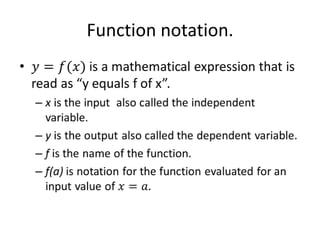
Function notation.𝑦=𝑓(𝑥) is a mathematical expression that is read as “y equals f of x”.  x is the input  also called the independent variable.y is the output also called the dependent variable.f is the name of the function.f(a) is notation for the function evaluated for an input value of 𝑥=𝑎. 
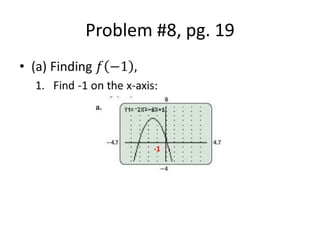
Problem #8, pg. 19(a) Finding 𝑓−1,Find -1 on the x-axis: -1
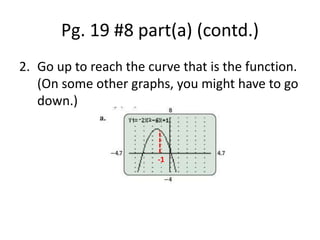
Pg. 19 #8 part(a) (contd.)Go up to reach the curve that is the function. (On some other graphs, you might have to go down.)-1
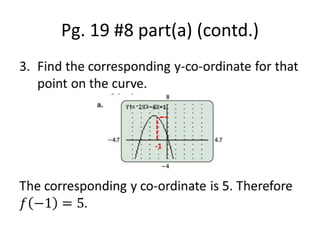
Pg. 19 #8 part(a) (contd.)Find the corresponding y-co-ordinate for that point on the curve.The corresponding y co-ordinate is 5. Therefore 𝑓−1=5. 
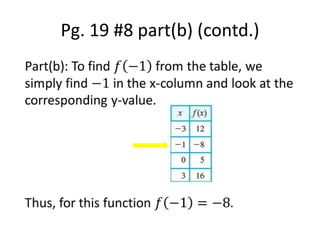
Pg. 19 #8 part(b) (contd.)Part(b): To find 𝑓−1 from the table, we simply find −1 in the x-column and look at the corresponding y-value.Thus, for this function 𝑓−1=−8. 
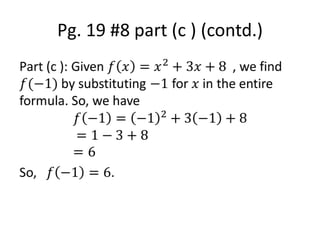
Pg. 19 #8 part (c ) (contd.)Part (c ): Given 𝑓𝑥=𝑥2+3𝑥+8  , we find 𝑓(−1) by substituting −1 for 𝑥 in the entire formula. So, we have 𝑓−1=−12+3−1+8	=1−3+8=6So,   𝑓−1=6. 
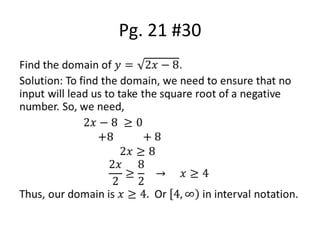
Pg. 21 #30Find the domain of 𝑦=2𝑥−8.Solution: To find the domain, we need to ensure that no input will lead us to take the square root of a negative number. So, we need,2𝑥−8 ≥0+8          +8                       2𝑥≥8                 2𝑥2≥82   ->    𝑥≥4 Thus, our domain is 𝑥≥4.  Or 4,∞ in interval notation. 
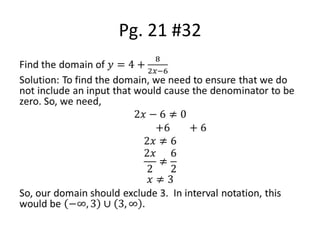
Pg. 21 #32Find the domain of 𝑦=4+82𝑥−6Solution: To find the domain, we need to ensure that we do not include an input that would cause the denominator to be zero. So, we need, 2𝑥−6≠0                 +6       +62𝑥≠62𝑥2≠62𝑥≠3So, our domain should exclude 3.  In interval notation, this would be −∞, 3∪3,∞. 
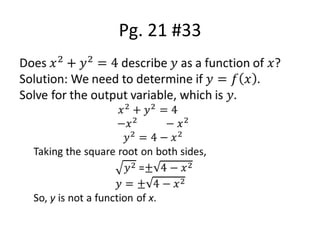
Pg. 21 #33Does 𝑥2+𝑦2=4 describe 𝑦 as a function of 𝑥?Solution: We need to determine if 𝑦=𝑓𝑥.Solve for the output variable, which is 𝑦. 𝑥2+𝑦2=4 −𝑥2          −𝑥2𝑦2=4−𝑥2Taking the square root on both sides,𝑦2 =±4−𝑥2𝑦=±4−𝑥2So, y is not a function of x. 
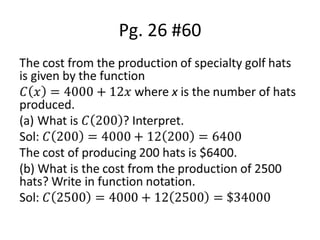
Pg. 26 #60The cost from the production of specialty golf hats is given by the function 𝐶𝑥=4000+12𝑥 where x is the number of hats produced.What is 𝐶200? Interpret.Sol: 𝐶200=4000+12200=6400The cost of producing 200 hats is $6400.(b) What is the cost from the production of 2500 hats? Write in function notation.Sol: 𝐶2500=4000+122500=$34000 

Section 1.1

  • 1.
  • 2.
    DefinitionsA Function isa rule that assigns to each input exactly one output.The set of all inputs is called the domain.The set of all outputs is called the range.
  • 3.
    Forms of functions.Functionscan be expressed in many forms.Ordered pairs.Arrow Diagrams.Tables.Graphs.Equations.Verbal descriptions.
  • 4.
    Finding Domain andRange.If the function is expressed as an ordered pair, arrow diagram or table thenList of all the inputs is the domain.List of all the outputs is the range.If the function is expressed as graph, then visually determine the intervals or points on the input axis where the graph exists. The intervals might be open or closed.
  • 5.
    Finding Domain andRange (contd.)Equations-(Refer Example 2, pg. 12)If you have a variable in the denominator, then set the denominator =0 and solve to find the values NOT in the domain.If you have a variable inside an even root set the expression ≥ 0 to find the domain. 
  • 6.
    Recognizing Functions.If youhave, Tables or Co-ordinate pairs,Check for duplicates in the input position.Arrow diagrams,Check for duplicates in the input, or,An input with arrows assigning it to two different outputs.
  • 7.
    Recognizing Functions (contd.)GraphsUsethe Vertical Line Test – A vertical line drawn anywhere should cross the graph exactly once.EquationsSolve the equation for the output variable (usually y), if you have an expression which will give you 2 answers, (usually because of a ±), the equation is not a function. 
  • 8.
    Function notation.𝑦=𝑓(𝑥) isa mathematical expression that is read as “y equals f of x”. x is the input also called the independent variable.y is the output also called the dependent variable.f is the name of the function.f(a) is notation for the function evaluated for an input value of 𝑥=𝑎. 
  • 9.
    Problem #8, pg.19(a) Finding 𝑓−1,Find -1 on the x-axis: -1
  • 10.
    Pg. 19 #8part(a) (contd.)Go up to reach the curve that is the function. (On some other graphs, you might have to go down.)-1
  • 11.
    Pg. 19 #8part(a) (contd.)Find the corresponding y-co-ordinate for that point on the curve.The corresponding y co-ordinate is 5. Therefore 𝑓−1=5. 
  • 12.
    Pg. 19 #8part(b) (contd.)Part(b): To find 𝑓−1 from the table, we simply find −1 in the x-column and look at the corresponding y-value.Thus, for this function 𝑓−1=−8. 
  • 13.
    Pg. 19 #8part (c ) (contd.)Part (c ): Given 𝑓𝑥=𝑥2+3𝑥+8  , we find 𝑓(−1) by substituting −1 for 𝑥 in the entire formula. So, we have 𝑓−1=−12+3−1+8 =1−3+8=6So,   𝑓−1=6. 
  • 14.
    Pg. 21 #30Findthe domain of 𝑦=2𝑥−8.Solution: To find the domain, we need to ensure that no input will lead us to take the square root of a negative number. So, we need,2𝑥−8 ≥0+8          +8                       2𝑥≥8                 2𝑥2≥82   ->    𝑥≥4 Thus, our domain is 𝑥≥4.  Or 4,∞ in interval notation. 
  • 15.
    Pg. 21 #32Findthe domain of 𝑦=4+82𝑥−6Solution: To find the domain, we need to ensure that we do not include an input that would cause the denominator to be zero. So, we need, 2𝑥−6≠0                 +6       +62𝑥≠62𝑥2≠62𝑥≠3So, our domain should exclude 3. In interval notation, this would be −∞, 3∪3,∞. 
  • 16.
    Pg. 21 #33Does𝑥2+𝑦2=4 describe 𝑦 as a function of 𝑥?Solution: We need to determine if 𝑦=𝑓𝑥.Solve for the output variable, which is 𝑦. 𝑥2+𝑦2=4 −𝑥2          −𝑥2𝑦2=4−𝑥2Taking the square root on both sides,𝑦2 =±4−𝑥2𝑦=±4−𝑥2So, y is not a function of x. 
  • 17.
    Pg. 26 #60Thecost from the production of specialty golf hats is given by the function 𝐶𝑥=4000+12𝑥 where x is the number of hats produced.What is 𝐶200? Interpret.Sol: 𝐶200=4000+12200=6400The cost of producing 200 hats is $6400.(b) What is the cost from the production of 2500 hats? Write in function notation.Sol: 𝐶2500=4000+122500=$34000