COMPUTER BASED
INFORMATION
SYSTEMS (CBIS)
NAME – AMIT SINGH
UNIVERSITY ROLL NO. – 14501221093
INTRODUCTION
• CBIS is a data processing system into a high-quality
information and can be used as tools that support decision-
making, coordination and control as well as visualization and
analysis.
• Some terms related to CBIS include:
• DATA
• INFORMATION
• SYSTEMS
• INFORMATION SYSTEMS
• COMPUTER BASE
DATA
• Data is a collection of raw, facts and figures.
• The word raw means that the facts have not yet been
processed.
• It may be consist of numbers, characters, symbols or picture.
• EXAMPLE: Student fill an admission form when they get
admission in college or university. The form consist of raw
facts (student’s name, father name, address etc.) The purpose
of collecting this data is to maintain records of the students
during study period.
INFORMATION
• Processed data is called information.
• When raw facts and figures are processed and arranged in
some order then they become information.
• Information is useful in decision making.
• Actually we process data to convert it into information.
• It is more meaningful than data.
• EXAMPLE: If we want to know about the student who is
outside from the Lahore then can be found by some
processing and this processed data is information.
SYSTEM
• System is a set of elements or components that interact with
one another to achieve a common goal.
• Systems are entities, both abstract and concrete, which
consists of several interrelated components to each other:
• Input (commands you enter from the keyboard to data from
another computer or device)
• Processing (Movement of data or material towards a known
goal or end result)
• Output(A result produced by a computer )
• EXAMPLES:
• An examination system
• A billing system
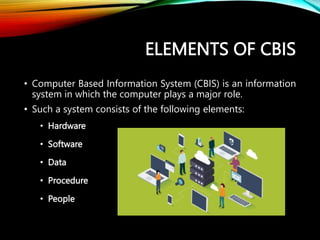
ELEMENTS OF CBIS
• Computer Based Information System (CBIS) is an information
system in which the computer plays a major role.
• Such a system consists of the following elements:
• Hardware
• Software
• Data
• Procedure
• People
ELEMENTS OF CBIS
• HARDWARE
• The term hardware refers to machinery.
• This category includes the computer itself, which is often referred to as the
central processing unit (CPU), and all of its support equipment.
• Among the support equipment are input and output devices, storage devices
and communications devices.
• SOFTWARE
• The term software refers to computer programs and the manuals (if any) that
support them.
• Computer programs are machine-readable instructions that direct the circuitry
within the hardware parts of the Computer Based Information System (CBIS) to
function in ways that produce useful information from data.
• Programs are generally stored on some input / output medium often a disk or
tape.
ELEMENTS OF CBIS
• DATA
• Data are facts that are used by program to produce useful information.
• Like programs, data are generally stored in machine readable form on disk or
tape until the computer needs them.
• It may be consist of numbers, characters, symbols or picture.
• PROCEDURES
• Procedures are the policies that govern the operation of a computer system.
• “Procedures are to people what software is to hardware” is a common analogy
that is used to illustrate the role of procedures in a CBIS.
• PEOPLE
• People are required for the operation of all information system.
• Every Computer Based Information System (CBIS) needs people if it is to be
useful.
• Often the most over-looked element of the CBIS is the people. probably the
components that most influence the success or failure of information system.
CONCLUSION
• Overall, computer-based information systems are an example
of strategic information systems and are thus useful for the
vast majority of contemporary businesses. Not only do they
allow improving processes and reducing costs, but they can
also help in facilitating the company’s competitive strategy,
whether it is based on cost leadership, differentiation, or
focus. Therefore, applying computer-based information
systems correctly can help businesses to survive in highly
competitive markets, while at the same time achieving
greater profits and higher customer satisfaction.
SE(Computer Based Information Systems (CBIS)).pptx

SE(Computer Based Information Systems (CBIS)).pptx

  • 1.
    COMPUTER BASED INFORMATION SYSTEMS (CBIS) NAME– AMIT SINGH UNIVERSITY ROLL NO. – 14501221093
  • 2.
    INTRODUCTION • CBIS isa data processing system into a high-quality information and can be used as tools that support decision- making, coordination and control as well as visualization and analysis. • Some terms related to CBIS include: • DATA • INFORMATION • SYSTEMS • INFORMATION SYSTEMS • COMPUTER BASE
  • 3.
    DATA • Data isa collection of raw, facts and figures. • The word raw means that the facts have not yet been processed. • It may be consist of numbers, characters, symbols or picture. • EXAMPLE: Student fill an admission form when they get admission in college or university. The form consist of raw facts (student’s name, father name, address etc.) The purpose of collecting this data is to maintain records of the students during study period.
  • 4.
    INFORMATION • Processed datais called information. • When raw facts and figures are processed and arranged in some order then they become information. • Information is useful in decision making. • Actually we process data to convert it into information. • It is more meaningful than data. • EXAMPLE: If we want to know about the student who is outside from the Lahore then can be found by some processing and this processed data is information.
  • 5.
    SYSTEM • System isa set of elements or components that interact with one another to achieve a common goal. • Systems are entities, both abstract and concrete, which consists of several interrelated components to each other: • Input (commands you enter from the keyboard to data from another computer or device) • Processing (Movement of data or material towards a known goal or end result) • Output(A result produced by a computer ) • EXAMPLES: • An examination system • A billing system
  • 6.
    ELEMENTS OF CBIS •Computer Based Information System (CBIS) is an information system in which the computer plays a major role. • Such a system consists of the following elements: • Hardware • Software • Data • Procedure • People
  • 7.
    ELEMENTS OF CBIS •HARDWARE • The term hardware refers to machinery. • This category includes the computer itself, which is often referred to as the central processing unit (CPU), and all of its support equipment. • Among the support equipment are input and output devices, storage devices and communications devices. • SOFTWARE • The term software refers to computer programs and the manuals (if any) that support them. • Computer programs are machine-readable instructions that direct the circuitry within the hardware parts of the Computer Based Information System (CBIS) to function in ways that produce useful information from data. • Programs are generally stored on some input / output medium often a disk or tape.
  • 8.
    ELEMENTS OF CBIS •DATA • Data are facts that are used by program to produce useful information. • Like programs, data are generally stored in machine readable form on disk or tape until the computer needs them. • It may be consist of numbers, characters, symbols or picture. • PROCEDURES • Procedures are the policies that govern the operation of a computer system. • “Procedures are to people what software is to hardware” is a common analogy that is used to illustrate the role of procedures in a CBIS. • PEOPLE • People are required for the operation of all information system. • Every Computer Based Information System (CBIS) needs people if it is to be useful. • Often the most over-looked element of the CBIS is the people. probably the components that most influence the success or failure of information system.
  • 9.
    CONCLUSION • Overall, computer-basedinformation systems are an example of strategic information systems and are thus useful for the vast majority of contemporary businesses. Not only do they allow improving processes and reducing costs, but they can also help in facilitating the company’s competitive strategy, whether it is based on cost leadership, differentiation, or focus. Therefore, applying computer-based information systems correctly can help businesses to survive in highly competitive markets, while at the same time achieving greater profits and higher customer satisfaction.