ObjectOrientedProgramming
TOPIC: Difference between Java and C
language
By Amit Singh
UNIVERSITY ROLL: 14501221093
 INTRODUCTION
• JAVA: Java is an object-oriented programming
language that produces software for multiple
platforms. When a programmer writes a Java
application, the compiled code (known as bytecode)
runs on most operating systems (OS), including
Windows, Linux, and Mac OS. Java derives much of
its syntax from the C and C++ programming
languages.
• C: C is a powerful general-purpose programming
language. It can be used to develop software like
operating systems, databases, compilers, and so on. C
programming is an excellent language to learn to
program for beginners
 KEY FEATURES OF JAVA
 One of the most interesting and important features which Java
supports is the WORA – Write Once Run Anywhere – feature. Once
compiled, Java code can be run on any computing platform. For
example, if a Java code has been written on a MAC Operating System,
the same Java code can be run on a Windows Operating System
without any trouble if the Windows Operating System has JVM (Java
Virtual Machine) installed on it.
 Java is purely an Object-Oriented-Programming Language, that is, all
Java codes are always written in the form of classes and objects.
 Java is a multithreaded language with automatic memory
management. It has great features for garbage collection and is
heavily used for distributed computing because of its network-
centricity.
 Java is dynamic and extensible.
 Java is also secure and robust.
 KEY FEATURES OF C
 C is a structured programming language that is extremely
easy to learn.
 It is an efficient programming language, that is, it is fast
and has very good performance.
 C is a highly portable and extensible programming
language because it is not tied to any hardware or system.
Any code written in C can be run on any machine which
supports C, without modifying a single line of code.
 C has a rich set of built-in Operators and libraries with
functions.
 C is modular and statically typed.
HISTORY
 C was developed by Dennis M. Ritchie between
1969 and 1973. C was originally developed for
UNIX operating system to beat the issues of
previous languages such as B, BCPL, etc.
 Java was developed by James Gosling in
1995.
Language type
C Java
 C is a Procedural
Programming Language.
 C is more procedure-
oriented.
 C is a middle-level language
because binding of the gaps
takes place between
machine-level language and
high-level languages.
 Java is an Object-
Oriented language.
 Java is more data-
oriented.
 Java is a high-level
language because the
translation of code takes
place into machine
language using a
compiler or interpreter.
Programming Paradigms
(pattern/models)
C Java
 C generally breaks down to
functions.
 It is more procedure oriented.
 Java breaks down to Objects.
 It is more data-oriented.
Object Management
• In C one has to manage it
manually.
• In java it is automatically
managed by the garbage
collector.
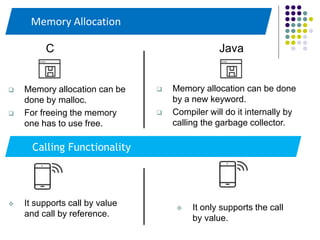
Memory Allocation
C Java
 Memory allocation can be
done by malloc.
 For freeing the memory
one has to use free.
 Memory allocation can be done
by a new keyword.
 Compiler will do it internally by
calling the garbage collector.
Calling Functionality
 It supports call by value
and call by reference.
 It only supports the call
by value.
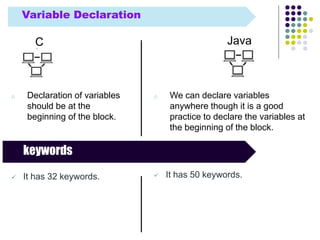
Variable Declaration
C Java
o Declaration of variables
should be at the
beginning of the block.
o We can declare variables
anywhere though it is a good
practice to declare the variables at
the beginning of the block.
keywords
 It has 32 keywords.  It has 50 keywords.
c vs java (2).pptx

c vs java (2).pptx

  • 1.
    ObjectOrientedProgramming TOPIC: Difference betweenJava and C language By Amit Singh UNIVERSITY ROLL: 14501221093
  • 2.
     INTRODUCTION • JAVA:Java is an object-oriented programming language that produces software for multiple platforms. When a programmer writes a Java application, the compiled code (known as bytecode) runs on most operating systems (OS), including Windows, Linux, and Mac OS. Java derives much of its syntax from the C and C++ programming languages. • C: C is a powerful general-purpose programming language. It can be used to develop software like operating systems, databases, compilers, and so on. C programming is an excellent language to learn to program for beginners
  • 3.
     KEY FEATURESOF JAVA  One of the most interesting and important features which Java supports is the WORA – Write Once Run Anywhere – feature. Once compiled, Java code can be run on any computing platform. For example, if a Java code has been written on a MAC Operating System, the same Java code can be run on a Windows Operating System without any trouble if the Windows Operating System has JVM (Java Virtual Machine) installed on it.  Java is purely an Object-Oriented-Programming Language, that is, all Java codes are always written in the form of classes and objects.  Java is a multithreaded language with automatic memory management. It has great features for garbage collection and is heavily used for distributed computing because of its network- centricity.  Java is dynamic and extensible.  Java is also secure and robust.
  • 4.
     KEY FEATURESOF C  C is a structured programming language that is extremely easy to learn.  It is an efficient programming language, that is, it is fast and has very good performance.  C is a highly portable and extensible programming language because it is not tied to any hardware or system. Any code written in C can be run on any machine which supports C, without modifying a single line of code.  C has a rich set of built-in Operators and libraries with functions.  C is modular and statically typed.
  • 5.
    HISTORY  C wasdeveloped by Dennis M. Ritchie between 1969 and 1973. C was originally developed for UNIX operating system to beat the issues of previous languages such as B, BCPL, etc.  Java was developed by James Gosling in 1995.
  • 6.
    Language type C Java C is a Procedural Programming Language.  C is more procedure- oriented.  C is a middle-level language because binding of the gaps takes place between machine-level language and high-level languages.  Java is an Object- Oriented language.  Java is more data- oriented.  Java is a high-level language because the translation of code takes place into machine language using a compiler or interpreter.
  • 7.
    Programming Paradigms (pattern/models) C Java C generally breaks down to functions.  It is more procedure oriented.  Java breaks down to Objects.  It is more data-oriented. Object Management • In C one has to manage it manually. • In java it is automatically managed by the garbage collector.
  • 8.
    Memory Allocation C Java Memory allocation can be done by malloc.  For freeing the memory one has to use free.  Memory allocation can be done by a new keyword.  Compiler will do it internally by calling the garbage collector. Calling Functionality  It supports call by value and call by reference.  It only supports the call by value.
  • 9.
    Variable Declaration C Java oDeclaration of variables should be at the beginning of the block. o We can declare variables anywhere though it is a good practice to declare the variables at the beginning of the block. keywords  It has 32 keywords.  It has 50 keywords.