





SECURITY BEYOND
COMPARE
Buffer Overflow
 Technique to force execution of malicious code

with unauthorized privileges
– launch a command shell
– search local disk or network for sensitive data
– register with command and control network as a
zombie
 Can be applied both locally and remotely
 Attack technique is independent of machine
 architecture and operating system
 Can be tricky to execute, but extremely effective
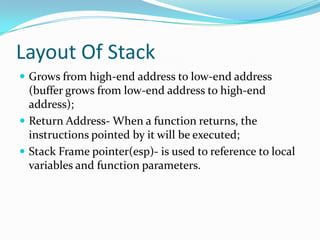
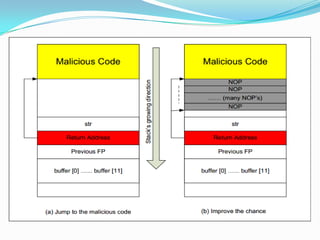
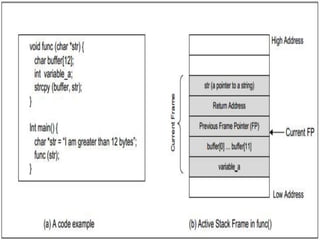
Layout Of Stack
 Grows from high-end address to low-end address

(buffer grows from low-end address to high-end
address);
 Return Address- When a function returns, the
instructions pointed by it will be executed;
 Stack Frame pointer(esp)- is used to reference to local
variables and function parameters.
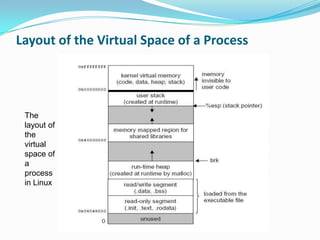
Layout of the Virtual Space of a Process

The
layout of
the
virtual
space of
a
process
in Linux
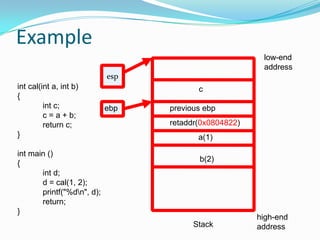
Example
low-end
address

esp
int cal(int a, int b)
{
int c;
c = a + b;
return c;
}
int main ()
{
int d;
d = cal(1, 2);
printf("%dn", d);
return;
}

c
ebp

previous ebp
retaddr(0x0804822)
a(1)
b(2)

Stack

high-end
address
Shell code
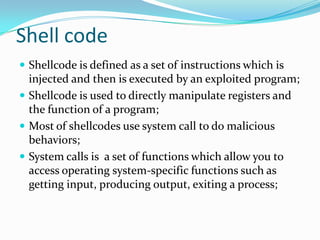
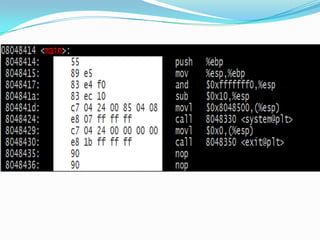
 Shellcode is defined as a set of instructions which is

injected and then is executed by an exploited program;
 Shellcode is used to directly manipulate registers and
the function of a program;
 Most of shellcodes use system call to do malicious
behaviors;
 System calls is a set of functions which allow you to
access operating system-specific functions such as
getting input, producing output, exiting a process;
How to prevent stack buffer
overflow?
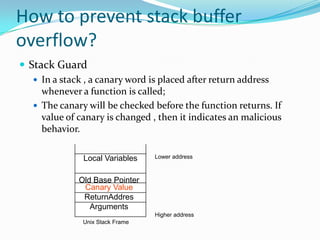
 Stack Guard
 In a stack , a canary word is placed after return address

whenever a function is called;
 The canary will be checked before the function returns. If
value of canary is changed , then it indicates an malicious
behavior.
Local Variables

Lower address

Old Base Pointer
Canary Value
ReturnAddres
Arguments
Higher address
Unix Stack Frame
Cont.
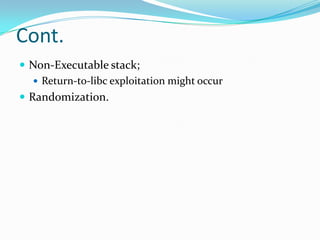
 Non-Executable stack;
 Return-to-libc exploitation might occur
 Randomization.
 Buffer Overflow by SecArmour
 Buffer Overflow by SecArmour

Buffer Overflow by SecArmour

  • 1.
  • 3.
    Buffer Overflow  Techniqueto force execution of malicious code with unauthorized privileges – launch a command shell – search local disk or network for sensitive data – register with command and control network as a zombie  Can be applied both locally and remotely  Attack technique is independent of machine  architecture and operating system  Can be tricky to execute, but extremely effective
  • 4.
    Layout Of Stack Grows from high-end address to low-end address (buffer grows from low-end address to high-end address);  Return Address- When a function returns, the instructions pointed by it will be executed;  Stack Frame pointer(esp)- is used to reference to local variables and function parameters.
  • 5.
    Layout of theVirtual Space of a Process The layout of the virtual space of a process in Linux
  • 6.
    Example low-end address esp int cal(int a,int b) { int c; c = a + b; return c; } int main () { int d; d = cal(1, 2); printf("%dn", d); return; } c ebp previous ebp retaddr(0x0804822) a(1) b(2) Stack high-end address
  • 10.
    Shell code  Shellcodeis defined as a set of instructions which is injected and then is executed by an exploited program;  Shellcode is used to directly manipulate registers and the function of a program;  Most of shellcodes use system call to do malicious behaviors;  System calls is a set of functions which allow you to access operating system-specific functions such as getting input, producing output, exiting a process;
  • 13.
    How to preventstack buffer overflow?  Stack Guard  In a stack , a canary word is placed after return address whenever a function is called;  The canary will be checked before the function returns. If value of canary is changed , then it indicates an malicious behavior. Local Variables Lower address Old Base Pointer Canary Value ReturnAddres Arguments Higher address Unix Stack Frame
  • 14.
    Cont.  Non-Executable stack; Return-to-libc exploitation might occur  Randomization.