A simple guide  to using the  Dewey Decimal  System Searching for Books Cathy Oxley   Library Services Coordinator,  Redlands College, Qld
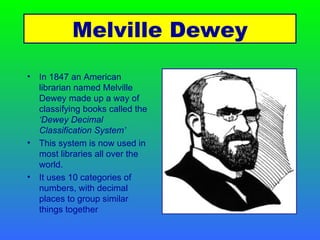
In 1847 an American librarian named Melville Dewey made up a way of classifying books called the  ‘Dewey Decimal Classification System’ This system is now used in most libraries all over the world. It uses 10 categories of numbers, with decimal places to group similar things together Melville Dewey
 
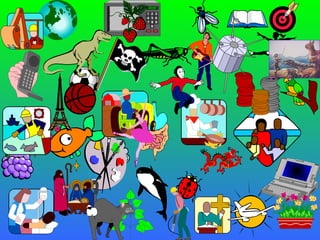
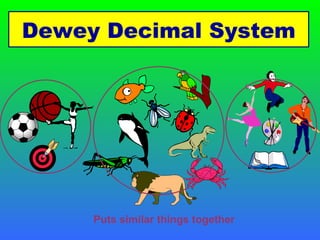
Dewey Decimal System Puts similar things together
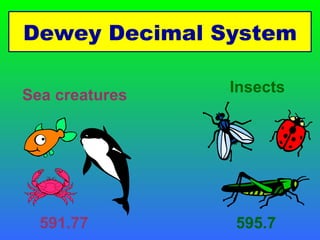
Dewey Decimal System 591.77 595.7 Insects Sea creatures
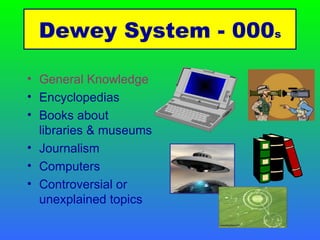
General Knowledge Encyclopedias Books about libraries & museums Journalism Computers Controversial or unexplained topics Dewey System - 000 s
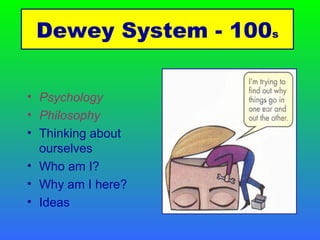
Psychology Philosophy   Thinking about ourselves Who am I? Why am I here? Ideas Image from: http://www.trcc.commnet.edu/Prog_Study/Soc_Sciences/Psych/faculty.htm Dewey System - 100 s
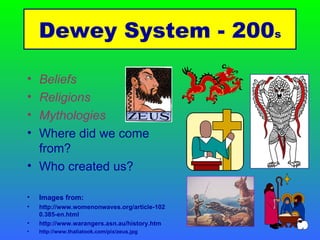
Beliefs Religions Mythologies Where did we come from? Who created us? Images from: http://www.womenonwaves.org/article-1020.385-en.html http://www.warangers.asn.au/history.htm http://www.thaliatook.com/pix/zeus.jpg Dewey System - 200 s
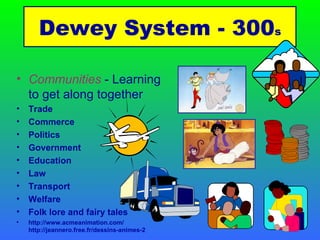
Communities  - Learning to get along together Trade  Commerce Politics  Government Education Law Transport Welfare Folk lore and fairy tales http://www.acmeanimation.com/ http://jeannero.free.fr/dessins-animes-2 Dewey System - 300 s
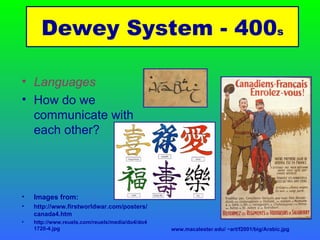
Languages How do we communicate with each other? Images from: http://www.firstworldwar.com/posters/canada4.htm http://www.reuels.com/reuels/media/do4/do41720-4.jpg Dewey System - 400 s www.macalester.edu/ ~art/f2001/big/Arabic.jpg
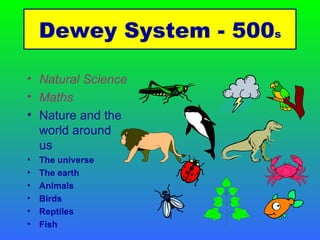
Natural Science Maths Nature and the world around us The universe The earth Animals Birds Reptiles Fish Dewey System - 500 s
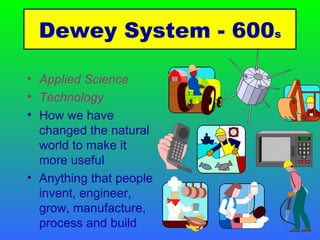
Applied Science  Technology How we have changed the natural world to make it more useful  Anything that people invent, engineer, grow, manufacture, process and build Dewey System - 600 s
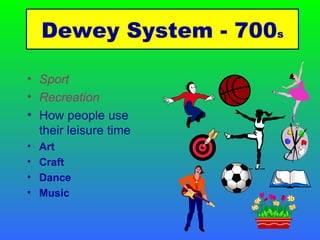
Sport  Recreation How people use their leisure time Art Craft Dance Music Dewey System - 700 s
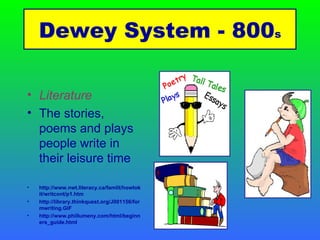
Literature The stories, poems and plays people write in their leisure time http://www.nwt.literacy.ca/famlit/howtokit/writcont/p1.htm http://library.thinkquest.org/J001156/formwriting.GIF http://www.phillumeny.com/html/beginners_guide.html Dewey System - 800 s
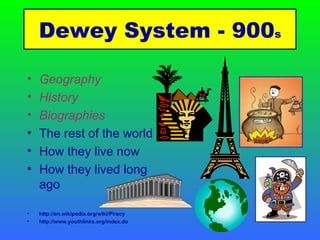
Geography History Biographies The rest of the world How they live now How they lived long ago http://en.wikipedia.org/wiki/Piracy http://www.youthlinks.org/index.do Dewey System - 900 s
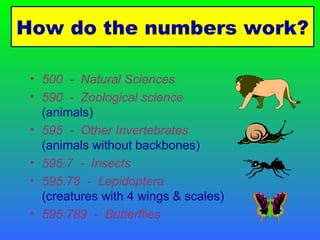
500  -  Natural Sciences 590  -  Zoological science   (animals) 595  -  Other Invertebrates   (animals without backbones) 595.7  -  Insects 595.78  -  Lepidoptera  (creatures with 4 wings & scales) 595.789  -  Butterflies How do the numbers work?
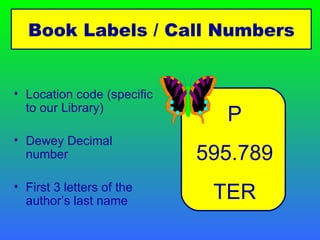
Location code (specific to our Library) Dewey Decimal number First 3 letters of the author’s last name Book Labels / Call Numbers P 595.789 TER
BPL - Bag Primary Large CH - Chart P - Primary PAR - Primary Accelerated Reader PB - Picture Book PM6 - Primary Multiple R - Reference S - Secondary SRB - Secondary RIB-IT Location Codes

Searching for Books - Dewey Decimal System

  • 1.
    A simple guide to using the Dewey Decimal System Searching for Books Cathy Oxley Library Services Coordinator, Redlands College, Qld
  • 2.
    In 1847 anAmerican librarian named Melville Dewey made up a way of classifying books called the ‘Dewey Decimal Classification System’ This system is now used in most libraries all over the world. It uses 10 categories of numbers, with decimal places to group similar things together Melville Dewey
  • 3.
  • 4.
    Dewey Decimal SystemPuts similar things together
  • 5.
    Dewey Decimal System591.77 595.7 Insects Sea creatures
  • 6.
    General Knowledge EncyclopediasBooks about libraries & museums Journalism Computers Controversial or unexplained topics Dewey System - 000 s
  • 7.
    Psychology Philosophy Thinking about ourselves Who am I? Why am I here? Ideas Image from: http://www.trcc.commnet.edu/Prog_Study/Soc_Sciences/Psych/faculty.htm Dewey System - 100 s
  • 8.
    Beliefs Religions MythologiesWhere did we come from? Who created us? Images from: http://www.womenonwaves.org/article-1020.385-en.html http://www.warangers.asn.au/history.htm http://www.thaliatook.com/pix/zeus.jpg Dewey System - 200 s
  • 9.
    Communities -Learning to get along together Trade Commerce Politics Government Education Law Transport Welfare Folk lore and fairy tales http://www.acmeanimation.com/ http://jeannero.free.fr/dessins-animes-2 Dewey System - 300 s
  • 10.
    Languages How dowe communicate with each other? Images from: http://www.firstworldwar.com/posters/canada4.htm http://www.reuels.com/reuels/media/do4/do41720-4.jpg Dewey System - 400 s www.macalester.edu/ ~art/f2001/big/Arabic.jpg
  • 11.
    Natural Science MathsNature and the world around us The universe The earth Animals Birds Reptiles Fish Dewey System - 500 s
  • 12.
    Applied Science Technology How we have changed the natural world to make it more useful Anything that people invent, engineer, grow, manufacture, process and build Dewey System - 600 s
  • 13.
    Sport RecreationHow people use their leisure time Art Craft Dance Music Dewey System - 700 s
  • 14.
    Literature The stories,poems and plays people write in their leisure time http://www.nwt.literacy.ca/famlit/howtokit/writcont/p1.htm http://library.thinkquest.org/J001156/formwriting.GIF http://www.phillumeny.com/html/beginners_guide.html Dewey System - 800 s
  • 15.
    Geography History BiographiesThe rest of the world How they live now How they lived long ago http://en.wikipedia.org/wiki/Piracy http://www.youthlinks.org/index.do Dewey System - 900 s
  • 16.
    500 - Natural Sciences 590 - Zoological science (animals) 595 - Other Invertebrates (animals without backbones) 595.7 - Insects 595.78 - Lepidoptera (creatures with 4 wings & scales) 595.789 - Butterflies How do the numbers work?
  • 17.
    Location code (specificto our Library) Dewey Decimal number First 3 letters of the author’s last name Book Labels / Call Numbers P 595.789 TER
  • 18.
    BPL - BagPrimary Large CH - Chart P - Primary PAR - Primary Accelerated Reader PB - Picture Book PM6 - Primary Multiple R - Reference S - Secondary SRB - Secondary RIB-IT Location Codes