University Library
September 2014
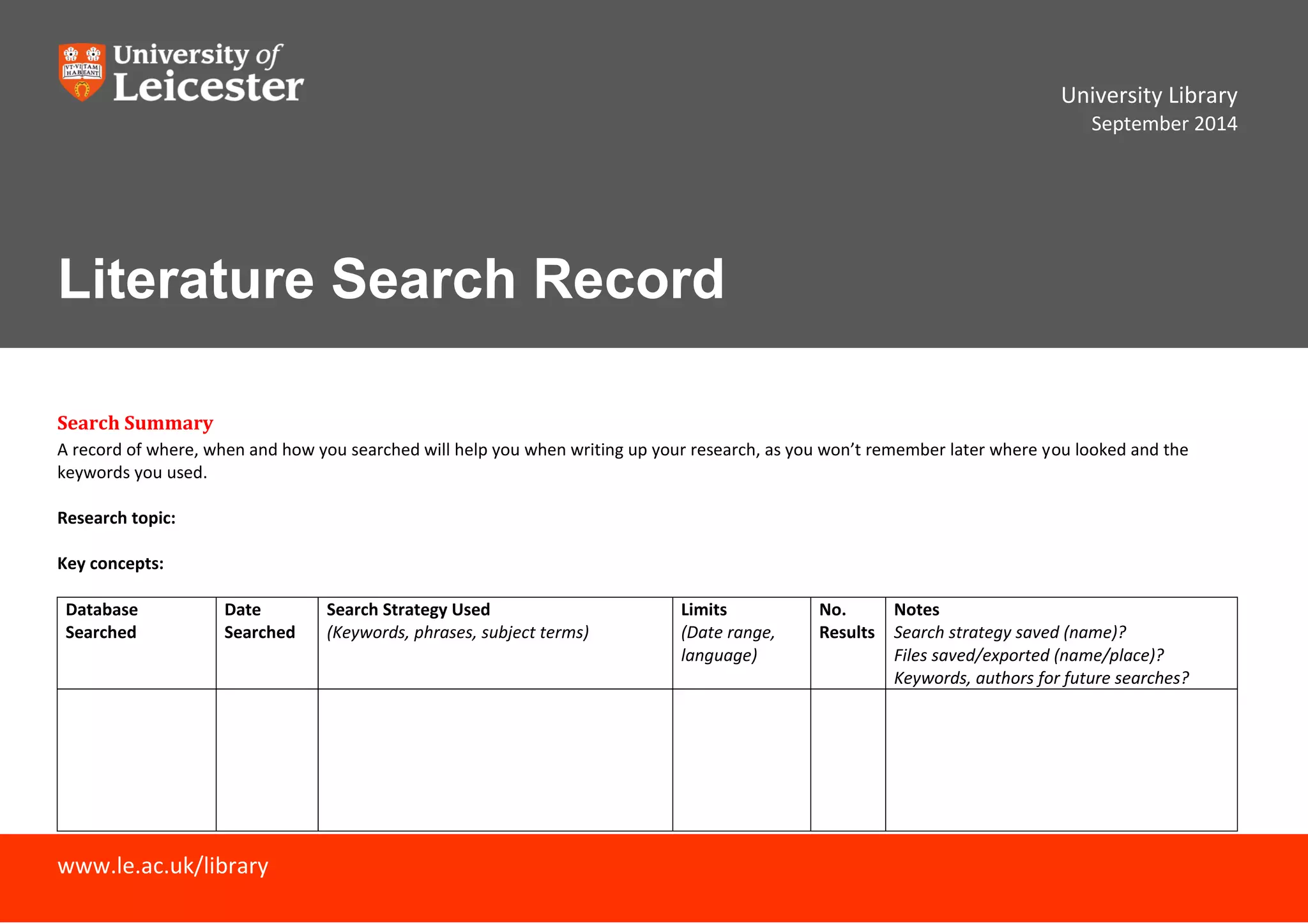
Literature Search Record
www.le.ac.uk/library
Search Summary
A record of where, when and how you searched will help you when writing up your research, as you won’t remember later where you looked and the
keywords you used.
Research topic:
Key concepts:
Database
Searched
Date
Searched
Search Strategy Used
(Keywords, phrases, subject terms)
Limits
(Date range,
language)
No.
Results
Notes
Search strategy saved (name)?
Files saved/exported (name/place)?
Keywords, authors for future searches?
2 UNIVERSITY OF LEICESTER · LIBRARY
www.le.ac.uk/library
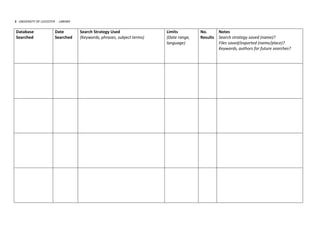
Database
Searched
Date
Searched
Search Strategy Used
(Keywords, phrases, subject terms)
Limits
(Date range,
language)
No.
Results
Notes
Search strategy saved (name)?
Files saved/exported (name/place)?
Keywords, authors for future searches?
3 UNIVERSITY OF LEICESTER · LIBRARY
www.le.ac.uk/library
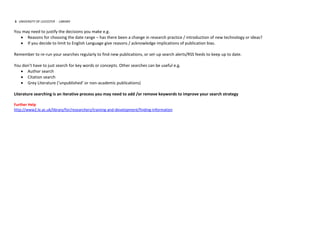
You may need to justify the decisions you make e.g.
 Reasons for choosing the date range – has there been a change in research practice / introduction of new technology or ideas?
 If you decide to limit to English Language give reasons / acknowledge implications of publication bias.
Remember to re-run your searches regularly to find new publications, or set-up search alerts/RSS feeds to keep up to date.
You don’t have to just search for key words or concepts. Other searches can be useful e.g.
 Author search
 Citation search
 Grey Literature (‘unpublished’ or non-academic publications)
Literature searching is an iterative process you may need to add /or remove keywords to improve your search strategy
Further Help
http://www2.le.ac.uk/library/for/researchers/training-and-development/finding-information
4 UNIVERSITY OF LEICESTER · LIBRARY
www.le.ac.uk/library

Search summary form

  • 1.
    University Library September 2014 LiteratureSearch Record www.le.ac.uk/library Search Summary A record of where, when and how you searched will help you when writing up your research, as you won’t remember later where you looked and the keywords you used. Research topic: Key concepts: Database Searched Date Searched Search Strategy Used (Keywords, phrases, subject terms) Limits (Date range, language) No. Results Notes Search strategy saved (name)? Files saved/exported (name/place)? Keywords, authors for future searches?
  • 2.
    2 UNIVERSITY OFLEICESTER · LIBRARY www.le.ac.uk/library Database Searched Date Searched Search Strategy Used (Keywords, phrases, subject terms) Limits (Date range, language) No. Results Notes Search strategy saved (name)? Files saved/exported (name/place)? Keywords, authors for future searches?
  • 3.
    3 UNIVERSITY OFLEICESTER · LIBRARY www.le.ac.uk/library You may need to justify the decisions you make e.g.  Reasons for choosing the date range – has there been a change in research practice / introduction of new technology or ideas?  If you decide to limit to English Language give reasons / acknowledge implications of publication bias. Remember to re-run your searches regularly to find new publications, or set-up search alerts/RSS feeds to keep up to date. You don’t have to just search for key words or concepts. Other searches can be useful e.g.  Author search  Citation search  Grey Literature (‘unpublished’ or non-academic publications) Literature searching is an iterative process you may need to add /or remove keywords to improve your search strategy Further Help http://www2.le.ac.uk/library/for/researchers/training-and-development/finding-information
  • 4.
    4 UNIVERSITY OFLEICESTER · LIBRARY www.le.ac.uk/library