Using Library Catalogs and Databases
Crime
Slavery
Monuments
Urban Renewal (1940s)
DC Civil War
Range of subject areas and time frames
Where do we look and for what kinds of things?
What do you need to find information?
Keywords
Databases
Time period
Geographic Area
What we’re getting at is how to narrow a particular search
Over 700 databases in the library
1.What are some synonyms for what I’m looking for
Broad terms
Narrow terms
2. Keep a research log
What database was I in?
What terms did I use
(It gets hazy after you’ve gone to multiple databases at different times looking for
information)
How do you know where to go?
Try Library of Congress
Check for reliable sources
Basic search in InPrimo for starting point of reliable articles
ProQuest (note that there are many ProQuest databases)
The research librarian’s answer: Do you need books or articles? That determines on
direction. If you need everything—InPrimo helps you search library holdings as well as a
number of databases.
A search for “Slavery in Washington, DC” yields 23,700 items.
L
Way too many. What do we do? InPrimo allows some limiting, but not much. If it’s
frustrating, take a break and try another tool.
In InPrimo, click on refine search and then more options to narrow the search.
What limiters might be helpful? Note that DATE is the date of publication—not the
historical date. In history, the date of publication won’t be as important as it would be
important to have very recent materials in science.
In history—it’s useful to know what the scholarly conversation was at particular times.
But you have to be aware that what is written about a topic in 1950 won’t reflect current
thinking.
InPrimo doesn’t differentiate between primary and secondary resources. It’s a mixed
bag. It is useful for things that are interdisciplinary.
So if InPrimo isn’t helpful, or too broad, where do you go?
Info guides, [See the listing under FIND in the main navigation bar} which are developed
by specialist in the subject area. They apply, not only to history, but to all classes.
Think discipline here—not course, not research topic. In this class we are looking for
history. Among the listings, you’ll find specific both topics and subject guides written for
particular courses.
American History and Life is among the main one, the most helpful database for
secondary sources. It’s an Ebsco database. A broad search term like Washington, DC
will yield anything from items published IN Washington, DC, to materials ABOUT
Washington, DC. Use the delimiting fields.
Remember, Google will try to figure out what you mean. Library databases do not. They
only look at what you put into the search fields. But the search feature does NOT as you
“did you mean” as Google does. Misspellings, ambiguous search terms will yield few
results or none.
How do we limit in American History and Life?
We can specify by era (time period), fields, publication dates.
When search results appear, look at how the library has classified them and use those
classifications for search terms.
Where else to go? Library Catalog? It’s a cranky database. Very specific, difficult to limit
searches when thousands of results appear, and not patient with misspellings.
Can you find primary sources in the Library catalog? What kinds and how do we find
them? You’ll mostly find PUBLISHED sources via the catalog. And use the subject
headings as a guide.
Published diaries.
Published correspondence
Autobiographies
Primary Sources: InfoGuides are useful. There is a general guide for primary source
research.
Using Library Catalogues and Databases, February12, 2014, HIST390-003

Using Library Catalogues and Databases, February12, 2014, HIST390-003

  • 1.
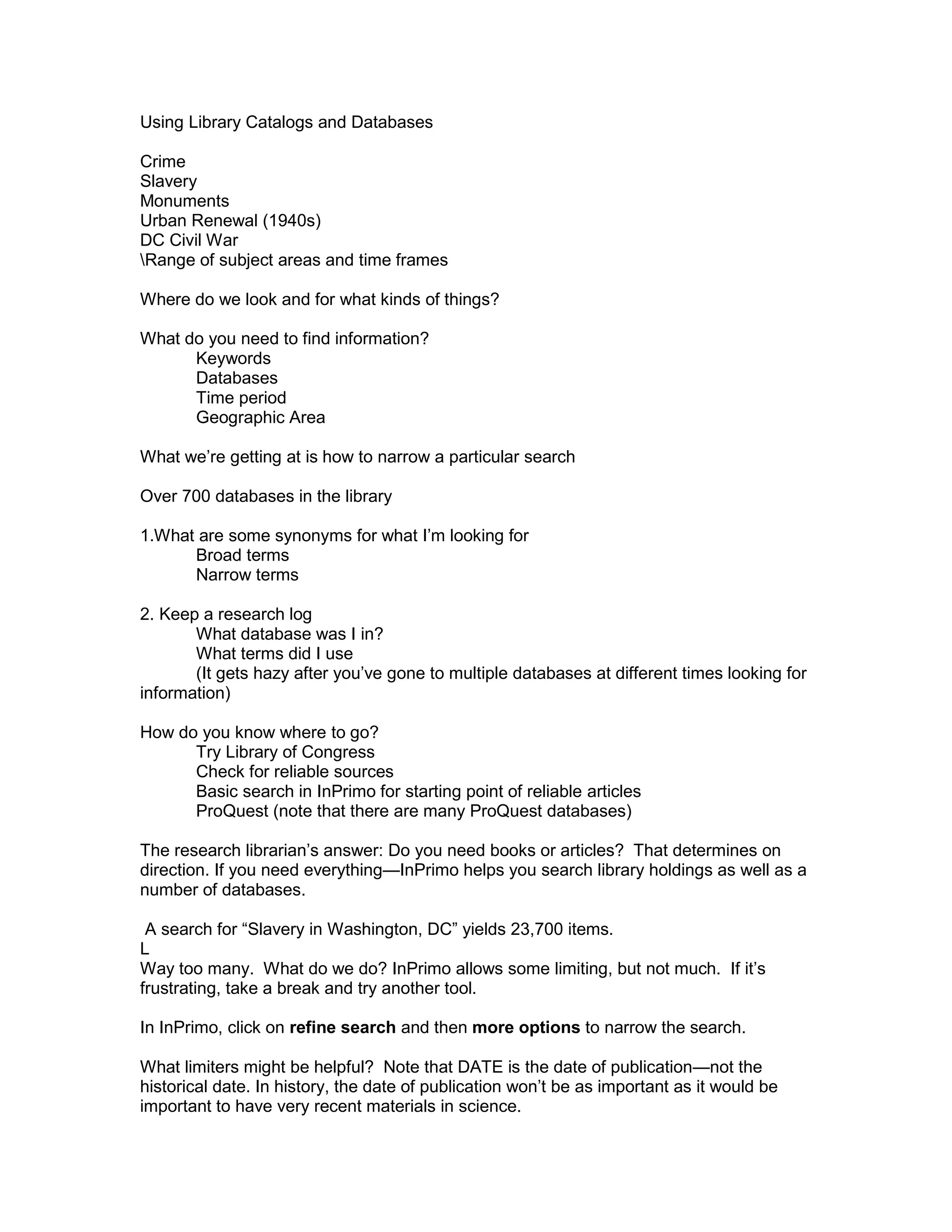
    Using Library Catalogsand Databases Crime Slavery Monuments Urban Renewal (1940s) DC Civil War Range of subject areas and time frames Where do we look and for what kinds of things? What do you need to find information? Keywords Databases Time period Geographic Area What we’re getting at is how to narrow a particular search Over 700 databases in the library 1.What are some synonyms for what I’m looking for Broad terms Narrow terms 2. Keep a research log What database was I in? What terms did I use (It gets hazy after you’ve gone to multiple databases at different times looking for information) How do you know where to go? Try Library of Congress Check for reliable sources Basic search in InPrimo for starting point of reliable articles ProQuest (note that there are many ProQuest databases) The research librarian’s answer: Do you need books or articles? That determines on direction. If you need everything—InPrimo helps you search library holdings as well as a number of databases. A search for “Slavery in Washington, DC” yields 23,700 items. L Way too many. What do we do? InPrimo allows some limiting, but not much. If it’s frustrating, take a break and try another tool. In InPrimo, click on refine search and then more options to narrow the search. What limiters might be helpful? Note that DATE is the date of publication—not the historical date. In history, the date of publication won’t be as important as it would be important to have very recent materials in science.
  • 2.
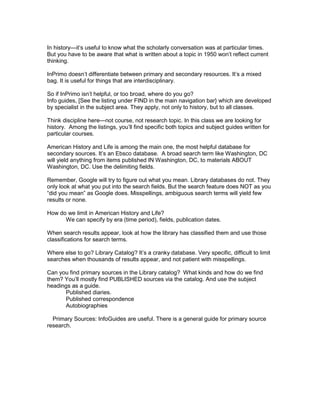
    In history—it’s usefulto know what the scholarly conversation was at particular times. But you have to be aware that what is written about a topic in 1950 won’t reflect current thinking. InPrimo doesn’t differentiate between primary and secondary resources. It’s a mixed bag. It is useful for things that are interdisciplinary. So if InPrimo isn’t helpful, or too broad, where do you go? Info guides, [See the listing under FIND in the main navigation bar} which are developed by specialist in the subject area. They apply, not only to history, but to all classes. Think discipline here—not course, not research topic. In this class we are looking for history. Among the listings, you’ll find specific both topics and subject guides written for particular courses. American History and Life is among the main one, the most helpful database for secondary sources. It’s an Ebsco database. A broad search term like Washington, DC will yield anything from items published IN Washington, DC, to materials ABOUT Washington, DC. Use the delimiting fields. Remember, Google will try to figure out what you mean. Library databases do not. They only look at what you put into the search fields. But the search feature does NOT as you “did you mean” as Google does. Misspellings, ambiguous search terms will yield few results or none. How do we limit in American History and Life? We can specify by era (time period), fields, publication dates. When search results appear, look at how the library has classified them and use those classifications for search terms. Where else to go? Library Catalog? It’s a cranky database. Very specific, difficult to limit searches when thousands of results appear, and not patient with misspellings. Can you find primary sources in the Library catalog? What kinds and how do we find them? You’ll mostly find PUBLISHED sources via the catalog. And use the subject headings as a guide. Published diaries. Published correspondence Autobiographies Primary Sources: InfoGuides are useful. There is a general guide for primary source research.