





www.le.ac.uk/library
Demonstrate your impact
with the h-index
Ian Rowlands
University Library
Research Festival 2014 Research Bytes 5
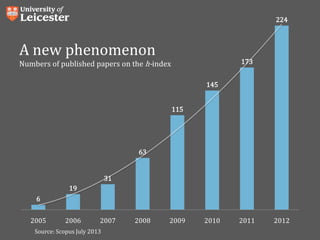
A new phenomenon
A new phenomenon
Numbers of published papers on the h-index
6
19
31
63
115
145
173
224
2005 2006 2007 2008 2009 2010 2011 2012
Papers
Source: Scopus July 2013
• What is the h-index?
• How do I find mine?
• Interpreting the h-index
What is the h-index?
This slide contains an embedded video.
Hover your cursor at the bottom of this screen
and click play.
What is the h-index?
• A single number that starts with your first citation
and accumulates over your research career
• It starts easy but gets progressively harder
• Summarises your broad research impact
Advantages of the h-index
• Simple: easy to generate and easy to understand
• Valid: correlates well with career achievements and
soft judgments about reputation
• Credible: difficult to game
• Flexible: any set of papers can have an h-index
How do I find mine?
How do I find mine?
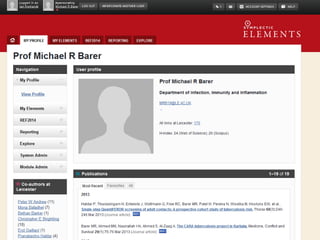
• If you have an IRIS account, go to My Profile
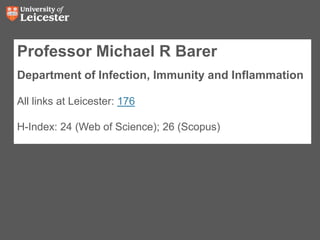
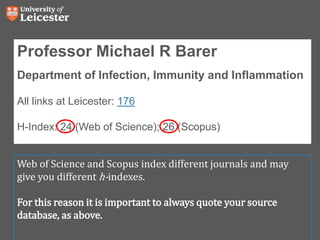
Professor Michael R Barer
Department of Infection, Immunity and Inflammation
All links at Leicester: 176
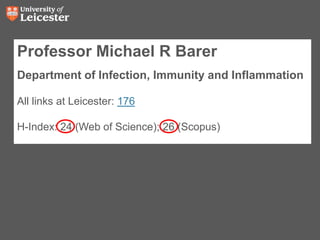
H-Index: 24 (Web of Science); 26 (Scopus)
Professor Michael R Barer
Department of Infection, Immunity and Inflammation
All links at Leicester: 176
H-Index: 24 (Web of Science); 26 (Scopus)
Professor Michael R Barer
Department of Infection, Immunity and Inflammation
All links at Leicester: 176
H-Index: 24 (Web of Science); 26 (Scopus)
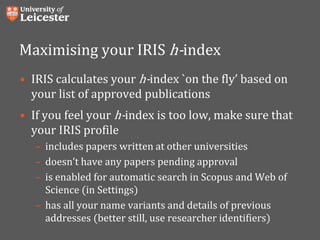
Web of Science and Scopus index different journals and may
give you different h-indexes.
For this reason it is important to always quote your source
database, as above.
Maximising your IRIS h-index
• IRIS calculates your h-index `on the fly’ based on
your list of approved publications
• If you feel your h-index is too low, make sure that
your IRIS profile
– includes papers written at other universities
– doesn’t have any papers pending approval
– is enabled for automatic search in Scopus and Web of
Science (in Settings)
– has all your name variants and details of previous
addresses (better still, use researcher identifiers)
If you don’t have an IRIS account …
• Find your h-index in Web of Science or Scopus by
– running a comprehensive author search
– selecting all your publications
– running the citation analysis tool
• Google Scholar works differently: you need to set up a
personal citation profile via your Google account
Interpreting the h-index
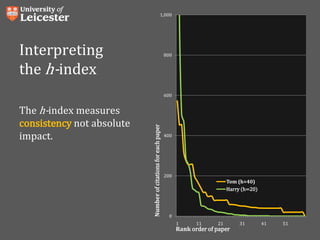
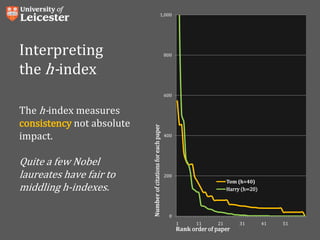
• Tom
– 60 papers
– 6,000 citations
– 100 citations per paper
• Harry
– 60 papers
– 6,000 citations
– 100 citations per paper
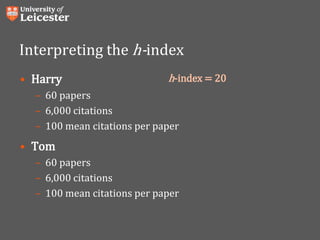
Interpreting the h-index
• Harry
– 60 papers
– 6,000 citations
– 100 mean citations per paper
• Tom
– 60 papers
– 6,000 citations
– 100 mean citations per paper
h-index = 20
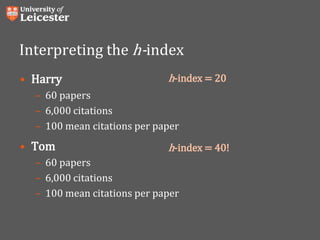
Interpreting the h-index
• Harry
– 60 papers
– 6,000 citations
– 100 mean citations per paper
• Tom
– 60 papers
– 6,000 citations
– 100 mean citations per paper
h-index = 20
h-index = 40!
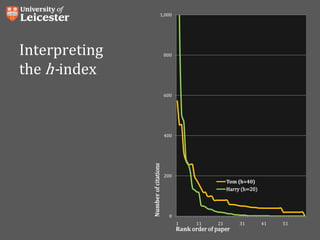
0
200
400
600
800
1,000
1 11 21 31 41 51
Tom (h=40)
Harry (h=20)
Rank order of paper
Numberofcitations
Interpreting
the h-index
The h-index measures
consistency not absolute
impact.
0
200
400
600
800
1,000
1 11 21 31 41 51
Tom (h=40)
Harry (h=20)
Rank order of paper
Numberofcitationsforeachpaper
Interpreting
the h-index
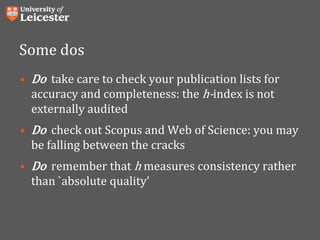
The h-index measures
consistency not absolute
impact.
Quite a few Nobel
laureates have fair to
middling h-indexes.
0
200
400
600
800
1,000
1 11 21 31 41 51
Tom (h=40)
Harry (h=20)
Rank order of paper
Numberofcitationsforeachpaper
Interpreting
the h-index
Some dos
• Do take care to check your publication lists for
accuracy and completeness: the h-index is not
externally audited
• Do check out Scopus and Web of Science: you may
be falling between the cracks
• Do remember that h measures consistency rather
than `absolute quality’
Some don’ts
• Don’t compare your h-index with that of an older
or younger colleague
• Don’t compare your h-index with someone
working in a different field
• Don’t put too much emphasis on a single number
Useful links
• How to find your h-index in Scopus
– http://tinyurl.com/h-scopus
• How to find your h-index in Web of Science
– http://tinyurl.com/h-websci
• How to find your h-index in Google Scholar
– http://tinyurl.com/h-scholar
Demonstrate your impact with the h-index

Demonstrate your impact with the h-index

  • 1.
    www.le.ac.uk/library Demonstrate your impact withthe h-index Ian Rowlands University Library Research Festival 2014 Research Bytes 5
  • 2.
  • 3.
    A new phenomenon Numbersof published papers on the h-index 6 19 31 63 115 145 173 224 2005 2006 2007 2008 2009 2010 2011 2012 Papers Source: Scopus July 2013
  • 4.
    • What isthe h-index? • How do I find mine? • Interpreting the h-index
  • 5.
    What is theh-index? This slide contains an embedded video. Hover your cursor at the bottom of this screen and click play.
  • 6.
    What is theh-index? • A single number that starts with your first citation and accumulates over your research career • It starts easy but gets progressively harder • Summarises your broad research impact
  • 7.
    Advantages of theh-index • Simple: easy to generate and easy to understand • Valid: correlates well with career achievements and soft judgments about reputation • Credible: difficult to game • Flexible: any set of papers can have an h-index
  • 8.
    How do Ifind mine?
  • 9.
    How do Ifind mine? • If you have an IRIS account, go to My Profile
  • 11.
    Professor Michael RBarer Department of Infection, Immunity and Inflammation All links at Leicester: 176 H-Index: 24 (Web of Science); 26 (Scopus)
  • 12.
    Professor Michael RBarer Department of Infection, Immunity and Inflammation All links at Leicester: 176 H-Index: 24 (Web of Science); 26 (Scopus)
  • 13.
    Professor Michael RBarer Department of Infection, Immunity and Inflammation All links at Leicester: 176 H-Index: 24 (Web of Science); 26 (Scopus) Web of Science and Scopus index different journals and may give you different h-indexes. For this reason it is important to always quote your source database, as above.
  • 14.
    Maximising your IRISh-index • IRIS calculates your h-index `on the fly’ based on your list of approved publications • If you feel your h-index is too low, make sure that your IRIS profile – includes papers written at other universities – doesn’t have any papers pending approval – is enabled for automatic search in Scopus and Web of Science (in Settings) – has all your name variants and details of previous addresses (better still, use researcher identifiers)
  • 15.
    If you don’thave an IRIS account … • Find your h-index in Web of Science or Scopus by – running a comprehensive author search – selecting all your publications – running the citation analysis tool • Google Scholar works differently: you need to set up a personal citation profile via your Google account
  • 16.
  • 17.
    Interpreting the h-index •Tom – 60 papers – 6,000 citations – 100 citations per paper • Harry – 60 papers – 6,000 citations – 100 citations per paper
  • 18.
    Interpreting the h-index •Harry – 60 papers – 6,000 citations – 100 mean citations per paper • Tom – 60 papers – 6,000 citations – 100 mean citations per paper h-index = 20
  • 19.
    Interpreting the h-index •Harry – 60 papers – 6,000 citations – 100 mean citations per paper • Tom – 60 papers – 6,000 citations – 100 mean citations per paper h-index = 20 h-index = 40!
  • 20.
    0 200 400 600 800 1,000 1 11 2131 41 51 Tom (h=40) Harry (h=20) Rank order of paper Numberofcitations Interpreting the h-index
  • 21.
    The h-index measures consistencynot absolute impact. 0 200 400 600 800 1,000 1 11 21 31 41 51 Tom (h=40) Harry (h=20) Rank order of paper Numberofcitationsforeachpaper Interpreting the h-index
  • 22.
    The h-index measures consistencynot absolute impact. Quite a few Nobel laureates have fair to middling h-indexes. 0 200 400 600 800 1,000 1 11 21 31 41 51 Tom (h=40) Harry (h=20) Rank order of paper Numberofcitationsforeachpaper Interpreting the h-index
  • 24.
    Some dos • Dotake care to check your publication lists for accuracy and completeness: the h-index is not externally audited • Do check out Scopus and Web of Science: you may be falling between the cracks • Do remember that h measures consistency rather than `absolute quality’
  • 25.
    Some don’ts • Don’tcompare your h-index with that of an older or younger colleague • Don’t compare your h-index with someone working in a different field • Don’t put too much emphasis on a single number
  • 26.
    Useful links • Howto find your h-index in Scopus – http://tinyurl.com/h-scopus • How to find your h-index in Web of Science – http://tinyurl.com/h-websci • How to find your h-index in Google Scholar – http://tinyurl.com/h-scholar

Editor's Notes

  • #3 Jorge Hirsch, physics professor at University of California San Diego published a paper in PNAS in 2005. In it he proposed a new way to evaluate the research impact of an individual scientist.The paper seems to have arisen out of disillusionment with the journal impact factor:Hirsch claims he was having getting his controversial work on superconductors accepted in top journals. But they still go t cited and he set out to find an altrnative.By the way, H stands for `highly cited’ not Hirsch
  • #4 Rapidly growing interest
  • #7 Hirsch showed that total citations, N was typically N = 4h2 or h=square root of N/4
  • #8 SIMPLICITYVALIDStudies show strong correlation with peer judgments of reputation, Nobel and other prizes, etc.CREDIBLETypically, a physicist with h=24 will have 2,300 citations. (N=4h2)FLEXIBLEResearch team DepartmentUniversityJournalcountryTopic– the h-index of the h-index is 48 (Scopus). H squared? Slice and dice.You could compare the impact of cardiovascular research in the UK, France and Germany using the h-index.
  • #14 For about 50% of people, h will be the more or less the same (+/- 2_ in both. But there are exceptions. Stephen Hawking (Scopus 19, WoS 59). 5% bigger wos 45% bigger scopus
  • #18 Who has the greater impact?
  • #23 Modelled on real life example of Harry Kroto, Nobel chemistry laureate for discovery of buckminsterfullerenes. Huge lasting impact but on the basis of a small number of papers. You don’t get any extra credit in h for citations > h
  • #24 Let’s look at an example
  • #26 AGECan’t expect a post doc and emeritus to be comparable. Could try m or H-5DISCIPLINEH tends to be bigger in the big sciences (well funded, lots of researchers, big teams) thn in say maths (the opposite usually, plus shorter reference lists)SINGLE NUMBERWouldn’t buy a 5-door car or expect a diagnosis on temperature alone, why different for something as complex as research impact