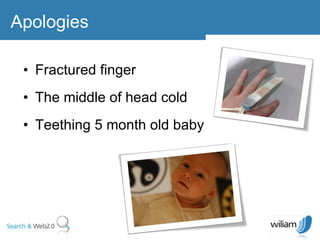
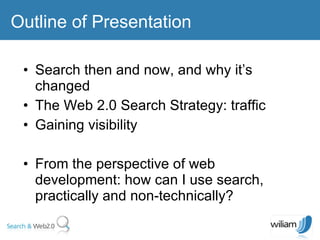
Fractured finger  The middle of head cold  Teething 5 month old baby boy Apologies
Search then and now, and why it’s changed The Web 2.0 Search Strategy: traffic Gaining visibility From the perspective of web development: how can I use search, practically and non-technically? Outline of Presentation
Reflected the web as it was then... Static, simple and easy manipulated  Scant benefit to users  Irrelevant results  Took forever to get listed  Think Altavista, Lycos, Looksmart Web 1.0 Search
Reflects the web now... Much more diverse organic results  Immediately listing pages in the results: users receive the very latest content Search provide great deal of traffic Many avenues for search other than search: user/search fragmentation Web 2.0 Search
You can now search just for.... products images blogs video  news  New Search Avenues
The Web 2.0 Search Strategy: traffic
Most businesses still develop their websites with Web 1.0 Search in-mind. Very few new businesses websites take advantage – or at least proper advantage – of Web 2.0 and search. You need constant evolution – because search is constantly evolving. The problem currently…
Assuming search means traffic, and traffic is the objective, search is much more than search engines. It means taking advantage of social networks and back-linking, blogging and content syndication.  It’s also important to remember…
Every decision on your website has to be about search  Web 2.0 and Search 101
Hold up search and compare every decision you make online: no Flash forms! Pin it to the wall...
The key to your success is traffic and without traffic it doesn’t matter. You can have the best content, the lowest prices, the best design. But without traffic, no one will know.... Search
If you’re not concentrating on search, you’ll be second to someone that is. You could be beaten by an offshore or interstate competitor. Being number one is essential. The different between position 1 and position 11 is 8 times the traffic. Today it’s totally about search
Web 2.0 development  with search
You have to create an Internet business; building a website for an offline business is not good enough. Customers are attracted very differently to the two: brands are less important. A website designed with search in mind will attract more traffic Strategy 2.0 – the online mindset
You must have a business plan that will provide benefit, whatever it is. Is it to sell products?  Is it lead generation, for offline?  Is the site supported by advertising?  Can it rely on user generated content? What’s the business plan?
Identify a niche  What do people search to reach that niche? Do users use local terms “widgets Sydney” Is it long-tail or short? Consider using a third party. Research Phase
Indentify direct and indirect competitors, locally and offshore Your offline competitors will be different to your online competitors  Your competitors are those in the number 1 – 10 positions Research Phase
What type of content will you be publishing? The type your customers are searching for; Consider where the buyer is in the purchasing cycle; buyers and influencers need different content: 100k hits, 100 forms. Content Publishing
Build with best practise  Forget designing key content pages in Flash  Create content pages that can be reached by search engines Don’t forget about the user experience; can it be read? Design pages with text Designing and building Web 2.0
Content shouldn’t be hidden from the search engines: even hidden content. Dynamically use meta data like titles, descriptions, keywords Don’t forget user-generated content Create Sitemaps regularly - don’t rely on the search engines to find content: and evolve and grow  Indexable Pages
Joost is a IPTV application  Runs as a program on your computer  Every channel and video has a direct link which is indexable Fifth Gear Channel  http://www.joost.com/01900b6  Audi S5 v BMW 335i Shoot-Out – video information page http://www.joost.com/01900gi URL which launches the video joost://01900gi  Example 1: Joost – Video Content
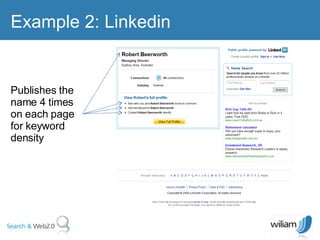
Linkedin a social networking tool for business  Publishes a page of every member  Has 20 million pages indexed in Google  Has 26 million pages indexed in Yahoo Generally ranks in the top ten for name searches Example: 2 Linkedin  User Generated Content
Example 2: Linkedin Publishes the name 4 times on each page for keyword density
On site Search  Every website or application should provide search Providing quality search results is essential  Search can contribute to increased page views  Systems such as a Google Box provide metrics  i.e. number of searches, searches with no results  No results search can help tailor future content
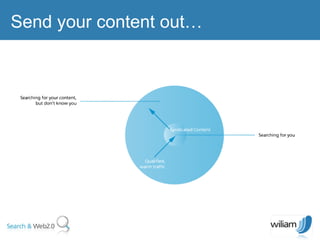
Send your content out…
Use RSS to push out new content to search engines  Develop content specific feeds i.e. video feed, blog feed etc  Decide what content to publish as it happens  Submit to relevant syndication sites like  www.plugger.com.au  or  www.topix.net   Syndication
Particularly necessary to blogs  Ping  is an XML-RPC-based push mechanism A ping is sent to ping servers when a site updates Pinging
Submit to search engines via webmaster tools Gain backlinks on related and relevant websites Marketing phase begins  Submission Stage
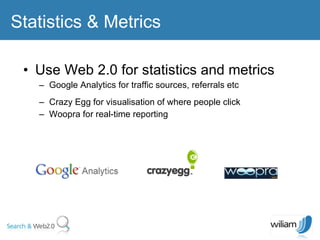
Use Web 2.0 for statistics and metrics Google Analytics for traffic sources, referrals etc  Crazy Egg for visualisation of where people click Woopra for real-time reporting  Statistics & Metrics
Gaining Search visibility using Web 2.0
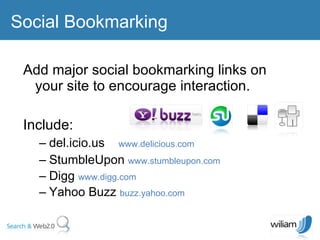
Add major social bookmarking links on your site to encourage interaction. Include:  del.icio.us  www.delicious.com   StumbleUpon  www.stumbleupon.com   Digg  www.digg.com Yahoo Buzz  buzz.yahoo.com Social Bookmarking
Creating a presence on all Social Networking sites such as:  Facebook, Bebo, Twitter, Linkedin Its costs nothing to establish presence  Consider developing an application on Facebook Developer platform or on Google Open Social Development typically takes between 2 weeks and 15 weeks  Web 2.0 Social Networks
Allows bloggers & companies to publish feeds on Facebook  Works on both Facebook Profiles & Pages  Automatically creates links to new content on your site Over 20k installations globally  http://apps.facebook.com/blogrssreader/ Web 2.0 Case Study Facebook Blog RSS Feed Reader
Allow you to share and discover products with other consumers: customers you’d never have  Allows you to submit your own products Typically have been US based.  Ideal for ecommerce sites  Social Shopping www.thisnext.com  www.mypicklist.com  www.kaboodle.com
The major engines now accept submissions of products  Update them via custom XML feeds  Product Search Engines products.live.com  www.google.com/products  shopping.yahoo.com
For bricks and mortar stores its essential to be found Ensure that your address is in address micro format Submit your stores and offices to the following sites:  Mapping maps.live.com  www.google.com.au/maps  www.whereis.com  au.maps.search.yahoo.com
Questions PowerPoint available at www.robertbeerworth.com [email_address]

Search And Web 2.0

  • 1.
  • 2.
    Fractured finger The middle of head cold Teething 5 month old baby boy Apologies
  • 3.
    Search then andnow, and why it’s changed The Web 2.0 Search Strategy: traffic Gaining visibility From the perspective of web development: how can I use search, practically and non-technically? Outline of Presentation
  • 4.
    Reflected the webas it was then... Static, simple and easy manipulated Scant benefit to users Irrelevant results Took forever to get listed Think Altavista, Lycos, Looksmart Web 1.0 Search
  • 5.
    Reflects the webnow... Much more diverse organic results Immediately listing pages in the results: users receive the very latest content Search provide great deal of traffic Many avenues for search other than search: user/search fragmentation Web 2.0 Search
  • 6.
    You can nowsearch just for.... products images blogs video news New Search Avenues
  • 7.
    The Web 2.0Search Strategy: traffic
  • 8.
    Most businesses stilldevelop their websites with Web 1.0 Search in-mind. Very few new businesses websites take advantage – or at least proper advantage – of Web 2.0 and search. You need constant evolution – because search is constantly evolving. The problem currently…
  • 9.
    Assuming search meanstraffic, and traffic is the objective, search is much more than search engines. It means taking advantage of social networks and back-linking, blogging and content syndication. It’s also important to remember…
  • 10.
    Every decision onyour website has to be about search Web 2.0 and Search 101
  • 11.
    Hold up searchand compare every decision you make online: no Flash forms! Pin it to the wall...
  • 12.
    The key toyour success is traffic and without traffic it doesn’t matter. You can have the best content, the lowest prices, the best design. But without traffic, no one will know.... Search
  • 13.
    If you’re notconcentrating on search, you’ll be second to someone that is. You could be beaten by an offshore or interstate competitor. Being number one is essential. The different between position 1 and position 11 is 8 times the traffic. Today it’s totally about search
  • 14.
    Web 2.0 development with search
  • 15.
    You have tocreate an Internet business; building a website for an offline business is not good enough. Customers are attracted very differently to the two: brands are less important. A website designed with search in mind will attract more traffic Strategy 2.0 – the online mindset
  • 16.
    You must havea business plan that will provide benefit, whatever it is. Is it to sell products? Is it lead generation, for offline? Is the site supported by advertising? Can it rely on user generated content? What’s the business plan?
  • 17.
    Identify a niche What do people search to reach that niche? Do users use local terms “widgets Sydney” Is it long-tail or short? Consider using a third party. Research Phase
  • 18.
    Indentify direct andindirect competitors, locally and offshore Your offline competitors will be different to your online competitors Your competitors are those in the number 1 – 10 positions Research Phase
  • 19.
    What type ofcontent will you be publishing? The type your customers are searching for; Consider where the buyer is in the purchasing cycle; buyers and influencers need different content: 100k hits, 100 forms. Content Publishing
  • 20.
    Build with bestpractise Forget designing key content pages in Flash Create content pages that can be reached by search engines Don’t forget about the user experience; can it be read? Design pages with text Designing and building Web 2.0
  • 21.
    Content shouldn’t behidden from the search engines: even hidden content. Dynamically use meta data like titles, descriptions, keywords Don’t forget user-generated content Create Sitemaps regularly - don’t rely on the search engines to find content: and evolve and grow Indexable Pages
  • 22.
    Joost is aIPTV application Runs as a program on your computer Every channel and video has a direct link which is indexable Fifth Gear Channel http://www.joost.com/01900b6 Audi S5 v BMW 335i Shoot-Out – video information page http://www.joost.com/01900gi URL which launches the video joost://01900gi Example 1: Joost – Video Content
  • 23.
    Linkedin a socialnetworking tool for business Publishes a page of every member Has 20 million pages indexed in Google Has 26 million pages indexed in Yahoo Generally ranks in the top ten for name searches Example: 2 Linkedin User Generated Content
  • 24.
    Example 2: LinkedinPublishes the name 4 times on each page for keyword density
  • 25.
    On site Search Every website or application should provide search Providing quality search results is essential Search can contribute to increased page views Systems such as a Google Box provide metrics i.e. number of searches, searches with no results No results search can help tailor future content
  • 26.
  • 27.
    Use RSS topush out new content to search engines Develop content specific feeds i.e. video feed, blog feed etc Decide what content to publish as it happens Submit to relevant syndication sites like www.plugger.com.au or www.topix.net Syndication
  • 28.
    Particularly necessary toblogs Ping is an XML-RPC-based push mechanism A ping is sent to ping servers when a site updates Pinging
  • 29.
    Submit to searchengines via webmaster tools Gain backlinks on related and relevant websites Marketing phase begins Submission Stage
  • 30.
    Use Web 2.0for statistics and metrics Google Analytics for traffic sources, referrals etc Crazy Egg for visualisation of where people click Woopra for real-time reporting Statistics & Metrics
  • 31.
  • 32.
    Add major socialbookmarking links on your site to encourage interaction. Include: del.icio.us www.delicious.com StumbleUpon www.stumbleupon.com Digg www.digg.com Yahoo Buzz buzz.yahoo.com Social Bookmarking
  • 33.
    Creating a presenceon all Social Networking sites such as: Facebook, Bebo, Twitter, Linkedin Its costs nothing to establish presence Consider developing an application on Facebook Developer platform or on Google Open Social Development typically takes between 2 weeks and 15 weeks Web 2.0 Social Networks
  • 34.
    Allows bloggers &companies to publish feeds on Facebook Works on both Facebook Profiles & Pages Automatically creates links to new content on your site Over 20k installations globally http://apps.facebook.com/blogrssreader/ Web 2.0 Case Study Facebook Blog RSS Feed Reader
  • 35.
    Allow you toshare and discover products with other consumers: customers you’d never have Allows you to submit your own products Typically have been US based. Ideal for ecommerce sites Social Shopping www.thisnext.com www.mypicklist.com www.kaboodle.com
  • 36.
    The major enginesnow accept submissions of products Update them via custom XML feeds Product Search Engines products.live.com www.google.com/products shopping.yahoo.com
  • 37.
    For bricks andmortar stores its essential to be found Ensure that your address is in address micro format Submit your stores and offices to the following sites: Mapping maps.live.com www.google.com.au/maps www.whereis.com au.maps.search.yahoo.com
  • 38.
    Questions PowerPoint availableat www.robertbeerworth.com [email_address]