CONTENTS
• Definition
• Evolutionof Sustainable Development Goals
• Millenium Development Goals
• Difference between MDGs & SDGs
• Outline goals that are significant to public health
• Identify the core health system targets within SDG 3
3.
• DEFINITION: “Developmentthat meets the needs of the present without
compromising the ability of future generations to meet their own needs”
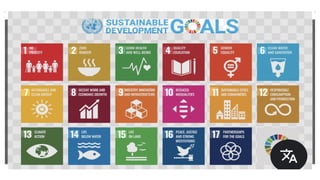
• 15year plan to achieve 17 integrated sustainable development goals with 169
targets and 231 indicators by 2030.
• Adopted by United Nations in 2015.
• 5P’s of new agenda- People, Planet, Prosperity, Peace and Partnership
• Theme: “Leave no one behind”
• 3 core elements :Economic growth, Social inclusion and Environmental protection
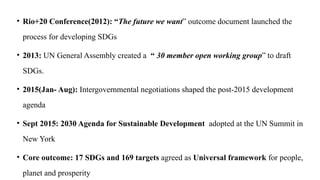
• Rio+20 Conference(2012):“The future we want” outcome document launched the
process for developing SDGs
• 2013: UN General Assembly created a “ 30 member open working group” to draft
SDGs.
• 2015(Jan- Aug): Intergovernmental negotiations shaped the post-2015 development
agenda
• Sept 2015: 2030 Agenda for Sustainable Development adopted at the UN Summit in
New York
• Core outcome: 17 SDGs and 169 targets agreed as Universal framework for people,
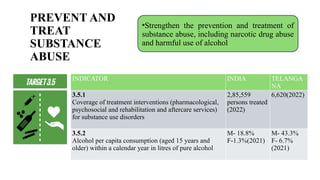
planet and prosperity
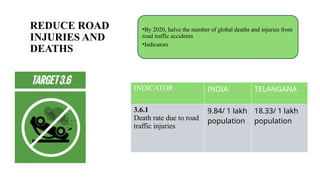
7.
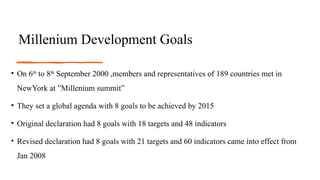
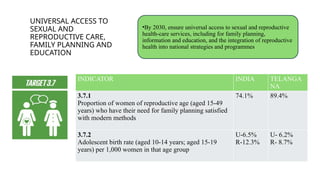
Millenium Development Goals
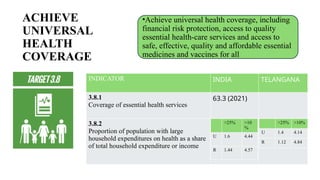
•On 6th
to 8th
September 2000 ,members and representatives of 189 countries met in
NewYork at ”Millenium summit”
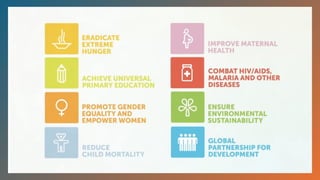
• They set a global agenda with 8 goals to be achieved by 2015
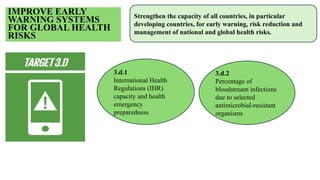
• Original declaration had 8 goals with 18 targets and 48 indicators
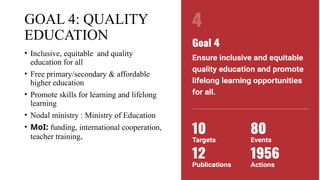
• Revised declaration had 8 goals with 21 targets and 60 indicators came into effect from
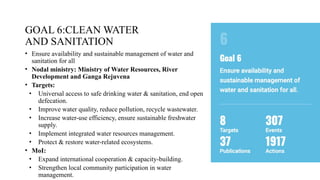
Jan 2008
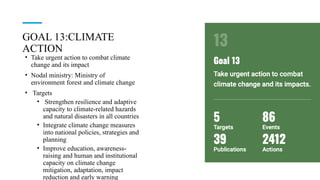
9.
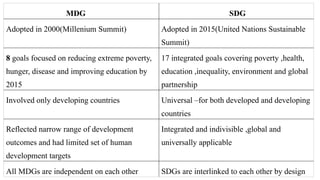
MDG SDG
Adopted in2000(Millenium Summit) Adopted in 2015(United Nations Sustainable
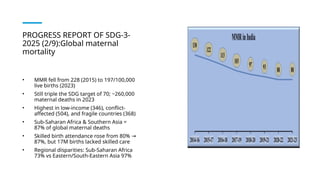
Summit)
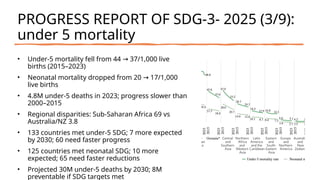
8 goals focused on reducing extreme poverty,
hunger, disease and improving education by
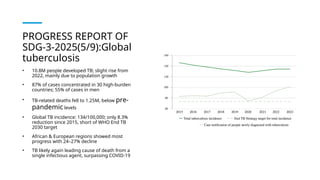
2015
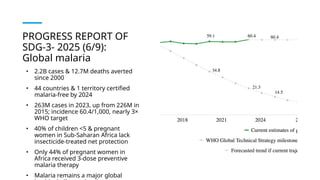
17 integrated goals covering poverty ,health,
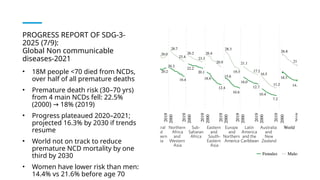
education ,inequality, environment and global
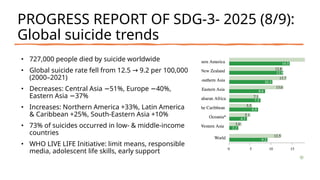
partnership
Involved only developing countries Universal –for both developed and developing
countries
Reflected narrow range of development
outcomes and had limited set of human
development targets
Integrated and indivisible ,global and
universally applicable
All MDGs are independent on each other SDGs are interlinked to each other by design
10.
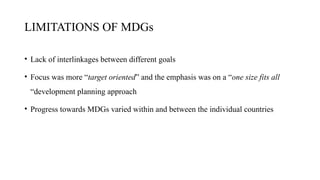
LIMITATIONS OF MDGs
•Lack of interlinkages between different goals
• Focus was more “target oriented” and the emphasis was on a “one size fits all
“development planning approach
• Progress towards MDGs varied within and between the individual countries
11.
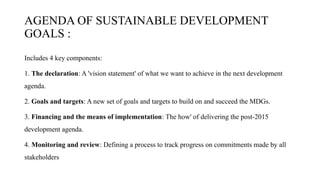
AGENDA OF SUSTAINABLEDEVELOPMENT
GOALS :
Includes 4 key components:
1. The declaration: A 'vision statement' of what we want to achieve in the next development
agenda.
2. Goals and targets: A new set of goals and targets to build on and succeed the MDGs.
3. Financing and the means of implementation: The how' of delivering the post-2015
development agenda.
4. Monitoring and review: Defining a process to track progress on commitments made by all
stakeholders
12.
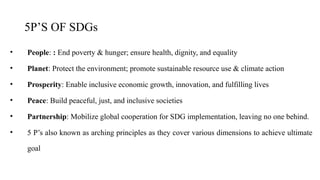
5P’S OF SDGs
•People: : End poverty & hunger; ensure health, dignity, and equality
• Planet: Protect the environment; promote sustainable resource use & climate action
• Prosperity: Enable inclusive economic growth, innovation, and fulfilling lives
• Peace: Build peaceful, just, and inclusive societies
• Partnership: Mobilize global cooperation for SDG implementation, leaving no one behind.
• 5 P’s also known as arching principles as they cover various dimensions to achieve ultimate
goal
13.
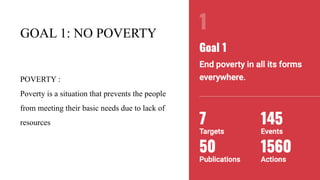
GOAL 1: NOPOVERTY
POVERTY :
Poverty is a situation that prevents the people
from meeting their basic needs due to lack of
resources
14.
• End povertyin all its forms everywhere
• Targets:
End poverty in all forms & eradicate extreme poverty
Reduce inequalities & ensure access to basic services
Build resilience to climate, economic & disaster shocks
MoI: mobilize resources & strengthen global partnerships
15.
GOAL 2: ZEROHUNGER
• End hunger , achieve food security and improved nutrition and promote sustainable
agriculture.
• Targets:
• End all forms of malnutrition & stunting/wasting in children.
• Ensure safe, nutritious, sufficient food year-round.
• Double productivity & incomes of small-scale farmers.
• Sustainable food systems & resilient agriculture.
• Maintain genetic diversity of seeds & livestock.
16.
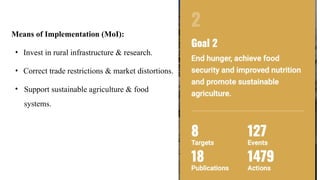
Means of Implementation(MoI):
• Invest in rural infrastructure & research.
• Correct trade restrictions & market distortions.
• Support sustainable agriculture & food
systems.
17.
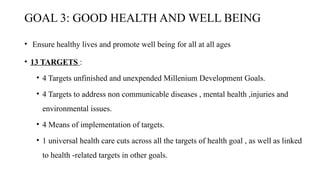
GOAL 3: GOODHEALTH AND WELL BEING
• Ensure healthy lives and promote well being for all at all ages
• 13 TARGETS :
• 4 Targets unfinished and unexpended Millenium Development Goals.
• 4 Targets to address non communicable diseases , mental health ,injuries and
environmental issues.
• 4 Means of implementation of targets.
• 1 universal health care cuts across all the targets of health goal , as well as linked
to health -related targets in other goals.
18.
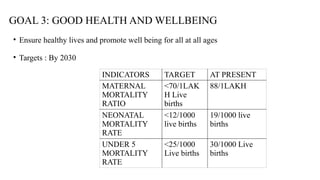
GOAL 3: GOODHEALTH AND WELLBEING
• Ensure healthy lives and promote well being for all at all ages
• Targets : By 2030
INDICATORS TARGET AT PRESENT
MATERNAL
MORTALITY
RATIO
<70/1LAK
H Live
births
88/1LAKH
NEONATAL
MORTALITY
RATE
<12/1000
live births
19/1000 live
births
UNDER 5
MORTALITY
RATE
<25/1000
Live births
30/1000 Live
births
20.
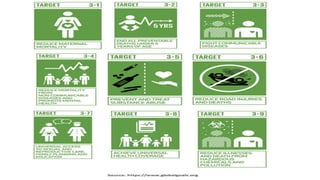
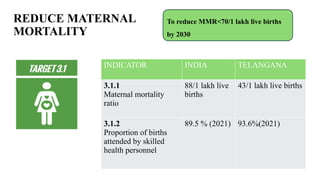
REDUCE MATERNAL
MORTALITY
To reduceMMR<70/1 lakh live births
by 2030
INDICATOR INDIA TELANGANA
3.1.1
Maternal mortality
ratio
88/1 lakh live
births
43/1 lakh live births
3.1.2
Proportion of births
attended by skilled
health personnel
89.5 % (2021) 93.6%(2021)
21.
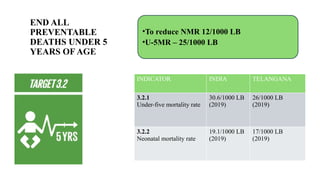
END ALL
PREVENTABLE
DEATHS UNDER5
YEARS OF AGE
•To reduce NMR 12/1000 LB
•U-5MR – 25/1000 LB
INDICATOR INDIA TELANGANA
3.2.1
Under-five mortality rate
30.6/1000 LB
(2019)
26/1000 LB
(2019)
3.2.2
Neonatal mortality rate
19.1/1000 LB
(2019)
17/1000 LB
(2019)
22.
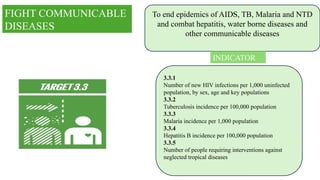
To end epidemicsof AIDS, TB, Malaria and NTD
and combat hepatitis, water borne diseases and
other communicable diseases
3.3.1
Number of new HIV infections per 1,000 uninfected
population, by sex, age and key populations
3.3.2
Tuberculosis incidence per 100,000 population
3.3.3
Malaria incidence per 1,000 population
3.3.4
Hepatitis B incidence per 100,000 population
3.3.5
Number of people requiring interventions against
neglected tropical diseases
FIGHT COMMUNICABLE
DISEASES
INDICATOR
23.
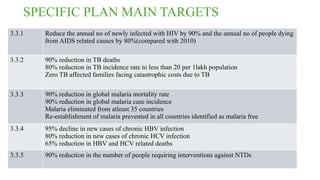
SPECIFIC PLAN MAINTARGETS
3.3.1 Reduce the annual no of newly infected with HIV by 90% and the annual no of people dying
from AIDS related causes by 80%(compared with 2010)
3.3.2 90% reduction in TB deaths
80% reduction in TB incidence rate to less than 20 per 1lakh population
Zero TB affected families facing catastrophic costs due to TB
3.3.3 90% reduction in global malaria mortality rate
90% reduction in global malaria case incidence
Malaria eliminated from atleast 35 countries
Re-establishment of malaria prevented in all countries identified as malaria free
3.3.4 95% decline in new cases of chronic HBV infection
80% reduction in new cases of chronic HCV infection
65% reduction in HBV and HCV related deaths
3.3.5 90% reduction in the number of people requiring interventions against NTDs
24.
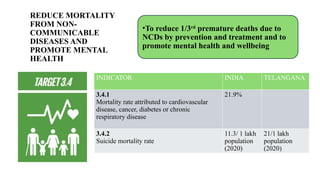
REDUCE MORTALITY
FROM NON-
COMMUNICABLE
DISEASESAND
PROMOTE MENTAL
HEALTH
•To reduce 1/3rd
premature deaths due to
NCDs by prevention and treatment and to
promote mental health and wellbeing
INDICATOR INDIA TELANGANA
3.4.1
Mortality rate attributed to cardiovascular
disease, cancer, diabetes or chronic
respiratory disease
21.9%
3.4.2
Suicide mortality rate
11.3/ 1 lakh
population
(2020)
21/1 lakh
population
(2020)
25.
PREVENT AND
TREAT
SUBSTANCE
ABUSE
•Strengthen theprevention and treatment of
substance abuse, including narcotic drug abuse
and harmful use of alcohol
INDICATOR INDIA TELANGA
NA
3.5.1
Coverage of treatment interventions (pharmacological,
psychosocial and rehabilitation and aftercare services)
for substance use disorders
2,85,559
persons treated
(2022)
6,620(2022)
3.5.2
Alcohol per capita consumption (aged 15 years and
older) within a calendar year in litres of pure alcohol
M- 18.8%
F-1.3%(2021)
M- 43.3%
F- 6.7%
(2021)
26.
REDUCE ROAD
INJURIES AND
DEATHS
•By2020, halve the number of global deaths and injuries from
road traffic accidents
•Indicators
INDICATOR INDIA TELANGANA
3.6.1
Death rate due to road
traffic injuries
9.84/ 1 lakh
population
18.33/ 1 lakh
population
27.
UNIVERSAL ACCESS TO
SEXUALAND
REPRODUCTIVE CARE,
FAMILY PLANNING AND
EDUCATION
•By 2030, ensure universal access to sexual and reproductive
health-care services, including for family planning,
information and education, and the integration of reproductive
health into national strategies and programmes
INDICATOR INDIA TELANGA
NA
3.7.1
Proportion of women of reproductive age (aged 15-49
years) who have their need for family planning satisfied
with modern methods
74.1% 89.4%
3.7.2
Adolescent birth rate (aged 10-14 years; aged 15-19
years) per 1,000 women in that age group
U-6.5%
R-12.3%
U- 6.2%
R- 8.7%
28.
ACHIEVE
UNIVERSAL
HEALTH
COVERAGE
•Achieve universal healthcoverage, including
financial risk protection, access to quality
essential health-care services and access to
safe, effective, quality and affordable essential
medicines and vaccines for all
INDICATOR INDIA TELANGANA
3.8.1
Coverage of essential health services
63.3 (2021)
3.8.2
Proportion of population with large
household expenditures on health as a share
of total household expenditure or income
>25% >10
%
U 1.6 4.44
R 1.44 4.57
>25% >10%
U 1.4 4.14
R 1.12 4.84
29.
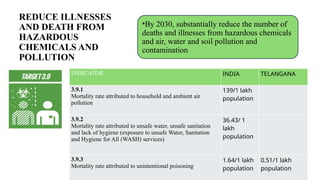
REDUCE ILLNESSES
AND DEATHFROM
HAZARDOUS
CHEMICALS AND
POLLUTION
•By 2030, substantially reduce the number of
deaths and illnesses from hazardous chemicals
and air, water and soil pollution and
contamination
INDICATOR INDIA TELANGANA
3.9.1
Mortality rate attributed to household and ambient air
pollution
139/1 lakh
population
3.9.2
Mortality rate attributed to unsafe water, unsafe sanitation
and lack of hygiene (exposure to unsafe Water, Sanitation
and Hygiene for All (WASH) services)
36.43/ 1
lakh
population
3.9.3
Mortality rate attributed to unintentional poisoning
1.64/1 lakh
population
0.51/1 lakh
population
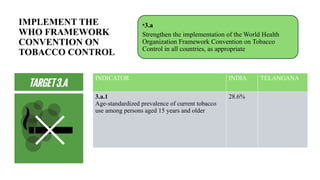
30.
IMPLEMENT THE
WHO FRAMEWORK
CONVENTIONON
TOBACCO CONTROL
•3.a
Strengthen the implementation of the World Health
Organization Framework Convention on Tobacco
Control in all countries, as appropriate
INDICATOR INDIA TELANGANA
3.a.1
Age-standardized prevalence of current tobacco
use among persons aged 15 years and older
28.6%
31.
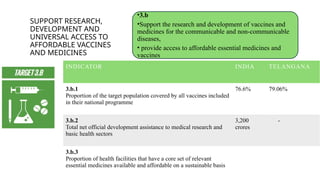
SUPPORT RESEARCH,
DEVELOPMENT AND
UNIVERSALACCESS TO
AFFORDABLE VACCINES
AND MEDICINES
•3.b
•Support the research and development of vaccines and
medicines for the communicable and non-communicable
diseases,
• provide access to affordable essential medicines and
vaccines
INDICATOR INDIA TELANGANA
3.b.1
Proportion of the target population covered by all vaccines included
in their national programme
76.6% 79.06%
3.b.2
Total net official development assistance to medical research and
basic health sectors
3,200
crores
-
3.b.3
Proportion of health facilities that have a core set of relevant
essential medicines available and affordable on a sustainable basis
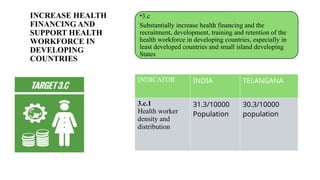
32.
INCREASE HEALTH
FINANCING AND
SUPPORTHEALTH
WORKFORCE IN
DEVELOPING
COUNTRIES
•3.c
Substantially increase health financing and the
recruitment, development, training and retention of the
health workforce in developing countries, especially in
least developed countries and small island developing
States
INDICATOR INDIA TELANGANA
3.c.1
Health worker
density and
distribution
31.3/10000
Population
30.3/10000
population
33.
Strengthen the capacityof all countries, in particular
developing countries, for early warning, risk reduction and
management of national and global health risks.
IMPROVE EARLY
WARNING SYSTEMS
FOR GLOBAL HEALTH
RISKS
3.d.1
International Health
Regulations (IHR)
capacity and health
emergency
preparedness
3.d.2
Percentage of
bloodstream infections
due to selected
antimicrobial-resistant
organisms
34.
GOAL 4: QUALITY
EDUCATION
•Inclusive, equitable and quality
education for all
• Free primary/secondary & affordable
higher education
• Promote skills for learning and lifelong
learning
• Nodal ministry : Ministry of Education
• MoI: funding, international cooperation,
teacher training.
35.
GOAL 6:CLEAN WATER
ANDSANITATION
• Ensure availability and sustainable management of water and
sanitation for all
• Nodal ministry: Ministry of Water Resources, River
Development and Ganga Rejuvena
• Targets:
• Universal access to safe drinking water & sanitation, end open
defecation.
• Improve water quality, reduce pollution, recycle wastewater.
• Increase water-use efficiency, ensure sustainable freshwater
supply.
• Implement integrated water resources management.
• Protect & restore water-related ecosystems.
• MoI:
• Expand international cooperation & capacity-building.
• Strengthen local community participation in water
management.
36.
GOAL 13:CLIMATE
ACTION
• Takeurgent action to combat climate
change and its impact
• Nodal ministry: Ministry of
environment forest and climate change
• Targets
• Strengthen resilience and adaptive
capacity to climate-related hazards
and natural disasters in all countries
• Integrate climate change measures
into national policies, strategies and
planning
• Improve education, awareness-
raising and human and institutional
capacity on climate change
mitigation, adaptation, impact
reduction and early warning
37.
• MoI:
• Implementthe commitment undertaken by developed-country parties to the United Nations
Framework Convention on Climate Change to a goal of mobilizing jointly $100 billion annually
by 2020 from all sources to address the needs of developing countries in the context of
meaningful mitigation actions and transparency on implementation and fully operationalize the
Green Climate Fund through its capitalization as soon as possible
• Promote mechanisms for raising capacity for effective climate change-related planning and
management in least developed countries and small island developing States, including focusing
on women, youth and local and marginalized communities
38.
PROGRESS REPORT OFSDG-3- 2025
(1/9):
• 2000–2019: Maternal & child mortality declined; HIV incidence fell; life expectancy
5+ years
↑
• COVID-19 cut life expectancy by 1.8 years; slowed progress on health-related SDGs
• AIDS deaths halved; 54 countries eliminated 1 neglected tropical disease;
≥
malaria & TB remain major threats
• NCDs caused 18M deaths <70 yrs; risk factors (tobacco, pollution, poor diet)
persist
• Inequalities & underfunded systems persist; bold investment & resilient health
systems needed for SDG targets by 2030
39.
PROGRESS REPORT OFSDG-3-
2025 (2/9):Global maternal
mortality
• MMR fell from 228 (2015) to 197/100,000
live births (2023)
• Still triple the SDG target of 70; ~260,000
maternal deaths in 2023
• Highest in low-income (346), conflict-
affected (504), and fragile countries (368)
• Sub-Saharan Africa & Southern Asia =
87% of global maternal deaths
• Skilled birth attendance rose from 80% →
87%, but 17M births lacked skilled care
• Regional disparities: Sub-Saharan Africa
73% vs Eastern/South-Eastern Asia 97%
40.
PROGRESS REPORT OFSDG-3- 2025 (3/9):
under 5 mortality
• Under-5 mortality fell from 44 37/1,000 live
→
births (2015–2023)
• Neonatal mortality dropped from 20 17/1,000
→
live births
• 4.8M under-5 deaths in 2023; progress slower than
2000–2015
• Regional disparities: Sub-Saharan Africa 69 vs
Australia/NZ 3.8
• 133 countries met under-5 SDG; 7 more expected
by 2030; 60 need faster progress
• 125 countries met neonatal SDG; 10 more
expected; 65 need faster reductions
• Projected 30M under-5 deaths by 2030; 8M
preventable if SDG targets met
41.
PROGRESS REPORT OFSDG-3- 2025
(4/9):
Global HIV/AIDS Progress
• AIDS-related deaths fell from 1.4M (2010) 630,000 (2024)
→
• New HIV infections 40% lower than 2010; Sub-Saharan Africa reduced 56%
• 1.3M people newly infected in 2024; adolescent girls in Sub-Saharan Africa highly
affected
• 40.8M living with HIV; 9.2M not on treatment; 120,000 children newly infected
• Funding cuts threaten services; US pause could cause 6M new infections & 4M
deaths by 2029
• Domestic financing and global solidarity critical to sustain progress
42.
PROGRESS REPORT OF
SDG-3-2025(5/9):Global
tuberculosis
•10.8M people developed TB; slight rise from
2022, mainly due to population growth
• 87% of cases concentrated in 30 high-burden
countries; 55% of cases in men
• TB-related deaths fell to 1.25M, below pre-
pandemic levels
• Global TB incidence: 134/100,000; only 8.3%
reduction since 2015, short of WHO End TB
2030 target
• African & European regions showed most
progress with 24–27% decline
• TB likely again leading cause of death from a
single infectious agent, surpassing COVID-19
43.
PROGRESS REPORT OF
SDG-3-2025 (6/9):
Global malaria
• 2.2B cases & 12.7M deaths averted
since 2000
• 44 countries & 1 territory certified
malaria-free by 2024
• 263M cases in 2023, up from 226M in
2015; incidence 60.4/1,000, nearly 3×
WHO target
• 40% of children <5 & pregnant
women in Sub-Saharan Africa lack
insecticide-treated net protection
• Only 44% of pregnant women in
Africa received 3-dose preventive
malaria therapy
• Malaria remains a major global
44.
PROGRESS REPORT OFSDG-3-
2025 (7/9):
Global Non communicable
diseases-2021
• 18M people <70 died from NCDs,
over half of all premature deaths
• Premature death risk (30–70 yrs)
from 4 main NCDs fell: 22.5%
(2000) 18% (2019)
→
• Progress plateaued 2020–2021;
projected 16.3% by 2030 if trends
resume
• World not on track to reduce
premature NCD mortality by one
third by 2030
• Women have lower risk than men:
14.4% vs 21.6% before age 70
45.
PROGRESS REPORT OFSDG-3- 2025 (8/9):
Global suicide trends
• 727,000 people died by suicide worldwide
• Global suicide rate fell from 12.5 9.2 per 100,000
→
(2000–2021)
• Decreases: Central Asia 51%, Europe 40%,
− −
Eastern Asia 37%
−
• Increases: Northern America +33%, Latin America
& Caribbean +25%, South-Eastern Asia +10%
• 73% of suicides occurred in low- & middle-income
countries
• WHO LIVE LIFE Initiative: limit means, responsible
media, adolescent life skills, early support
46.
PROGRESS REPORT OFSDG-3- 2025
(9/9):
Global health workforce
• 70M health workers globally; 52M in 5 key occupations (doctors, nurses,
midwives, dentists, pharmacists)
• Global shortage: 14.7M in 2023; projected 11.1M by 2030, mainly in Northern
& Sub-Saharan Africa
• Workforce density rose 26% (2013–2023), but inequities remain
• High-income countries: 1 worker/64 people; low-income: 1/621
• 80% of key workers serve 53% of population; 8.4M more needed by 2030 to
meet demand
47.
High level PoliticalForum on
Sustainable Development
• Central United Nations platform for follow-up and review of Sustainable
Development Goals
• Meets annually under the Economic and Social Council; every four years at the
United Nations General Assembly
• Monitors global progress using SDG indicators and reports
• Provides guidance, shares best practices, and fosters international partnerships
• Supports countries in implementing the 2030 Agenda and achieving the
Sustainable Development Goals
48.
UNITED NATIONS DATACOMMONS
• Central platform for accessing global data on Sustainable Development Goals
(SDGs)
• Provides open, reliable, and harmonized data from United Nations agencies and
national statistical systems
• Facilitates evidence-based decision-making, monitoring, and reporting on the
2030 Agenda
• Offers tools for visualization, analysis, and downloading SDG indicators
• Supports policymakers, researchers, and stakeholders in tracking progress and
identifying gaps
49.
SDG INDIA INDEX
•NITI Aayog has developed SDG India Index to measure India and it’s states progress towards
the SDGs for 2030
• Intended to provide a holistic view of the social,economic and environmental status of the
country and it’s states and union territories
• It computes goal wise scores on the 115 indicators
• Incorporates 16 out of 17 SDGs with qualitative assessment on goal 17 and covers 70 SDG
targets
• Scores range between 0 and 100
50.
• If astate has achieved a score of 100,it signifies it has achieved the 2030 targets
• States and union territories are classified into 4 categories based on sdg index
score
1. Aspirant(0-49)
2. Performer(50-64)
3. Front runner(65-99)
4. Achiever(100)
51.
References
• United Nations.Sustainable Development Goals [Internet]. United Nations. 2015 [cited 2025
Oct 3]. Available from: https://sdgs.un.org/goals
• United Nations. UN Data Commons [Internet]. United Nations. 2025 [cited 2025 Oct 3].
Available from: https://data.un.org
• United Nations Department of Economic and Social Affairs. SDG Progress Reports [Internet].
United Nations. 2025 [cited 2025 Oct 3]. Available from: https://sdgs.un.org/progress.
• IAPSM Textbook of Community Medicine.
• K.PARK Textbook of Community Medicine.
52.
References
• Sustainable DevelopmentGoals (SDGs), Targets, CSS, Interventions, Nodal and other Ministries (As on
04.04.2016).
• Available at: http://niti.gov.in/content/SDGs.php
• www.undp.org/content/undp/en/home/sustainable-
• development-goals.html
• https://www.drishtiias.com/daily-news-analysis/ sdg-india-index-2020-21-niti-aayog
• https://www.niti.gov.in/sites/default/files/2019-01/
• SDGMapping-Document-NITI_O.pdf
#20 Global MMR is 223 in 2020
Kerala (19),
Maharashtra (33),
Telangana (43)
Andhra Pradesh (45),
Tamil Nadu (54),
Jharkhand (56),
Gujarat (57),
Karnataka (69).
#28 The Universal Health Coverage (UHC) Service Coverage Index is measured on a scale from 0 (worst) to 100 (best)based on the average coverage of essential services including reproductive, maternal, newborn and child health,infectious diseases, non-communicable diseases and service capacity and access.
#31 Percentage of children age 12-23 months fully vaccinated with BCG, Measles and three doses each of Polio and DPT or Penta vaccine (excluding polio vaccine given at birth) | Percentarrow_forward
2015-2016,2019-2021
info
3.b.2: Budgetary allocation for Department of Health Research | Rs. Crorearrow_forward
![References
• United Nations. Sustainable Development Goals [Internet]. United Nations. 2015 [cited 2025
Oct 3]. Available from: https://sdgs.un.org/goals
• United Nations. UN Data Commons [Internet]. United Nations. 2025 [cited 2025 Oct 3].
Available from: https://data.un.org
• United Nations Department of Economic and Social Affairs. SDG Progress Reports [Internet].
United Nations. 2025 [cited 2025 Oct 3]. Available from: https://sdgs.un.org/progress.
• IAPSM Textbook of Community Medicine.
• K.PARK Textbook of Community Medicine.](https://image.slidesharecdn.com/sustainabledevelopmentgoalsppt3-260119044015-d6da6196/85/Progress-on-sustainable-development-goals-2026-pptx-51-320.jpg)


![Cells and Organs of immune system [Autosaved].pptx](https://cdn.slidesharecdn.com/ss_thumbnails/cellsandorgansofimmunesystemautosaved-260123152717-ea0cb261-thumbnail.jpg?width=640&height=640&fit=bounds)


![Hypothalamus short notes on location, function and disorders by Dr. Neha [PT]...](https://cdn.slidesharecdn.com/ss_thumbnails/hypothalamusbydr-260124142231-2b48143d-thumbnail.jpg?width=640&height=640&fit=bounds)


