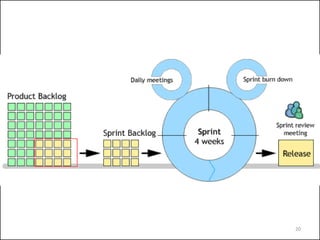


managing
thought
complexity


Scrum        1
Who am I?


        2
What is SCRUM?
             3
We’re losing the relay race

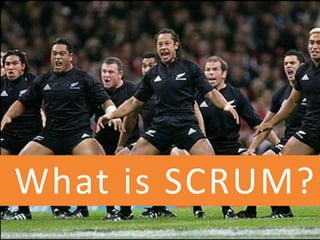
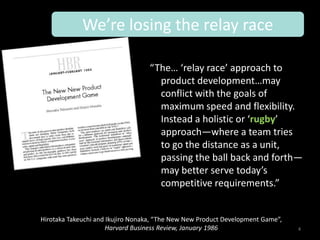
                                  “The… ‘relay race’ approach to
                                    product development…may
                                    conflict with the goals of
                                    maximum speed and flexibility.
                                    Instead a holistic or ‘rugby’
                                    approach—where a team tries
                                    to go the distance as a unit,
                                    passing the ball back and forth—
                                    may better serve today’s
                                    competitive requirements.”


Hirotaka Takeuchi and Ikujiro Nonaka, “The New New Product Development Game”,
                      Harvard Business Review, January 1986                     4
Why?
       5
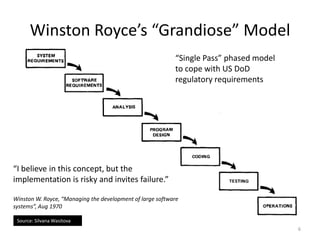
Winston Royce’s “Grandiose” Model
                                                           “Single Pass” phased model
                                                           to cope with US DoD
                                                           regulatory requirements


“I believe in this concept, but the
implementation is risky and invites failure.”

Winston W. Royce, “Managing the development of large software
systems”, Aug 1970

 Source: Silvana Wasitova
                                                                                        6
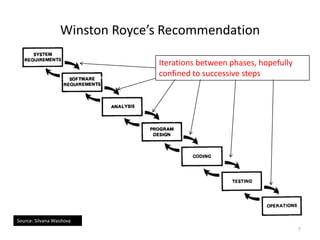
Winston Royce’s Recommendation

                                 Iterations between phases, hopefully
                                 confined to successive steps


Source: Silvana Wasitova
                                                                        7
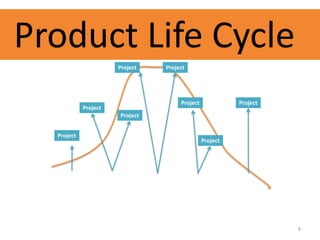
Product Life Cycle
                      Project   Project


                                     Project             Project
            Project
                      Project


  Project
                                               Project


                                                                   8
Scrum is a framework
structured to support
   complex product
    development.

                        9
Compl
 exity   10
11
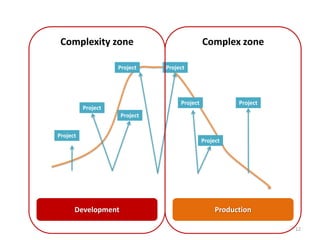
Complexity zone                             Complex zone

                    Project   Project


                                   Project              Project
          Project
                    Project


Project
                                             Project


      Development                                 Production

                                                                  12
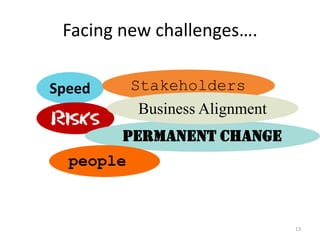
Facing new challenges….

Speed      Stakeholders
            Business Alignment
Risks
        Permanent change
  people


                                 13
Scrum
        14
Scrum in 100 words
• Scrum is an agile process that allows us to focus on
  delivering the highest business value in the shortest time.

• It allows us to rapidly and repeatedly inspect actual
  working software (every two weeks to one month).

• The business sets the priorities. Teams self-organize to
  determine the best way to deliver the highest priority
  features.

• Every two weeks to a month anyone can see real working
  software and decide to release it as is or continue to
  enhance it for another sprint.
                                                                15
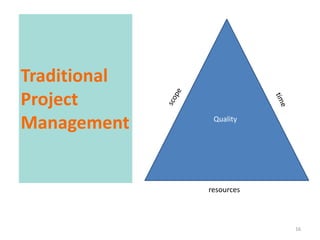
Traditional
Project
Management     Quality


              resources


                          16
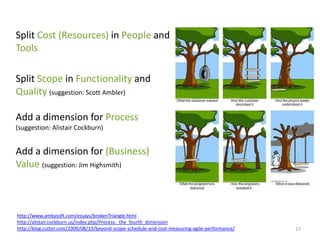
Split Cost (Resources) in People and
Tools

Split Scope in Functionality and
Quality (suggestion: Scott Ambler)

Add a dimension for Process
(suggestion: Alistair Cockburn)


Add a dimension for (Business)
Value (suggestion: Jim Highsmith)


http://www.ambysoft.com/essays/brokenTriangle.html
http://alistair.cockburn.us/index.php/Process:_the_fourth_dimension
http://blog.cutter.com/2009/08/10/beyond-scope-schedule-and-cost-measuring-agile-performance/   17
And we get...      1.   Value
the 7 dimensions   2.   People
of software        3.   Functionality
projects           4.   Quality
                   5.   Tools
                   6.   Time
                   7.   Process

                                        18
Scrum Theory

• Scrum is founded on empirical process control
  theory, or empiricism.

• Empiricism asserts that knowledge comes from
  experience and making decisions based on what
  is known.

• Scrum employs an iterative, incremental
  approach to optimize predictability and control
  risk

                                                    19
20
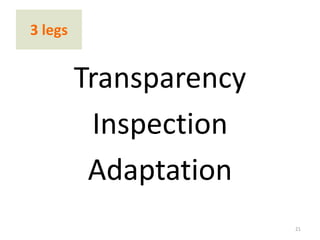
3 legs


         Transparency
          Inspection
          Adaptation
                        21
Scrum consists of Scrum Teams and their
  associated roles, events, artifacts, and rules.

Each component within the framework serves a
  specific purpose and is essential to Scrum’s
  success and usage.

The rules of Scrum bind together the events,
  roles, and artifacts, governing the relationship
  and interaction between them.
                                              22
The Scrum Team
• The Scrum Team consists of a Product Owner, the
  Development Team, and a Scrum Master.

• Scrum Teams are self-organizing and cross-functional.

• The team model in Scrum is designed to optimize
  flexibility, creativity, and productivity.

• Scrum Teams deliver products iteratively and
  incrementally, maximizing opportunities for feedback.

                                                          23
A Product Owner
• The Product Owner is responsible for
  maximizing the value of the product and the
  work of the Development Team.

• The Product Owner is the sole person
  responsible for managing the Product Backlog.


                                                24
The Development Team
• The Development Team consists of
  professionals who do the work of delivering a
  potentially releasable Increment of “Done”
  product at the end of each Sprint.
  – Self organizing
  – Cross-functional
• Optimal Development Team size is small
  enough to remain nimble and large enough to
  complete significant work.

                                                  25
The Scrum Master
• The Scrum Master is responsible for ensuring
  Scrum is understood and enacted.

• Scrum Masters do this by ensuring that the Scrum
  Team adheres to Scrum theory, practices, and
  rules.

• The Scrum Master helps those outside the Scrum
  Team understand which of their interactions with
  the Scrum Team are helpful and which aren't.

                                                 26
• Clear and catching vision
  Basic
             • Maintained Product Backlog
principles
             • High Stakeholder’s
               participitation

             • Sprint is protected

             • Collaborative Sprint Reviews

             • Retrospectives focusing on
               work and progress
                                              27
Example
          28
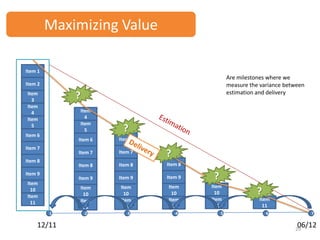
Maximizing Value

Item 1
                                                   Are milestones where we
Item 2                                             measure the variance between
                                                   estimation and delivery
Item
  3
             ?
Item
  4              Item
Item               4
  5              Item
                   5     ?
Item 6
             Item 6     Item 6
Item 7
             Item 7     Item 7
                                 ?
Item 8
             Item 8     Item 8   Item 8
Item 9
             Item 9     Item 9   Item 9    ?
Item
                 Item   Item     Item     Item
  10
Item               10     10       10       10                ?
                 Item   Item     Item     Item                Item
  11
                   11     11       11       11                  11
         1        2        3         4         5                  6               7

    12/11                                                                   06/12
                                                                           29
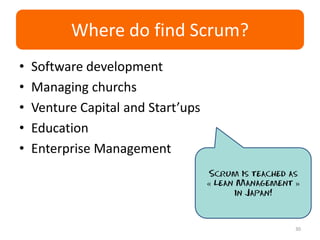
Where do find Scrum?
•   Software development
•   Managing churchs
•   Venture Capital and Start’ups
•   Education
•   Enterprise Management
                                    Scrum is teached as
                                    « Lean Management »
                                          in Japan!


                                                      30
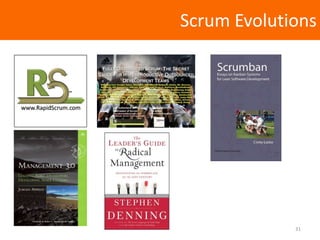
Scrum Evolutions


             31
Credits
• Jurgen Appelo, What is Agile Management?

• Mike Cohn, Introduction to Scrum

• Dave Snowden, Cynefin


                                             32
Questions?
         33
34
35
Thanks
         36
Pierre E. NEIS

 Management Consultant

 Head of Lean Centre of

Competence at coPROcess S.A.

 Scrum & Lean Coach


                               37

Scrum managing through complexity

  • 1.
  • 2.
  • 3.
  • 4.
    We’re losing therelay race “The… ‘relay race’ approach to product development…may conflict with the goals of maximum speed and flexibility. Instead a holistic or ‘rugby’ approach—where a team tries to go the distance as a unit, passing the ball back and forth— may better serve today’s competitive requirements.” Hirotaka Takeuchi and Ikujiro Nonaka, “The New New Product Development Game”, Harvard Business Review, January 1986 4
  • 5.
  • 6.
    Winston Royce’s “Grandiose”Model “Single Pass” phased model to cope with US DoD regulatory requirements “I believe in this concept, but the implementation is risky and invites failure.” Winston W. Royce, “Managing the development of large software systems”, Aug 1970 Source: Silvana Wasitova 6
  • 7.
    Winston Royce’s Recommendation Iterations between phases, hopefully confined to successive steps Source: Silvana Wasitova 7
  • 8.
    Product Life Cycle Project Project Project Project Project Project Project Project 8
  • 9.
    Scrum is aframework structured to support complex product development. 9
  • 10.
  • 11.
  • 12.
    Complexity zone Complex zone Project Project Project Project Project Project Project Project Development Production 12
  • 13.
    Facing new challenges…. Speed Stakeholders Business Alignment Risks Permanent change people 13
  • 14.
  • 15.
    Scrum in 100words • Scrum is an agile process that allows us to focus on delivering the highest business value in the shortest time. • It allows us to rapidly and repeatedly inspect actual working software (every two weeks to one month). • The business sets the priorities. Teams self-organize to determine the best way to deliver the highest priority features. • Every two weeks to a month anyone can see real working software and decide to release it as is or continue to enhance it for another sprint. 15
  • 16.
    Traditional Project Management Quality resources 16
  • 17.
    Split Cost (Resources)in People and Tools Split Scope in Functionality and Quality (suggestion: Scott Ambler) Add a dimension for Process (suggestion: Alistair Cockburn) Add a dimension for (Business) Value (suggestion: Jim Highsmith) http://www.ambysoft.com/essays/brokenTriangle.html http://alistair.cockburn.us/index.php/Process:_the_fourth_dimension http://blog.cutter.com/2009/08/10/beyond-scope-schedule-and-cost-measuring-agile-performance/ 17
  • 18.
    And we get... 1. Value the 7 dimensions 2. People of software 3. Functionality projects 4. Quality 5. Tools 6. Time 7. Process 18
  • 19.
    Scrum Theory • Scrumis founded on empirical process control theory, or empiricism. • Empiricism asserts that knowledge comes from experience and making decisions based on what is known. • Scrum employs an iterative, incremental approach to optimize predictability and control risk 19
  • 20.
  • 21.
    3 legs Transparency Inspection Adaptation 21
  • 22.
    Scrum consists ofScrum Teams and their associated roles, events, artifacts, and rules. Each component within the framework serves a specific purpose and is essential to Scrum’s success and usage. The rules of Scrum bind together the events, roles, and artifacts, governing the relationship and interaction between them. 22
  • 23.
    The Scrum Team •The Scrum Team consists of a Product Owner, the Development Team, and a Scrum Master. • Scrum Teams are self-organizing and cross-functional. • The team model in Scrum is designed to optimize flexibility, creativity, and productivity. • Scrum Teams deliver products iteratively and incrementally, maximizing opportunities for feedback. 23
  • 24.
    A Product Owner •The Product Owner is responsible for maximizing the value of the product and the work of the Development Team. • The Product Owner is the sole person responsible for managing the Product Backlog. 24
  • 25.
    The Development Team •The Development Team consists of professionals who do the work of delivering a potentially releasable Increment of “Done” product at the end of each Sprint. – Self organizing – Cross-functional • Optimal Development Team size is small enough to remain nimble and large enough to complete significant work. 25
  • 26.
    The Scrum Master •The Scrum Master is responsible for ensuring Scrum is understood and enacted. • Scrum Masters do this by ensuring that the Scrum Team adheres to Scrum theory, practices, and rules. • The Scrum Master helps those outside the Scrum Team understand which of their interactions with the Scrum Team are helpful and which aren't. 26
  • 27.
    • Clear andcatching vision Basic • Maintained Product Backlog principles • High Stakeholder’s participitation • Sprint is protected • Collaborative Sprint Reviews • Retrospectives focusing on work and progress 27
  • 28.
  • 29.
    Maximizing Value Item 1 Are milestones where we Item 2 measure the variance between estimation and delivery Item 3 ? Item 4 Item Item 4 5 Item 5 ? Item 6 Item 6 Item 6 Item 7 Item 7 Item 7 ? Item 8 Item 8 Item 8 Item 8 Item 9 Item 9 Item 9 Item 9 ? Item Item Item Item Item 10 Item 10 10 10 10 ? Item Item Item Item Item 11 11 11 11 11 11 1 2 3 4 5 6 7 12/11 06/12 29
  • 30.
    Where do findScrum? • Software development • Managing churchs • Venture Capital and Start’ups • Education • Enterprise Management Scrum is teached as « Lean Management » in Japan! 30
  • 31.
  • 32.
    Credits • Jurgen Appelo,What is Agile Management? • Mike Cohn, Introduction to Scrum • Dave Snowden, Cynefin 32
  • 33.
  • 34.
  • 35.
  • 36.
  • 37.
    Pierre E. NEIS Management Consultant Head of Lean Centre of Competence at coPROcess S.A. Scrum & Lean Coach 37

Editor's Notes

  • #7 Winston W. Royce,Managing the development of large software systemsProc. IEEE WESCON, Aug 1970Royce developed the phased delivery model to cope with regulatory requirements set out in the US DoD STD-2167 document, which was so byzantine and bureaucratic that the waterfall was the only way to cope with it;
  • #8 Winston W. Royce,Managing the development of large software systemsProc. IEEE WESCON, Aug 1970Royce’s Son:http://usability.typepad.com/confusability/2006/02/index.html