Scrum中文网敏捷沙龙系列
                           Scrum中文网敏捷沙龙系列

                         6月北京,敏捷大师Arne谈敏捷实施的五项准备

                                2011年7月6日


http://www.scrumcn.com            Copyright © Scrum中文网
关于Scrum中文网
    关于Scrum
      Scrum中文网

      ScrumCN由海内外资深敏捷顾问团队共同创办,成立于2008年,是中国
    领先的敏捷及Scrum推广组织。ScrumCN致力于推动Scrum及敏捷 在中文世
    界中的应用和发展。ScrumCN为企业提供Scrum和敏捷导入总体解决方案,
    为行业培养优秀的Scrum及敏捷人才,同时也提供开放式的公益 性交流平台。


                         培训   ●   咨询        ●    认证      ●   社区


http://www.scrumcn.com            Copyright © Scrum中文网            第 2页
Five things to do
before you go Agile


 Arne Åhlander
       hlander   安儒宣

                       3
Five things do do before you go Agile
1.   Identify your Why
2.   Inform and Educate
3.   Define your Engineering Practices
4.   Define your Product Backlog
5.   Set your definition of Done


                                         4
• Today many teams and companies are turning
  to Agile product development. Scrum is
  among the most popular choices.
• The promises from Agile are several. Still it is
  good advice to do a couple of things before
  you go Agile.
• In the following I will list and discuss five
  things to do before you go Agile.

                                                 5
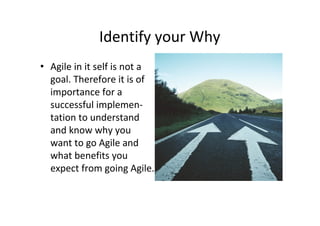
Identify your Why
• Agile in it self is not a
  goal. Therefore it is of
  importance for a
  successful implemen-
  tation to understand
  and know why you
  want to go Agile and
  what benefits you
  expect from going Agile.
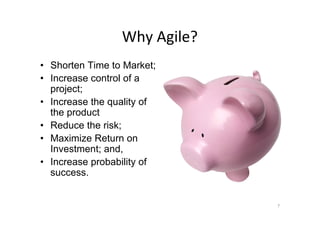
Why Agile?
• Shorten Time to Market;
• Increase control of a
  project;
• Increase the quality of
  the product
• Reduce the risk;
• Maximize Return on
  Investment; and,
• Increase probability of
  success.


                              7
More why
• Customers, users, and
  stakeholders are active
  participants throughout the
  project
• Requirements change
  rapidly
• Primary focus is on software
  development rather than
  processes or
  documentation
• Aim is for simplicity in terms
  of tools and models used
Benefits of Agile
         •   Simplicity and transparency
         •   Higher customer satisfaction
         •   Greater staff morale and
             retention
         •   Improved quality deliverables
         •   Improved business value
         •   Quicker Return on Investment
             (ROI)
         •   Increased productivity and
             decreased development costs
         •   Ability to rapidly change direction
How to?
• Define your vision
   – Where do you want to
     go?


• Create a guiding
  coalition
   – Senior people with
     decision power
Inform and Educate
         • Since Agile ways of working
           often include different ways
           of thinking than traditional
           product development it is
           well adviced to inform and
           train the team or teams
           turning Agile as well as the
           rest of the organization.
         • Often Agile development
           will have an effect not only
           on the development depart-
           ment but also on other
           parts of the organization.
Define your Engineering Practices
• One of the important parts
  of Agile is the Engineering
  Practices. In eXtreme
  Programming (XP) the
  engineering practices is an
  integral part.
• In Scrum the are up to the
  team or the organization to
  choose. In both cases you
  benefit from having a base-
  line of existing practices and
  a plan on which practices to
  add and introduce.

                                     12
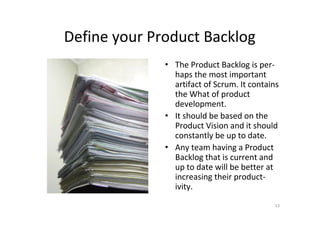
Define your Product Backlog
              • The Product Backlog is per-
                haps the most important
                artifact of Scrum. It contains
                the What of product
                development.
              • It should be based on the
                Product Vision and it should
                constantly be up to date.
              • Any team having a Product
                Backlog that is current and
                up to date will be better at
                increasing their product-
                ivity.
                                            13
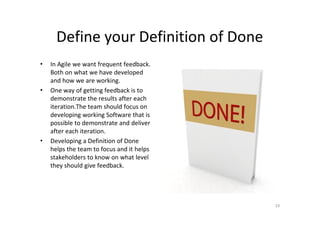
Define your Definition of Done
•   In Agile we want frequent feedback.
    Both on what we have developed
    and how we are working.
•   One way of getting feedback is to
    demonstrate the results after each
    iteration.The team should focus on
    developing working Software that is
    possible to demonstrate and deliver
    after each iteration.
•   Developing a Definition of Done
    helps the team to focus and it helps
    stakeholders to know on what level
    they should give feedback.


                                           14
Five things do do before you go Agile
1.   Identify your Why
2.   Inform and Educate
3.   Define your Engineering Practices
4.   Define your Product Backlog
5.   Set your definition of Done


                                         15
16
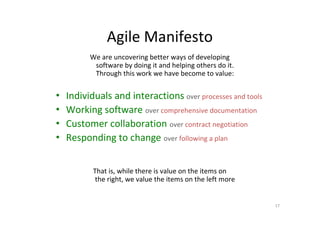
Agile Manifesto
          We are uncovering better ways of developing
           software by doing it and helping others do it.
           Through this work we have become to value:


•   Individuals and interactions over processes and tools
•   Working software over comprehensive documentation
•   Customer collaboration over contract negotiation
•   Responding to change over following a plan


           That is, while there is value on the items on
            the right, we value the items on the left more


                                                             17
Agile Principles


                   18
Our highest priority is
to satisfy the customer
through early and
continuous delivery of
valuable software.
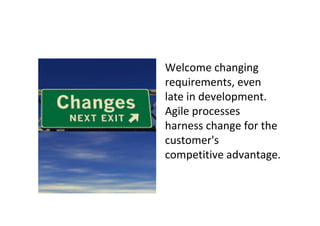
Welcome changing
requirements, even
late in development.
Agile processes
harness change for the
customer's
competitive advantage.
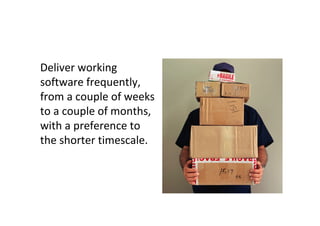
Deliver working
software frequently,
from a couple of weeks
to a couple of months,
with a preference to
the shorter timescale.
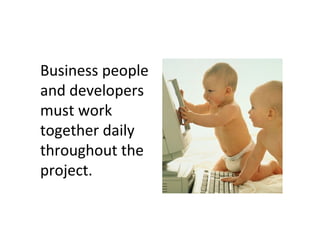
Business people
and developers
must work
together daily
throughout the
project.
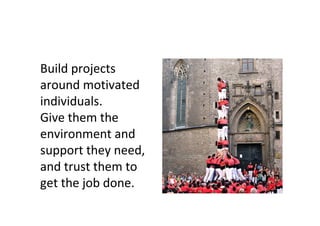
Build projects
around motivated
individuals.
Give them the
environment and
support they need,
and trust them to
get the job done.
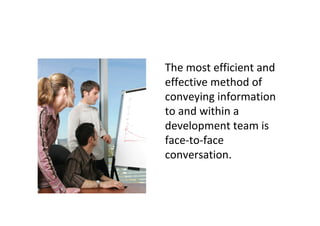
The most efficient and
effective method of
conveying information
to and within a
development team is
face-to-face
conversation.
Working software
is the primary
measure of
progress.
Agile processes
promote sustainable
development. The
sponsors, developers,
and users should be
able to maintain a
constant pace
indefinitely.
Simplicity--the art
of maximizing the
amount of work
not done--
is essential.
The best
architectures,
requirements, and
designs emerge
from self-
organizing teams.
At regular intervals,
the team reflects on
how to become
more effective, then
tunes and adjusts its
behavior
accordingly.
•   Arne Åhlander 安儒宣
•   arne.ahlander@aqqurite.se
•   www.twitter.com/arneahl
•   http://www.linkedin.com/in/arneahlander


                                         aqqurite

敏捷大师Arne谈敏捷实施的五项准备

  • 1.
    Scrum中文网敏捷沙龙系列 Scrum中文网敏捷沙龙系列 6月北京,敏捷大师Arne谈敏捷实施的五项准备 2011年7月6日 http://www.scrumcn.com Copyright © Scrum中文网
  • 2.
    关于Scrum中文网 关于Scrum Scrum中文网 ScrumCN由海内外资深敏捷顾问团队共同创办,成立于2008年,是中国 领先的敏捷及Scrum推广组织。ScrumCN致力于推动Scrum及敏捷 在中文世 界中的应用和发展。ScrumCN为企业提供Scrum和敏捷导入总体解决方案, 为行业培养优秀的Scrum及敏捷人才,同时也提供开放式的公益 性交流平台。 培训 ● 咨询 ● 认证 ● 社区 http://www.scrumcn.com Copyright © Scrum中文网 第 2页
  • 3.
    Five things todo before you go Agile Arne Åhlander hlander 安儒宣 3
  • 4.
    Five things dodo before you go Agile 1. Identify your Why 2. Inform and Educate 3. Define your Engineering Practices 4. Define your Product Backlog 5. Set your definition of Done 4
  • 5.
    • Today manyteams and companies are turning to Agile product development. Scrum is among the most popular choices. • The promises from Agile are several. Still it is good advice to do a couple of things before you go Agile. • In the following I will list and discuss five things to do before you go Agile. 5
  • 6.
    Identify your Why •Agile in it self is not a goal. Therefore it is of importance for a successful implemen- tation to understand and know why you want to go Agile and what benefits you expect from going Agile.
  • 7.
    Why Agile? • ShortenTime to Market; • Increase control of a project; • Increase the quality of the product • Reduce the risk; • Maximize Return on Investment; and, • Increase probability of success. 7
  • 8.
    More why • Customers,users, and stakeholders are active participants throughout the project • Requirements change rapidly • Primary focus is on software development rather than processes or documentation • Aim is for simplicity in terms of tools and models used
  • 9.
    Benefits of Agile • Simplicity and transparency • Higher customer satisfaction • Greater staff morale and retention • Improved quality deliverables • Improved business value • Quicker Return on Investment (ROI) • Increased productivity and decreased development costs • Ability to rapidly change direction
  • 10.
    How to? • Defineyour vision – Where do you want to go? • Create a guiding coalition – Senior people with decision power
  • 11.
    Inform and Educate • Since Agile ways of working often include different ways of thinking than traditional product development it is well adviced to inform and train the team or teams turning Agile as well as the rest of the organization. • Often Agile development will have an effect not only on the development depart- ment but also on other parts of the organization.
  • 12.
    Define your EngineeringPractices • One of the important parts of Agile is the Engineering Practices. In eXtreme Programming (XP) the engineering practices is an integral part. • In Scrum the are up to the team or the organization to choose. In both cases you benefit from having a base- line of existing practices and a plan on which practices to add and introduce. 12
  • 13.
    Define your ProductBacklog • The Product Backlog is per- haps the most important artifact of Scrum. It contains the What of product development. • It should be based on the Product Vision and it should constantly be up to date. • Any team having a Product Backlog that is current and up to date will be better at increasing their product- ivity. 13
  • 14.
    Define your Definitionof Done • In Agile we want frequent feedback. Both on what we have developed and how we are working. • One way of getting feedback is to demonstrate the results after each iteration.The team should focus on developing working Software that is possible to demonstrate and deliver after each iteration. • Developing a Definition of Done helps the team to focus and it helps stakeholders to know on what level they should give feedback. 14
  • 15.
    Five things dodo before you go Agile 1. Identify your Why 2. Inform and Educate 3. Define your Engineering Practices 4. Define your Product Backlog 5. Set your definition of Done 15
  • 16.
  • 17.
    Agile Manifesto We are uncovering better ways of developing software by doing it and helping others do it. Through this work we have become to value: • Individuals and interactions over processes and tools • Working software over comprehensive documentation • Customer collaboration over contract negotiation • Responding to change over following a plan That is, while there is value on the items on the right, we value the items on the left more 17
  • 18.
  • 19.
    Our highest priorityis to satisfy the customer through early and continuous delivery of valuable software.
  • 20.
    Welcome changing requirements, even latein development. Agile processes harness change for the customer's competitive advantage.
  • 21.
    Deliver working software frequently, froma couple of weeks to a couple of months, with a preference to the shorter timescale.
  • 22.
    Business people and developers mustwork together daily throughout the project.
  • 23.
    Build projects around motivated individuals. Givethem the environment and support they need, and trust them to get the job done.
  • 24.
    The most efficientand effective method of conveying information to and within a development team is face-to-face conversation.
  • 25.
    Working software is theprimary measure of progress.
  • 26.
    Agile processes promote sustainable development.The sponsors, developers, and users should be able to maintain a constant pace indefinitely.
  • 27.
    Simplicity--the art of maximizingthe amount of work not done-- is essential.
  • 28.
    The best architectures, requirements, and designsemerge from self- organizing teams.
  • 29.
    At regular intervals, theteam reflects on how to become more effective, then tunes and adjusts its behavior accordingly.
  • 30.
    Arne Åhlander 安儒宣 • arne.ahlander@aqqurite.se • www.twitter.com/arneahl • http://www.linkedin.com/in/arneahlander aqqurite