Ready for Work
Ready for Work
A person who could read and write in ancient Egypt was
called a scribe. And a scribe’s job was one of the very best!
The skills required to become a scribe took years of training.
But successful scribes never had to do manual labor and
they were highly respected in society.
Scribe ready for work
Scribes and supervisor
A Practical Plant
A Practical Plant
What did scribes write and draw
on way back then? Papyrus!
This handy plant grew along the
banks of the Nile River. Ancient
Egyptians used it to make many
things from boats and baskets to
sandals and "paper."
Papyrus plant
Papyrus calendar
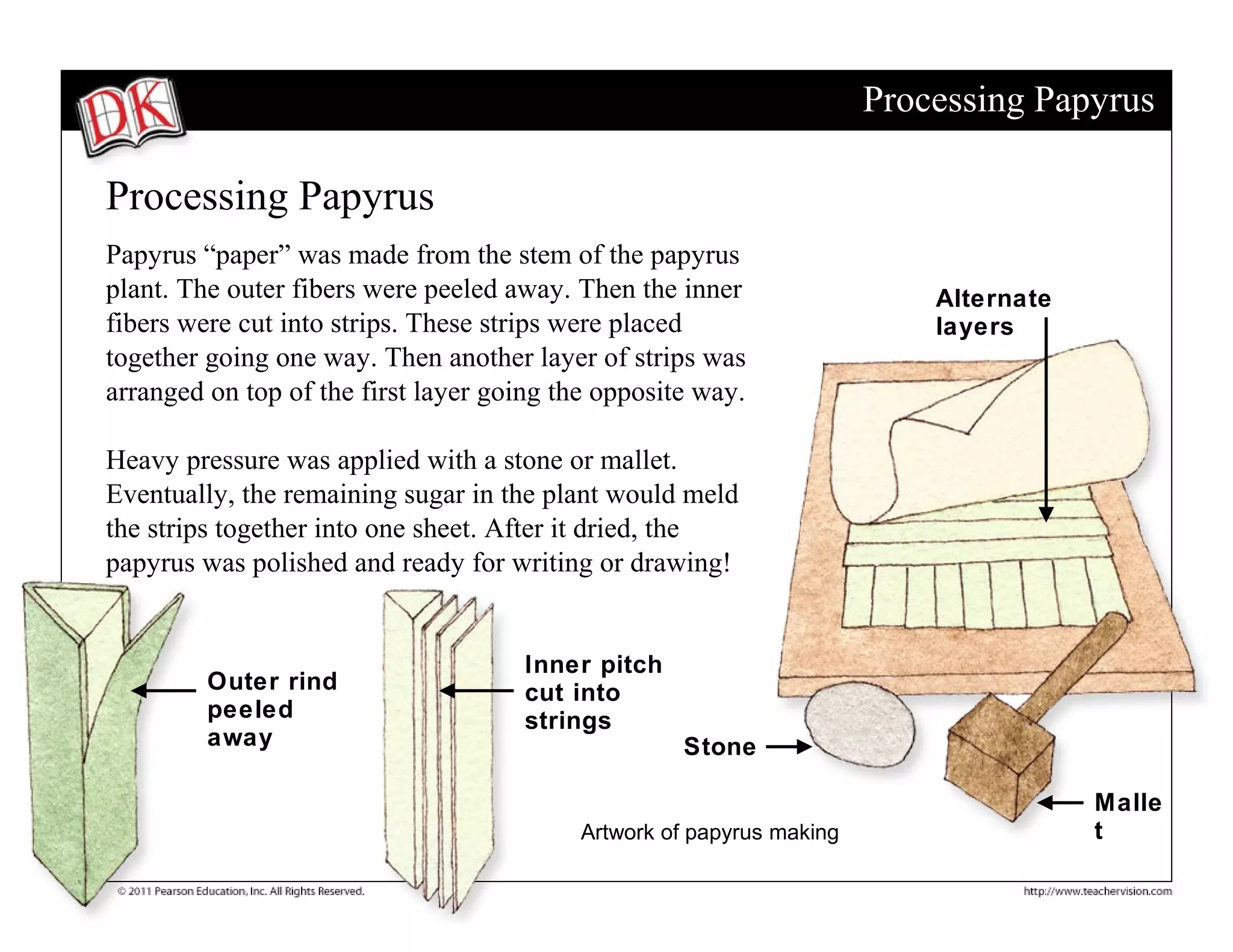
Processing Papyrus
Processing Papyrus
Papyrus “paper” was made from the stem of the papyrus
plant. The outer fibers were peeled away. Then the inner
fibers were cut into strips. These strips were placed
together going one way. Then another layer of strips was
arranged on top of the first layer going the opposite way.
Heavy pressure was applied with a stone or mallet.
Eventually, the remaining sugar in the plant would meld
the strips together into one sheet. After it dried, the
papyrus was polished and ready for writing or drawing!
Artwork of papyrus making
Outer rind
peeled
away
Inner pitch
cut into
strings
Alternate
layers
Stone
Malle
t
Two Scripts
Two Scripts
Scribes were experts in a form of picture-writing called hieroglyphics.
(It was hard to learn, so not many people could do it.) Scribes also used
a faster form of script writing called hieratic. You can see examples of
both styles here.
Two scripts hieroglyphics
Hieroglyphics
(the picture
form)
Royal door plate
Hieratic script (the faster form)
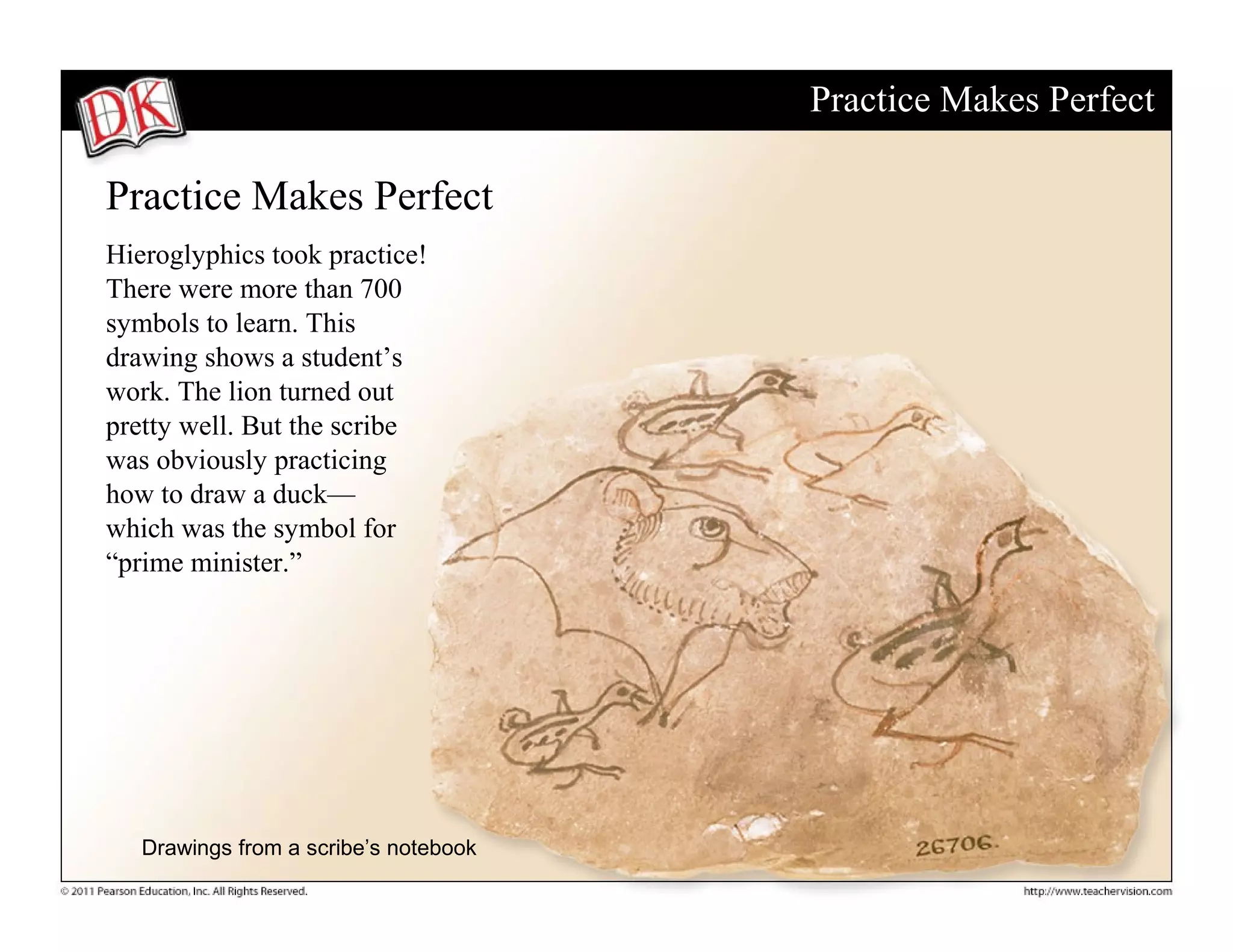
Practice Makes Perfect
Hieroglyphics took practice!
There were more than 700
symbols to learn. This
drawing shows a student’s
work. The lion turned out
pretty well. But the scribe
was obviously practicing
how to draw a duck—
which was the symbol for
“prime minister.”
Drawings from a scribe’s notebook
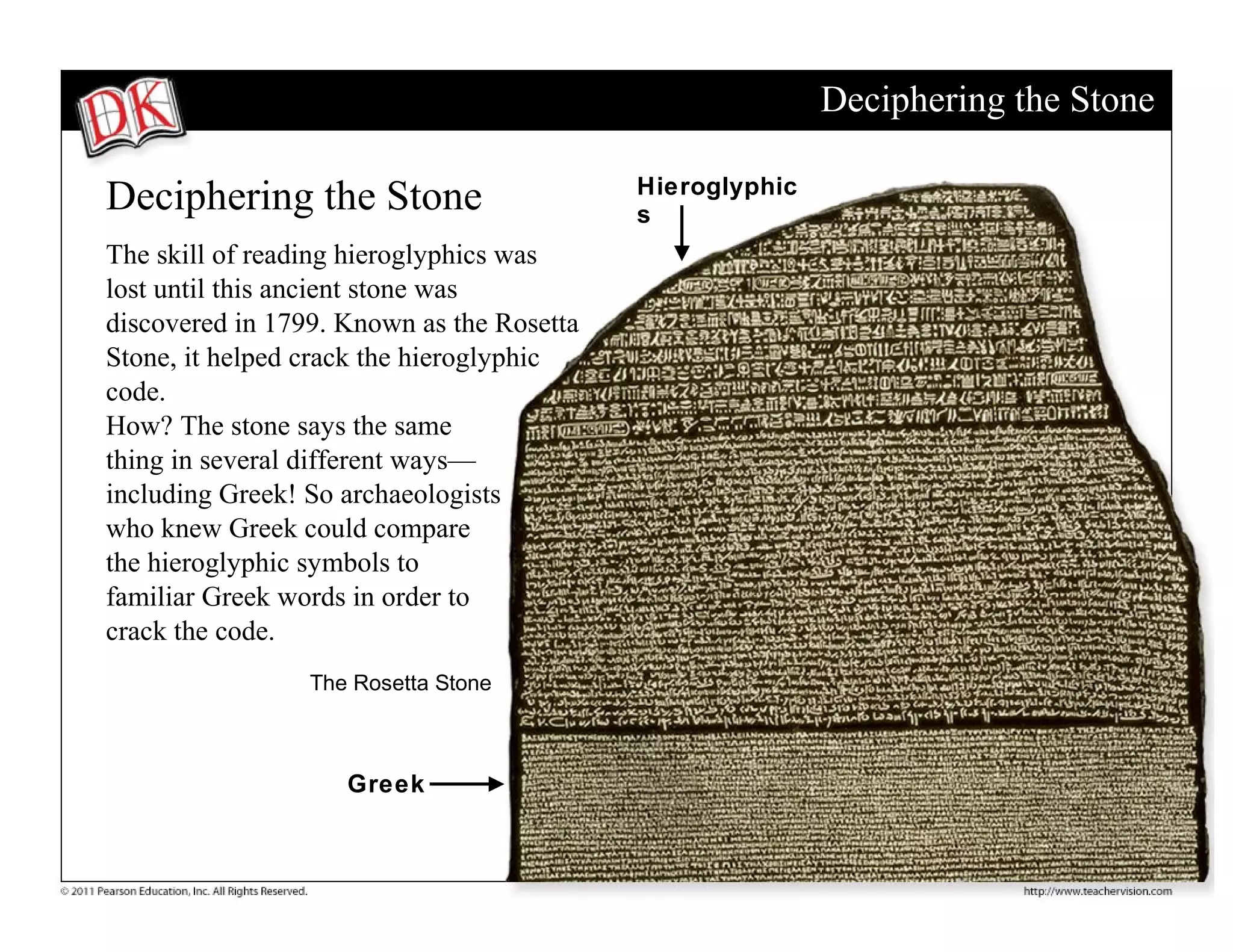
Deciphering the Stone
The skill of reading hieroglyphics was
lost until this ancient stone was
discovered in 1799. Known as the Rosetta
Stone, it helped crack the hieroglyphic
code.
How? The stone says the same
thing in several different ways—
including Greek! So archaeologists
who knew Greek could compare
the hieroglyphic symbols to
familiar Greek words in order to
crack the code.
The Rosetta Stone
Hieroglyphic
s
Greek
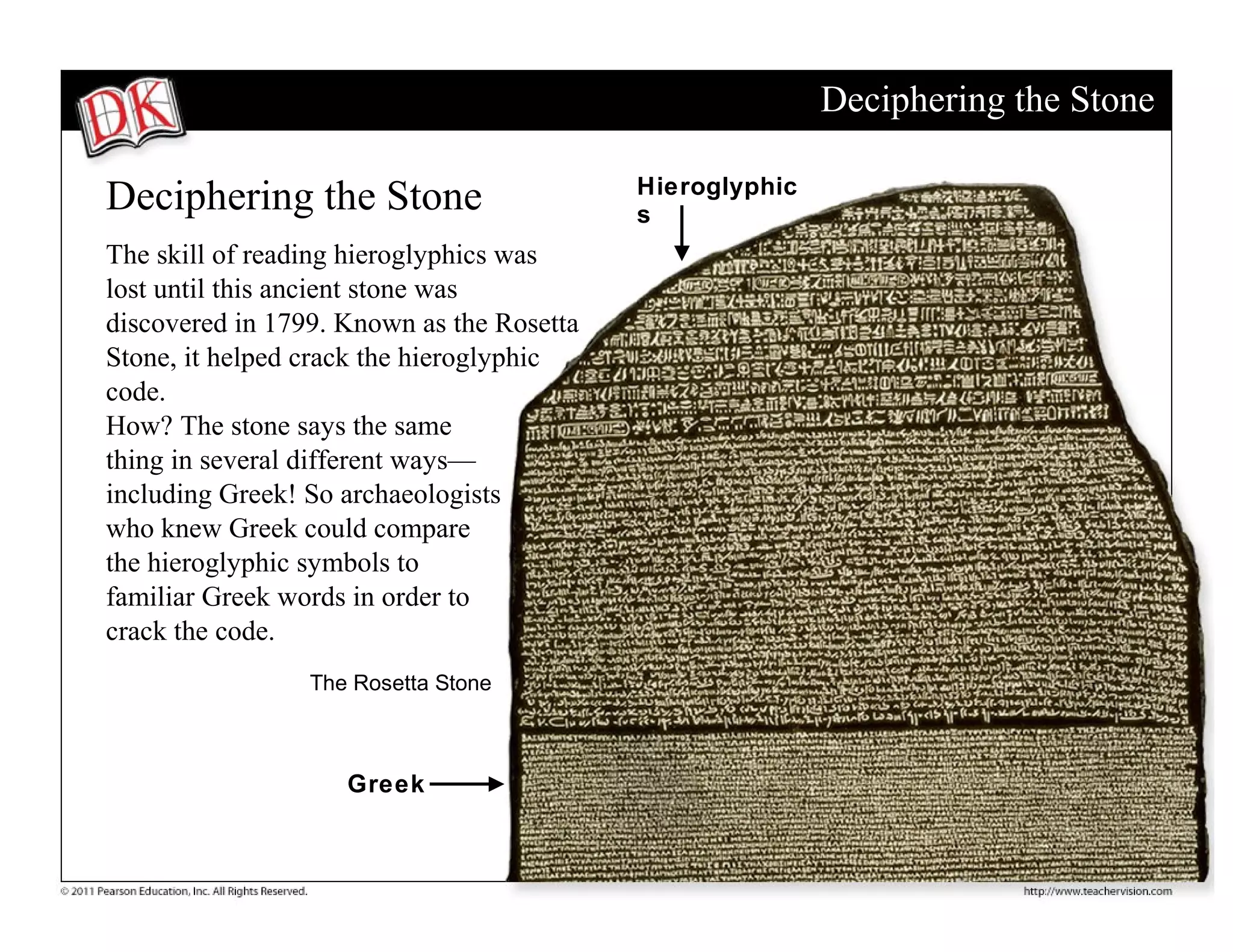
Deciphering the Stone
The skill of reading hieroglyphics was
lost until this ancient stone was
discovered in 1799. Known as the Rosetta
Stone, it helped crack the hieroglyphic
code.
How? The stone says the same
thing in several different ways—
including Greek! So archaeologists
who knew Greek could compare
the hieroglyphic symbols to
familiar Greek words in order to
crack the code.
The Rosetta Stone
Hieroglyphic
s
Greek

Scribes of ancient egypt

  • 1.
    Ready for Work Readyfor Work A person who could read and write in ancient Egypt was called a scribe. And a scribe’s job was one of the very best! The skills required to become a scribe took years of training. But successful scribes never had to do manual labor and they were highly respected in society. Scribe ready for work Scribes and supervisor
  • 2.
    A Practical Plant APractical Plant What did scribes write and draw on way back then? Papyrus! This handy plant grew along the banks of the Nile River. Ancient Egyptians used it to make many things from boats and baskets to sandals and "paper." Papyrus plant Papyrus calendar
  • 3.
    Processing Papyrus Processing Papyrus Papyrus“paper” was made from the stem of the papyrus plant. The outer fibers were peeled away. Then the inner fibers were cut into strips. These strips were placed together going one way. Then another layer of strips was arranged on top of the first layer going the opposite way. Heavy pressure was applied with a stone or mallet. Eventually, the remaining sugar in the plant would meld the strips together into one sheet. After it dried, the papyrus was polished and ready for writing or drawing! Artwork of papyrus making Outer rind peeled away Inner pitch cut into strings Alternate layers Stone Malle t
  • 4.
    Two Scripts Two Scripts Scribeswere experts in a form of picture-writing called hieroglyphics. (It was hard to learn, so not many people could do it.) Scribes also used a faster form of script writing called hieratic. You can see examples of both styles here. Two scripts hieroglyphics Hieroglyphics (the picture form) Royal door plate Hieratic script (the faster form)
  • 5.
    Practice Makes Perfect PracticeMakes Perfect Hieroglyphics took practice! There were more than 700 symbols to learn. This drawing shows a student’s work. The lion turned out pretty well. But the scribe was obviously practicing how to draw a duck— which was the symbol for “prime minister.” Drawings from a scribe’s notebook
  • 6.
    Deciphering the Stone Decipheringthe Stone The skill of reading hieroglyphics was lost until this ancient stone was discovered in 1799. Known as the Rosetta Stone, it helped crack the hieroglyphic code. How? The stone says the same thing in several different ways— including Greek! So archaeologists who knew Greek could compare the hieroglyphic symbols to familiar Greek words in order to crack the code. The Rosetta Stone Hieroglyphic s Greek
  • 7.
    Deciphering the Stone Decipheringthe Stone The skill of reading hieroglyphics was lost until this ancient stone was discovered in 1799. Known as the Rosetta Stone, it helped crack the hieroglyphic code. How? The stone says the same thing in several different ways— including Greek! So archaeologists who knew Greek could compare the hieroglyphic symbols to familiar Greek words in order to crack the code. The Rosetta Stone Hieroglyphic s Greek

Editor's Notes

  • #2 Ready for Work One form of encouragement offered to pupils who were undergoing the arduous process of learning to be a scribe was to list the defects of other professions—exaggerated, of course. For example, jewelers and metalworkers were said to choke on the heat of their furnaces; weavers had to put up with cramped conditions. But the scribe could look forward to authority, freedom from taxes and national service during times of flood, and immortality through his writings.
  • #3 A Practical Plant This triangular-stemmed reed, which grew about 13 ft (4 m) tall, flourished along the banks of the Nile, but vanished due to overharvesting for boats, baskets, sandals, rope, and writing material. Attempts are now being made to reintroduce it into Egypt.
  • #4 Processing Papyrus There were different methods used to develop the papyrus used for writing, but the basic steps are as follows. The strips of pith were arranged in two layers, one set horizontal, the next vertical, above each other. They were covered with linen and heavy pressure was applied with stones or a mallet. Eventually the strips would weld together in their own sap.
  • #5 Two Scripts On papyrus, scribes usually used the fast form of writing called hieratic. On this example, hieroglyphs appear above the picture of a high priest making an offering to the god Osiris. To the left is the script in hieratic.
  • #6 Practice Makes Perfect Some hieroglyphic signs needed a lot of practice from pupil scribes. Here, a scribe has gotten carried away drawing the duckling hieroglyph, which was used in writing the word for “prime minister”. The scribe has also practiced drawing the head of a lion, which is used in one of the scenes in the Book of the Dead.
  • #7 Deciphering the Stone When the last temple was closed, in the 6th century A.D., the skill of reading hieroglyphs was lost until the discovery of this stone in 1799. On the stone are three scripts. The bottom section is in Greek, the center in demotic, and the top in hieroglyphs. The stone was first set up in a temple. It was an elaborate “thank you” to the Greek ruler of Egypt, Ptolemy V, who reigned in the 2nd century B.C., for favors that he had given to the priests. The three scripts contained the same text, allowing the hieroglyphs to be translated. French archeologist, Jean-François Champollion spent many years deciphering the symbols. His work on the Rosetta Stone was an important breakthrough in the translation of ancient hieroglyphics.