SCREWS
A screw is a very efficient implant
for re- pairing a fracture using
interfragmentary compression, or
for fixing a splinting device such as
a plate, nail, or fixator to a bone.
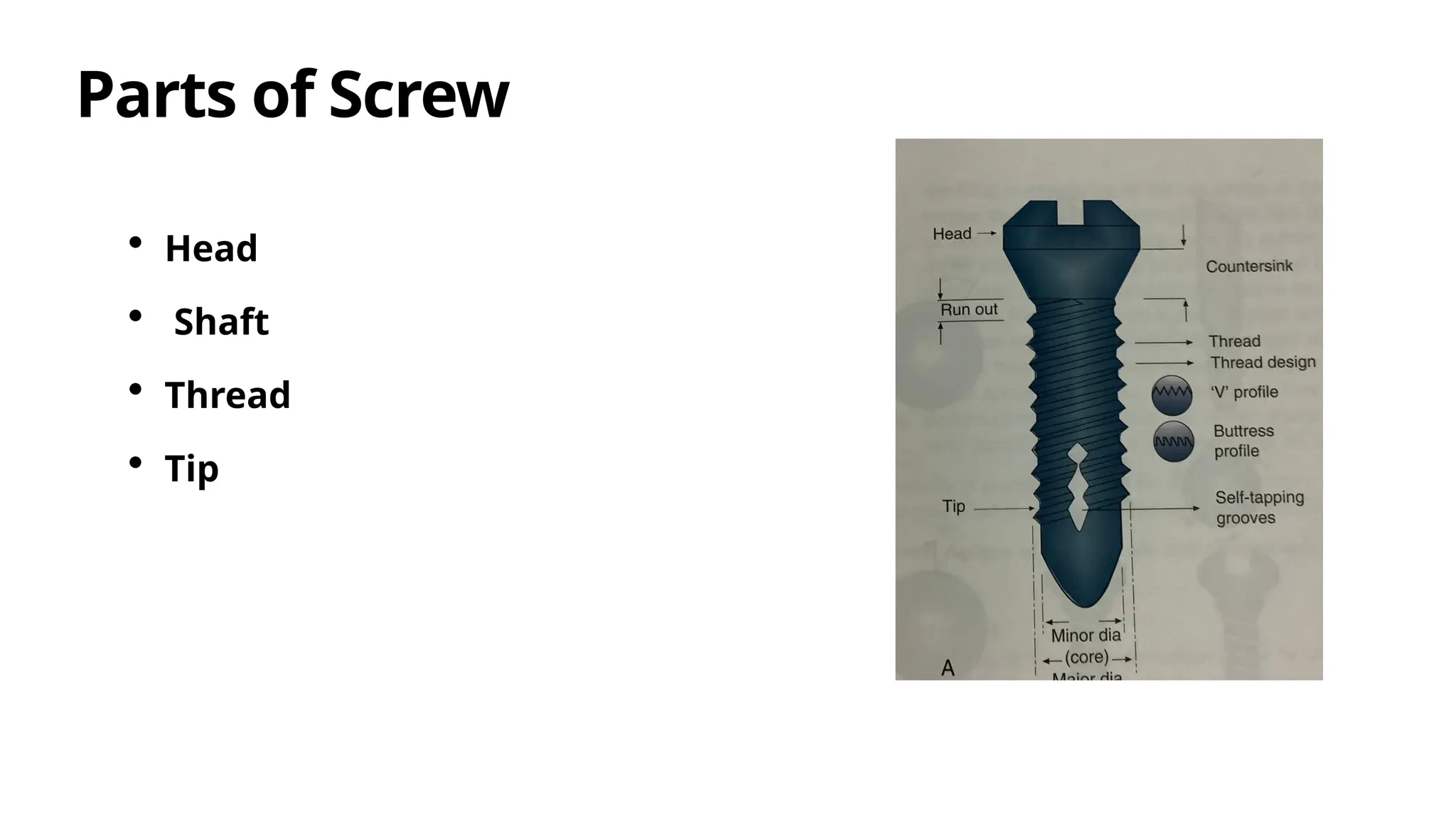
• Head
• Shaft
• Thread
• Tip
Parts of Screw
• Countersink refers to the hemispherical or conical undersurface of the
screw head
• Shaft is the smooth part of the screw between the head and the thread
• Run out is the spot where the shaft ends and the thread begins
• Core diameter refers to the minimum diameter of the screw across the
base of the thread
• Pitch defines the distance between the adjacent threads
• Lead of the screw refers to the distance the screw will advance with each
turn , lead is therefore equal to the pitch
• The thread (or outside) diameter is the widest diameter of the screw.
• Tip of the screw is the end opposite to the head
Screw head
Recess
• Single slot head
• Cruciate head
• Phillips head
• Recessed hexagonal head
• Torx type head socket
Recessed hexagonal head
• The hexagonal head driver makes a strong and alignment insensitive
connection with the screw and offers a good lateral guidance that allows
blind insertion and removal
• The torque transmission is independent of axial thrust and thus does not
compromise initially unstable reduction of the fracture fragments.
Functions of head
• It provides the means of applying torque (twisting force) to the screw
• It acts as a stop
• As the head comes in contact with the bone surface, the translational
motion of the screw stops and the torque transforms to tension in the
screw, which in turn induces compression between the two surfaces
• Compression develops only after the translational motion of the screw
stops
Shaft
• Shaft or shank is the smooth link between the head and the thread
• The shaft length is variable ,in a standard cortical bone screw it is almost
nonexistent but in a cortical shaft screw or in a cancellous screw it is
significant
• Screws with long shafts are used as lag screws ,the smooth shaft has no
purchase in the proximal hole and ensures compression by lagging
Core diameter
• Core diameter also known as the inside or root diameter represents the
narrowest diameter of the screw across the base of the threads.
• It is the weakest part of the screw.
• Smaller the root diameter ,greater the tendency to shear off during
insertion and removal
• Torsional strength of the screw varies with the cube of its root diameter
Cont
• Doubling the root diameter of a screw increases the extent of torque that
it fan withstand by a factor of 8
Pitch
• Pitch is the distance between the adjacent threads
• Cortical screw has small pitch, cancellous screw has a large pitch.
• Stronger the bone (cortex), the smaller the pitch
• Weaker the bone (cancellous), larger the pitch
• Pitch also determines the rate of advance of the screw (lead) through the
bone.
Cont
• It is measured as threads per inch(tpi)
• AO cortical screw -40.5 tpi
• AO large fragment cancellous screw -9.2 tpi
Lead
• The lead of the screw means the distance it travles on a complete turn
• Smaller the thread greater the, mechanical advantage of the screw
• Stronger cortical screws have a smaller lead as compared
Outside diameter
• It refers to the diameter across the maximum thread width and affects its
pull-out strength.
• The greater the outside diameter, the greater the resistance to pull out.
• V thread
• Buttress thread
• Buttress thread with rounded
base
• Locking screw thread
• Bone screw fastner
Thread design
Tip of screws
• Self tapping tip
• Non-self-tapping tip
• Corkscrew tip
• Trocar tip
• Self-drilling self-tapping tip
Self tapping tip
• It has a thread cutting device called a flute .
• This mechanism cuts threads in the bone over which the screw advances
• As the screw advances, the cutting flute chisel into the bone and direct
bone chips away from the root.
• It has no purchase on the distal cortex due to the presence of flutes
• Advantages: No pretapping required, ensures very tight fit of the screw
Non self tapping tip
• The thread extends upto the tip and lacks thread cutting device.
• Threads are precut using tap
• Advantages:Higher interfragmental compression, offers greater
resistance to pull out, better purchase on the distal cortex
Corkscrew tip
• Used only in cancellous screws where the tip clears the predrilled hole.
• Cancellous screws forms its own threads by compressing the thin walled
trabecular bone
Trocar tip
• It does not produce a true thread but rather displaces the bone as it
advances.
• Malleolar screw has trocar tip which is well suited for soft cancellous bone
of the distal tibia and medial malleolus.(schanz screws )
Self drilling self tapping tip
• The additionally sharpened tip of the screw drills a hole efficiently and
reduces heat generation and the resisitance as the drillimg tip penetrates
the bone.
• It is exclusively used for monocortical insertion because there is no
possibility of measuring the exact screw length and the sharp drill bit like
tip may injure the structured outside the bone.
• Particularly used in osteoporotic bone and in metaplyseal region
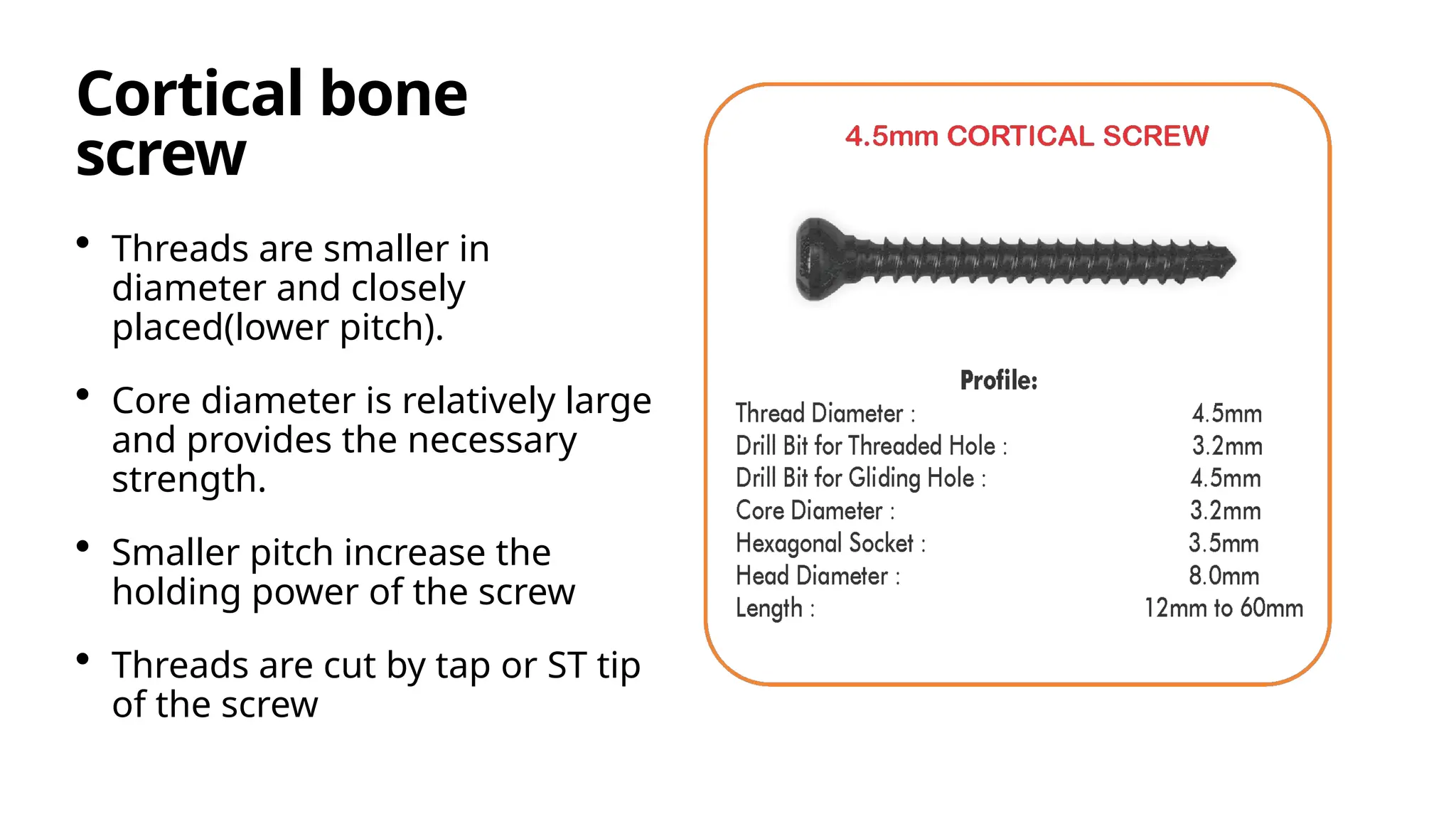
• Threads are smaller in
diameter and closely
placed(lower pitch).
• Core diameter is relatively large
and provides the necessary
strength.
• Smaller pitch increase the
holding power of the screw
• Threads are cut by tap or ST tip
of the screw
Cortical bone
screw
Cancellous bone screw
• Tip is not tapered
• It has larger threads and a higher pitch.
• Core diameter which is smaller than that of
the shaft, provides greater surface area for
purchase of screw threads on bone.
• Increase in thread diameter increases the
pull-out strength
• It is inserted into untapped pilot hole
Self tapping screw
• It is inserted directly into a predrilled hole without first tapping a thread.
• Two types -thread forming and thread cutting.
• Cancellous screw is a thread forming, ST screw.
• Cortical screws may be ST or NST
Fully and partially threaded screws
• Cortical screw is usually fully threaded.
• It may be NST or ST
• Partially threaded screw is called a shaft screw.It has better strength and
stiffness than a fully threaded screw
• Fully threaded cancellous screw is used as a placement screw to fix a bone
plate in metaphyseal and epiphyseal regions.
• Partially threaded cancellous screw is used a lag screw.
Locking screws
• It is a bone screw with threads on the undersurface or countersink of the
head.
• On tightening it locks in the matching threads in the plate hole and the
screw becomes axially and angularly stable
• Its conical countersink offers better distribution of forces between the
scew head and the threaded holes and improves locking fixation in the
screw hole.
•
Herbert screw
• It is a specialised implant to achieve interfragmentary compression.
• There is no head and threads are available at both ends of the screw with
a pitch difference between the leading and the trailing threads.
• Interfragmentary compression is achieved by the difference in the thread
pitch, the coarser pitch moves the screw a greater distance through a
bone with each turn than does the finer pitch.
• As the screw is turned ,the leading thread penetrates the bone faster than
the trailing threads, slowing penetration, reducing the surfaces to come
together and creating compression during insertion.
• Indications include scaphoid fracture, capitellar fractures, radial head
fractures, osteochondral fractures, osteochondritis dissecans and small
joint arthrodesis.
DRILL BIT
SCREW SIZE THREADED HOLE TAP SIZE
3.5MM 2.5MM 3.5MM
4.5MM 3.2MM 4.5MM
2.7MM 2.0MM 2.7MM
Drill bit
Measurement of screw length
• Depth gauge is used to measure the required screw length
• Measured before tapping the thread
Drill sleeve
• A drill sleeve is an instrument used to direct the placement of a drill hole
and simultaneously protect the surrounding soft tissues
• It increases the accuracy of drilling and prevents the drill point from
wandering across the bone
Washers
• It is often used with a cancellous screw to prevent the screw head from
burying into the thin cortex overlying the cancellous bone.
• The flat side of the washer rests on the bone whereas the countersink
side matches the underside of the screw head
Lag screw
• It a technique of insertion and not a screw
• It is the most effective way to achieve compression between two fracture
fragments
• It pulls the fragments together producing friction across the fracture line
• Ir achieves this by gaining purchase on the distal fragment while being
able to turn freely in the proximal
Position screw
• When the insertion of a lag screw will cause a fragment to collapse into
the medullary cavity, it is preferable to use a position screw
• In this screw, thread holes are drilled in the cortex of both the near and
far ined.fragments.
• Drill hole is measured and tapped.
• When the appropriate screw is inserted, the position of the two fragments
is maintained.
cont
• In other words, it is fully threaded screw that joins two anatomical parts at
a defined distance without compression.
• Eg.syndesmotic screw
Poller screw
• It is used as a fulcrum to redirect an intramedullary nail.
ACUTRAK SCREW
• It is a headless screw
• It has variable thread pitch
• It is self cutting and cannulated and fully threaded
• Used in fracture fixation of scaphoid, metatarsals, metacarpals
Malleolar screw
• It has smooth shaft and is partially threaded.
• It acts as a lag screw for medial malleolus fixation
Interference screw
• It is an effective technique in bone patellar tendon bone and ACL
reconstruction
Bolt
• It is also an externally threaded device like screw, which is used in
conjunction with a nut and is tightened or released only by twisting the
nut.
THANK YOU

SCREWS- Basic principles in fracture management .pptx

  • 1.
  • 2.
    A screw isa very efficient implant for re- pairing a fracture using interfragmentary compression, or for fixing a splinting device such as a plate, nail, or fixator to a bone.
  • 3.
    • Head • Shaft •Thread • Tip Parts of Screw
  • 4.
    • Countersink refersto the hemispherical or conical undersurface of the screw head • Shaft is the smooth part of the screw between the head and the thread • Run out is the spot where the shaft ends and the thread begins • Core diameter refers to the minimum diameter of the screw across the base of the thread • Pitch defines the distance between the adjacent threads
  • 5.
    • Lead ofthe screw refers to the distance the screw will advance with each turn , lead is therefore equal to the pitch • The thread (or outside) diameter is the widest diameter of the screw. • Tip of the screw is the end opposite to the head
  • 6.
    Screw head Recess • Singleslot head • Cruciate head • Phillips head • Recessed hexagonal head • Torx type head socket
  • 7.
    Recessed hexagonal head •The hexagonal head driver makes a strong and alignment insensitive connection with the screw and offers a good lateral guidance that allows blind insertion and removal • The torque transmission is independent of axial thrust and thus does not compromise initially unstable reduction of the fracture fragments.
  • 9.
    Functions of head •It provides the means of applying torque (twisting force) to the screw • It acts as a stop • As the head comes in contact with the bone surface, the translational motion of the screw stops and the torque transforms to tension in the screw, which in turn induces compression between the two surfaces • Compression develops only after the translational motion of the screw stops
  • 10.
    Shaft • Shaft orshank is the smooth link between the head and the thread • The shaft length is variable ,in a standard cortical bone screw it is almost nonexistent but in a cortical shaft screw or in a cancellous screw it is significant • Screws with long shafts are used as lag screws ,the smooth shaft has no purchase in the proximal hole and ensures compression by lagging
  • 11.
    Core diameter • Corediameter also known as the inside or root diameter represents the narrowest diameter of the screw across the base of the threads. • It is the weakest part of the screw. • Smaller the root diameter ,greater the tendency to shear off during insertion and removal • Torsional strength of the screw varies with the cube of its root diameter
  • 12.
    Cont • Doubling theroot diameter of a screw increases the extent of torque that it fan withstand by a factor of 8
  • 13.
    Pitch • Pitch isthe distance between the adjacent threads • Cortical screw has small pitch, cancellous screw has a large pitch. • Stronger the bone (cortex), the smaller the pitch • Weaker the bone (cancellous), larger the pitch • Pitch also determines the rate of advance of the screw (lead) through the bone.
  • 14.
    Cont • It ismeasured as threads per inch(tpi) • AO cortical screw -40.5 tpi • AO large fragment cancellous screw -9.2 tpi
  • 15.
    Lead • The leadof the screw means the distance it travles on a complete turn • Smaller the thread greater the, mechanical advantage of the screw • Stronger cortical screws have a smaller lead as compared
  • 16.
    Outside diameter • Itrefers to the diameter across the maximum thread width and affects its pull-out strength. • The greater the outside diameter, the greater the resistance to pull out.
  • 17.
    • V thread •Buttress thread • Buttress thread with rounded base • Locking screw thread • Bone screw fastner Thread design
  • 19.
    Tip of screws •Self tapping tip • Non-self-tapping tip • Corkscrew tip • Trocar tip • Self-drilling self-tapping tip
  • 20.
    Self tapping tip •It has a thread cutting device called a flute . • This mechanism cuts threads in the bone over which the screw advances • As the screw advances, the cutting flute chisel into the bone and direct bone chips away from the root. • It has no purchase on the distal cortex due to the presence of flutes • Advantages: No pretapping required, ensures very tight fit of the screw
  • 21.
    Non self tappingtip • The thread extends upto the tip and lacks thread cutting device. • Threads are precut using tap • Advantages:Higher interfragmental compression, offers greater resistance to pull out, better purchase on the distal cortex
  • 22.
    Corkscrew tip • Usedonly in cancellous screws where the tip clears the predrilled hole. • Cancellous screws forms its own threads by compressing the thin walled trabecular bone
  • 23.
    Trocar tip • Itdoes not produce a true thread but rather displaces the bone as it advances. • Malleolar screw has trocar tip which is well suited for soft cancellous bone of the distal tibia and medial malleolus.(schanz screws )
  • 24.
    Self drilling selftapping tip • The additionally sharpened tip of the screw drills a hole efficiently and reduces heat generation and the resisitance as the drillimg tip penetrates the bone. • It is exclusively used for monocortical insertion because there is no possibility of measuring the exact screw length and the sharp drill bit like tip may injure the structured outside the bone. • Particularly used in osteoporotic bone and in metaplyseal region
  • 25.
    • Threads aresmaller in diameter and closely placed(lower pitch). • Core diameter is relatively large and provides the necessary strength. • Smaller pitch increase the holding power of the screw • Threads are cut by tap or ST tip of the screw Cortical bone screw
  • 26.
    Cancellous bone screw •Tip is not tapered • It has larger threads and a higher pitch. • Core diameter which is smaller than that of the shaft, provides greater surface area for purchase of screw threads on bone. • Increase in thread diameter increases the pull-out strength • It is inserted into untapped pilot hole
  • 27.
    Self tapping screw •It is inserted directly into a predrilled hole without first tapping a thread. • Two types -thread forming and thread cutting. • Cancellous screw is a thread forming, ST screw. • Cortical screws may be ST or NST
  • 28.
    Fully and partiallythreaded screws • Cortical screw is usually fully threaded. • It may be NST or ST • Partially threaded screw is called a shaft screw.It has better strength and stiffness than a fully threaded screw • Fully threaded cancellous screw is used as a placement screw to fix a bone plate in metaphyseal and epiphyseal regions. • Partially threaded cancellous screw is used a lag screw.
  • 29.
    Locking screws • Itis a bone screw with threads on the undersurface or countersink of the head. • On tightening it locks in the matching threads in the plate hole and the screw becomes axially and angularly stable • Its conical countersink offers better distribution of forces between the scew head and the threaded holes and improves locking fixation in the screw hole. •
  • 30.
    Herbert screw • Itis a specialised implant to achieve interfragmentary compression. • There is no head and threads are available at both ends of the screw with a pitch difference between the leading and the trailing threads. • Interfragmentary compression is achieved by the difference in the thread pitch, the coarser pitch moves the screw a greater distance through a bone with each turn than does the finer pitch.
  • 31.
    • As thescrew is turned ,the leading thread penetrates the bone faster than the trailing threads, slowing penetration, reducing the surfaces to come together and creating compression during insertion. • Indications include scaphoid fracture, capitellar fractures, radial head fractures, osteochondral fractures, osteochondritis dissecans and small joint arthrodesis.
  • 32.
    DRILL BIT SCREW SIZETHREADED HOLE TAP SIZE 3.5MM 2.5MM 3.5MM 4.5MM 3.2MM 4.5MM 2.7MM 2.0MM 2.7MM
  • 33.
  • 34.
    Measurement of screwlength • Depth gauge is used to measure the required screw length • Measured before tapping the thread
  • 35.
    Drill sleeve • Adrill sleeve is an instrument used to direct the placement of a drill hole and simultaneously protect the surrounding soft tissues • It increases the accuracy of drilling and prevents the drill point from wandering across the bone
  • 36.
    Washers • It isoften used with a cancellous screw to prevent the screw head from burying into the thin cortex overlying the cancellous bone. • The flat side of the washer rests on the bone whereas the countersink side matches the underside of the screw head
  • 37.
    Lag screw • Ita technique of insertion and not a screw • It is the most effective way to achieve compression between two fracture fragments • It pulls the fragments together producing friction across the fracture line • Ir achieves this by gaining purchase on the distal fragment while being able to turn freely in the proximal
  • 42.
    Position screw • Whenthe insertion of a lag screw will cause a fragment to collapse into the medullary cavity, it is preferable to use a position screw • In this screw, thread holes are drilled in the cortex of both the near and far ined.fragments. • Drill hole is measured and tapped. • When the appropriate screw is inserted, the position of the two fragments is maintained.
  • 43.
    cont • In otherwords, it is fully threaded screw that joins two anatomical parts at a defined distance without compression. • Eg.syndesmotic screw
  • 44.
    Poller screw • Itis used as a fulcrum to redirect an intramedullary nail.
  • 45.
    ACUTRAK SCREW • Itis a headless screw • It has variable thread pitch • It is self cutting and cannulated and fully threaded • Used in fracture fixation of scaphoid, metatarsals, metacarpals
  • 46.
    Malleolar screw • Ithas smooth shaft and is partially threaded. • It acts as a lag screw for medial malleolus fixation
  • 47.
    Interference screw • Itis an effective technique in bone patellar tendon bone and ACL reconstruction
  • 48.
    Bolt • It isalso an externally threaded device like screw, which is used in conjunction with a nut and is tightened or released only by twisting the nut.
  • 49.