Amandeep Dhillon
M-Pharm 2nd Sem
 Pathogenesis of Type 1 & 2 Diabetes mellitus.
 Diabetes mellitus is a chronic metabolic disorder
characterised by a high blood glucose concentration
Hyperglycemia due to insulin deficiency and/or insulin
resistance.
 Hyperglycemia occurs because of uncontrolled hepatic
glucose output & reduced uptake of glucose by skeletal
muscles with reduced glycogen synthesis.
 Hypoglycemic effects causes “Blood sugar lowering”
effects (Assay of insulin & insulin like activity).
Cataract Formation
 Diabetic patients are known to have a higher incidence of
cataract formation. Which produce changes in the
transparency or the refractory index of the lens.
 Aldose reductase catalyst the reduction of aldoses like
“Glucose & Galactose” to corresponding polyols.
 Aldose reductase inhibitors have been shown to prevent
sugar induced cataract fomation.
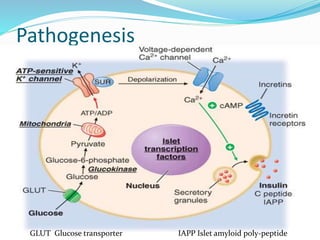
Pathogenesis
GLUT Glucose transporter IAPP Islet amyloid poly-peptide
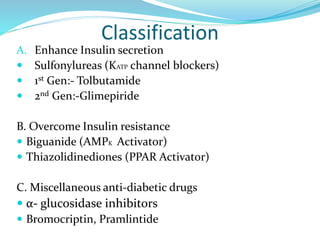
Classification
A. Enhance Insulin secretion
 Sulfonylureas (KATP channel blockers)
 1st Gen:- Tolbutamide
 2nd Gen:-Glimepiride
B. Overcome Insulin resistance
 Biguanide (AMPK Activator)
 Thiazolidinediones (PPAR Activator)
C. Miscellaneous anti-diabetic drugs
 α- glucosidase inhibitors
 Bromocriptin, Pramlintide
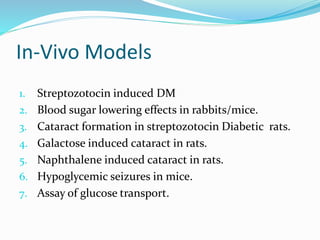
In-Vivo Models
1. Streptozotocin induced DM
2. Blood sugar lowering effects in rabbits/mice.
3. Cataract formation in streptozotocin Diabetic rats.
4. Galactose induced cataract in rats.
5. Naphthalene induced cataract in rats.
6. Hypoglycemic seizures in mice.
7. Assay of glucose transport.
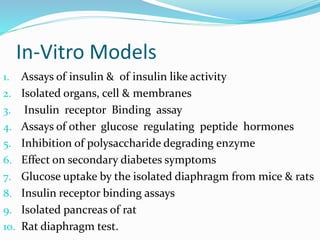
In-Vitro Models
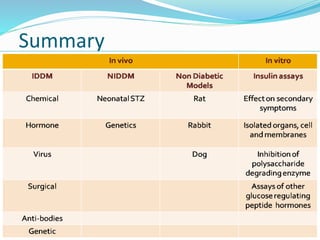
1. Assays of insulin & of insulin like activity
2. Isolated organs, cell & membranes
3. Insulin receptor Binding assay
4. Assays of other glucose regulating peptide hormones
5. Inhibition of polysaccharide degrading enzyme
6. Effect on secondary diabetes symptoms
7. Glucose uptake by the isolated diaphragm from mice & rats
8. Insulin receptor binding assays
9. Isolated pancreas of rat
10. Rat diaphragm test.
Streptozotocin induced DM
Streptozotocin [60 mg/kg body weight] is prepared in citrated buffer [ph 4.5]
Albino rats of either sex weighing 150-200 g are injected i.p with above solution.
Animals showing fasting blood glucose levels > 140mg/dl after 48 hours of
streptozotocin administration are considered diabetic.
After six weeks of treatment blood samples are collected from 6 hour fasting
animal
Serum is separated by centrifuge (3000 rpm) under cooling (2-4 °C) for ten
minutes
Serum glucose level is estimated by glucose- peroxidase method [GOD-POD
kit] using autoanalyser
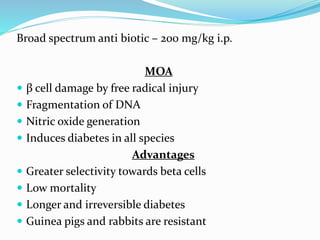
Broad spectrum anti biotic – 200 mg/kg i.p.
MOA
 β cell damage by free radical injury
 Fragmentation of DNA
 Nitric oxide generation
 Induces diabetes in all species
Advantages
 Greater selectivity towards beta cells
 Low mortality
 Longer and irreversible diabetes
 Guinea pigs and rabbits are resistant
Insulin antibody induced diabetes
Principle: - A transient diabetic syndrome can be
induced by injecting guinea pigs with anti insulin
serum.
Preparation of antibody
Bovine insulin, dissolved in acidified water [ph 3.0] at a dose
of 1mg /ml
Anti insulin sera is collected after two weeks of antigenic challenge
Injected into guinea
pigs
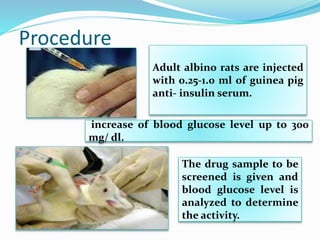
Procedure
Adult albino rats are injected
with 0.25-1.0 ml of guinea pig
anti- insulin serum.
increase of blood glucose level up to 300
mg/ dl.
The drug sample to be
screened is given and
blood glucose level is
analyzed to determine
the activity.
Blood sugar lowering effecs in
rabbits/mice.
PURPOSE & RATIONALE :- A biological assay of
insulin preparations in comparison with a stable
standard using the blood sugar lowering effects in
rabbits.
EVALUATION :-The result of the assay are calculated
by standard methods.
Rabbits
150mg/kg
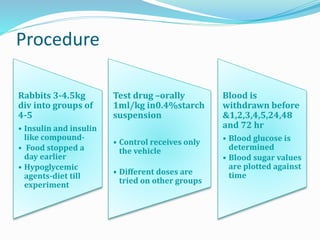
Procedure
Rabbits 3-4.5kg
div into groups of
4-5
• Insulin and insulin
like compound-
• Food stopped a
day earlier
• Hypoglycemic
agents-diet till
experiment
Test drug –orally
1ml/kg in0.4%starch
suspension
• Control receives only
the vehicle
• Different doses are
tried on other groups
Blood is
withdrawn before
&1,2,3,4,5,24,48
and 72 hr
• Blood glucose is
determined
• Blood sugar values
are plotted against
time
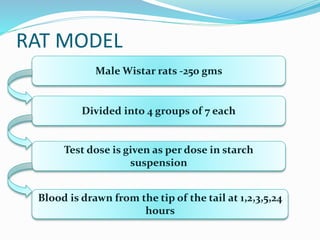
RAT MODEL
Male Wistar rats -250 gms
Divided into 4 groups of 7 each
Test dose is given as per dose in starch
suspension
Blood is drawn from the tip of the tail at 1,2,3,5,24
hours
IN VITRO METHODS ON ISOLATED
ORGANS AND CELLS
 PRINCIPLE:- To study the effect of the drug on
insulin, glucagon & somatostatin secretion without
interference from other organs.
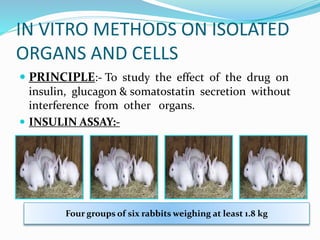
 INSULIN ASSAY:-
Four groups of six rabbits weighing at least 1.8 kg
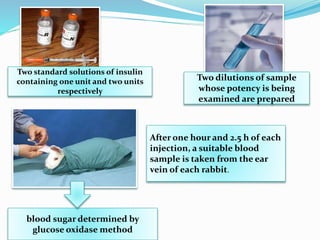
Two standard solutions of insulin
containing one unit and two units
respectively
Two dilutions of sample
whose potency is being
examined are prepared
After one hour and 2.5 h of each
injection, a suitable blood
sample is taken from the ear
vein of each rabbit.
blood sugar determined by
glucose oxidase method
Summary
screening of hypoglycemic agent

screening of hypoglycemic agent

  • 1.
  • 2.
     Pathogenesis ofType 1 & 2 Diabetes mellitus.  Diabetes mellitus is a chronic metabolic disorder characterised by a high blood glucose concentration Hyperglycemia due to insulin deficiency and/or insulin resistance.  Hyperglycemia occurs because of uncontrolled hepatic glucose output & reduced uptake of glucose by skeletal muscles with reduced glycogen synthesis.  Hypoglycemic effects causes “Blood sugar lowering” effects (Assay of insulin & insulin like activity).
  • 3.
    Cataract Formation  Diabeticpatients are known to have a higher incidence of cataract formation. Which produce changes in the transparency or the refractory index of the lens.  Aldose reductase catalyst the reduction of aldoses like “Glucose & Galactose” to corresponding polyols.  Aldose reductase inhibitors have been shown to prevent sugar induced cataract fomation.
  • 4.
    Pathogenesis GLUT Glucose transporterIAPP Islet amyloid poly-peptide
  • 5.
    Classification A. Enhance Insulinsecretion  Sulfonylureas (KATP channel blockers)  1st Gen:- Tolbutamide  2nd Gen:-Glimepiride B. Overcome Insulin resistance  Biguanide (AMPK Activator)  Thiazolidinediones (PPAR Activator) C. Miscellaneous anti-diabetic drugs  α- glucosidase inhibitors  Bromocriptin, Pramlintide
  • 6.
    In-Vivo Models 1. Streptozotocininduced DM 2. Blood sugar lowering effects in rabbits/mice. 3. Cataract formation in streptozotocin Diabetic rats. 4. Galactose induced cataract in rats. 5. Naphthalene induced cataract in rats. 6. Hypoglycemic seizures in mice. 7. Assay of glucose transport.
  • 7.
    In-Vitro Models 1. Assaysof insulin & of insulin like activity 2. Isolated organs, cell & membranes 3. Insulin receptor Binding assay 4. Assays of other glucose regulating peptide hormones 5. Inhibition of polysaccharide degrading enzyme 6. Effect on secondary diabetes symptoms 7. Glucose uptake by the isolated diaphragm from mice & rats 8. Insulin receptor binding assays 9. Isolated pancreas of rat 10. Rat diaphragm test.
  • 8.
    Streptozotocin induced DM Streptozotocin[60 mg/kg body weight] is prepared in citrated buffer [ph 4.5] Albino rats of either sex weighing 150-200 g are injected i.p with above solution. Animals showing fasting blood glucose levels > 140mg/dl after 48 hours of streptozotocin administration are considered diabetic. After six weeks of treatment blood samples are collected from 6 hour fasting animal Serum is separated by centrifuge (3000 rpm) under cooling (2-4 °C) for ten minutes Serum glucose level is estimated by glucose- peroxidase method [GOD-POD kit] using autoanalyser
  • 9.
    Broad spectrum antibiotic – 200 mg/kg i.p. MOA  β cell damage by free radical injury  Fragmentation of DNA  Nitric oxide generation  Induces diabetes in all species Advantages  Greater selectivity towards beta cells  Low mortality  Longer and irreversible diabetes  Guinea pigs and rabbits are resistant
  • 10.
    Insulin antibody induceddiabetes Principle: - A transient diabetic syndrome can be induced by injecting guinea pigs with anti insulin serum. Preparation of antibody Bovine insulin, dissolved in acidified water [ph 3.0] at a dose of 1mg /ml Anti insulin sera is collected after two weeks of antigenic challenge Injected into guinea pigs
  • 11.
    Procedure Adult albino ratsare injected with 0.25-1.0 ml of guinea pig anti- insulin serum. increase of blood glucose level up to 300 mg/ dl. The drug sample to be screened is given and blood glucose level is analyzed to determine the activity.
  • 12.
    Blood sugar loweringeffecs in rabbits/mice. PURPOSE & RATIONALE :- A biological assay of insulin preparations in comparison with a stable standard using the blood sugar lowering effects in rabbits. EVALUATION :-The result of the assay are calculated by standard methods. Rabbits 150mg/kg
  • 13.
    Procedure Rabbits 3-4.5kg div intogroups of 4-5 • Insulin and insulin like compound- • Food stopped a day earlier • Hypoglycemic agents-diet till experiment Test drug –orally 1ml/kg in0.4%starch suspension • Control receives only the vehicle • Different doses are tried on other groups Blood is withdrawn before &1,2,3,4,5,24,48 and 72 hr • Blood glucose is determined • Blood sugar values are plotted against time
  • 14.
    RAT MODEL Male Wistarrats -250 gms Divided into 4 groups of 7 each Test dose is given as per dose in starch suspension Blood is drawn from the tip of the tail at 1,2,3,5,24 hours
  • 15.
    IN VITRO METHODSON ISOLATED ORGANS AND CELLS  PRINCIPLE:- To study the effect of the drug on insulin, glucagon & somatostatin secretion without interference from other organs.  INSULIN ASSAY:- Four groups of six rabbits weighing at least 1.8 kg
  • 16.
    Two standard solutionsof insulin containing one unit and two units respectively Two dilutions of sample whose potency is being examined are prepared After one hour and 2.5 h of each injection, a suitable blood sample is taken from the ear vein of each rabbit. blood sugar determined by glucose oxidase method
  • 17.