THE INDIAN PATENT ACT – 1970
(Amendment)
Submitted by:
Mohit Kumar Verma
(Pharmacology 1st Year)
Dept. of Pharmaceutical Science
Contents
• INTRODUCTION
• MECHANISM OF IPR
• WHAT IS A PATENT ?
• TYPES OF PATENTS
• THE INDIAN PATENT ACT
• LAW AND REGULATIONS
• WHAT CAN BE PATENTED?
• PATENT LAW - SALIENT FEATURES
• NON-PATENTABLE INVENTIONS
• STAGES - FILING TO GRANT OF PATENT
• PATENT FIRST AMENDMENT ACT OF 1999
• THE PATENTS AMENDMENT ACT -2002
• THE PATENTS AMENDMENT ACT -2005
• PATENTS (AMENDMENT) 2010
• REFERENCES
INTELLECTUAL PROPERTY
• Intellectual property is the product or creation of the mind. It is different from
other properties in term that it is “intangible”. Hence it needs some different way
for its protection.
INTELLECTUAL PROPERTY RIGHTS
• IPR is the body of law developed to protect the creative people who have
disclosed their invention for the benefit of man kind. This protects their
invention from being copied or imitated without their consent.
INTRODUCTION
Mechanism of IPR
• Patents
• Copyrights
• Trademarks
• Industrial designs
• Layout designs of integrated circuits
• Geographical indications
• Plant Breeding Rights
• Trade secrets
What is a patent ?
• A patent is a grant from the government which confers on the
guarantee for a limited period of time the exclusive privilege of
making, selling and using the invention for which a patent has
been granted
Types Of Patents
• Three types of patent are granted under the provisions of the
act, namely:
1. An Ordinary Patent (Original application)
2. A Patent Of Addition
3. A Patent Of Convention
• A second type of classification of patent is:
1. Product Patent
2. Process Patent
THE INDIAN PATENT ACT
• In India the grant of patents is governed by the patent Act
1970 and Rules 1972.
• The patents granted under the act are operative in the whole of
India.
HISTORY
 The Patent Law of 1856
 The Patent and Designs Act, 1911.
 The Patents Act, 1970 and Rules 1972
 The Patent amendment act 2005
Law and Regulations
• Patents Act,1970
Patents Act of Amended -1999
Patents Act of Amended - 2002
Patents Act of Amended - 2005
Patents Act of Amended - 2010
• Patents Rules,1972
Patents Rules of Amended - 2003
Patents Rules of Amended - 2005
Patents Rules of Amended - 2006
Purpose of getting a patent……
• To enjoy the exclusive rights over the invention.
• The patent is to ensure commercial returns to the inventor for the
time and money spend in generating a new product.
What can be patented?
 In order to be patentable, an invention must pass four tests;
1. The invention must fall into one of the five “statutory classes”:
Processes, Machines , Manufactures Compositions of matter, and
New uses of any of the above
2. The invention must be “useful”
3. The invention must be “novel”
4. The invention must be “nonobvious”
Patent Law - Salient Features
• Both product and process patent provided
• Term of patent – 20 years
• Examination on request
• Both pre-grant and post-grant opposition
• Fast track mechanism for disposal of appeals
• Provision for protection of bio-diversity and traditional knowledge
• Publication of applications after 18 months with facility for early
publication
• Substantially reduced time-lines
Patentable Inventions
Invention must
Relates to a process or product or both
Must be new (novel)
Involves an inventive step
Be capable of industrial application
Not fall under section 3 and 4
“NEW” MEANS……….
Invention must not be
Published in India or elsewhere
In prior public knowledge or prior public use with in India
Claimed before in any specification in India
Section 3 exclusions
Section 3(a)
1. Inventions contrary to well established natural laws
Examples
1. Machine that gives more than 100% performance
2. Perpetual machine
Section 3(b)
 Commercial exploitation or primary use of inventions, which is
Contrary to
1. Public order or
2. Morality
Examples
1. Gambling machine,
2. Device for house-breaking
Section 3(b)
Commercial exploitation or primary use of inventions , which
Causes serious Prejudice to
Health or Human, Animal, Plant life or to the environment
Examples
 Biological warfare material or device, weapons of
mass destruction
 Terminator gene technology,
 Embryonic stem cell
Non-Patentable Inventions
• Inventions falling within Section 20(1) of the Atomic Energy
Act, 1962 are not patentable
Example:
Inventions relating to compounds of Uranium, Beryllium,
Thorium, Plutonium, Radium, Graphite, Lithium and more
as notified by Central Govt. from time to time.
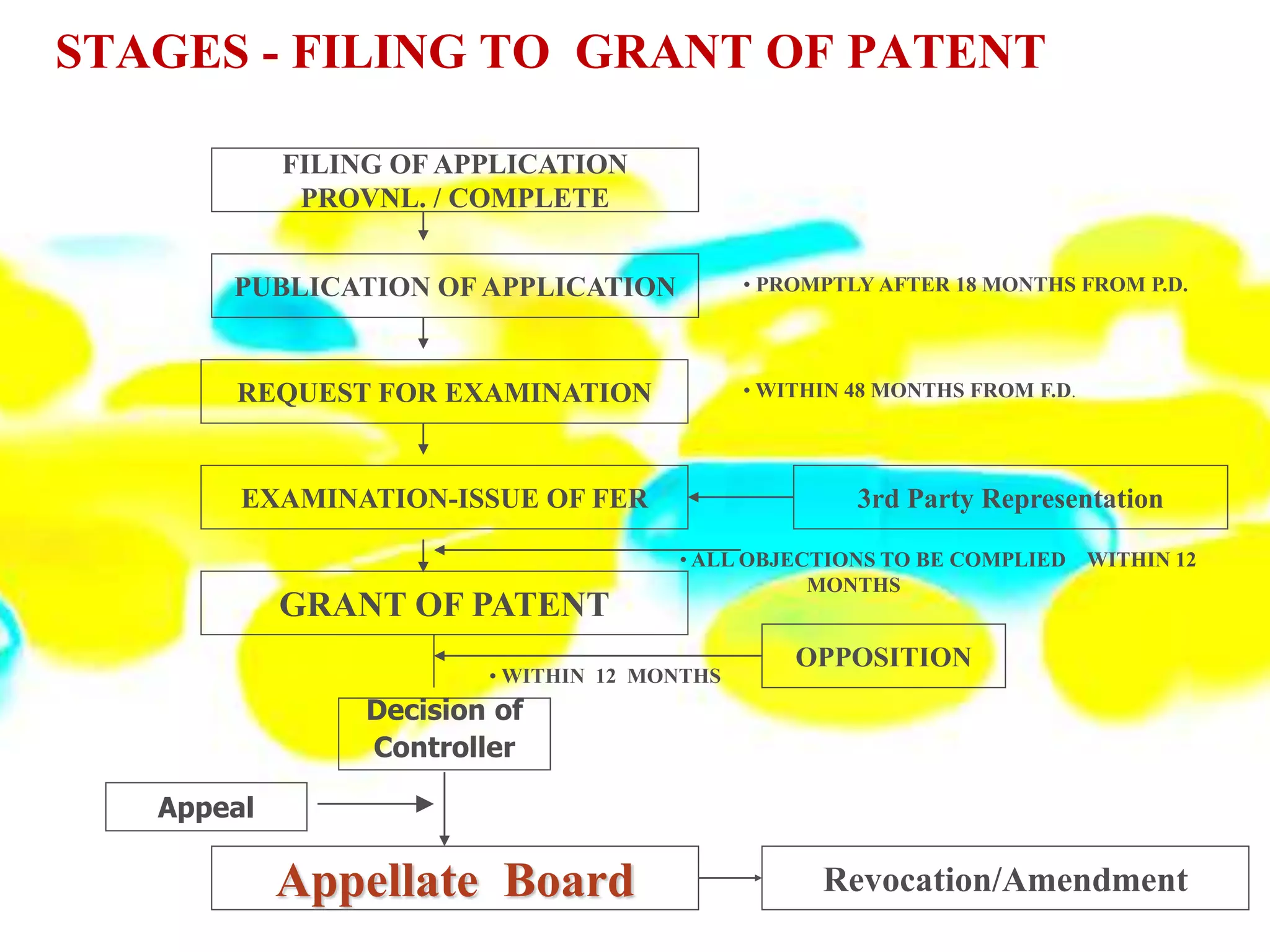
STAGES - FILING TO GRANT OF PATENT
PUBLICATION OF APPLICATION
REQUEST FOR EXAMINATION
GRANT OF PATENT
3rd Party Representation
Revocation/Amendment
OPPOSITION
• PROMPTLY AFTER 18 MONTHS FROM P.D.
• WITHIN 48 MONTHS FROM F.D.
• ALL OBJECTIONS TO BE COMPLIED WITHIN 12
MONTHS
• WITHIN 12 MONTHS
FILING OF APPLICATION
PROVNL. / COMPLETE
Decision of
Controller
EXAMINATION-ISSUE OF FER
Appellate Board
Appeal
Patent First Amendment Act of 1999:
Section 24A(1) mandate can be granted under Section 3 and 4
(and not under Section 5 which previously excluded drugs etc).
Controller to determine whether it is an invention falling within
Section 3 and 4, which will be the decisive factor for granting
the EMR.
Section 24B(1)(b) authorizes the grant of an EMR for five years
for inventions made in India on or after January 1, 1995 and for
which a claim for process patent has been made, and granted.
Omitted by the Patents (Amendment) Act, 2002
Patents Amendment Act- 2002
 A few important aspects of the Patents amendment act 2002
are mentioned below
 Hastening the process of patent grant, a patent is granted
within approximately two years of filing an application.
 The inventor had to fill a declaration of inventorship.
 The amendment also made the Indian patent act GATT
compatible.
The Patents amendment act -2005
Some of the major features of the Patents amendment act 2005 are ;
 Emphasis on Indigenous manufacturers
 Both pre-grant and post-grant opposition avenues
 In order to prevent "ever greening" of patents for pharmaceutical
substances, provisions listing out exceptions to patentability have been
suitably amended so as to remove all ambiguity as to the scope of
patentability.
 Product patent has been included in all fields of technology (that is drugs,
food and chemicals)
 Inventions where only methods or processes of manufacture patentable:
[Omitted by the Patents (Amendment) Act, 2005]
Patents (Amendment) 2010
• General Amendment of Act
The principal Act is amended by the deletion of the words "Patent
Office”
wherever they appear and the substitution therefor of the word
"Agency".
• Registrar and other staff Act No. 15 of 2010
The Registrar shall exercise the powers and perform the duties
assigned to the Registrar by this Act and the Patents and Companies
Registration Agency Act, 2010.
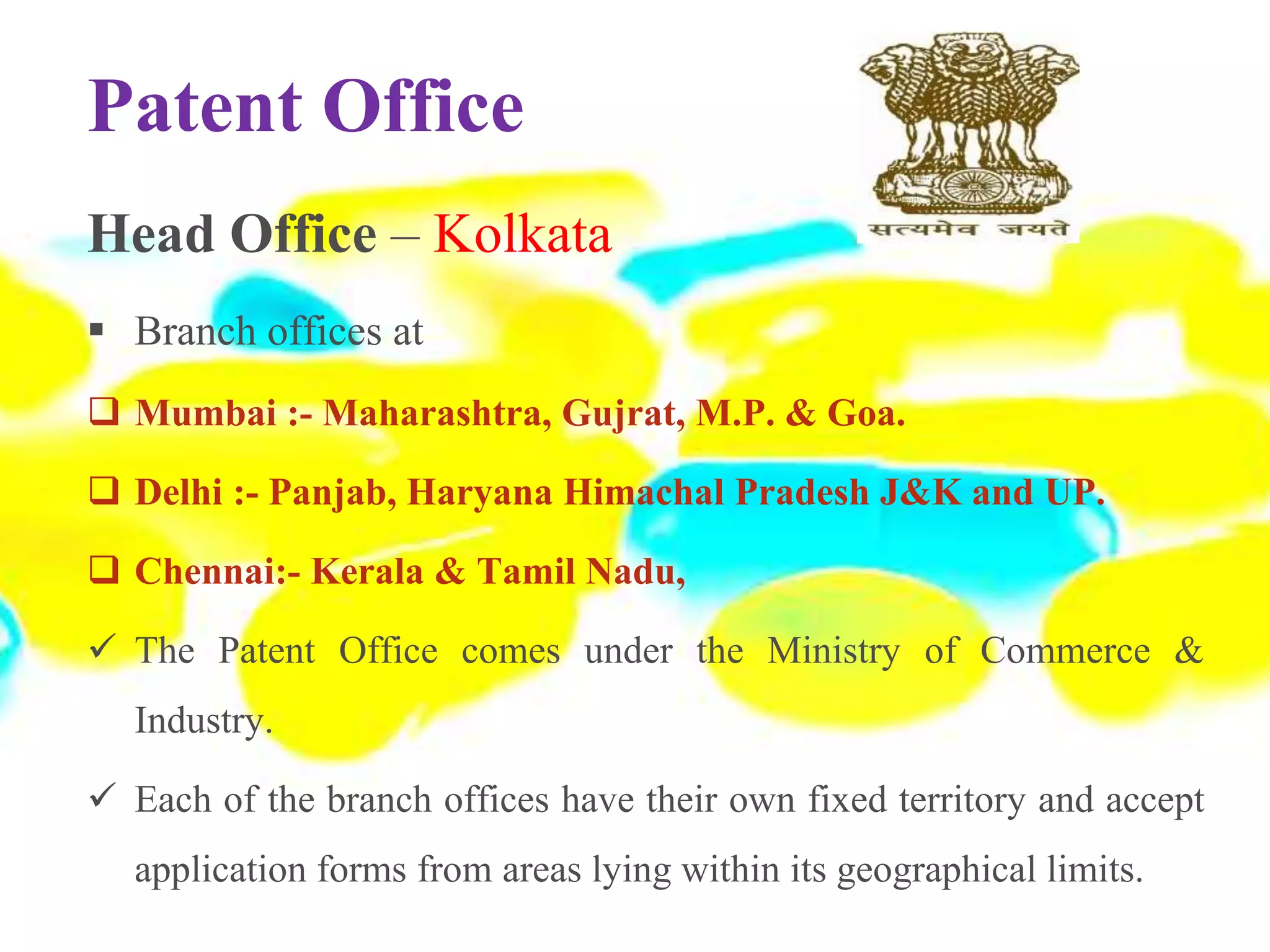
Patent Office
Head Office – Kolkata
 Branch offices at
 Mumbai :- Maharashtra, Gujrat, M.P. & Goa.
 Delhi :- Panjab, Haryana Himachal Pradesh J&K and UP.
 Chennai:- Kerala & Tamil Nadu,
 The Patent Office comes under the Ministry of Commerce &
Industry.
 Each of the branch offices have their own fixed territory and accept
application forms from areas lying within its geographical limits.
References
• An Act to amend the Patents (Amendment) Act. [16th April,
2010 ENACTED by the Parliament of Zambia ACT No. 14 of
2010 dated 13th April, 2010, No.14 of 2010 105
• Kishan Arora, The Patent Act, 1970 (39 of 1970) 1-4 (New
Delhi: Professional Book Publishers, 2007)
• Sajeev Chandran, Archana Roy and Lokesh Jain, Journal of
intellectual property right, Vol 10, July 2005, pp 269-280
• Bansal Parikshit ,IPR Handbook For Pharma Students and
Researchers, and Publishead by Pharma med Press2009

Mohit dra patent act amentment ppt

  • 1.
    THE INDIAN PATENTACT – 1970 (Amendment) Submitted by: Mohit Kumar Verma (Pharmacology 1st Year) Dept. of Pharmaceutical Science
  • 2.
    Contents • INTRODUCTION • MECHANISMOF IPR • WHAT IS A PATENT ? • TYPES OF PATENTS • THE INDIAN PATENT ACT • LAW AND REGULATIONS • WHAT CAN BE PATENTED? • PATENT LAW - SALIENT FEATURES • NON-PATENTABLE INVENTIONS • STAGES - FILING TO GRANT OF PATENT • PATENT FIRST AMENDMENT ACT OF 1999 • THE PATENTS AMENDMENT ACT -2002 • THE PATENTS AMENDMENT ACT -2005 • PATENTS (AMENDMENT) 2010 • REFERENCES
  • 3.
    INTELLECTUAL PROPERTY • Intellectualproperty is the product or creation of the mind. It is different from other properties in term that it is “intangible”. Hence it needs some different way for its protection. INTELLECTUAL PROPERTY RIGHTS • IPR is the body of law developed to protect the creative people who have disclosed their invention for the benefit of man kind. This protects their invention from being copied or imitated without their consent. INTRODUCTION
  • 4.
    Mechanism of IPR •Patents • Copyrights • Trademarks • Industrial designs • Layout designs of integrated circuits • Geographical indications • Plant Breeding Rights • Trade secrets
  • 5.
    What is apatent ? • A patent is a grant from the government which confers on the guarantee for a limited period of time the exclusive privilege of making, selling and using the invention for which a patent has been granted
  • 6.
    Types Of Patents •Three types of patent are granted under the provisions of the act, namely: 1. An Ordinary Patent (Original application) 2. A Patent Of Addition 3. A Patent Of Convention • A second type of classification of patent is: 1. Product Patent 2. Process Patent
  • 7.
    THE INDIAN PATENTACT • In India the grant of patents is governed by the patent Act 1970 and Rules 1972. • The patents granted under the act are operative in the whole of India. HISTORY  The Patent Law of 1856  The Patent and Designs Act, 1911.  The Patents Act, 1970 and Rules 1972  The Patent amendment act 2005
  • 8.
    Law and Regulations •Patents Act,1970 Patents Act of Amended -1999 Patents Act of Amended - 2002 Patents Act of Amended - 2005 Patents Act of Amended - 2010 • Patents Rules,1972 Patents Rules of Amended - 2003 Patents Rules of Amended - 2005 Patents Rules of Amended - 2006
  • 9.
    Purpose of gettinga patent…… • To enjoy the exclusive rights over the invention. • The patent is to ensure commercial returns to the inventor for the time and money spend in generating a new product.
  • 10.
    What can bepatented?  In order to be patentable, an invention must pass four tests; 1. The invention must fall into one of the five “statutory classes”: Processes, Machines , Manufactures Compositions of matter, and New uses of any of the above 2. The invention must be “useful” 3. The invention must be “novel” 4. The invention must be “nonobvious”
  • 11.
    Patent Law -Salient Features • Both product and process patent provided • Term of patent – 20 years • Examination on request • Both pre-grant and post-grant opposition • Fast track mechanism for disposal of appeals • Provision for protection of bio-diversity and traditional knowledge • Publication of applications after 18 months with facility for early publication • Substantially reduced time-lines
  • 12.
    Patentable Inventions Invention must Relatesto a process or product or both Must be new (novel) Involves an inventive step Be capable of industrial application Not fall under section 3 and 4
  • 13.
    “NEW” MEANS………. Invention mustnot be Published in India or elsewhere In prior public knowledge or prior public use with in India Claimed before in any specification in India
  • 14.
    Section 3 exclusions Section3(a) 1. Inventions contrary to well established natural laws Examples 1. Machine that gives more than 100% performance 2. Perpetual machine
  • 15.
    Section 3(b)  Commercialexploitation or primary use of inventions, which is Contrary to 1. Public order or 2. Morality Examples 1. Gambling machine, 2. Device for house-breaking
  • 16.
    Section 3(b) Commercial exploitationor primary use of inventions , which Causes serious Prejudice to Health or Human, Animal, Plant life or to the environment Examples  Biological warfare material or device, weapons of mass destruction  Terminator gene technology,  Embryonic stem cell
  • 17.
    Non-Patentable Inventions • Inventionsfalling within Section 20(1) of the Atomic Energy Act, 1962 are not patentable Example: Inventions relating to compounds of Uranium, Beryllium, Thorium, Plutonium, Radium, Graphite, Lithium and more as notified by Central Govt. from time to time.
  • 18.
    STAGES - FILINGTO GRANT OF PATENT PUBLICATION OF APPLICATION REQUEST FOR EXAMINATION GRANT OF PATENT 3rd Party Representation Revocation/Amendment OPPOSITION • PROMPTLY AFTER 18 MONTHS FROM P.D. • WITHIN 48 MONTHS FROM F.D. • ALL OBJECTIONS TO BE COMPLIED WITHIN 12 MONTHS • WITHIN 12 MONTHS FILING OF APPLICATION PROVNL. / COMPLETE Decision of Controller EXAMINATION-ISSUE OF FER Appellate Board Appeal
  • 19.
    Patent First AmendmentAct of 1999: Section 24A(1) mandate can be granted under Section 3 and 4 (and not under Section 5 which previously excluded drugs etc). Controller to determine whether it is an invention falling within Section 3 and 4, which will be the decisive factor for granting the EMR. Section 24B(1)(b) authorizes the grant of an EMR for five years for inventions made in India on or after January 1, 1995 and for which a claim for process patent has been made, and granted. Omitted by the Patents (Amendment) Act, 2002
  • 20.
    Patents Amendment Act-2002  A few important aspects of the Patents amendment act 2002 are mentioned below  Hastening the process of patent grant, a patent is granted within approximately two years of filing an application.  The inventor had to fill a declaration of inventorship.  The amendment also made the Indian patent act GATT compatible.
  • 21.
    The Patents amendmentact -2005 Some of the major features of the Patents amendment act 2005 are ;  Emphasis on Indigenous manufacturers  Both pre-grant and post-grant opposition avenues  In order to prevent "ever greening" of patents for pharmaceutical substances, provisions listing out exceptions to patentability have been suitably amended so as to remove all ambiguity as to the scope of patentability.  Product patent has been included in all fields of technology (that is drugs, food and chemicals)  Inventions where only methods or processes of manufacture patentable: [Omitted by the Patents (Amendment) Act, 2005]
  • 22.
    Patents (Amendment) 2010 •General Amendment of Act The principal Act is amended by the deletion of the words "Patent Office” wherever they appear and the substitution therefor of the word "Agency". • Registrar and other staff Act No. 15 of 2010 The Registrar shall exercise the powers and perform the duties assigned to the Registrar by this Act and the Patents and Companies Registration Agency Act, 2010.
  • 23.
    Patent Office Head Office– Kolkata  Branch offices at  Mumbai :- Maharashtra, Gujrat, M.P. & Goa.  Delhi :- Panjab, Haryana Himachal Pradesh J&K and UP.  Chennai:- Kerala & Tamil Nadu,  The Patent Office comes under the Ministry of Commerce & Industry.  Each of the branch offices have their own fixed territory and accept application forms from areas lying within its geographical limits.
  • 25.
    References • An Actto amend the Patents (Amendment) Act. [16th April, 2010 ENACTED by the Parliament of Zambia ACT No. 14 of 2010 dated 13th April, 2010, No.14 of 2010 105 • Kishan Arora, The Patent Act, 1970 (39 of 1970) 1-4 (New Delhi: Professional Book Publishers, 2007) • Sajeev Chandran, Archana Roy and Lokesh Jain, Journal of intellectual property right, Vol 10, July 2005, pp 269-280 • Bansal Parikshit ,IPR Handbook For Pharma Students and Researchers, and Publishead by Pharma med Press2009