ETHICS AND PHARMACEUTICAL
INDUSTRY
Presented by Seth Kokora
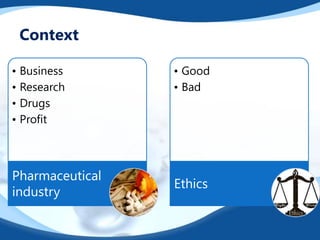
Context
• Business
• Research
• Drugs
• Profit
Pharmaceutical
industry
• Good
• Bad
Ethics
Ethical cases
Death from prescription drugs(Hull, Massachusetts US 2006)
Rebecca Riley, the daughter of Michael and Carolyn Riley and resident of Massachusetts,
was found dead at age 4 in her home after prolonged exposure to various medications,
her lungs filled with fluid.
The medical examiner's office determined the girl died from "intoxication due to the
combined effects" of prescription drugs.
Police reports state she was taking 750 milligrams a day of Depakote, 200 milligrams a
day of Seroquel, and .35 milligrams a day of Clonidine.
Rebecca had been taking the drugs since the age of two for bipolar disorder and ADHD,
diagnosed by child psychiatrist Kayoko Kifuji of the Tufts-New England Medical Center.
Ethical cases
human experiments
In 2004 GlaxoSmithKline (GSK) sponsored at least four medical trials using Hispanic and
black children at New York Incarnation Children's Centre. Normally trials on children
require parental consent but, as the infants are in care, New York's authorities hold that
role. Experiments were designed to test the “safety and tolerance” of Aids medications,
some of which have potentially dangerous side effects.
In 2006 GSK and US Army have been criticized for Hepatitis-E vaccine experiments on
2000 soldiers of Royal Nepalese Army conducted in 2003. It was said that using soldiers
as volunteers is unethical because they "could easily be coerced into taking part".
In January 2012 GSK and two scientists who led the trials have been fined approximately
$240,000 in Argentina for "experimenting with human beings" and "falsifying parental
authorization" during vaccine trials on 15000 children, under the age of one. Babies were
recruited from poor families that attended public hospitals for medical treatment. 14
babies allegedly died as a result of trials.
Ethics in pharmaceutical industry
Ethics in pharmaceutical industry: Ethical
behavior
Integrity
Information sharing
Accurate prescription
Transparency
Objectivity
Fairness
Care for and about people
Ethics in pharmaceutical industry:
Unethical behavior
Misleading advertisements
Personal interest
Misguiding prescription
Subjectivity
Partiality
Selling of samples to public
Uncontrolled testing
Core issues
Profit
Business
Share holders
Employees
Medical
research
Improvement
Face new
diseases
Alternatives for
inappropriate
drugs
Some other issues
Ethnical and racial inclusion in clinical trial
Including children in research: participation
or exploitation?
Intellectual property rights
• Bayer case : Cipro for anthrax.
International Federation of Pharmaceutical
Manufacturers and Associations (IFPMA)
Standards of promotional Information
• Consistency of product information
• Accurate and not misleading
• Substantiation
Infringement, complaints and enforcement
• Encourage genuine complaints
• Adopt procedure to assure adherence to
national code.
Regulatory bodies
International
• WHO (World Health organization)
• FDA (Food and Drug Administration)
• HSA (Health Sciences Authority) – Singapore
India
• CDSCO (Central Drugs Standard Control
Organization)
• NPPA (National Pharmaceutical Pricing
Authority)
• The drugs and cosmetics act and rules 1945 (as
corrected up to 30th April 2003)
Ethics
Pharma
THANK YOU!

Ethics & pharmaceutical industry

  • 1.
  • 2.
    Context • Business • Research •Drugs • Profit Pharmaceutical industry • Good • Bad Ethics
  • 3.
    Ethical cases Death fromprescription drugs(Hull, Massachusetts US 2006) Rebecca Riley, the daughter of Michael and Carolyn Riley and resident of Massachusetts, was found dead at age 4 in her home after prolonged exposure to various medications, her lungs filled with fluid. The medical examiner's office determined the girl died from "intoxication due to the combined effects" of prescription drugs. Police reports state she was taking 750 milligrams a day of Depakote, 200 milligrams a day of Seroquel, and .35 milligrams a day of Clonidine. Rebecca had been taking the drugs since the age of two for bipolar disorder and ADHD, diagnosed by child psychiatrist Kayoko Kifuji of the Tufts-New England Medical Center.
  • 4.
    Ethical cases human experiments In2004 GlaxoSmithKline (GSK) sponsored at least four medical trials using Hispanic and black children at New York Incarnation Children's Centre. Normally trials on children require parental consent but, as the infants are in care, New York's authorities hold that role. Experiments were designed to test the “safety and tolerance” of Aids medications, some of which have potentially dangerous side effects. In 2006 GSK and US Army have been criticized for Hepatitis-E vaccine experiments on 2000 soldiers of Royal Nepalese Army conducted in 2003. It was said that using soldiers as volunteers is unethical because they "could easily be coerced into taking part". In January 2012 GSK and two scientists who led the trials have been fined approximately $240,000 in Argentina for "experimenting with human beings" and "falsifying parental authorization" during vaccine trials on 15000 children, under the age of one. Babies were recruited from poor families that attended public hospitals for medical treatment. 14 babies allegedly died as a result of trials.
  • 5.
  • 6.
    Ethics in pharmaceuticalindustry: Ethical behavior Integrity Information sharing Accurate prescription Transparency Objectivity Fairness Care for and about people
  • 7.
    Ethics in pharmaceuticalindustry: Unethical behavior Misleading advertisements Personal interest Misguiding prescription Subjectivity Partiality Selling of samples to public Uncontrolled testing
  • 8.
  • 9.
    Some other issues Ethnicaland racial inclusion in clinical trial Including children in research: participation or exploitation? Intellectual property rights • Bayer case : Cipro for anthrax.
  • 10.
    International Federation ofPharmaceutical Manufacturers and Associations (IFPMA) Standards of promotional Information • Consistency of product information • Accurate and not misleading • Substantiation Infringement, complaints and enforcement • Encourage genuine complaints • Adopt procedure to assure adherence to national code.
  • 11.
    Regulatory bodies International • WHO(World Health organization) • FDA (Food and Drug Administration) • HSA (Health Sciences Authority) – Singapore India • CDSCO (Central Drugs Standard Control Organization) • NPPA (National Pharmaceutical Pricing Authority) • The drugs and cosmetics act and rules 1945 (as corrected up to 30th April 2003)
  • 12.
  • 13.