ScreenScreen
PrintingPrinting
History - beginningsHistory - beginnings
• Screen-printing firstScreen-printing first
appeared in aappeared in a
recognizable form inrecognizable form in
China during the SongChina during the Song
Dynasty (960–1279 CE).Dynasty (960–1279 CE).
Japan and other AsianJapan and other Asian
countries adopted thiscountries adopted this
method of printing andmethod of printing and
advanced the craft usingadvanced the craft using
it in conjunction with blockit in conjunction with block
printing and paints.printing and paints.
History – western introductionHistory – western introduction
• Screen-printing was introduced to WesternScreen-printing was introduced to Western
Europe from Asia sometime in the lateEurope from Asia sometime in the late
1700s, but did not gain large acceptance1700s, but did not gain large acceptance
or use in Europe until silk mesh was moreor use in Europe until silk mesh was more
available for trade from the east and aavailable for trade from the east and a
profitable outlet for the mediumprofitable outlet for the medium
discovered.discovered.
History – popularity increasesHistory – popularity increases
• Screen-printing was first patented inScreen-printing was first patented in
England by Samuel Simon in 1907. It wasEngland by Samuel Simon in 1907. It was
originally used as a popular method tooriginally used as a popular method to
print expensive wall paper, printed onprint expensive wall paper, printed on
linen, silk, and other fine fabrics. Westernlinen, silk, and other fine fabrics. Western
screen printers developed businessscreen printers developed business
policies intended to keep secret theirpolicies intended to keep secret their
workshops' knowledge and techniques.workshops' knowledge and techniques.
• Originally a profitable industrial technology,Originally a profitable industrial technology,
screen printing was eventually adopted by artistsscreen printing was eventually adopted by artists
as an expressive and conveniently repeatableas an expressive and conveniently repeatable
medium for duplication well before the 1900s. Itmedium for duplication well before the 1900s. It
is currently popular both in fine arts and inis currently popular both in fine arts and in
commercial printing, where it is commonly usedcommercial printing, where it is commonly used
to print images on T-shirts, hats, CDs, DVDs,to print images on T-shirts, hats, CDs, DVDs,
ceramics, glass, polyethylene, polypropylene,ceramics, glass, polyethylene, polypropylene,
paper, metals, and wood.paper, metals, and wood.
The process of forcing inkThe process of forcing ink
through a porous fabricthrough a porous fabric
and the open areas of aand the open areas of a
stencil to produce anstencil to produce an
image.image.
Screen Printing ProcessScreen Printing Process
1960’s to present1960’s to present
• Credit is generally givenCredit is generally given
to the artist Andyto the artist Andy
Warhol for popularizingWarhol for popularizing
screen printingscreen printing
identified as serigraphy,identified as serigraphy,
in the United States.in the United States.
Warhol is particularlyWarhol is particularly
identified with his 1962identified with his 1962
depiction of actressdepiction of actress
Marilyn Monroe screenMarilyn Monroe screen
printed in garish colors.printed in garish colors.
Two terms commonly used:Two terms commonly used:
Serigraphy (in the field ofSerigraphy (in the field of
fine arts) and Screenfine arts) and Screen
Printing used in the graphicPrinting used in the graphic
communications industry.communications industry.
Applications for ScreenApplications for Screen
Printing:Printing:
• PostersPosters
• Plastic bottlesPlastic bottles
• Drinking glassesDrinking glasses
• Soda bottlesSoda bottles
• Mirrors, metal surfacesMirrors, metal surfaces
• WoodWood
• TextilesTextiles
• Printed circuit boardsPrinted circuit boards
• Product displaysProduct displays
• Vinyl bindersVinyl binders
Advantages of Screen PrintingAdvantages of Screen Printing
• Images can be printed on a wide variety ofImages can be printed on a wide variety of
substrates.substrates.
• The production process is relatively easy.The production process is relatively easy.
• Capital expenditures are low compared to otherCapital expenditures are low compared to other
printing processes.printing processes.
• Images can be printed with glitter, flock, andImages can be printed with glitter, flock, and
other decorative finishes.other decorative finishes.
• The ink film is very resilient due to the extremeThe ink film is very resilient due to the extreme
thickness of the ink deposit.thickness of the ink deposit.
Disadvantages of ScreenDisadvantages of Screen
PrintingPrinting
• The process is usually limited to flat, relativelyThe process is usually limited to flat, relatively
thin substrates, such as paper, metal, orthin substrates, such as paper, metal, or
plastic.plastic.
• Rate of production is slow.Rate of production is slow.
• Ink mileage is poor.Ink mileage is poor.
• Excessive drying times may be necessary.Excessive drying times may be necessary.
• Details and fine line images may be difficult toDetails and fine line images may be difficult to
print.print.
Basic tools & Equipment for ScreenBasic tools & Equipment for Screen
Printing:Printing:
• FrameFrame
• SqueegeeSqueegee
• Vacuum Printing FrameVacuum Printing Frame
• Printing TablePrinting Table
• Screw DriverScrew Driver
• DividerDivider
• HammerHammer
• Sharp KnifeSharp Knife
FramesFrames
 Materials
◦ Wood– less expensive, warps or rots faster
◦ Aluminum– more expensive, durable
 Sizes
◦ Labeled according to I.D. (inside dimension)
 Recommended sizes for printing: at least 6 inches beyond.
 Image size at top and bottom: at least 6 inches on each side.
 Types
◦ Wooden with groove: made for attaching fabric with a rope.
◦ Wooden or aluminum without a groove: fabric attached with glue.
◦ Retensionable aluminum: screen can be tightened repeatedly.
FabricsFabrics
• Two main functions
• Provide support for stencil.
• Control ink flow.
• Mesh count: how many opening per inch.
• Fine mesh=100 count (ct) up to 500 ct. mesh
• More detail and uses less ink; feels softer to touch.
• Less likely to smear on non-absorbent substrates.
• Coarse mesh=40 to 100 ct. mesh
• Heavy ink deposit (good for light inks on dark shirts.
• Better opacity
FabricsFabrics cont…cont…
Two general types
Multifilament: tiny strands twisted together
Includes: polyester and silk
Good for film stencils (like amber film)—sticks to it better
 Monofilament: (mono= one) single strand of thread
Good for liquid emulsion
Includes polyester; stainless steel
Good for fine detail; easier to clean than multifilament
FabricsFabrics cont…cont…
Colored Fabrics: used to reduce unwanted glare during
exposure, called “halation’s.” Halation’s cause distortion
around edge of images.
Chemicals Used In Screen
Printing
Autosol.
Photocure Texture.
Sp-1300.
Benzene.
Carbon tetra chloride
Detergent powder
Glue(swan Aica)
Cold and clean water
Light Sensitive Film For Screen
Printing
Direct film
Indirect film (Pre-sensitized gelatin film & Pre-sensitized synthetic
polymer coated film. Known as five star film)
Indirect film used for indirect stencil making.
StencilsStencils (Two Types)(Two Types)
 Non-photographic: hand cut (i.e. amber film, or paper)
 Photographic: (light sensitive) photo emulsion (liquid)
◦ Exposure process: Some type of light is used to harden emulsion.
 Why does the image spray out?- The particles in the emulsion that the
positive was not covering, was hardened by the UV light.
◦ Overexposure: results in image NOT spraying out completely.
◦ Underexposure: results in scuming (an almost invisible film forms
on stencil from the still soft emulsion running across screen as it
dries)
Stencil Making
There are two way of stencil making.
Direct process.
Indirect Process
Stencil Making of Direct Process
In a darkened room or in a room with
a yellow safe light, pour the emulsion
into a scoop coater
Coat the screen, applying 2 thin coats of
emulsion on each side of the screen.
If your scoop coater is
smaller than the width of
your screen, coat as
shown in this slide.
Once you have one coat
on this side, turn the
screen upside down to
apply the second coat.
Then apply two thin
coats onto the back side
of the screen, again
flipping the screen
upside down in between
coats.
Wipe off any excess
emulsion that gathers
around the edges.
Store the coated screens
in a dark room or light-tight
box until they are dry.
Screens should dry with
the flat side down (the side
you used the squeegee on
should be facing up). They
need to dry perfectly flat. If
the screen is tilted even
the slightest bit, then the
emulsion might dry
unevenly and run off the
screen.
If you are coating
more than one
screen, stack them
using small blocks
in between each
one.
Once the screens
are dry they may be
put in black plastic
garbage bags until
you are ready to
expose them
Expose the silkscreen with the students’ Film
Positives. There are different types of exposing
units. This one is a light table with clear glass
and florescent light bulbs.
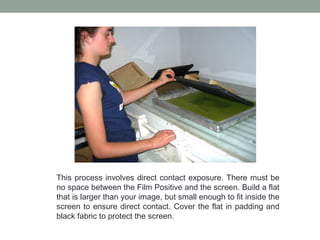
This process involves direct contact exposure. There must be
no space between the Film Positive and the screen. Build a flat
that is larger than your image, but small enough to fit inside the
screen to ensure direct contact. Cover the flat in padding and
black fabric to protect the screen.
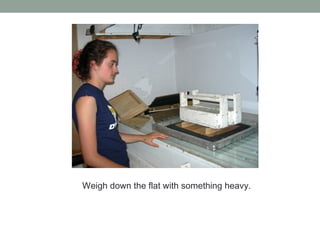
Weigh down the flat with something heavy.
After your exposure
time is up, rinse the
screen on both sides.
The emulsion that was
not exposed to light
(because it was
blocked by the opaque
black areas of the Film
Positive) will wash
away. Wash the
screen until there are
very few white bubbles
remaining. Store the
screen on a flat
surface to dry or use a
fan.
When dry, screen is
ready to proof.
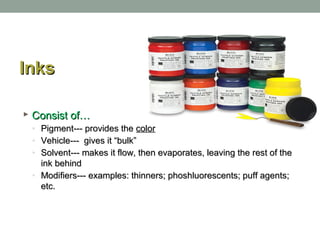
InksInks
 Consist of…Consist of…
◦ Pigment--- provides thePigment--- provides the colorcolor
◦ Vehicle--- gives it “bulk”Vehicle--- gives it “bulk”
◦ Solvent--- makes it flow, then evaporates, leaving the rest of theSolvent--- makes it flow, then evaporates, leaving the rest of the
ink behindink behind
◦ Modifiers--- examples: thinners; phoshluorescents; puff agents;Modifiers--- examples: thinners; phoshluorescents; puff agents;
etc.etc.
Types of InkTypes of Ink
Conventional– dry by air
Water based
Solvent based
 Non-conventional– cured by “polymerization”
Plastisol– cured with heat (325 degrees); used for absorbent
materials only (textiles); won’t work on paper, except for heat
transfers.
 UV (ultraviolet) inks– cured with UV light; for
non-absorbent substrates such as vinyl, and
coated papers. Quick, clean method.
Inks cont…Inks cont…
Process inks vs. spot colors
Process inks- ________, ________, _______,________
combined to produce full color prints. Process inks have less
“opacity.”
Spot color– one or more colors to improve appearance without
expense of process printing (or could be a special color added to
a process print)
Squeegees
Three main purposes
Force ink through mesh
“Flood” stroke: purpose
Control ink deposit
Squeegees cont…Squeegees cont…
 Recommended size:Recommended size: two inches wider than image widthtwo inches wider than image width
(maximum)(maximum)
 Storage:Storage: Blade upBlade up
 Blades vary in:Blades vary in:
◦ Material: vinyl or rubberMaterial: vinyl or rubber
◦ Hardness: durometer rating (the higher the rating, the stiffer theHardness: durometer rating (the higher the rating, the stiffer the
blade)blade)
◦ Shape:Shape:
Squeegee cont…Squeegee cont…
Clean-up
Water based ink- cleans up with Water!!
Plastisols require __________ (paint thinner) or other specially
made ink cleaning solutions.
Liquid (direct) emulsion– remove by degreasing first to get rid of
ink solvents left behind, then apply reclaimer.
Potential for Further Development
The main focus of further development lies principally in the plate
making sector:
• The direct imaging of screens (computer to screen) will become more
and more prevalent, especially in conjunction with rotary screen
printing units for large print runs.
• The already available but still little used filmless stencil production
with ink jet printing technology is of particular interest for large format
applications. At approximately 600dpi, the resolution guarantees
sufficiently good print quality even with color gradations.
Computer to
screen for
screen
printing
• Computer to screen printing is the digital
production of image carriers for screen printing
in which the print image data, controlled
directly via the computer, are output onto the
stencil or screen. Most computer to screen
systems work using the ink jet technology, in
which either heated wax or ink is applied to the
screen.
• First the screen must be lined with a closed
layer/ emulsion (stencil material). The print
image is applied to this coating using ink jet ink
(as a film substitute). This is then followed by
the usual exposure to cure the stencil material.
The uncured ink-covered areas of the coating
are then washed off with water. After drying, the
stencil/ screen plate is ready for printing.
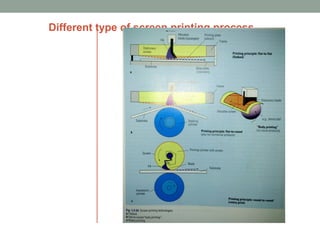
Different type of screen printing process
Modern
screen
printing
proces
s
Terms to Know!Terms to Know!
 Scum:
Unexpected image which comes from stencil or plate.
 Haze:
Generalized faint staining of screen mesh caused photo
stencils, screen filters, printing mixtures and varnishes: cf. ghost.
 Fisheye:
Unwanted open area in a photo stencil which prints with
the appearance of the eye of a fish.
 Margin:
Perimeter of mesh adjacent to the frame of the screen: this non
printing area is closed during printing, either temporarily or
permanently, to protect the mesh and to be used as a printing mix
reservoir.
 Digital positive:
Positive created and output using a computer.
 Artwork:
A general term for photographs, drawings, and others materials
prepared to illustrate printed matter.
 Heat transfer paper:
The substrate used in thermal transfer printing. The design
is first printed on it with inks containing sublimely
dispersed.
 Flood stroke:
The squeegee motion that deposits a thick layer of ink on
top of the screen printing screen under light pressure. The
excessive ink prevents the image areas from drying
between printing strokes.
 Mesh aperture:
The space between the woven threads of screen printing
fabric, through which the ink passes during printing.
Screen opener:
A chemical, usually in aerosol spray from, used to
clear dried-in areas of a screen printing stencil.
Dark reaction:
In an unexposed light-sensitive emulsion or
coating, the sloe chemical change that occurs when
the material is stored in an unlighted area.
Mesh?
Stencil?
Screen printing

Screen printing

  • 3.
  • 4.
    History - beginningsHistory- beginnings • Screen-printing firstScreen-printing first appeared in aappeared in a recognizable form inrecognizable form in China during the SongChina during the Song Dynasty (960–1279 CE).Dynasty (960–1279 CE). Japan and other AsianJapan and other Asian countries adopted thiscountries adopted this method of printing andmethod of printing and advanced the craft usingadvanced the craft using it in conjunction with blockit in conjunction with block printing and paints.printing and paints.
  • 5.
    History – westernintroductionHistory – western introduction • Screen-printing was introduced to WesternScreen-printing was introduced to Western Europe from Asia sometime in the lateEurope from Asia sometime in the late 1700s, but did not gain large acceptance1700s, but did not gain large acceptance or use in Europe until silk mesh was moreor use in Europe until silk mesh was more available for trade from the east and aavailable for trade from the east and a profitable outlet for the mediumprofitable outlet for the medium discovered.discovered.
  • 6.
    History – popularityincreasesHistory – popularity increases • Screen-printing was first patented inScreen-printing was first patented in England by Samuel Simon in 1907. It wasEngland by Samuel Simon in 1907. It was originally used as a popular method tooriginally used as a popular method to print expensive wall paper, printed onprint expensive wall paper, printed on linen, silk, and other fine fabrics. Westernlinen, silk, and other fine fabrics. Western screen printers developed businessscreen printers developed business policies intended to keep secret theirpolicies intended to keep secret their workshops' knowledge and techniques.workshops' knowledge and techniques.
  • 7.
    • Originally aprofitable industrial technology,Originally a profitable industrial technology, screen printing was eventually adopted by artistsscreen printing was eventually adopted by artists as an expressive and conveniently repeatableas an expressive and conveniently repeatable medium for duplication well before the 1900s. Itmedium for duplication well before the 1900s. It is currently popular both in fine arts and inis currently popular both in fine arts and in commercial printing, where it is commonly usedcommercial printing, where it is commonly used to print images on T-shirts, hats, CDs, DVDs,to print images on T-shirts, hats, CDs, DVDs, ceramics, glass, polyethylene, polypropylene,ceramics, glass, polyethylene, polypropylene, paper, metals, and wood.paper, metals, and wood.
  • 8.
    The process offorcing inkThe process of forcing ink through a porous fabricthrough a porous fabric and the open areas of aand the open areas of a stencil to produce anstencil to produce an image.image.
  • 9.
  • 10.
    1960’s to present1960’sto present • Credit is generally givenCredit is generally given to the artist Andyto the artist Andy Warhol for popularizingWarhol for popularizing screen printingscreen printing identified as serigraphy,identified as serigraphy, in the United States.in the United States. Warhol is particularlyWarhol is particularly identified with his 1962identified with his 1962 depiction of actressdepiction of actress Marilyn Monroe screenMarilyn Monroe screen printed in garish colors.printed in garish colors.
  • 11.
    Two terms commonlyused:Two terms commonly used: Serigraphy (in the field ofSerigraphy (in the field of fine arts) and Screenfine arts) and Screen Printing used in the graphicPrinting used in the graphic communications industry.communications industry.
  • 12.
    Applications for ScreenApplicationsfor Screen Printing:Printing: • PostersPosters • Plastic bottlesPlastic bottles • Drinking glassesDrinking glasses • Soda bottlesSoda bottles • Mirrors, metal surfacesMirrors, metal surfaces • WoodWood • TextilesTextiles • Printed circuit boardsPrinted circuit boards • Product displaysProduct displays • Vinyl bindersVinyl binders
  • 13.
    Advantages of ScreenPrintingAdvantages of Screen Printing • Images can be printed on a wide variety ofImages can be printed on a wide variety of substrates.substrates. • The production process is relatively easy.The production process is relatively easy. • Capital expenditures are low compared to otherCapital expenditures are low compared to other printing processes.printing processes. • Images can be printed with glitter, flock, andImages can be printed with glitter, flock, and other decorative finishes.other decorative finishes. • The ink film is very resilient due to the extremeThe ink film is very resilient due to the extreme thickness of the ink deposit.thickness of the ink deposit.
  • 14.
    Disadvantages of ScreenDisadvantagesof Screen PrintingPrinting • The process is usually limited to flat, relativelyThe process is usually limited to flat, relatively thin substrates, such as paper, metal, orthin substrates, such as paper, metal, or plastic.plastic. • Rate of production is slow.Rate of production is slow. • Ink mileage is poor.Ink mileage is poor. • Excessive drying times may be necessary.Excessive drying times may be necessary. • Details and fine line images may be difficult toDetails and fine line images may be difficult to print.print.
  • 15.
    Basic tools &Equipment for ScreenBasic tools & Equipment for Screen Printing:Printing: • FrameFrame • SqueegeeSqueegee • Vacuum Printing FrameVacuum Printing Frame • Printing TablePrinting Table • Screw DriverScrew Driver • DividerDivider • HammerHammer • Sharp KnifeSharp Knife
  • 16.
    FramesFrames  Materials ◦ Wood–less expensive, warps or rots faster ◦ Aluminum– more expensive, durable  Sizes ◦ Labeled according to I.D. (inside dimension)  Recommended sizes for printing: at least 6 inches beyond.  Image size at top and bottom: at least 6 inches on each side.  Types ◦ Wooden with groove: made for attaching fabric with a rope. ◦ Wooden or aluminum without a groove: fabric attached with glue. ◦ Retensionable aluminum: screen can be tightened repeatedly.
  • 17.
    FabricsFabrics • Two mainfunctions • Provide support for stencil. • Control ink flow. • Mesh count: how many opening per inch. • Fine mesh=100 count (ct) up to 500 ct. mesh • More detail and uses less ink; feels softer to touch. • Less likely to smear on non-absorbent substrates. • Coarse mesh=40 to 100 ct. mesh • Heavy ink deposit (good for light inks on dark shirts. • Better opacity
  • 18.
    FabricsFabrics cont…cont… Two generaltypes Multifilament: tiny strands twisted together Includes: polyester and silk Good for film stencils (like amber film)—sticks to it better  Monofilament: (mono= one) single strand of thread Good for liquid emulsion Includes polyester; stainless steel Good for fine detail; easier to clean than multifilament
  • 19.
    FabricsFabrics cont…cont… Colored Fabrics:used to reduce unwanted glare during exposure, called “halation’s.” Halation’s cause distortion around edge of images.
  • 20.
    Chemicals Used InScreen Printing Autosol. Photocure Texture. Sp-1300. Benzene. Carbon tetra chloride Detergent powder Glue(swan Aica) Cold and clean water
  • 21.
    Light Sensitive FilmFor Screen Printing Direct film Indirect film (Pre-sensitized gelatin film & Pre-sensitized synthetic polymer coated film. Known as five star film) Indirect film used for indirect stencil making.
  • 22.
    StencilsStencils (Two Types)(TwoTypes)  Non-photographic: hand cut (i.e. amber film, or paper)  Photographic: (light sensitive) photo emulsion (liquid) ◦ Exposure process: Some type of light is used to harden emulsion.  Why does the image spray out?- The particles in the emulsion that the positive was not covering, was hardened by the UV light. ◦ Overexposure: results in image NOT spraying out completely. ◦ Underexposure: results in scuming (an almost invisible film forms on stencil from the still soft emulsion running across screen as it dries)
  • 23.
    Stencil Making There aretwo way of stencil making. Direct process. Indirect Process
  • 24.
    Stencil Making ofDirect Process In a darkened room or in a room with a yellow safe light, pour the emulsion into a scoop coater
  • 25.
    Coat the screen,applying 2 thin coats of emulsion on each side of the screen.
  • 26.
    If your scoopcoater is smaller than the width of your screen, coat as shown in this slide. Once you have one coat on this side, turn the screen upside down to apply the second coat. Then apply two thin coats onto the back side of the screen, again flipping the screen upside down in between coats. Wipe off any excess emulsion that gathers around the edges.
  • 27.
    Store the coatedscreens in a dark room or light-tight box until they are dry. Screens should dry with the flat side down (the side you used the squeegee on should be facing up). They need to dry perfectly flat. If the screen is tilted even the slightest bit, then the emulsion might dry unevenly and run off the screen.
  • 28.
    If you arecoating more than one screen, stack them using small blocks in between each one.
  • 29.
    Once the screens aredry they may be put in black plastic garbage bags until you are ready to expose them
  • 30.
    Expose the silkscreenwith the students’ Film Positives. There are different types of exposing units. This one is a light table with clear glass and florescent light bulbs.
  • 31.
    This process involvesdirect contact exposure. There must be no space between the Film Positive and the screen. Build a flat that is larger than your image, but small enough to fit inside the screen to ensure direct contact. Cover the flat in padding and black fabric to protect the screen.
  • 32.
    Weigh down theflat with something heavy.
  • 33.
    After your exposure timeis up, rinse the screen on both sides. The emulsion that was not exposed to light (because it was blocked by the opaque black areas of the Film Positive) will wash away. Wash the screen until there are very few white bubbles remaining. Store the screen on a flat surface to dry or use a fan. When dry, screen is ready to proof.
  • 34.
    InksInks  Consist of…Consistof… ◦ Pigment--- provides thePigment--- provides the colorcolor ◦ Vehicle--- gives it “bulk”Vehicle--- gives it “bulk” ◦ Solvent--- makes it flow, then evaporates, leaving the rest of theSolvent--- makes it flow, then evaporates, leaving the rest of the ink behindink behind ◦ Modifiers--- examples: thinners; phoshluorescents; puff agents;Modifiers--- examples: thinners; phoshluorescents; puff agents; etc.etc.
  • 35.
    Types of InkTypesof Ink Conventional– dry by air Water based Solvent based  Non-conventional– cured by “polymerization” Plastisol– cured with heat (325 degrees); used for absorbent materials only (textiles); won’t work on paper, except for heat transfers.  UV (ultraviolet) inks– cured with UV light; for non-absorbent substrates such as vinyl, and coated papers. Quick, clean method.
  • 36.
    Inks cont…Inks cont… Processinks vs. spot colors Process inks- ________, ________, _______,________ combined to produce full color prints. Process inks have less “opacity.” Spot color– one or more colors to improve appearance without expense of process printing (or could be a special color added to a process print)
  • 37.
    Squeegees Three main purposes Forceink through mesh “Flood” stroke: purpose Control ink deposit
  • 38.
    Squeegees cont…Squeegees cont… Recommended size:Recommended size: two inches wider than image widthtwo inches wider than image width (maximum)(maximum)  Storage:Storage: Blade upBlade up  Blades vary in:Blades vary in: ◦ Material: vinyl or rubberMaterial: vinyl or rubber ◦ Hardness: durometer rating (the higher the rating, the stiffer theHardness: durometer rating (the higher the rating, the stiffer the blade)blade) ◦ Shape:Shape:
  • 39.
    Squeegee cont…Squeegee cont… Clean-up Waterbased ink- cleans up with Water!! Plastisols require __________ (paint thinner) or other specially made ink cleaning solutions. Liquid (direct) emulsion– remove by degreasing first to get rid of ink solvents left behind, then apply reclaimer.
  • 40.
    Potential for FurtherDevelopment The main focus of further development lies principally in the plate making sector: • The direct imaging of screens (computer to screen) will become more and more prevalent, especially in conjunction with rotary screen printing units for large print runs. • The already available but still little used filmless stencil production with ink jet printing technology is of particular interest for large format applications. At approximately 600dpi, the resolution guarantees sufficiently good print quality even with color gradations.
  • 41.
    Computer to screen for screen printing •Computer to screen printing is the digital production of image carriers for screen printing in which the print image data, controlled directly via the computer, are output onto the stencil or screen. Most computer to screen systems work using the ink jet technology, in which either heated wax or ink is applied to the screen. • First the screen must be lined with a closed layer/ emulsion (stencil material). The print image is applied to this coating using ink jet ink (as a film substitute). This is then followed by the usual exposure to cure the stencil material. The uncured ink-covered areas of the coating are then washed off with water. After drying, the stencil/ screen plate is ready for printing.
  • 42.
    Different type ofscreen printing process
  • 43.
  • 44.
    Terms to Know!Termsto Know!  Scum: Unexpected image which comes from stencil or plate.  Haze: Generalized faint staining of screen mesh caused photo stencils, screen filters, printing mixtures and varnishes: cf. ghost.  Fisheye: Unwanted open area in a photo stencil which prints with the appearance of the eye of a fish.  Margin: Perimeter of mesh adjacent to the frame of the screen: this non printing area is closed during printing, either temporarily or permanently, to protect the mesh and to be used as a printing mix reservoir.  Digital positive: Positive created and output using a computer.
  • 45.
     Artwork: A generalterm for photographs, drawings, and others materials prepared to illustrate printed matter.  Heat transfer paper: The substrate used in thermal transfer printing. The design is first printed on it with inks containing sublimely dispersed.  Flood stroke: The squeegee motion that deposits a thick layer of ink on top of the screen printing screen under light pressure. The excessive ink prevents the image areas from drying between printing strokes.  Mesh aperture: The space between the woven threads of screen printing fabric, through which the ink passes during printing.
  • 46.
    Screen opener: A chemical,usually in aerosol spray from, used to clear dried-in areas of a screen printing stencil. Dark reaction: In an unexposed light-sensitive emulsion or coating, the sloe chemical change that occurs when the material is stored in an unlighted area. Mesh? Stencil?