Group 3: II- Edison
Screen Printing Equipment:
Photo emulsion is what makes the
modern day screen printing process
            possible. The emulsion is a
   substance that reacts to ultraviolet
   light. Once it has been exposed to
                   the correct ultraviolet
   wavelength, the emulsion hardens
  and becomes impermeable. There
are many different types of emulsion
        in the market, as well as many
different methods of application. In a
 later post, I’ll dive into the two most
      popular methods for coating the
           screen mesh with emulsion.
A squeegee is a flat, rubber or
urethane blade set into a handle.
Some people may argue that this
         is not necessary and that
brushes or sponges can be used
       to push the ink through the
  screen. They are correct and it
 can be done, but the results and
    time consumption can lead to
    very mixed results. Almost all
 professional screen printers use
            squeegees to produce
  consistent, high quality results.
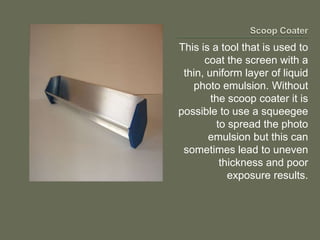
This is a tool that is used to
      coat the screen with a
 thin, uniform layer of liquid
   photo emulsion. Without
        the scoop coater it is
possible to use a squeegee
         to spread the photo
       emulsion but this can
 sometimes lead to uneven
          thickness and poor
            exposure results.
The film positive refers to the artwork
    which is typically printed or drawn onto
    on a transparent medium. The artwork
       must be opaque in order to produce
proper results when exposing the screen.
  One of the cheapest ways to create the
         film positive is to print directly onto
   transparency film from your laser or ink
     jet printer. Be sure to have the printer
 settings set to produce the darkest black
             possible for your artwork. As an
alternative, vellum can also be used as a
 film positive. If you are using vellum add
 approximately 20% to the exposure time
   due to the reduced transparency of the
                                        vellum.
In order to properly expose
the emulsion and “burn” the
     screen, a light source is
       required that contains
  Ultraviolet Radiation in the
         350-420 Nanometer
      spectrum. Fluorescent
       unfiltered tubes, metal
  halide lamps and even the
 sun can be used to expose
                     a screen.
These are essential if you
     plan on screen printing
   paper goods or other flat
 objects. The hinge clamps
 you to keep your screen in
the same position, allowing
   for easy registration and
           consistent prints.
There are kinds of tape that I use
   on a regular basis. The first is
painter’s tape which use for easy
                    registration of
screens, positioning acetate, etc.
   The second type of tape that I
   use is a tape made for screen
      printing which is water and
    solvent resistant. This one is
    used for taping my screens. I
  have also used plastic packing
           tape with great results.
During the coating and exposure
   process it is important to create
  light safe conditions. Premature
               exposure to UV light
       (sunlight, regular household
    lights, etc) can pre-expose the
 coated screens resulting in poor
results. Yellow bulbs filter out the
spectrum of light that can expose
 the emulsion, making it “safe” to
      work under those conditions.
Screen Printing Equipment:
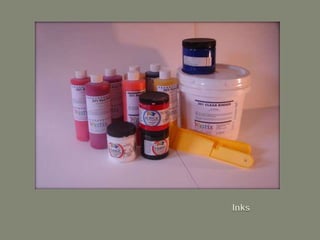
 There  are two main types of inks that are
  used for screen printing, each with their
  own advantages and disadvantages.
 Water-based inks utilize either dyes or
  pigments in a suspension with water as the
  solvent. The evaporation of the water is
  necessary to set or cure the ink.
 Plastisol is a thermoplastic ink. It is
  composed of PVC (polyvinyl chloride)
  particles suspended in a plasticizer. High
  temperatures are required to cause the
  molecules of PVC resin and plasticizer to
  cross-link and fully cure.
 Water-based    inks tend to be a little more
 environmentally friendly and give printed
 fabrics a soft “hand”. A soft hand means that
 your hand cannot easily feel the ink when it
 passes across the surface of the fabric. Water
 based inks printed on fabric can also be
 ironed (Plastisol will melt and smear if heated
 up to it’s curing temperature). For paper
 screen printing applications water-based inks
 are ideal as they will air dry as the water
 content in the ink evaporates. Clean up is
 easy and can be done without much impact to
 the environment.
   Water-based ink is much more difficult to cure than
    plastisol for fabric applications. With water-based
    ink, the curing temperature must be reached and
    then held until all of the solvent (water) is removed.
    If you don’t fully cure the ink (for example on a T-
    shirt), the ink will fade with repeated washings. If
    water-based ink is left in open mesh for even a
    short period of time, it can clog the mesh and ruin
    the screen. You don’t really have to worry with
    regards to paper applications however. The other
    thing is that water-based inks will break down
    regular emulsion very quickly and even break
    down water resistant emulsions over time leading
    to screen breakdown for longer print runs.
 Plastisolinks are not water-soluble and the
 ink will not dry if left in the screen for
 extended periods of time. It can be left in
 the screen for extended periods of time
 without worrying about clogging the mesh.
 Platisol will not break down the screen
 emulsion like water-based inks. They also
 happen to be very opaque and great for
 applications on colored fabric
 Plastisol inks will not air dry and need to be cured
  (heated) as a result. Curing the inks can be done with
  a flash dryer, or more inexpensively, any home oven.
  Be careful not to burn your house down! Most
  plastisols need to reach a temperature of about 350
  Fahrenheit before being fully cured.
 Plastisol tends to sit on top of the threads instead of
  soaking into them, which typically results in a
  raised, plasticized texture. There
  are, however, plastisol additives that can give the ink a
  softer “hand”. If the ink is under-cured, the print will
  crack and peel over time.
 Plastisol inks are generally considered harsher on the
  environment. Fortunately, there are a number of
  plastisol inks on the market that contain less
  toxins, and there are also eco-friendly solvents that are
  available for clean up.
Screen Printing Equipment:
The screen frame is a structure
that the woven mesh is stretched
upon and adhered to. Screen
frames come in a variety of
shapes and sizes, depending on
the size of the art work and
printing surface. The mesh is
either stapled or glued to the
frame with sufficient tension to
provide a flat printing surface that
Typically, frames are made out of
 wood or aluminum. Personally I
 recommend aluminum frames
 over wood because they are
 easily cleaned and can be reused
 indefinitely without losing their
 shape.
Wood   screens will be fine for a
while but repeated water
exposure tends to warp the frame
over time. Over time, with
extended use, both wood and
aluminum screen meshes will lose
some tension which may result in
poorer quality printing results. If
you start to notice this occurring
it’s best to have the screens re-
Always    choose a screen frame
 that is larger than the area you
 are attempting to print by at least
 2 inches on every side. This will
 make your life easier when
 applying emulsion, exposing
 artwork and printing.
Screen Printing Equipment:
 Woven mesh is the “silk” in silkscreen. Typically this
  mesh is made out of mono-filament polyester fabric
  which is stretched taut over a screen frame. The
  spaces between the mesh make the fabric porous
  which allows ink to pass through.
 Screen fabric come in a wide variety of mesh counts.
  Lower mesh counts means that the fibers of the mesh
  are spaced farther apart, allowing more ink to pass
  through. Higher mesh counts deposit smaller amounts
  of ink and are generally better for fine details and line
  work. A general rule of thumb is 110 – 160 mesh count
  for fabrics and 230+ if you are printing on paper. If you
  are on a budget and only want one screen, 150 should
  do the trick for both fabric and paper.
 Screen mesh is available in either white or dyed mesh
  (typically yellow). Dyed mesh cuts down the amount of
  light diffusion during the exposure process which leads
  to a sharper print. For lower mesh counts around 110 it
  doesn’t really make a difference if the color is white or
  dyed.
Screen Printing Equipments

Screen Printing Equipments

  • 1.
  • 2.
  • 3.
    Photo emulsion iswhat makes the modern day screen printing process possible. The emulsion is a substance that reacts to ultraviolet light. Once it has been exposed to the correct ultraviolet wavelength, the emulsion hardens and becomes impermeable. There are many different types of emulsion in the market, as well as many different methods of application. In a later post, I’ll dive into the two most popular methods for coating the screen mesh with emulsion.
  • 4.
    A squeegee isa flat, rubber or urethane blade set into a handle. Some people may argue that this is not necessary and that brushes or sponges can be used to push the ink through the screen. They are correct and it can be done, but the results and time consumption can lead to very mixed results. Almost all professional screen printers use squeegees to produce consistent, high quality results.
  • 5.
    This is atool that is used to coat the screen with a thin, uniform layer of liquid photo emulsion. Without the scoop coater it is possible to use a squeegee to spread the photo emulsion but this can sometimes lead to uneven thickness and poor exposure results.
  • 6.
    The film positiverefers to the artwork which is typically printed or drawn onto on a transparent medium. The artwork must be opaque in order to produce proper results when exposing the screen. One of the cheapest ways to create the film positive is to print directly onto transparency film from your laser or ink jet printer. Be sure to have the printer settings set to produce the darkest black possible for your artwork. As an alternative, vellum can also be used as a film positive. If you are using vellum add approximately 20% to the exposure time due to the reduced transparency of the vellum.
  • 7.
    In order toproperly expose the emulsion and “burn” the screen, a light source is required that contains Ultraviolet Radiation in the 350-420 Nanometer spectrum. Fluorescent unfiltered tubes, metal halide lamps and even the sun can be used to expose a screen.
  • 8.
    These are essentialif you plan on screen printing paper goods or other flat objects. The hinge clamps you to keep your screen in the same position, allowing for easy registration and consistent prints.
  • 9.
    There are kindsof tape that I use on a regular basis. The first is painter’s tape which use for easy registration of screens, positioning acetate, etc. The second type of tape that I use is a tape made for screen printing which is water and solvent resistant. This one is used for taping my screens. I have also used plastic packing tape with great results.
  • 10.
    During the coatingand exposure process it is important to create light safe conditions. Premature exposure to UV light (sunlight, regular household lights, etc) can pre-expose the coated screens resulting in poor results. Yellow bulbs filter out the spectrum of light that can expose the emulsion, making it “safe” to work under those conditions.
  • 11.
  • 12.
     There are two main types of inks that are used for screen printing, each with their own advantages and disadvantages.  Water-based inks utilize either dyes or pigments in a suspension with water as the solvent. The evaporation of the water is necessary to set or cure the ink.  Plastisol is a thermoplastic ink. It is composed of PVC (polyvinyl chloride) particles suspended in a plasticizer. High temperatures are required to cause the molecules of PVC resin and plasticizer to cross-link and fully cure.
  • 13.
     Water-based inks tend to be a little more environmentally friendly and give printed fabrics a soft “hand”. A soft hand means that your hand cannot easily feel the ink when it passes across the surface of the fabric. Water based inks printed on fabric can also be ironed (Plastisol will melt and smear if heated up to it’s curing temperature). For paper screen printing applications water-based inks are ideal as they will air dry as the water content in the ink evaporates. Clean up is easy and can be done without much impact to the environment.
  • 14.
    Water-based ink is much more difficult to cure than plastisol for fabric applications. With water-based ink, the curing temperature must be reached and then held until all of the solvent (water) is removed. If you don’t fully cure the ink (for example on a T- shirt), the ink will fade with repeated washings. If water-based ink is left in open mesh for even a short period of time, it can clog the mesh and ruin the screen. You don’t really have to worry with regards to paper applications however. The other thing is that water-based inks will break down regular emulsion very quickly and even break down water resistant emulsions over time leading to screen breakdown for longer print runs.
  • 15.
     Plastisolinks arenot water-soluble and the ink will not dry if left in the screen for extended periods of time. It can be left in the screen for extended periods of time without worrying about clogging the mesh. Platisol will not break down the screen emulsion like water-based inks. They also happen to be very opaque and great for applications on colored fabric
  • 16.
     Plastisol inkswill not air dry and need to be cured (heated) as a result. Curing the inks can be done with a flash dryer, or more inexpensively, any home oven. Be careful not to burn your house down! Most plastisols need to reach a temperature of about 350 Fahrenheit before being fully cured.  Plastisol tends to sit on top of the threads instead of soaking into them, which typically results in a raised, plasticized texture. There are, however, plastisol additives that can give the ink a softer “hand”. If the ink is under-cured, the print will crack and peel over time.  Plastisol inks are generally considered harsher on the environment. Fortunately, there are a number of plastisol inks on the market that contain less toxins, and there are also eco-friendly solvents that are available for clean up.
  • 18.
  • 19.
    The screen frameis a structure that the woven mesh is stretched upon and adhered to. Screen frames come in a variety of shapes and sizes, depending on the size of the art work and printing surface. The mesh is either stapled or glued to the frame with sufficient tension to provide a flat printing surface that
  • 20.
    Typically, frames aremade out of wood or aluminum. Personally I recommend aluminum frames over wood because they are easily cleaned and can be reused indefinitely without losing their shape.
  • 21.
    Wood screens will be fine for a while but repeated water exposure tends to warp the frame over time. Over time, with extended use, both wood and aluminum screen meshes will lose some tension which may result in poorer quality printing results. If you start to notice this occurring it’s best to have the screens re-
  • 22.
    Always choose a screen frame that is larger than the area you are attempting to print by at least 2 inches on every side. This will make your life easier when applying emulsion, exposing artwork and printing.
  • 24.
  • 25.
     Woven meshis the “silk” in silkscreen. Typically this mesh is made out of mono-filament polyester fabric which is stretched taut over a screen frame. The spaces between the mesh make the fabric porous which allows ink to pass through.  Screen fabric come in a wide variety of mesh counts. Lower mesh counts means that the fibers of the mesh are spaced farther apart, allowing more ink to pass through. Higher mesh counts deposit smaller amounts of ink and are generally better for fine details and line work. A general rule of thumb is 110 – 160 mesh count for fabrics and 230+ if you are printing on paper. If you are on a budget and only want one screen, 150 should do the trick for both fabric and paper.  Screen mesh is available in either white or dyed mesh (typically yellow). Dyed mesh cuts down the amount of light diffusion during the exposure process which leads to a sharper print. For lower mesh counts around 110 it doesn’t really make a difference if the color is white or dyed.