Scraper
Introduction
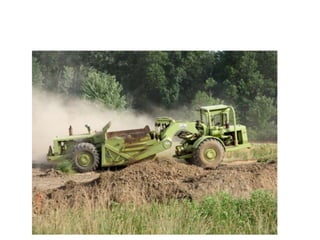
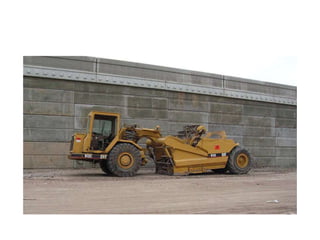
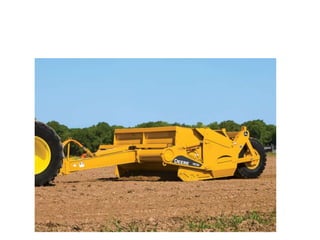
• Tractor pulled scrapers: Designed to load, haul
and dump loose material in controlled lifts
• High versatility
– Used to load and haul a wide variety of materials
– Economical over wide range of haul lengths and haul
conditions
– Self loading – not dependent on other equipment
– Not as efficient as exclusively designed machines
– Off highway and <1 mile scraper is better than trucks
– Ability to deposit loads in layers of uniform thickness
Construction
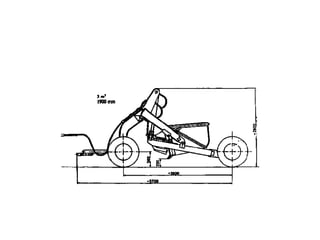
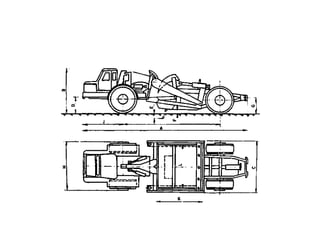
Parts : Bowl, Apron and Ejector
Bowl:
• Loading and carrying component
• Has a cutting edge that extends horizontally across front
bottom edge
• Lowered for loading, raised during travel
Apron:
• Front wall of the bowl, independent of bowl
• Raised during loading and dumping, lowered during
haulage – to avoid spillage
Ejector:
Rear vertical wall, gets activated and moves forward, helps
positive discharge of material
Production Cycle
1. Loading
2. Haul travel
3. Dumping and Spreading
4. Turning
5. Return travel
6. Turning and positioning to pickup the next
load
Types
Based on method of loading & number of axles
1. Pusher Loaded ( Conventional )
a) Single powered axle
b) Tandem powered axles
2. Self Loading
a) Push – pull, tandem powered axles
b) Elevating type
c) Auger type
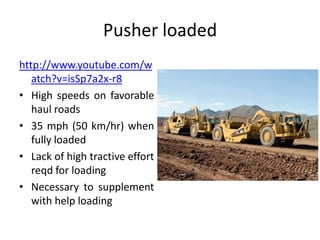
Pusher loaded
http://www.youtube.com/w
atch?v=isSp7a2x-r8
• High speeds on favorable
haul roads
• 35 mph (50 km/hr) when
fully loaded
• Lack of high tractive effort
reqd for loading
• Necessary to supplement
with help loading
Self loading - Push – pull type
http://www.youtube.com/watch?v=tLR7LZh3VM0
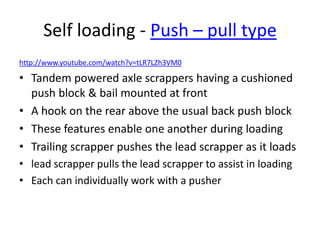
• Tandem powered axle scrappers having a cushioned
push block & bail mounted at front
• A hook on the rear above the usual back push block
• These features enable one another during loading
• Trailing scrapper pushes the lead scrapper as it loads
• lead scrapper pulls the lead scrapper to assist in loading
• Each can individually work with a pusher
Self loading – Elevating type
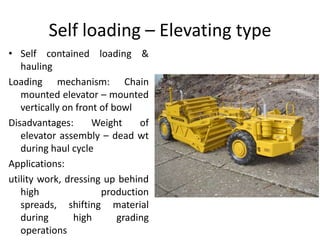
• Self contained loading &
hauling
Loading mechanism: Chain
mounted elevator – mounted
vertically on front of bowl
Disadvantages: Weight of
elevator assembly – dead wt
during haul cycle
Applications:
utility work, dressing up behind
high production
spreads, shifting material
during high grading
operations
Auger Type
http://www.youtube.com/watch?v=Jq3vXSXFnw8
• Can self load in difficult conditions
Ex: Laminated rock, granular materials, frozen
material
• Has independent hydrostatic system located
at centre of the bowl
• Types – Single and Tandem powered
Dis:
– Non – load wt is added during haul (wt of mechanism)
– More costly to own and operate
Volume of Scraper
• Struck or Heaped capacity
of the bowl (Cubic yard)
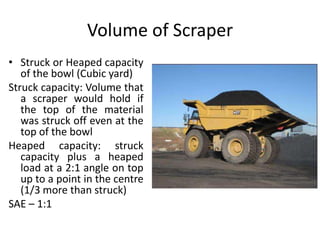
Struck capacity: Volume that
a scraper would hold if
the top of the material
was struck off even at the
top of the bowl
Heaped capacity: struck
capacity plus a heaped
load at a 2:1 angle on top
up to a point in the centre
(1/3 more than struck)
SAE – 1:1

Scraper

  • 1.
  • 2.
    Introduction • Tractor pulledscrapers: Designed to load, haul and dump loose material in controlled lifts • High versatility – Used to load and haul a wide variety of materials – Economical over wide range of haul lengths and haul conditions – Self loading – not dependent on other equipment – Not as efficient as exclusively designed machines – Off highway and <1 mile scraper is better than trucks – Ability to deposit loads in layers of uniform thickness
  • 3.
    Construction Parts : Bowl,Apron and Ejector Bowl: • Loading and carrying component • Has a cutting edge that extends horizontally across front bottom edge • Lowered for loading, raised during travel Apron: • Front wall of the bowl, independent of bowl • Raised during loading and dumping, lowered during haulage – to avoid spillage Ejector: Rear vertical wall, gets activated and moves forward, helps positive discharge of material
  • 9.
    Production Cycle 1. Loading 2.Haul travel 3. Dumping and Spreading 4. Turning 5. Return travel 6. Turning and positioning to pickup the next load
  • 10.
    Types Based on methodof loading & number of axles 1. Pusher Loaded ( Conventional ) a) Single powered axle b) Tandem powered axles 2. Self Loading a) Push – pull, tandem powered axles b) Elevating type c) Auger type
  • 11.
    Pusher loaded http://www.youtube.com/w atch?v=isSp7a2x-r8 • Highspeeds on favorable haul roads • 35 mph (50 km/hr) when fully loaded • Lack of high tractive effort reqd for loading • Necessary to supplement with help loading
  • 12.
    Self loading -Push – pull type http://www.youtube.com/watch?v=tLR7LZh3VM0 • Tandem powered axle scrappers having a cushioned push block & bail mounted at front • A hook on the rear above the usual back push block • These features enable one another during loading • Trailing scrapper pushes the lead scrapper as it loads • lead scrapper pulls the lead scrapper to assist in loading • Each can individually work with a pusher
  • 13.
    Self loading –Elevating type • Self contained loading & hauling Loading mechanism: Chain mounted elevator – mounted vertically on front of bowl Disadvantages: Weight of elevator assembly – dead wt during haul cycle Applications: utility work, dressing up behind high production spreads, shifting material during high grading operations
  • 14.
    Auger Type http://www.youtube.com/watch?v=Jq3vXSXFnw8 • Canself load in difficult conditions Ex: Laminated rock, granular materials, frozen material • Has independent hydrostatic system located at centre of the bowl • Types – Single and Tandem powered Dis: – Non – load wt is added during haul (wt of mechanism) – More costly to own and operate
  • 15.
    Volume of Scraper •Struck or Heaped capacity of the bowl (Cubic yard) Struck capacity: Volume that a scraper would hold if the top of the material was struck off even at the top of the bowl Heaped capacity: struck capacity plus a heaped load at a 2:1 angle on top up to a point in the centre (1/3 more than struck) SAE – 1:1