Organizational
Competence and
Trust
What is Competence?
 Ability to do something well
 Application of knowledge, skills and attributes to
achieve intended result or desired goals (IPMA,
2016).
 Capacity of an individual to successfully handle
certain situations or complete a certain job (Ellstrom
and Kock, 2008).
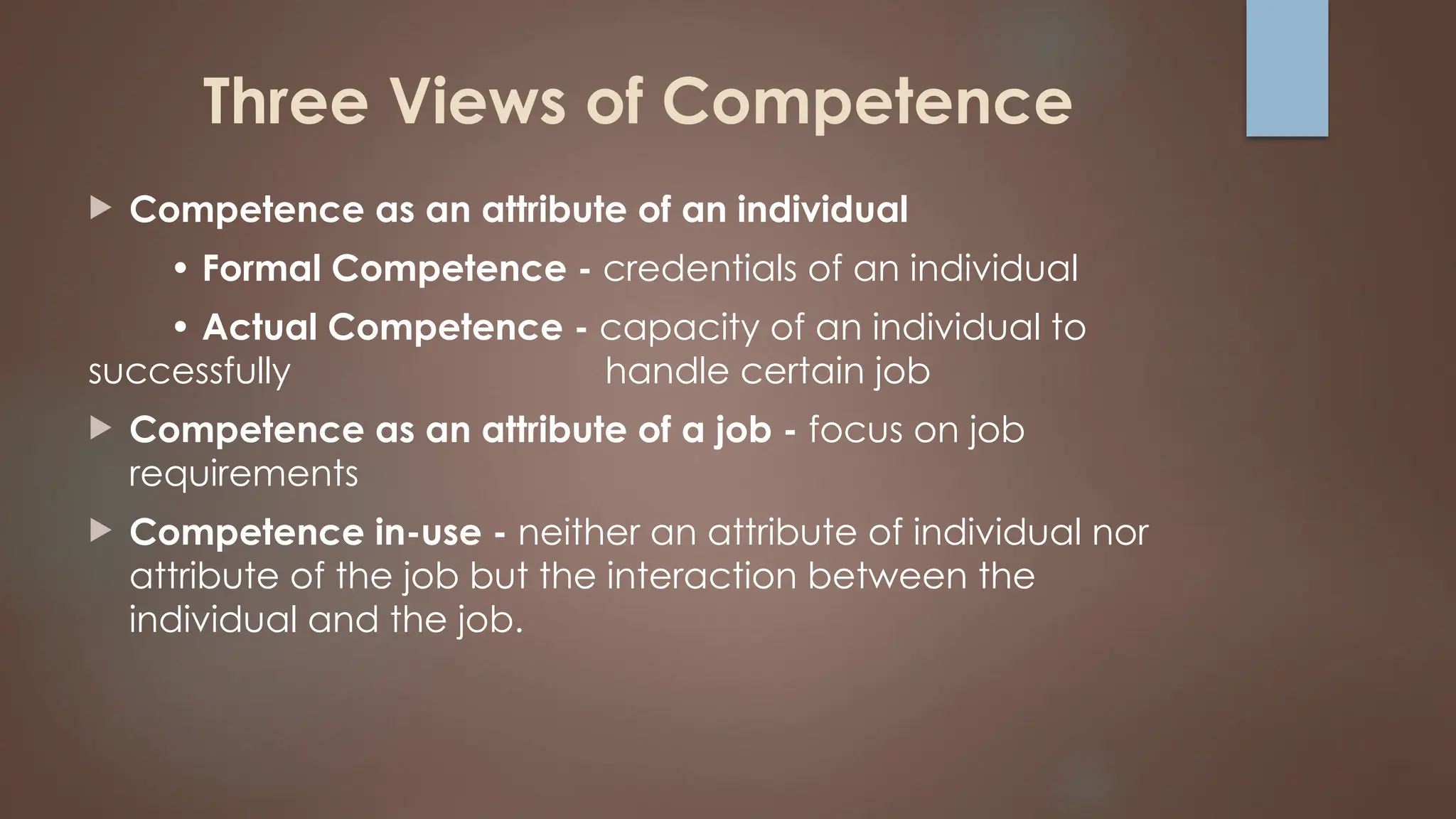
Three Views of Competence
 Competence as an attribute of an individual
• Formal Competence - credentials of an individual
• Actual Competence - capacity of an individual to
successfully handle certain job
 Competence as an attribute of a job - focus on job
requirements
 Competence in-use - neither an attribute of individual nor
attribute of the job but the interaction between the
individual and the job.
What is Organizational Competence?
 Total of skills, attributes and learning an organization needs to perform
its task.
 Are the competencies needed in the organization so that it can excel
and remain competitive in the market.
This includes :
(i) job-relevant behavior (what the employees say or do which result in
good or poor performance),
(ii) (ii) motivation (how the employees feel about a job, organization, or
geographic location), and
(iii) (iii) technical knowledge/skills (what the employees
know/demonstrate regarding facts, technologies, their professions,
procedures, jobs, and the organization, etc.).
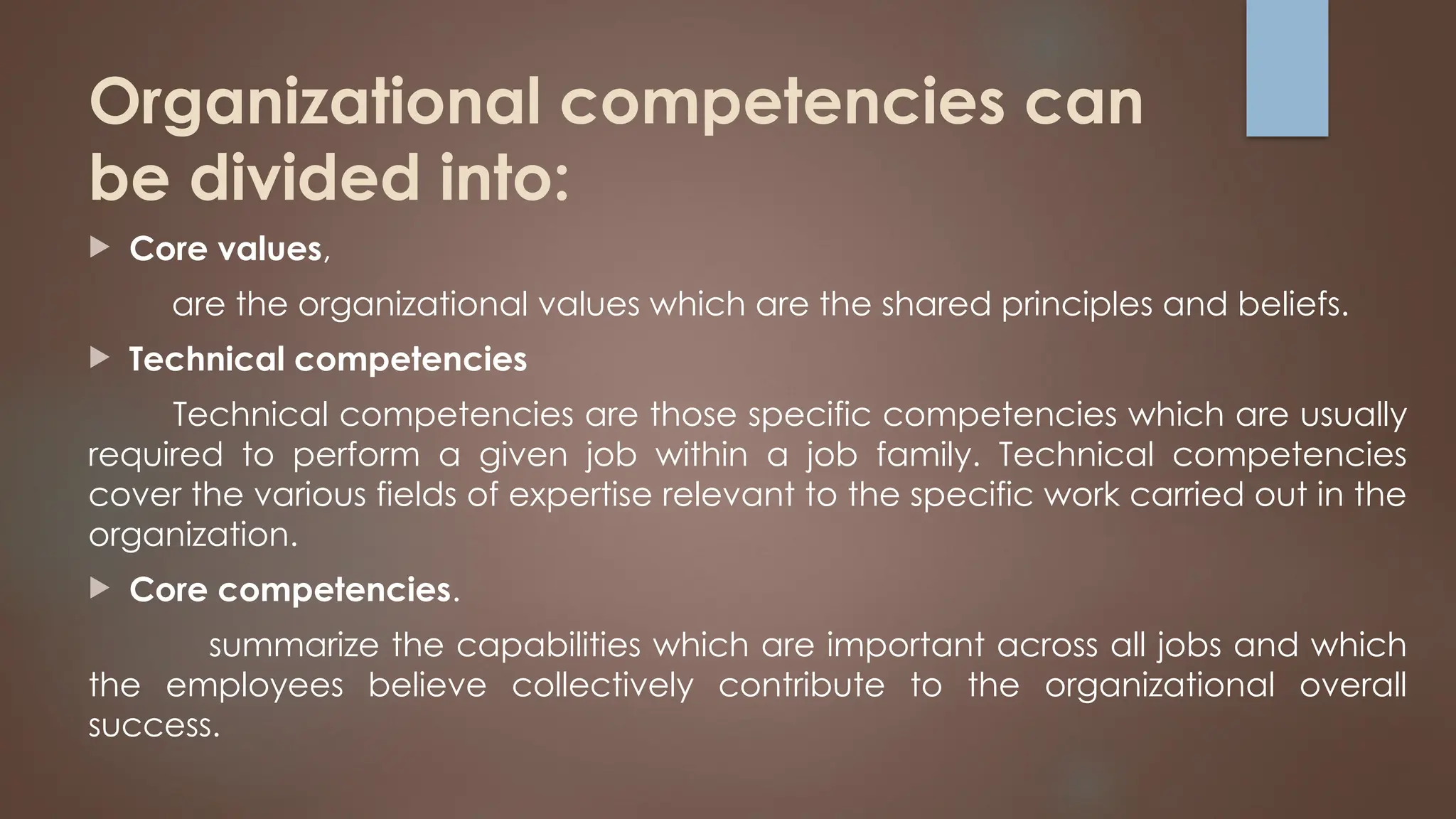
Organizational competencies can
be divided into:
 Core values,
are the organizational values which are the shared principles and beliefs.
 Technical competencies
Technical competencies are those specific competencies which are usually
required to perform a given job within a job family. Technical competencies
cover the various fields of expertise relevant to the specific work carried out in the
organization.
 Core competencies.
summarize the capabilities which are important across all jobs and which
the employees believe collectively contribute to the organizational overall
success.
What is Ethics?
 Greek word ethos means character, habit, ways of
behavior.
 Systematic study of human actions from the point of view
of their rightfulness and wrongfulness as means for the
attainment of the ultimate happiness.
 Refers to what is good and the ways to get it and what is
bad and how to avoid it.
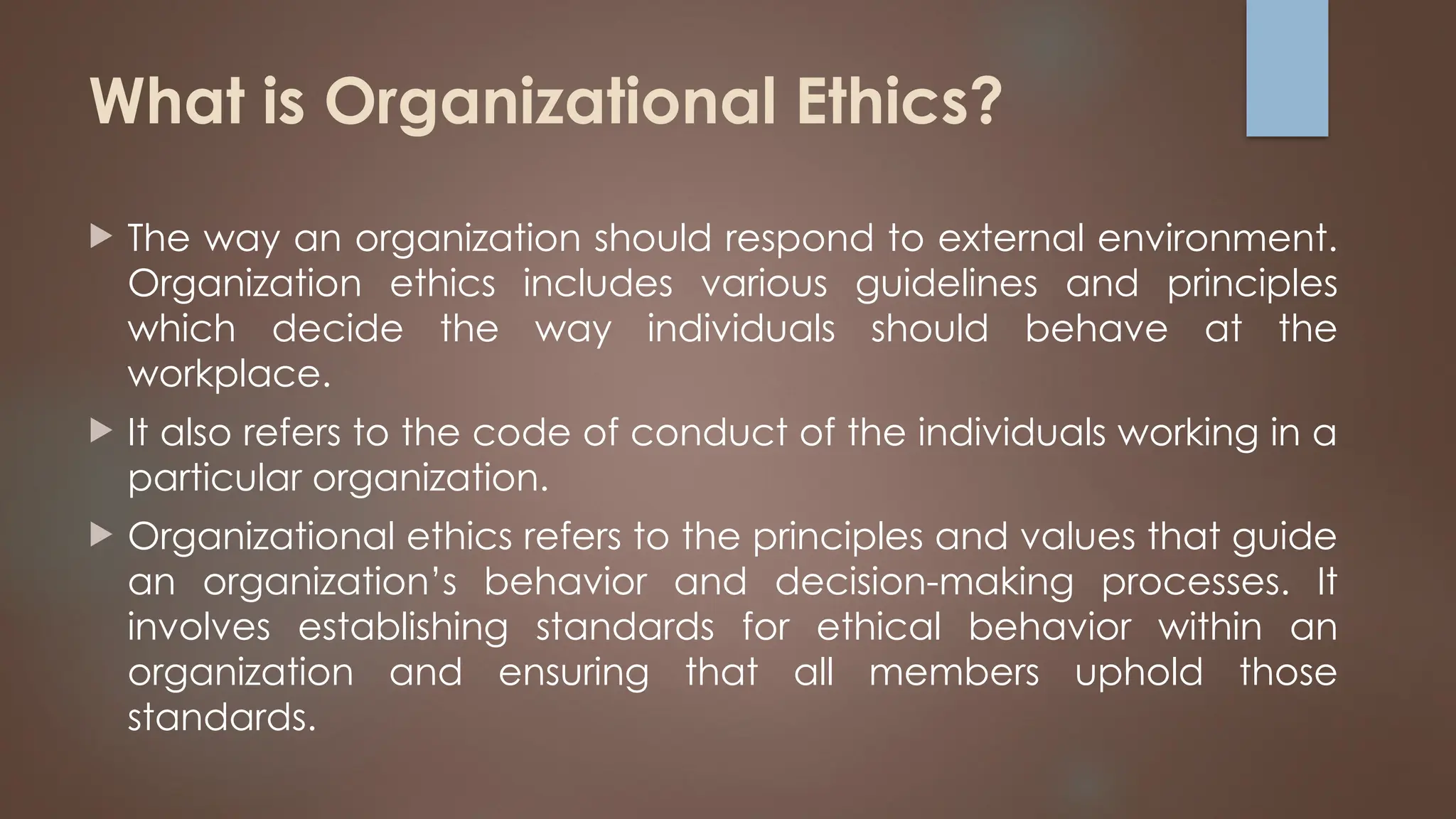
What is Organizational Ethics?
 The way an organization should respond to external environment.
Organization ethics includes various guidelines and principles
which decide the way individuals should behave at the
workplace.
 It also refers to the code of conduct of the individuals working in a
particular organization.
 Organizational ethics refers to the principles and values that guide
an organization’s behavior and decision-making processes. It
involves establishing standards for ethical behavior within an
organization and ensuring that all members uphold those
standards.
What Are the Core Values of
Organizational Ethics?
 1. Integrity
 2. Responsibility
 3. Respect
 4. Fairness
 5. Trustworthiness
 6. Accountability
Ethics Resource Center in Washington, DC. The ERC conducted a
survey of employees in large public, private, and nonprofit
organizations in 1994 and again in 2000. The findings suggest that
when organizations have ethics programs containing written
standards, training for employees, and means for employees to
get ethics advice, then employees:
 • Feel less pressure to compromise ethical standards;
 • Observe less misconduct in the organization;
 • Are more satisfied with the organization’s response to reported
misconduct;
 • Are more satisfied with the organization; and
 • Feel more valued by the organization.
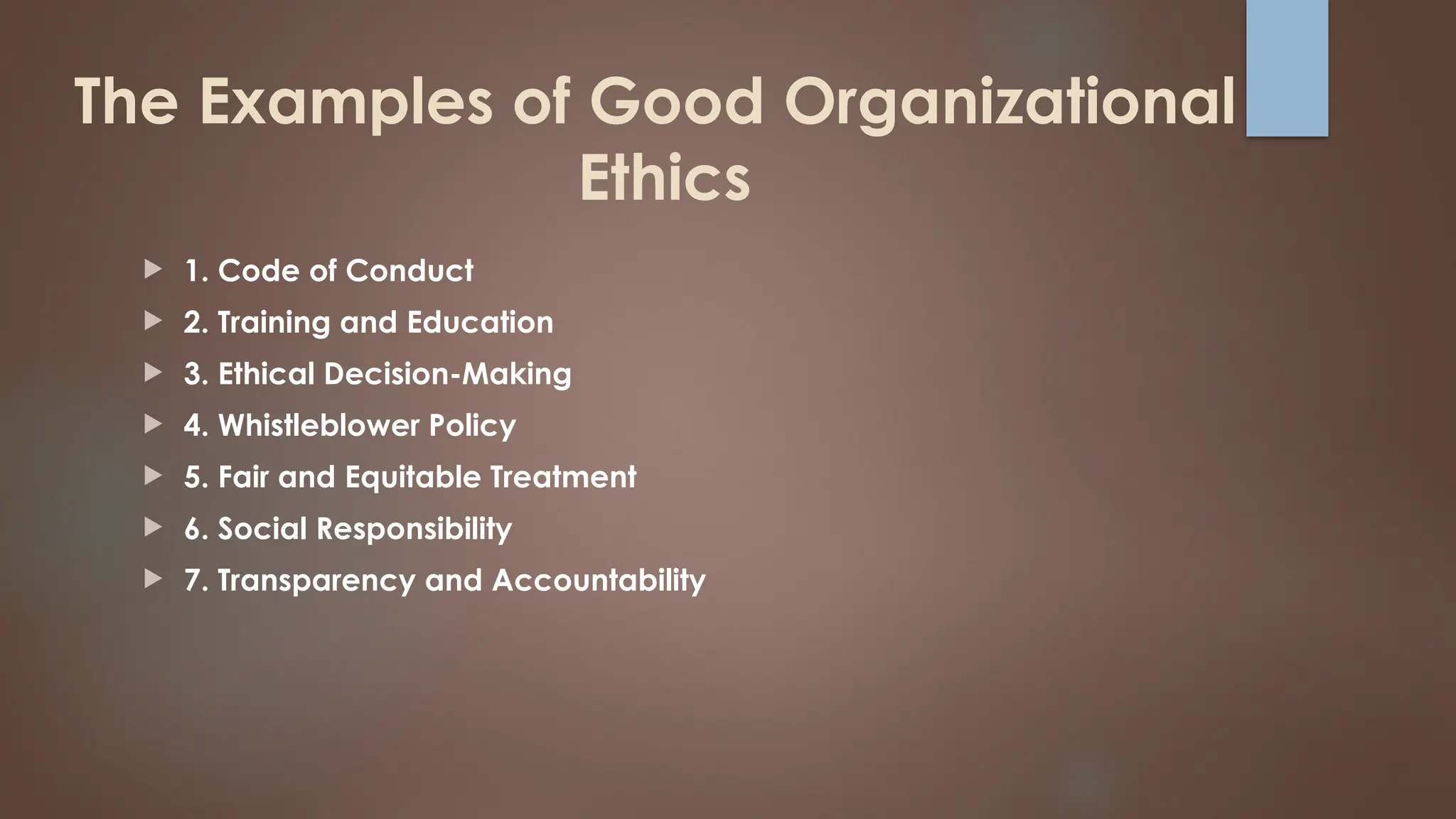
The Examples of Good Organizational
Ethics
 1. Code of Conduct
 2. Training and Education
 3. Ethical Decision-Making
 4. Whistleblower Policy
 5. Fair and Equitable Treatment
 6. Social Responsibility
 7. Transparency and Accountability
CONCLUSION
Building trust and effective leadership is an ongoing process. It
requires consistent effort, open communication, and a commitment
to cultivate a positive work environment.
Organizational competence is crucial for competitiveness and
sustainability in a rapidly changing environment while Organizational
ethics are not just rules; they build trust, integrity, and long-term
success. Adopting ethical beliefs is essential for reputation,
sustainability, and competitive advantage.
RECOMMENDATION
 Foster open communication, set clear expectations, delegate
effectively, recognize achievements, provide development
opportunities, cultivate a culture of trust, be receptive to feedback,
and demonstrate empathy. These actions create a positive and
trusting environment that encourages teamwork and success.
 The harmonious integration of organizational leadership,
trust, competence and ethics is a powerful catalyst for sustainable
success. By following the recommendations mentioned,
organizations can forge a path that combines excellence in skills
and a commitment to ethical principles, ensuring not only their
competitive edge but also their reputation and long-term viability in
an ever-evolving business landscape.
REFERENCES
 Appelbaum, S.H., Bartolomucci, N., Beaumier, E., Boulanger, J.,
Corrigan, R.,
 Doré,I.,Girard, C., & Serroni, C. (2004). Organizational
citizenship behavior:
a case study of culture, leadership and trust. Management
Decision, 42(1),
13–40. https://doi.org/10.1108/00251740410504412
 Denhardt, k. (n.d.). Ethics in Public Organizations. Public
Administration and Public
Policy. University of Delware, USA
 Ellstrom, P., Kock, H. (2008). Competence Development in the
Workplace: Concepts,
 Strategies and Effects. Asia Pacific Education Review.
Sweden. Education
Research Institute.
 https://www.britannica.com/topic/ethics-philosophy
 https://www.britannica.com/dictionary/competence
 Jose, W. (n.d.). Introduction to Ethics. St. John's College. Kondadaba
 Organizational Ethics: Definition, Importance &
Examples.https://blog.bit.ai
/organizational-ethics/
 Organization Ethics - Meaning and its
Importance.https://www.managementstudy
guide.com/organization-ethics.htm
 Satyendra. (2018). Organizational Competencies
Ispatguru.
https://www.ispatguru.com/organizational-
competencies/
 Vijayamohan, P. (March 2023). Organizational
Competencies: Types, Importance &
 Examples.
https://surveysparrow.com/blog/organizational-
competencies/
 Wagner, R. et al., (2016). Organisational Competence
Baseline for Developing
 Competence in Managing by Projects.
International Project Management
 Association.
 Zak,P.J.(2017). The neuroscience of trust.The Neuroscience
of Trust.
 https://apunteca.usal.edu.ar/id/eprint/1402/

Organizational Competence and Trust.pptx

  • 1.
  • 2.
    What is Competence? Ability to do something well  Application of knowledge, skills and attributes to achieve intended result or desired goals (IPMA, 2016).  Capacity of an individual to successfully handle certain situations or complete a certain job (Ellstrom and Kock, 2008).
  • 3.
    Three Views ofCompetence  Competence as an attribute of an individual • Formal Competence - credentials of an individual • Actual Competence - capacity of an individual to successfully handle certain job  Competence as an attribute of a job - focus on job requirements  Competence in-use - neither an attribute of individual nor attribute of the job but the interaction between the individual and the job.
  • 4.
    What is OrganizationalCompetence?  Total of skills, attributes and learning an organization needs to perform its task.  Are the competencies needed in the organization so that it can excel and remain competitive in the market. This includes : (i) job-relevant behavior (what the employees say or do which result in good or poor performance), (ii) (ii) motivation (how the employees feel about a job, organization, or geographic location), and (iii) (iii) technical knowledge/skills (what the employees know/demonstrate regarding facts, technologies, their professions, procedures, jobs, and the organization, etc.).
  • 5.
    Organizational competencies can bedivided into:  Core values, are the organizational values which are the shared principles and beliefs.  Technical competencies Technical competencies are those specific competencies which are usually required to perform a given job within a job family. Technical competencies cover the various fields of expertise relevant to the specific work carried out in the organization.  Core competencies. summarize the capabilities which are important across all jobs and which the employees believe collectively contribute to the organizational overall success.
  • 6.
    What is Ethics? Greek word ethos means character, habit, ways of behavior.  Systematic study of human actions from the point of view of their rightfulness and wrongfulness as means for the attainment of the ultimate happiness.  Refers to what is good and the ways to get it and what is bad and how to avoid it.
  • 7.
    What is OrganizationalEthics?  The way an organization should respond to external environment. Organization ethics includes various guidelines and principles which decide the way individuals should behave at the workplace.  It also refers to the code of conduct of the individuals working in a particular organization.  Organizational ethics refers to the principles and values that guide an organization’s behavior and decision-making processes. It involves establishing standards for ethical behavior within an organization and ensuring that all members uphold those standards.
  • 8.
    What Are theCore Values of Organizational Ethics?  1. Integrity  2. Responsibility  3. Respect  4. Fairness  5. Trustworthiness  6. Accountability
  • 9.
    Ethics Resource Centerin Washington, DC. The ERC conducted a survey of employees in large public, private, and nonprofit organizations in 1994 and again in 2000. The findings suggest that when organizations have ethics programs containing written standards, training for employees, and means for employees to get ethics advice, then employees:  • Feel less pressure to compromise ethical standards;  • Observe less misconduct in the organization;  • Are more satisfied with the organization’s response to reported misconduct;  • Are more satisfied with the organization; and  • Feel more valued by the organization.
  • 10.
    The Examples ofGood Organizational Ethics  1. Code of Conduct  2. Training and Education  3. Ethical Decision-Making  4. Whistleblower Policy  5. Fair and Equitable Treatment  6. Social Responsibility  7. Transparency and Accountability
  • 11.
    CONCLUSION Building trust andeffective leadership is an ongoing process. It requires consistent effort, open communication, and a commitment to cultivate a positive work environment. Organizational competence is crucial for competitiveness and sustainability in a rapidly changing environment while Organizational ethics are not just rules; they build trust, integrity, and long-term success. Adopting ethical beliefs is essential for reputation, sustainability, and competitive advantage.
  • 12.
    RECOMMENDATION  Foster opencommunication, set clear expectations, delegate effectively, recognize achievements, provide development opportunities, cultivate a culture of trust, be receptive to feedback, and demonstrate empathy. These actions create a positive and trusting environment that encourages teamwork and success.  The harmonious integration of organizational leadership, trust, competence and ethics is a powerful catalyst for sustainable success. By following the recommendations mentioned, organizations can forge a path that combines excellence in skills and a commitment to ethical principles, ensuring not only their competitive edge but also their reputation and long-term viability in an ever-evolving business landscape.
  • 13.
    REFERENCES  Appelbaum, S.H.,Bartolomucci, N., Beaumier, E., Boulanger, J., Corrigan, R.,  Doré,I.,Girard, C., & Serroni, C. (2004). Organizational citizenship behavior: a case study of culture, leadership and trust. Management Decision, 42(1), 13–40. https://doi.org/10.1108/00251740410504412  Denhardt, k. (n.d.). Ethics in Public Organizations. Public Administration and Public Policy. University of Delware, USA  Ellstrom, P., Kock, H. (2008). Competence Development in the Workplace: Concepts,  Strategies and Effects. Asia Pacific Education Review. Sweden. Education Research Institute.  https://www.britannica.com/topic/ethics-philosophy  https://www.britannica.com/dictionary/competence  Jose, W. (n.d.). Introduction to Ethics. St. John's College. Kondadaba  Organizational Ethics: Definition, Importance & Examples.https://blog.bit.ai /organizational-ethics/  Organization Ethics - Meaning and its Importance.https://www.managementstudy guide.com/organization-ethics.htm  Satyendra. (2018). Organizational Competencies Ispatguru. https://www.ispatguru.com/organizational- competencies/  Vijayamohan, P. (March 2023). Organizational Competencies: Types, Importance &  Examples. https://surveysparrow.com/blog/organizational- competencies/  Wagner, R. et al., (2016). Organisational Competence Baseline for Developing  Competence in Managing by Projects. International Project Management  Association.  Zak,P.J.(2017). The neuroscience of trust.The Neuroscience of Trust.  https://apunteca.usal.edu.ar/id/eprint/1402/