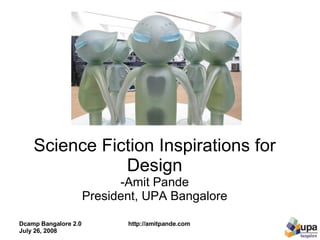
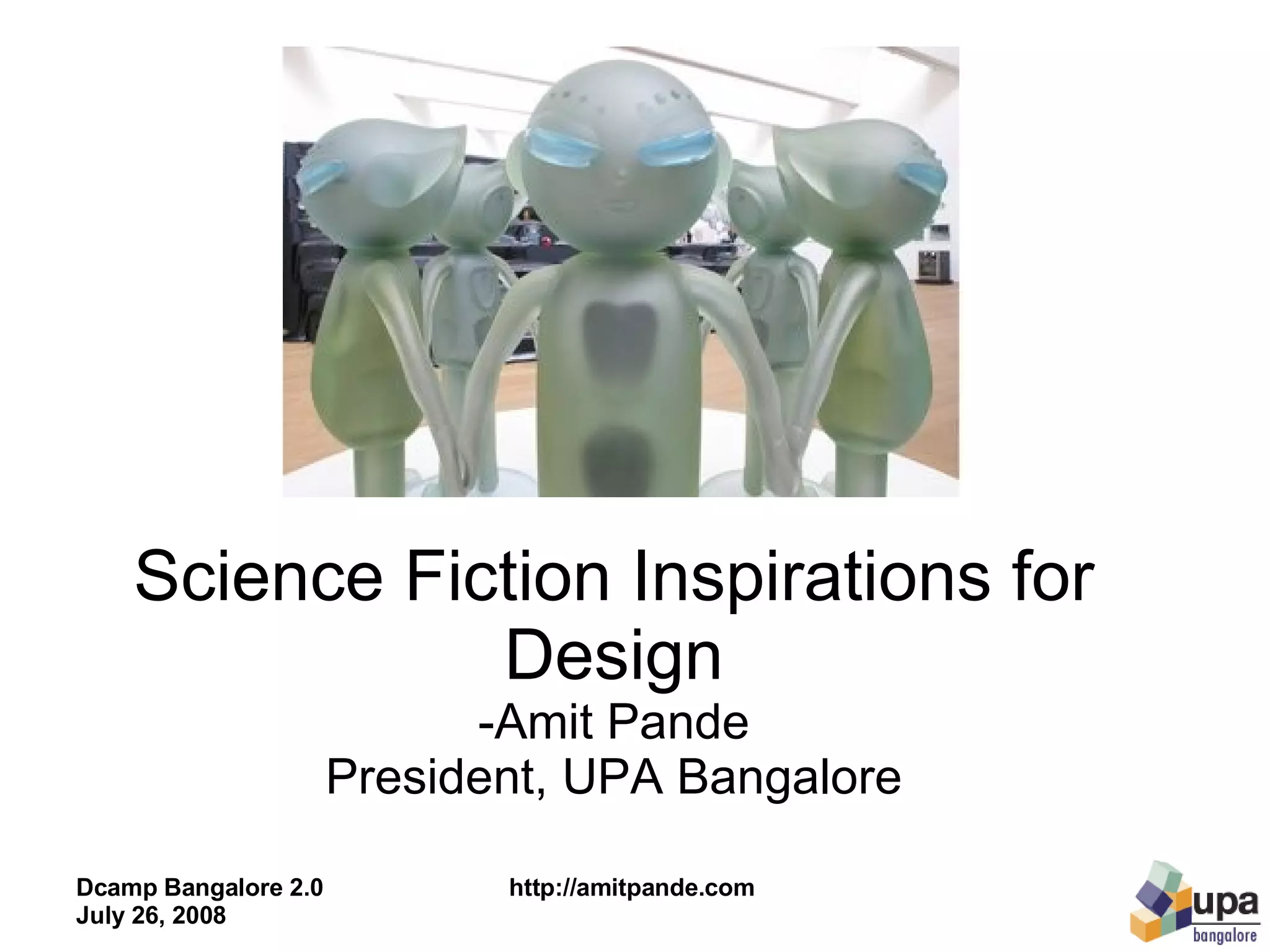
Science Fiction Inspirations for Design -Amit Pande President, UPA Bangalore
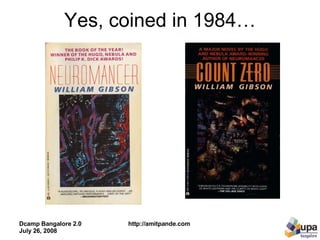
Pop Quiz – Identify the books Cyberspace . A consensual hallucination experienced daily by billions of legitimate operators, in every nation, by children being taught mathematical concepts... A graphic representation of data abstracted from banks of every computer in the human system. Unthinkable complexity. Lines of light ranged in the nonspace of the mind, clusters and constellations of data. Like city lights, receding  … Her destination was one of the dubious software rental complexes that lined Memory Lane... The clientele were young, few of them out of their teens. They all seemed to have carbon sockets planted behind the left ear, but she didn't focus on them. The counters that fronted the booths displayed hundreds of slivers of  microsofts , angular fragments of colored silicon mounted under oblong transparent bubbles on squares of white cardboard ... Behind [one] counter a boy with a shaven head stared vacantly into space, a dozen spikes of microsoft protruding from the socket behind his ear.  …
Yes, coined in 1984…
Presentation Structure Why Science Fiction as inspiration source Note on Sci Fi Movies Note on Sci Fi books  One example: Postsingular  Other References
Why Science (or speculative) Fiction? Sci-fi takes the existing techno-social-cultural structure and projects into the unknown  Sci-Fi projects fairly radical, imaginative, and unbounded situations and solutions – an antidote to mankind’s existential crisis  Not bound by proximal constraints – out of box  Many technologies of today are the dreams of a last generation’s science fiction (quote source unknown)
Assumptions / disclaimers Presentation is a broad brush stroke across Science Fiction books and movies Random reference points - hobbyist not researcher perspective No attempt to ‘force fit’ Science Fiction perspectives into design thinking
Early Science Fiction A Greek satirist, Lucian of Samosata (second century A.D.), may have been the earliest science fiction writer Through his writing educated Romans read about space travel and the adventures of a man whose ship was lifted from the Atlantic Ocean by a storm and deposited on the moon Beginning in the 17th century, speculative and technologically-oriented literature appears in European literature. Two themes are constant: marvelous adventures in strange lands ( Gulliver's Travels ) and the consequences of scientific research ( Frankenstein ) By the end of the 19th century, the work of Jules Verne (Captain Nemo) and HG Wells (Time Machine) brought "true" science fiction to enormous popularity and they share the honor of being named the fathers of modern science fiction
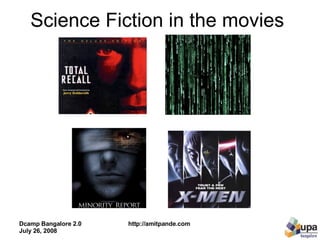
Science Fiction in the movies
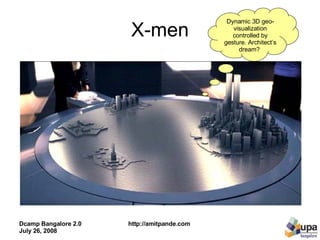
X-men Dynamic 3D geo-visualization controlled by gesture. Architect’s dream?
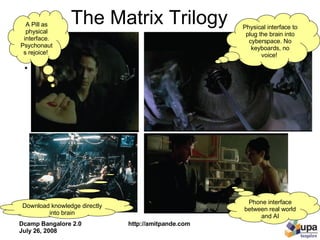
The Matrix Trilogy A Pill as physical interface. Psychonauts rejoice!  Phone interface between real world and AI Download knowledge directly into brain Physical interface to plug the brain into cyberspace. No keyboards, no voice!
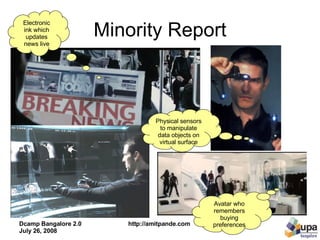
Minority Report Electronic ink which updates news live Avatar who remembers buying preferences Physical sensors to manipulate data objects on virtual surface
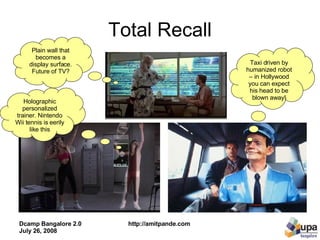
Total Recall Plain wall that becomes a display surface. Future of TV? Taxi driven by humanized robot – in Hollywood you can expect his head to be blown away! Holographic personalized trainer. Nintendo Wii tennis is eerily like this
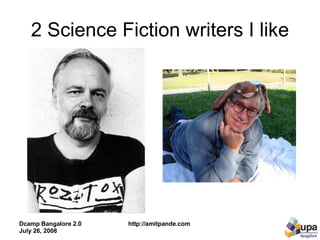
2 Science Fiction writers I like
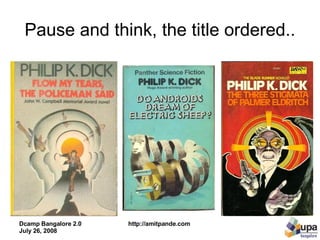
Pause and think, the title ordered..
The Dicksian worldview.. Dick’s novels started where his Sci-Fi predecessors’ novels often ended. He was never ‘lazy’ in his speculations – created very interesting realities  Wrote about issues like what it means to be human ( Do Androids Dream of Electric Sheep ), are you still the same person if you lose your memory ( Total Recall ) , and whether it would be just to punish someone for what they will do in the future ( Minority Report ).  Other themes Dick explored  Chemically altered realities as legitimate dimensions  Robots that can design other robots and what happens then  Needle eye weaponry, stench and sound as deterrents (too bad the US military also thought of them decades later…scary)
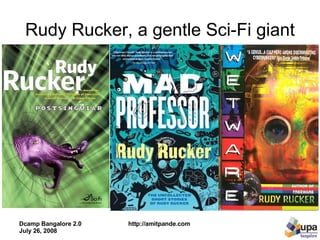
Rudy Rucker, a gentle Sci-Fi giant
Postsingular, highly recommended you read this book… Free Online:  http://www.rudyrucker.com/postsingular/#postsingulardownload   Singularity The point at which machine/computer intelligence exceeds human intelligence A threshold, computational or mechanistic  What happens after the Singularity? Not more computers and dull robots!! Read the book you extra-dimensional seekers  
Postsingular – some themes Computational piezoplastic Orphids and Orphidnet  Ad triggers/spam on all interfaces Webeyes and Vlogging The Metanovel
Other interesting Sci-Fi sources Cory Doctorow – Futuristic Tales of the Here and Now (Free download)  http://www.boingboing.net/2008/06/09/my-new-graphic-novel.html   Samit Basu -  http://samitbasu.com/   Neil Stephenson -  http://www.nealstephenson.com/   Bruce Sterling -  http://blog.wired.com/sterling/
Inconclusive conclusions Science (and speculative) fiction is a fount of great ideas and visions Creative professionals (including designers) could real or write science fiction to stretch their basic assumptions and definitions Consider what new interactions, interfaces and experiences will exist if even 20% of the best science fiction comes true I wait for that day with (bated earthly) breath  

Science Fiction - An inspiration source for design

  • 1.
    Science Fiction Inspirationsfor Design -Amit Pande President, UPA Bangalore
  • 2.
    Pop Quiz –Identify the books Cyberspace . A consensual hallucination experienced daily by billions of legitimate operators, in every nation, by children being taught mathematical concepts... A graphic representation of data abstracted from banks of every computer in the human system. Unthinkable complexity. Lines of light ranged in the nonspace of the mind, clusters and constellations of data. Like city lights, receding … Her destination was one of the dubious software rental complexes that lined Memory Lane... The clientele were young, few of them out of their teens. They all seemed to have carbon sockets planted behind the left ear, but she didn't focus on them. The counters that fronted the booths displayed hundreds of slivers of microsofts , angular fragments of colored silicon mounted under oblong transparent bubbles on squares of white cardboard ... Behind [one] counter a boy with a shaven head stared vacantly into space, a dozen spikes of microsoft protruding from the socket behind his ear. …
  • 3.
  • 4.
    Presentation Structure WhyScience Fiction as inspiration source Note on Sci Fi Movies Note on Sci Fi books One example: Postsingular Other References
  • 5.
    Why Science (orspeculative) Fiction? Sci-fi takes the existing techno-social-cultural structure and projects into the unknown Sci-Fi projects fairly radical, imaginative, and unbounded situations and solutions – an antidote to mankind’s existential crisis Not bound by proximal constraints – out of box Many technologies of today are the dreams of a last generation’s science fiction (quote source unknown)
  • 6.
    Assumptions / disclaimersPresentation is a broad brush stroke across Science Fiction books and movies Random reference points - hobbyist not researcher perspective No attempt to ‘force fit’ Science Fiction perspectives into design thinking
  • 7.
    Early Science FictionA Greek satirist, Lucian of Samosata (second century A.D.), may have been the earliest science fiction writer Through his writing educated Romans read about space travel and the adventures of a man whose ship was lifted from the Atlantic Ocean by a storm and deposited on the moon Beginning in the 17th century, speculative and technologically-oriented literature appears in European literature. Two themes are constant: marvelous adventures in strange lands ( Gulliver's Travels ) and the consequences of scientific research ( Frankenstein ) By the end of the 19th century, the work of Jules Verne (Captain Nemo) and HG Wells (Time Machine) brought "true" science fiction to enormous popularity and they share the honor of being named the fathers of modern science fiction
  • 8.
  • 9.
    X-men Dynamic 3Dgeo-visualization controlled by gesture. Architect’s dream?
  • 10.
    The Matrix TrilogyA Pill as physical interface. Psychonauts rejoice! Phone interface between real world and AI Download knowledge directly into brain Physical interface to plug the brain into cyberspace. No keyboards, no voice!
  • 11.
    Minority Report Electronicink which updates news live Avatar who remembers buying preferences Physical sensors to manipulate data objects on virtual surface
  • 12.
    Total Recall Plainwall that becomes a display surface. Future of TV? Taxi driven by humanized robot – in Hollywood you can expect his head to be blown away! Holographic personalized trainer. Nintendo Wii tennis is eerily like this
  • 13.
    2 Science Fictionwriters I like
  • 14.
    Pause and think,the title ordered..
  • 15.
    The Dicksian worldview..Dick’s novels started where his Sci-Fi predecessors’ novels often ended. He was never ‘lazy’ in his speculations – created very interesting realities Wrote about issues like what it means to be human ( Do Androids Dream of Electric Sheep ), are you still the same person if you lose your memory ( Total Recall ) , and whether it would be just to punish someone for what they will do in the future ( Minority Report ). Other themes Dick explored Chemically altered realities as legitimate dimensions Robots that can design other robots and what happens then Needle eye weaponry, stench and sound as deterrents (too bad the US military also thought of them decades later…scary)
  • 16.
    Rudy Rucker, agentle Sci-Fi giant
  • 17.
    Postsingular, highly recommendedyou read this book… Free Online: http://www.rudyrucker.com/postsingular/#postsingulardownload Singularity The point at which machine/computer intelligence exceeds human intelligence A threshold, computational or mechanistic What happens after the Singularity? Not more computers and dull robots!! Read the book you extra-dimensional seekers 
  • 18.
    Postsingular – somethemes Computational piezoplastic Orphids and Orphidnet Ad triggers/spam on all interfaces Webeyes and Vlogging The Metanovel
  • 19.
    Other interesting Sci-Fisources Cory Doctorow – Futuristic Tales of the Here and Now (Free download) http://www.boingboing.net/2008/06/09/my-new-graphic-novel.html Samit Basu - http://samitbasu.com/ Neil Stephenson - http://www.nealstephenson.com/ Bruce Sterling - http://blog.wired.com/sterling/
  • 20.
    Inconclusive conclusions Science(and speculative) fiction is a fount of great ideas and visions Creative professionals (including designers) could real or write science fiction to stretch their basic assumptions and definitions Consider what new interactions, interfaces and experiences will exist if even 20% of the best science fiction comes true I wait for that day with (bated earthly) breath 