Topic
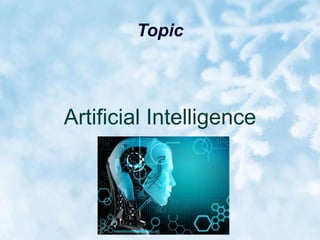
Artificial Intelligence
Outline
 What is Artificial Intelligence(AI) ?
 Short history of AI
 Goals of AI
 Approaches of implementing AI
 Programming Language
 Application
 Advantage
 Disadvantage
 Reference link
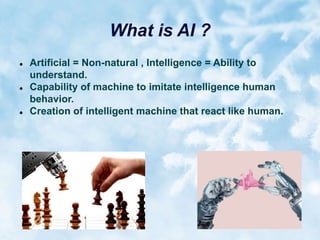
What is AI ?
 Artificial = Non-natural , Intelligence = Ability to
understand.
 Capability of machine to imitate intelligence human
behavior.
 Creation of intelligent machine that react like human.
History
 1898 : Nikola Tesla’s Radio-controlled vessel.
 1950 : “ Programming a computer playing chess” by
Claude Shanon.
 1950 : “Computing Machinery and Intelligence”
published by Alan Turing. (Turing test)
 1997 : Deep Blue - chess game
 1998 : Furby – Domestic pet robot
 2001 : “Artificial Intelligence ” a film of Steven Spielberg.
 2009 : Driver less car developing by google.
 2011 : Watson - A neural question answering computer.
Goals
 Create technology for machine & computer to function
in an intelligent manner.
 As a science : Explain human intellectuals activities &
abilities.
 As a technology : Reproduce those activities & abilities
& use them to social practical problem.
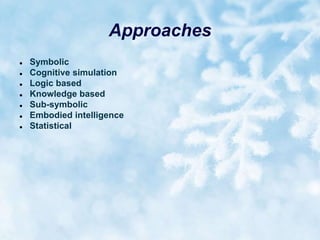
Approaches
 Symbolic
 Cognitive simulation
 Logic based
 Knowledge based
 Sub-symbolic
 Embodied intelligence
 Statistical
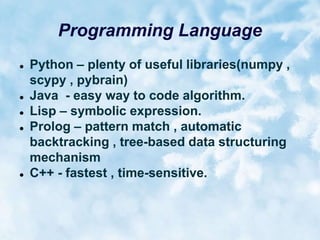
Programming Language
 Python – plenty of useful libraries(numpy ,
scypy , pybrain)
 Java - easy way to code algorithm.
 Lisp – symbolic expression.
 Prolog – pattern match , automatic
backtracking , tree-based data structuring
mechanism
 C++ - fastest , time-sensitive.
Application
 Game playing
 Speech recognition
 Virtual personal assistant
 Smart car
 Online customer support
 Spam recognition
 Medical application
 Fraud detection
Application
Advantage
 Improve our way of life
 Machine will be able to do jobs
 Decision making capabilities
 Use for heavy construction , military
capabilities , personal assistants.
 Comparatively less injuries to human.
 Use for entertainments.
Disadvantages
 High cost
 No replication human
 No improvement with experience
 No original creativity
 Unemployment

Reference Link
 https://www.forbes.com/sites/gilpress/2016/12/30/a-very-short-history-
of-artificial-intelligence-ai/5/#dd6167b3dfe5
 https://link.springer.com/chapter/10.1007/1-4020-5045-3_1
 https://en.wikipedia.org/wiki/Artificial_intelligence
 https://www.infoworld.com/article/3186599/artificial-intelligence/the-5-
best-programming-languages-for-ai-development.html
 https://content.wisestep.com/advantages-disadvantages-artificial-
intelligence/
 https://beebom.com/examples-of-artificial-intelligence/

Any Question ??

Artificial Intelligence (AI)

  • 1.
  • 2.
    Outline  What isArtificial Intelligence(AI) ?  Short history of AI  Goals of AI  Approaches of implementing AI  Programming Language  Application  Advantage  Disadvantage  Reference link
  • 3.
    What is AI?  Artificial = Non-natural , Intelligence = Ability to understand.  Capability of machine to imitate intelligence human behavior.  Creation of intelligent machine that react like human.
  • 4.
    History  1898 :Nikola Tesla’s Radio-controlled vessel.  1950 : “ Programming a computer playing chess” by Claude Shanon.  1950 : “Computing Machinery and Intelligence” published by Alan Turing. (Turing test)  1997 : Deep Blue - chess game  1998 : Furby – Domestic pet robot  2001 : “Artificial Intelligence ” a film of Steven Spielberg.  2009 : Driver less car developing by google.  2011 : Watson - A neural question answering computer.
  • 5.
    Goals  Create technologyfor machine & computer to function in an intelligent manner.  As a science : Explain human intellectuals activities & abilities.  As a technology : Reproduce those activities & abilities & use them to social practical problem.
  • 6.
    Approaches  Symbolic  Cognitivesimulation  Logic based  Knowledge based  Sub-symbolic  Embodied intelligence  Statistical
  • 7.
    Programming Language  Python– plenty of useful libraries(numpy , scypy , pybrain)  Java - easy way to code algorithm.  Lisp – symbolic expression.  Prolog – pattern match , automatic backtracking , tree-based data structuring mechanism  C++ - fastest , time-sensitive.
  • 8.
    Application  Game playing Speech recognition  Virtual personal assistant  Smart car  Online customer support  Spam recognition  Medical application  Fraud detection
  • 9.
  • 10.
    Advantage  Improve ourway of life  Machine will be able to do jobs  Decision making capabilities  Use for heavy construction , military capabilities , personal assistants.  Comparatively less injuries to human.  Use for entertainments.
  • 11.
    Disadvantages  High cost No replication human  No improvement with experience  No original creativity  Unemployment 
  • 12.
    Reference Link  https://www.forbes.com/sites/gilpress/2016/12/30/a-very-short-history- of-artificial-intelligence-ai/5/#dd6167b3dfe5 https://link.springer.com/chapter/10.1007/1-4020-5045-3_1  https://en.wikipedia.org/wiki/Artificial_intelligence  https://www.infoworld.com/article/3186599/artificial-intelligence/the-5- best-programming-languages-for-ai-development.html  https://content.wisestep.com/advantages-disadvantages-artificial- intelligence/  https://beebom.com/examples-of-artificial-intelligence/ 
  • 13.