Elements of Science Fiction
what if…?
Horror
 the presence of "monsters" or
"monstrous behavior" coinciding with
a psychological flight from the
"unclean”
 a visceral revulsion, disbelief; state
of abnormal physical agitation
Terror
 fear of psychological rape,
and/or mental disorder
 a state of constant or
near-constant fear that is
paralyzing
The Three Types of Horror
(from Noel Carrol's The Philosophy of Horror)
 Historical Gothic (1764-1880)
(a.k.a. the “Gothic Novel” or ghost story)
Set in an imagined past with emphasis
on natural causes & effects/results,
tinged with romanticism – and horror.
(“The Castle of Otranto” by Horace Walpole, ”“Frankenstein” by Mary Shelley)
The Three Types of Horror
(from Noel Carrol's The Philosophy of Horror)
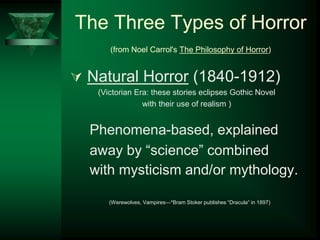
 Natural Horror (1840-1912)
(Victorian Era: these stories eclipses Gothic Novel
with their use of realism )
Phenomena-based, explained
away by “science” combined
with mysticism and/or mythology.
(Werewolves, Vampires—*Bram Stoker publishes “Dracula” in 1897)
The Three Types of Horror
(from Noel Carrol's The Philosophy of Horror)
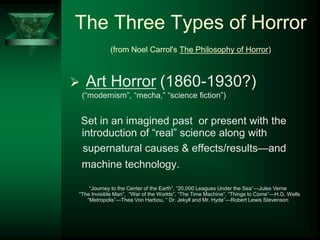
 Art Horror (1860-1930?)
(“modernism”, “mecha,” “science fiction”)
Set in an imagined past or present with the
introduction of “real” science along with
supernatural causes & effects/results—and
machine technology.
“Journey to the Center of the Earth”, “20,000 Leagues Under the Sea”—Jules Verne
“The Invisible Man”, “War of the Worlds”, “The Time Machine”, “Things to Come”—H.G. Wells
“Metropolis”—Thea Von Harbou, “ Dr. Jekyll and Mr. Hyde”—Robert Lewis Stevenson
Monsters or Monstrous Behavior
(horrible & terrible)
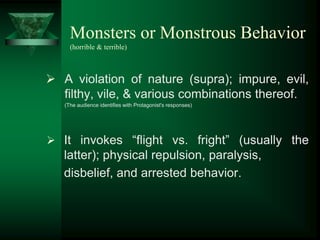
 A violation of nature (supra); impure, evil,
filthy, vile, & various combinations thereof.
(The audience identifies with Protagonist's responses)
 It invokes “flight vs. fright” (usually the
latter); physical repulsion, paralysis,
disbelief, and arrested behavior.
Type of Monstrosities
“Phobias and the Fantastic”—and RJ
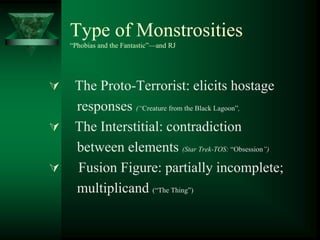
 The Proto-Terrorist: elicits hostage
responses (“Creature from the Black Lagoon”,
 The Interstitial: contradiction
between elements (Star Trek-TOS: “Obsession”)
 Fusion Figure: partially incomplete;
multiplicand (“The Thing”)
 Fission Figure: vaporous or gelatinous;
a collection of ideas (not self-aware)
 Magnification: enlarged or augmentation
of existing phobias; extremities of social
angst (“Invasion of the Body Snatchers”, “Incredible Shrinking Man”, “28 Days”)
 Massification: Fantastic biologists;
enlarged social irresponsibility (“Them”, “The Hulk”)
Type of Monstrosities
“Phobias and the Fantastic”—and RJ
“Science Fiction”
A cross-media genre, identified by the
emotions it characteristically or ideally
promotes. Distinguished by monsters
and/or monstrous-behavior that is amplified
by the presence or absence of
“advanced technology” and/or its
larger theoretical application(s).
Frankenstein vs. Data
(controlling the beast)
 Man, in order to become God-like creates
life thru animating the dead
 Man, in order to become God-like creates
life thru applied theory (“animatronics”)
(Phillip K. Dick- “Blade Runner”, Isaac Asimov-”I, Robot”)
THE THREE LAWS OF ROBOTICS
by Isaac Asimov
 A robot may not injure a human being or,
through inaction, allow a human being to
come to harm.
 A robot must obey orders given it by a human
being except where such orders would
conflict with the First Law.
 A robot must project its own existence as long
as such protection does not conflict with the
First and Second Law.
Post-modern Categories of Science Fiction
(L. David Allen, Sci-Fi Guide, RJ)
 Hard: major themes & emphasis on the
“hard sciences” with usually one discipline
dominating (“Altered States”, “Pandemic”)
 Gadget Stories: man and relationship to
machines (“RoboCop”, “Transformers”, “Pacific Rim”)
 Extrapolative: projection of current
knowledge & acceptable theory applied to
new worlds (“Forbidden Planet”, “Star Trek”, “2001”, “Soylent Green”, “Oblivion”)
 Soft: major emphasis on “soft sciences”;
less accurate projection, multi-disciplinary
(“The Time Machine”, “Planet of the Apes”, “Alien”, “Benjamin Button”)
 Fantasy: magic, Para-physics (“sword &
sorcery”); assumes an orderly universe
with discernable physical laws
(“Jason and the Argonaughts”, “Dune”, “Highlander”, “John Carter”)
Post-modern Categories of Science Fiction
(L. David Allen, Sci-Fi Guide, RJ)
 New Wave: highly visual stylistic
experimentation (“chaos theory”)
(“The World, the Flesh, and the Devil”, “Until the End/World”, “Inception”)
 Cyberspace: [from East Steps edited by M. Benedict]
an infinite artificial universe where humanity
mind-melds with information constants in a
Euclidian abstraction
(“Neuromancer” by Wm Gibson; “Minority Report”, “Tron”, “The Matrix”)
Post-modern Categories of Science Fiction
(L. David Allen, Sci-Fi Guide, RJ)
 Apocalyptic: a dystopian world-view, where
all social constructs have devolved and a
system of governance exists based on survival of
the fittest; usually post-Atomic War/pandemic
(“The Postman”, “Mad Max Beyond Thunderdome”, “Terminator: Rise of the Machines”,
“The Book of Eli”, “Elysium”)
 Zombie: a smorgasbord of (usually) disease-ridden
undead “beings” sharing a hunger for living
flesh; societal breakdown resulting in mass
assaults (a variation on Vampire stories/culture).
(“Night/Dawn/Day of the Living Dead”—George Romero, “World War Z”, etc., etc., etc. )
Post-modern Categories of Science Fiction
(L. David Allen, Sci-Fi Guide, RJ)

Elements of Science Fiction

  • 1.
    Elements of ScienceFiction what if…?
  • 2.
    Horror  the presenceof "monsters" or "monstrous behavior" coinciding with a psychological flight from the "unclean”  a visceral revulsion, disbelief; state of abnormal physical agitation
  • 3.
    Terror  fear ofpsychological rape, and/or mental disorder  a state of constant or near-constant fear that is paralyzing
  • 4.
    The Three Typesof Horror (from Noel Carrol's The Philosophy of Horror)  Historical Gothic (1764-1880) (a.k.a. the “Gothic Novel” or ghost story) Set in an imagined past with emphasis on natural causes & effects/results, tinged with romanticism – and horror. (“The Castle of Otranto” by Horace Walpole, ”“Frankenstein” by Mary Shelley)
  • 5.
    The Three Typesof Horror (from Noel Carrol's The Philosophy of Horror)  Natural Horror (1840-1912) (Victorian Era: these stories eclipses Gothic Novel with their use of realism ) Phenomena-based, explained away by “science” combined with mysticism and/or mythology. (Werewolves, Vampires—*Bram Stoker publishes “Dracula” in 1897)
  • 6.
    The Three Typesof Horror (from Noel Carrol's The Philosophy of Horror)  Art Horror (1860-1930?) (“modernism”, “mecha,” “science fiction”) Set in an imagined past or present with the introduction of “real” science along with supernatural causes & effects/results—and machine technology. “Journey to the Center of the Earth”, “20,000 Leagues Under the Sea”—Jules Verne “The Invisible Man”, “War of the Worlds”, “The Time Machine”, “Things to Come”—H.G. Wells “Metropolis”—Thea Von Harbou, “ Dr. Jekyll and Mr. Hyde”—Robert Lewis Stevenson
  • 7.
    Monsters or MonstrousBehavior (horrible & terrible)  A violation of nature (supra); impure, evil, filthy, vile, & various combinations thereof. (The audience identifies with Protagonist's responses)  It invokes “flight vs. fright” (usually the latter); physical repulsion, paralysis, disbelief, and arrested behavior.
  • 8.
    Type of Monstrosities “Phobiasand the Fantastic”—and RJ  The Proto-Terrorist: elicits hostage responses (“Creature from the Black Lagoon”,  The Interstitial: contradiction between elements (Star Trek-TOS: “Obsession”)  Fusion Figure: partially incomplete; multiplicand (“The Thing”)
  • 9.
     Fission Figure:vaporous or gelatinous; a collection of ideas (not self-aware)  Magnification: enlarged or augmentation of existing phobias; extremities of social angst (“Invasion of the Body Snatchers”, “Incredible Shrinking Man”, “28 Days”)  Massification: Fantastic biologists; enlarged social irresponsibility (“Them”, “The Hulk”) Type of Monstrosities “Phobias and the Fantastic”—and RJ
  • 10.
    “Science Fiction” A cross-mediagenre, identified by the emotions it characteristically or ideally promotes. Distinguished by monsters and/or monstrous-behavior that is amplified by the presence or absence of “advanced technology” and/or its larger theoretical application(s).
  • 11.
    Frankenstein vs. Data (controllingthe beast)  Man, in order to become God-like creates life thru animating the dead  Man, in order to become God-like creates life thru applied theory (“animatronics”) (Phillip K. Dick- “Blade Runner”, Isaac Asimov-”I, Robot”)
  • 12.
    THE THREE LAWSOF ROBOTICS by Isaac Asimov  A robot may not injure a human being or, through inaction, allow a human being to come to harm.  A robot must obey orders given it by a human being except where such orders would conflict with the First Law.  A robot must project its own existence as long as such protection does not conflict with the First and Second Law.
  • 13.
    Post-modern Categories ofScience Fiction (L. David Allen, Sci-Fi Guide, RJ)  Hard: major themes & emphasis on the “hard sciences” with usually one discipline dominating (“Altered States”, “Pandemic”)  Gadget Stories: man and relationship to machines (“RoboCop”, “Transformers”, “Pacific Rim”)  Extrapolative: projection of current knowledge & acceptable theory applied to new worlds (“Forbidden Planet”, “Star Trek”, “2001”, “Soylent Green”, “Oblivion”)
  • 14.
     Soft: majoremphasis on “soft sciences”; less accurate projection, multi-disciplinary (“The Time Machine”, “Planet of the Apes”, “Alien”, “Benjamin Button”)  Fantasy: magic, Para-physics (“sword & sorcery”); assumes an orderly universe with discernable physical laws (“Jason and the Argonaughts”, “Dune”, “Highlander”, “John Carter”) Post-modern Categories of Science Fiction (L. David Allen, Sci-Fi Guide, RJ)
  • 15.
     New Wave:highly visual stylistic experimentation (“chaos theory”) (“The World, the Flesh, and the Devil”, “Until the End/World”, “Inception”)  Cyberspace: [from East Steps edited by M. Benedict] an infinite artificial universe where humanity mind-melds with information constants in a Euclidian abstraction (“Neuromancer” by Wm Gibson; “Minority Report”, “Tron”, “The Matrix”) Post-modern Categories of Science Fiction (L. David Allen, Sci-Fi Guide, RJ)
  • 16.
     Apocalyptic: adystopian world-view, where all social constructs have devolved and a system of governance exists based on survival of the fittest; usually post-Atomic War/pandemic (“The Postman”, “Mad Max Beyond Thunderdome”, “Terminator: Rise of the Machines”, “The Book of Eli”, “Elysium”)  Zombie: a smorgasbord of (usually) disease-ridden undead “beings” sharing a hunger for living flesh; societal breakdown resulting in mass assaults (a variation on Vampire stories/culture). (“Night/Dawn/Day of the Living Dead”—George Romero, “World War Z”, etc., etc., etc. ) Post-modern Categories of Science Fiction (L. David Allen, Sci-Fi Guide, RJ)