LESSON PLAN IN SCIENCE 6
(WATER)
I. OBJECTIVES:
At the end of the lesson, pupils are expected to:
a. Define water.
b. Identify and describe the properties and phases/states of water
c. Discuss the importance of water in our daily life.
II. SUBJECT MATTER:
Topic: Water
Reference:https://thebiologynotes.com/water/;
https://www.youtube.com/watch?v=xgS9uXb3o8I
Materials: pictures, video presentation
Science Processes : Identifying
Science Concept: Water is an inorganic, transparent, tasteless, odorless, and nearly
colorless chemical substance, which is the main constituent of Earth's hydrosphere and
the fluids of all known living organisms (in which it acts as a solvent[1]
). It is vital for all known
forms of life, even though it provides no calories or organic nutrients. .
Value Focus: Appreciate vital role of water in daily life.
III. PROCEDURE
TEACHER’S ACTIVITY LEARNER’S ACTIVITY
 Preliminary activity
1. Daily Routine
a. Prayer
b. Greetings
Good morning class!
c. Checking of Attendance
(The teacher will check the attendance according to
row which is in the seat plan)
2. Drill
Dear Lord, Help us to be good, help us
to do the things we should. Bless my
teacher, my classmates and all. Amen
Good morning Teacher! Good morning
classmates
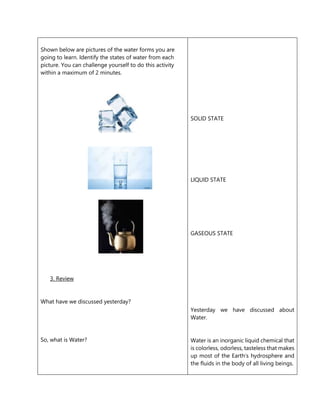
Shown below are pictures of the water forms you are
going to learn. Identify the states of water from each
picture. You can challenge yourself to do this activity
within a maximum of 2 minutes.
3. Review
What have we discussed yesterday?
So, what is Water?
SOLID STATE
LIQUID STATE
GASEOUS STATE
Yesterday we have discussed about
Water.
Water is an inorganic liquid chemical that
is colorless, odorless, tasteless that makes
up most of the Earth’s hydrosphere and
the fluids in the body of all living beings.
Very good!
Give the different states of water?
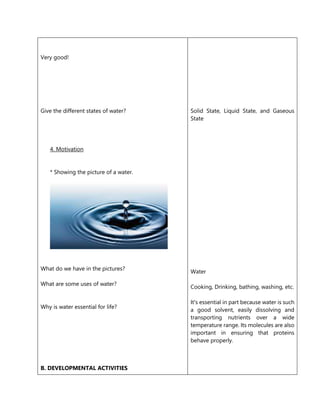
4. Motivation
* Showing the picture of a water.
What do we have in the pictures?
What are some uses of water?
Why is water essential for life?
B. DEVELOPMENTAL ACTIVITIES
Solid State, Liquid State, and Gaseous
State
Water
Cooking, Drinking, bathing, washing, etc.
It's essential in part because water is such
a good solvent, easily dissolving and
transporting nutrients over a wide
temperature range. Its molecules are also
important in ensuring that proteins
behave properly.
 Presentation
In this lesson you will learn water and its properties.
(Teacher may have a video presentation before the
activity)
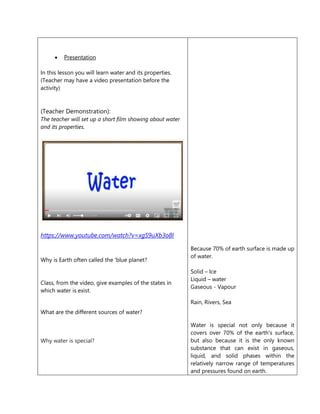
(Teacher Demonstration):
The teacher will set up a short film showing about water
and its properties.
https://www.youtube.com/watch?v=xgS9uXb3o8I
Why is Earth often called the 'blue planet?
Class, from the video, give examples of the states in
which water is exist.
What are the different sources of water?
Why water is special?
Because 70% of earth surface is made up
of water.
Solid – Ice
Liquid – water
Gaseous - Vapour
Rain, Rivers, Sea
Water is special not only because it
covers over 70% of the earth's surface,
but also because it is the only known
substance that can exist in gaseous,
liquid, and solid phases within the
relatively narrow range of temperatures
and pressures found on earth.
 Discussion
Guided Questions:
What are the properties of water?
What is a structure of a water molecule?
Why is water important to our body?
 Group Activity
Group the learners into 3 and give the respective tasks for
each group. To do this activity in the maximum of 15mins.
Group 1 – The learners will make a slogan about the
conservation of water.
Group 2 – The learners will make a jingle about
importance of water in daily life.
Group 3 – The learners will do the role playing on the
common usage of water in the household.
Water is colorless liquid.
Water is tasteless liquid.
Water is natural to litmus test.
Water is a good conductor of electricity.
It is made up of two atoms of hydrogen
and one atom of oxygen. (H2O)
Water plays many important roles in the
body including flushing waste from the
body, regulating body temperature,
transportation of nutrients and is
necessary for digestion.
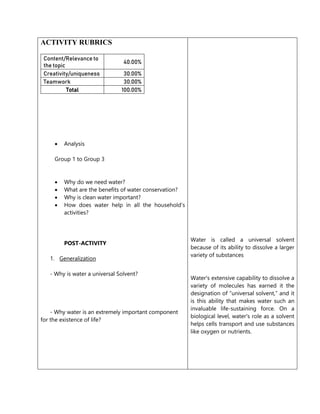
ACTIVITY RUBRICS
Content/Relevance to
the topic
40.00%
Creativity/uniqueness 30.00%
Teamwork 30.00%
Total 100.00%
 Analysis
Group 1 to Group 3
 Why do we need water?
 What are the benefits of water conservation?
 Why is clean water important?
 How does water help in all the household’s
activities?
POST-ACTIVITY
1. Generalization
- Why is water a universal Solvent?
- Why water is an extremely important component
for the existence of life?
Water is called a universal solvent
because of its ability to dissolve a larger
variety of substances
Water's extensive capability to dissolve a
variety of molecules has earned it the
designation of “universal solvent,” and it
is this ability that makes water such an
invaluable life-sustaining force. On a
biological level, water's role as a solvent
helps cells transport and use substances
like oxygen or nutrients.
2. Application
(Seat work)
List down all the uses and function of water you can
think in your everyday life.
3. Valuing
Appreciate the functions and role of water in daily
life.
IV. EVALUATION
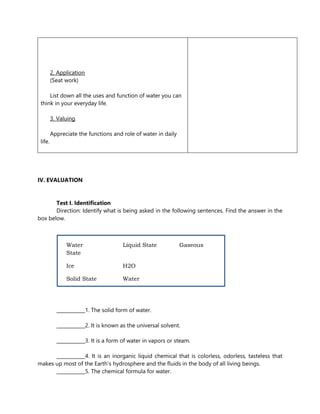
Test I. Identification
Direction: Identify what is being asked in the following sentences. Find the answer in the
box below.
____________1. The solid form of water.
____________2. It is known as the universal solvent.
____________3. It is a form of water in vapors or steam.
____________4. It is an inorganic liquid chemical that is colorless, odorless, tasteless that
makes up most of the Earth’s hydrosphere and the fluids in the body of all living beings.
____________5. The chemical formula for water.
Water Liquid State Gaseous
State
Ice H2O
Solid State Water
____________6. The state of water that has a fixed shape plus volume.
____________7. The state of water that has No fixed shape but they do have volume.
V. ASSIGNMENT
ESSAY.
What will happen in our daily life without water? Explain your answer and write it in a
sheet of paper.
Prepared by:
SARAH JANE L. FRONTERAS
BEED I – 81507
Submitted to:
Mrs. LEONILA P. CLAMO
Instructor

SCIENCE DLP - WATER.docx

  • 1.
    LESSON PLAN INSCIENCE 6 (WATER) I. OBJECTIVES: At the end of the lesson, pupils are expected to: a. Define water. b. Identify and describe the properties and phases/states of water c. Discuss the importance of water in our daily life. II. SUBJECT MATTER: Topic: Water Reference:https://thebiologynotes.com/water/; https://www.youtube.com/watch?v=xgS9uXb3o8I Materials: pictures, video presentation Science Processes : Identifying Science Concept: Water is an inorganic, transparent, tasteless, odorless, and nearly colorless chemical substance, which is the main constituent of Earth's hydrosphere and the fluids of all known living organisms (in which it acts as a solvent[1] ). It is vital for all known forms of life, even though it provides no calories or organic nutrients. . Value Focus: Appreciate vital role of water in daily life. III. PROCEDURE TEACHER’S ACTIVITY LEARNER’S ACTIVITY  Preliminary activity 1. Daily Routine a. Prayer b. Greetings Good morning class! c. Checking of Attendance (The teacher will check the attendance according to row which is in the seat plan) 2. Drill Dear Lord, Help us to be good, help us to do the things we should. Bless my teacher, my classmates and all. Amen Good morning Teacher! Good morning classmates
  • 2.
    Shown below arepictures of the water forms you are going to learn. Identify the states of water from each picture. You can challenge yourself to do this activity within a maximum of 2 minutes. 3. Review What have we discussed yesterday? So, what is Water? SOLID STATE LIQUID STATE GASEOUS STATE Yesterday we have discussed about Water. Water is an inorganic liquid chemical that is colorless, odorless, tasteless that makes up most of the Earth’s hydrosphere and the fluids in the body of all living beings.
  • 3.
    Very good! Give thedifferent states of water? 4. Motivation * Showing the picture of a water. What do we have in the pictures? What are some uses of water? Why is water essential for life? B. DEVELOPMENTAL ACTIVITIES Solid State, Liquid State, and Gaseous State Water Cooking, Drinking, bathing, washing, etc. It's essential in part because water is such a good solvent, easily dissolving and transporting nutrients over a wide temperature range. Its molecules are also important in ensuring that proteins behave properly.
  • 4.
     Presentation In thislesson you will learn water and its properties. (Teacher may have a video presentation before the activity) (Teacher Demonstration): The teacher will set up a short film showing about water and its properties. https://www.youtube.com/watch?v=xgS9uXb3o8I Why is Earth often called the 'blue planet? Class, from the video, give examples of the states in which water is exist. What are the different sources of water? Why water is special? Because 70% of earth surface is made up of water. Solid – Ice Liquid – water Gaseous - Vapour Rain, Rivers, Sea Water is special not only because it covers over 70% of the earth's surface, but also because it is the only known substance that can exist in gaseous, liquid, and solid phases within the relatively narrow range of temperatures and pressures found on earth.
  • 5.
     Discussion Guided Questions: Whatare the properties of water? What is a structure of a water molecule? Why is water important to our body?  Group Activity Group the learners into 3 and give the respective tasks for each group. To do this activity in the maximum of 15mins. Group 1 – The learners will make a slogan about the conservation of water. Group 2 – The learners will make a jingle about importance of water in daily life. Group 3 – The learners will do the role playing on the common usage of water in the household. Water is colorless liquid. Water is tasteless liquid. Water is natural to litmus test. Water is a good conductor of electricity. It is made up of two atoms of hydrogen and one atom of oxygen. (H2O) Water plays many important roles in the body including flushing waste from the body, regulating body temperature, transportation of nutrients and is necessary for digestion.
  • 6.
    ACTIVITY RUBRICS Content/Relevance to thetopic 40.00% Creativity/uniqueness 30.00% Teamwork 30.00% Total 100.00%  Analysis Group 1 to Group 3  Why do we need water?  What are the benefits of water conservation?  Why is clean water important?  How does water help in all the household’s activities? POST-ACTIVITY 1. Generalization - Why is water a universal Solvent? - Why water is an extremely important component for the existence of life? Water is called a universal solvent because of its ability to dissolve a larger variety of substances Water's extensive capability to dissolve a variety of molecules has earned it the designation of “universal solvent,” and it is this ability that makes water such an invaluable life-sustaining force. On a biological level, water's role as a solvent helps cells transport and use substances like oxygen or nutrients.
  • 7.
    2. Application (Seat work) Listdown all the uses and function of water you can think in your everyday life. 3. Valuing Appreciate the functions and role of water in daily life. IV. EVALUATION Test I. Identification Direction: Identify what is being asked in the following sentences. Find the answer in the box below. ____________1. The solid form of water. ____________2. It is known as the universal solvent. ____________3. It is a form of water in vapors or steam. ____________4. It is an inorganic liquid chemical that is colorless, odorless, tasteless that makes up most of the Earth’s hydrosphere and the fluids in the body of all living beings. ____________5. The chemical formula for water. Water Liquid State Gaseous State Ice H2O Solid State Water
  • 8.
    ____________6. The stateof water that has a fixed shape plus volume. ____________7. The state of water that has No fixed shape but they do have volume. V. ASSIGNMENT ESSAY. What will happen in our daily life without water? Explain your answer and write it in a sheet of paper. Prepared by: SARAH JANE L. FRONTERAS BEED I – 81507 Submitted to: Mrs. LEONILA P. CLAMO Instructor