MARKY MARK M. AJERO
TEACHER I
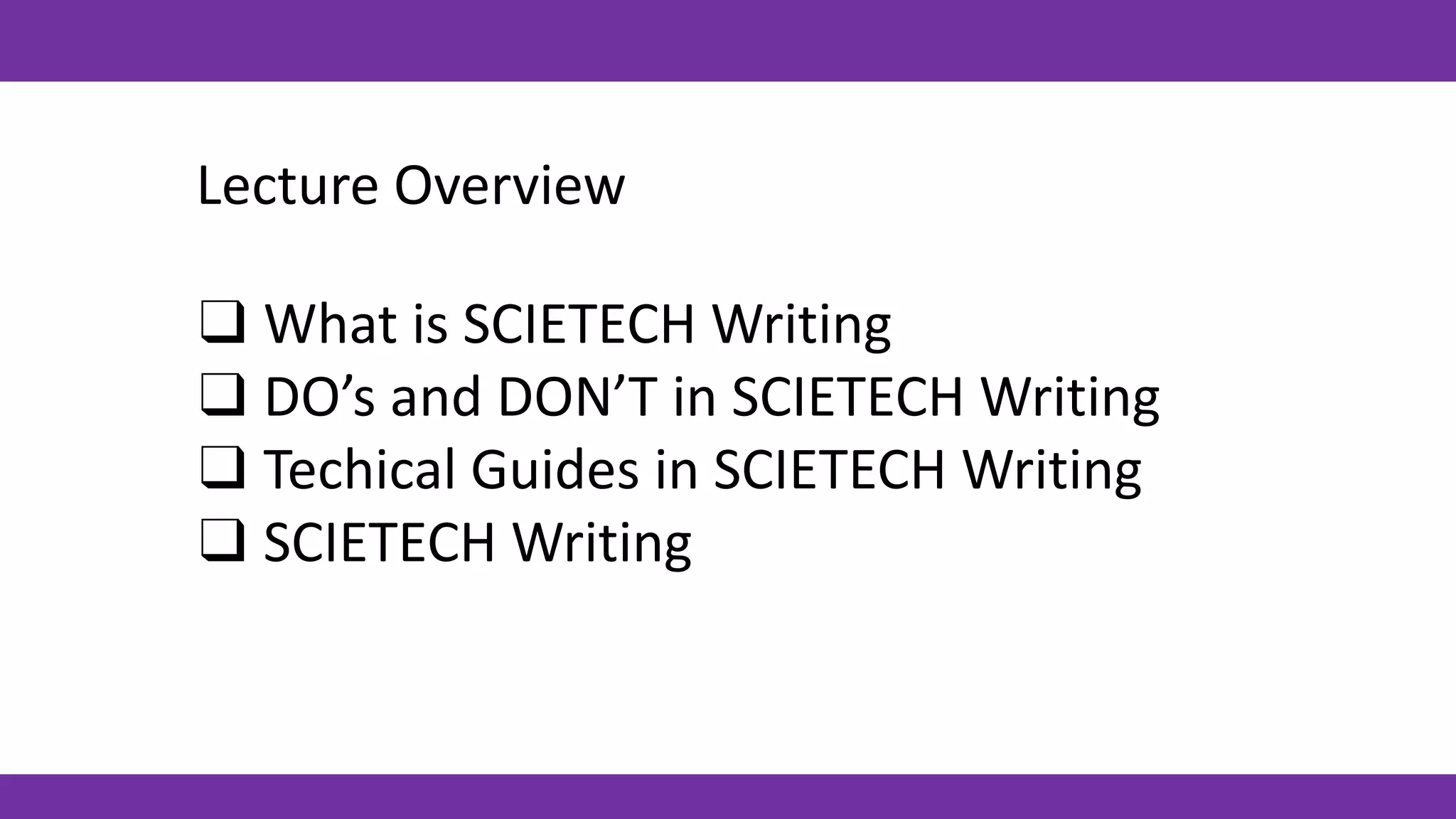
Lecture Overview
❑ What is SCIETECH Writing
❑ DO’s and DON’T in SCIETECH Writing
❑ Techical Guides in SCIETECH Writing
❑ SCIETECH Writing
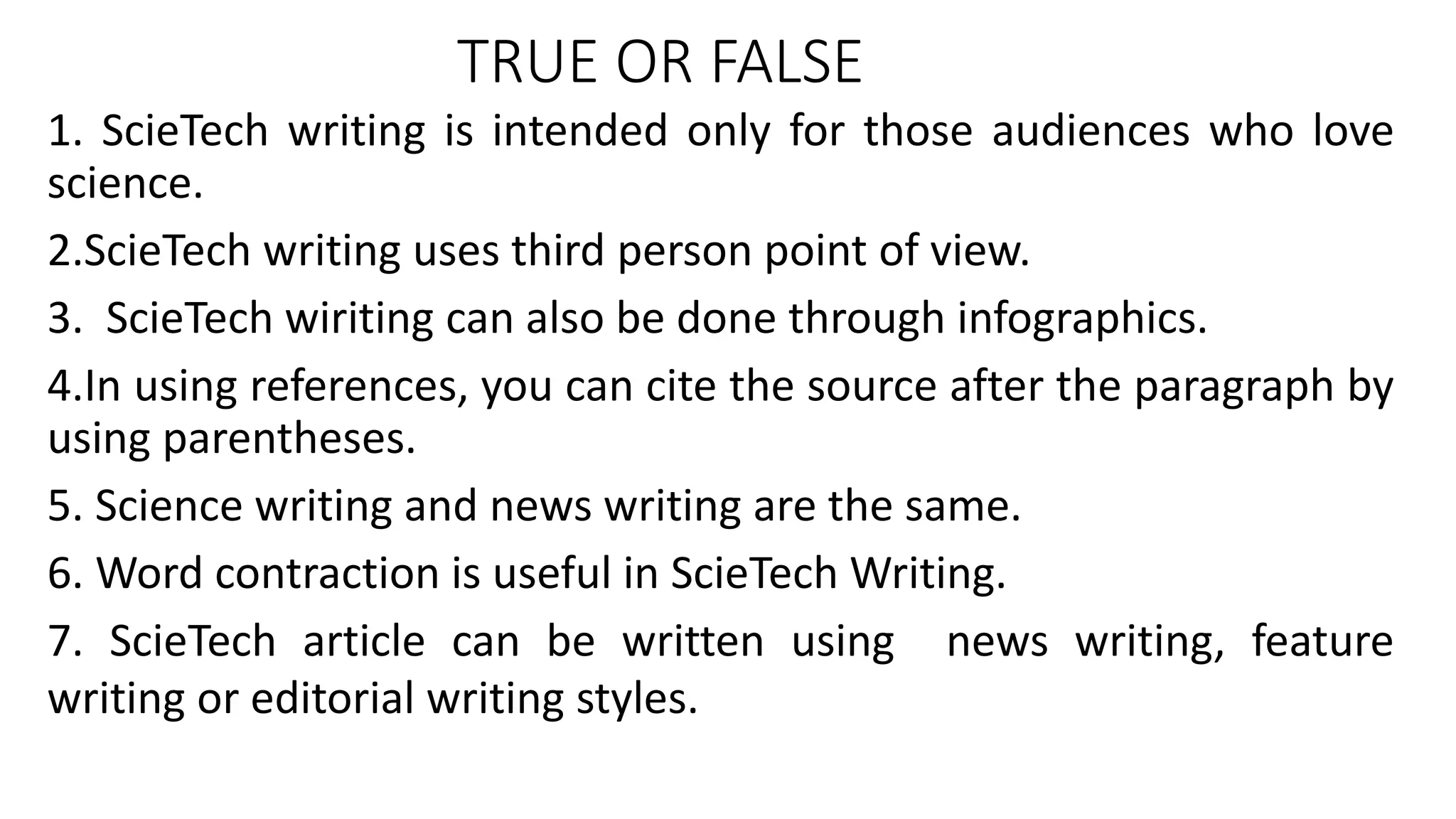
TRUE OR FALSE
1. ScieTech writing is intended only for those audiences who love
science.
2.ScieTech writing uses third person point of view.
3. ScieTech wiriting can also be done through infographics.
4.In using references, you can cite the source after the paragraph by
using parentheses.
5. Science writing and news writing are the same.
6. Word contraction is useful in ScieTech Writing.
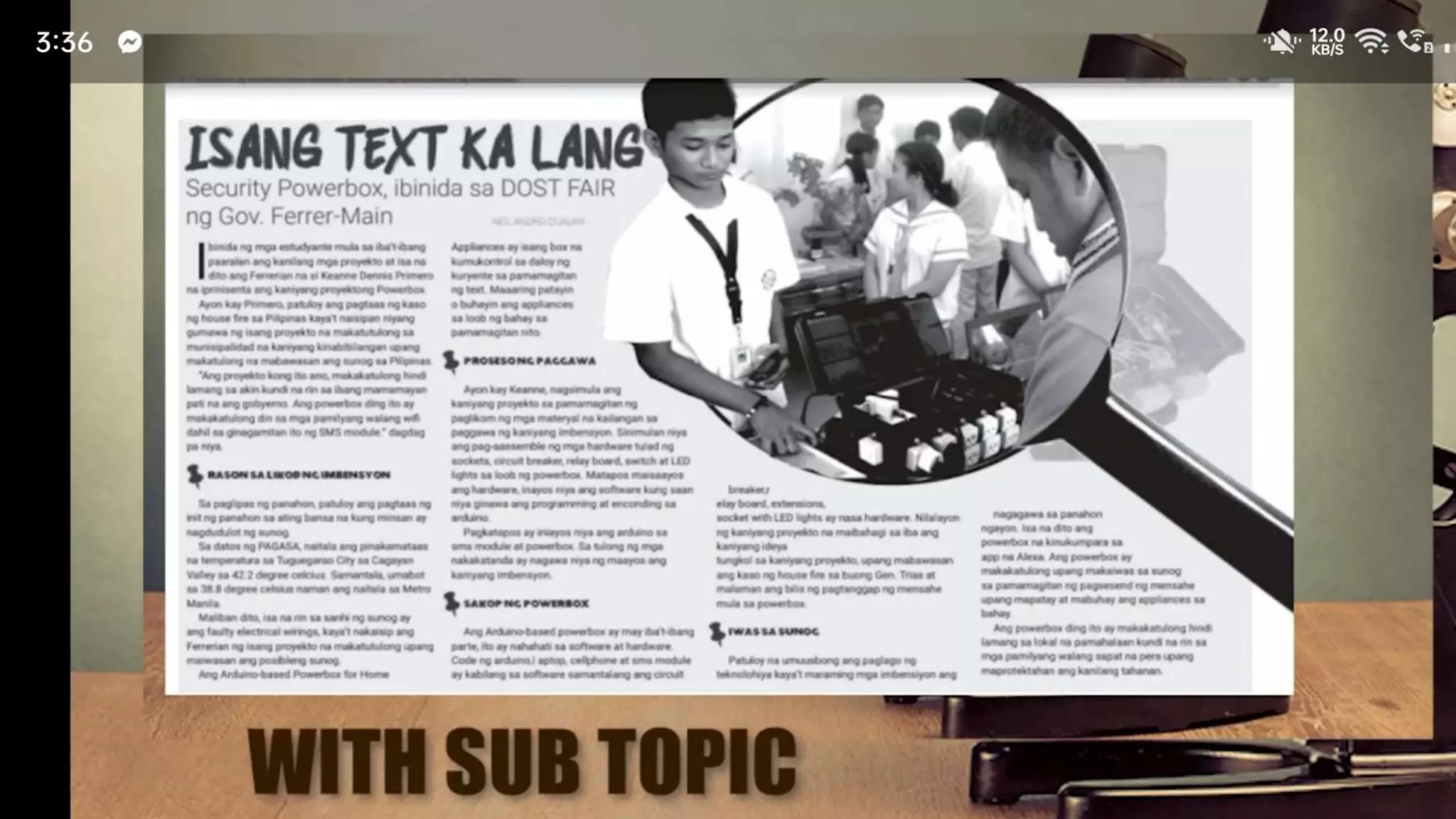
7. ScieTech article can be written using news writing, feature
writing or editorial writing styles.
SCIENCE JOURNALISM
•refers to news, interpretations, and
features of science and technology
•covers the principles of standard
journalism, except that the subject is
science.
•reports about what scientists do to
promote science.
•acts as bridge between ordinary
people and science.
REGIONAL TRAINING OF TRAINERS IN CAMPUS JOURNALISM
SOCCSKSARGEN REGION
What is Science Writing?
⚫ It is communicating scientific concepts effectively to a target
audience
⚫ Depending on the audience, it can be a news article, a
feature story, a comic strip, a technical report, etc.—It could be
anything!
⚫ The common denominator is that science writing is “writing
about science”
⚫ All science writing is evidence-based
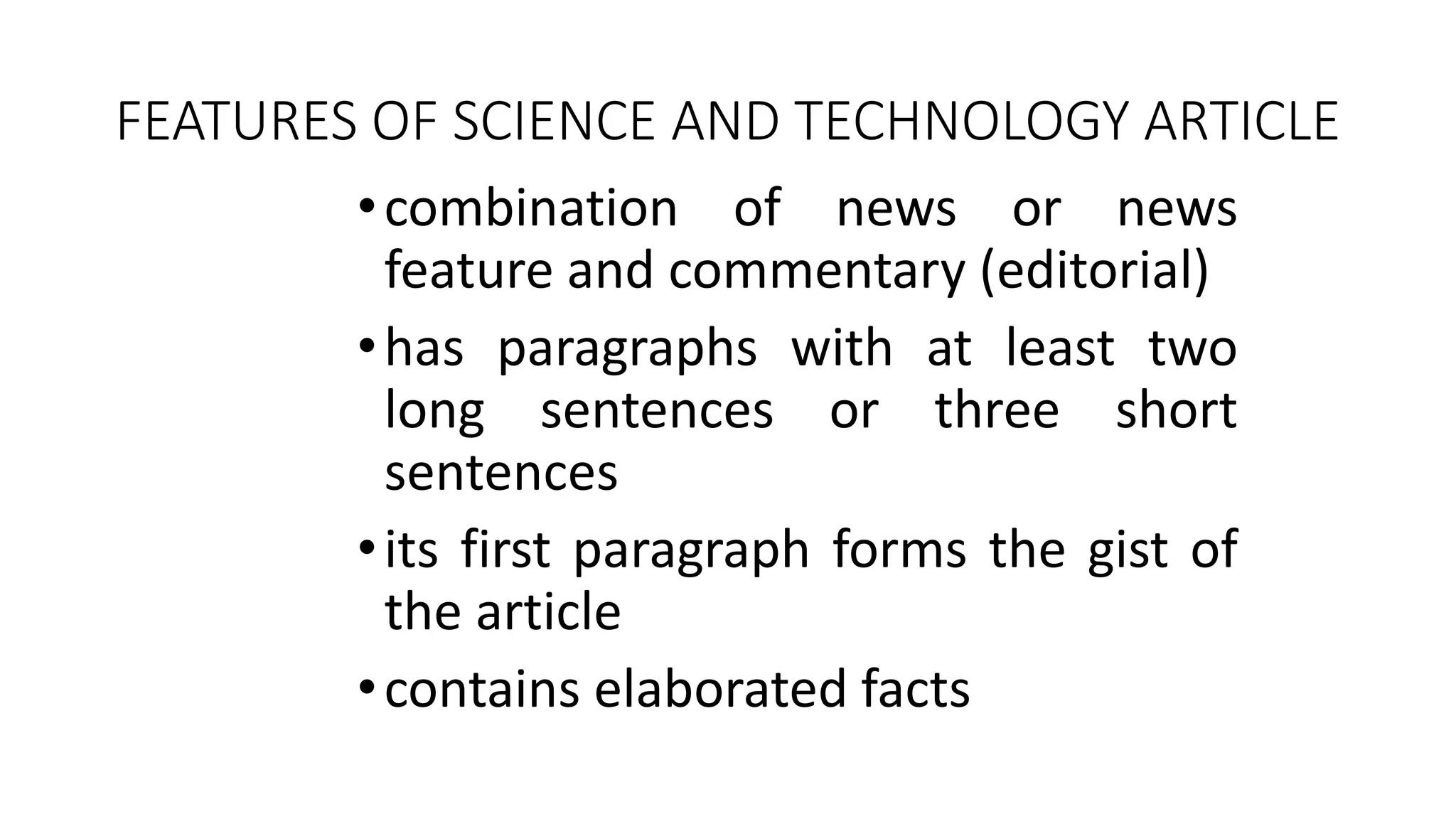
FEATURES OF SCIENCE AND TECHNOLOGY ARTICLE
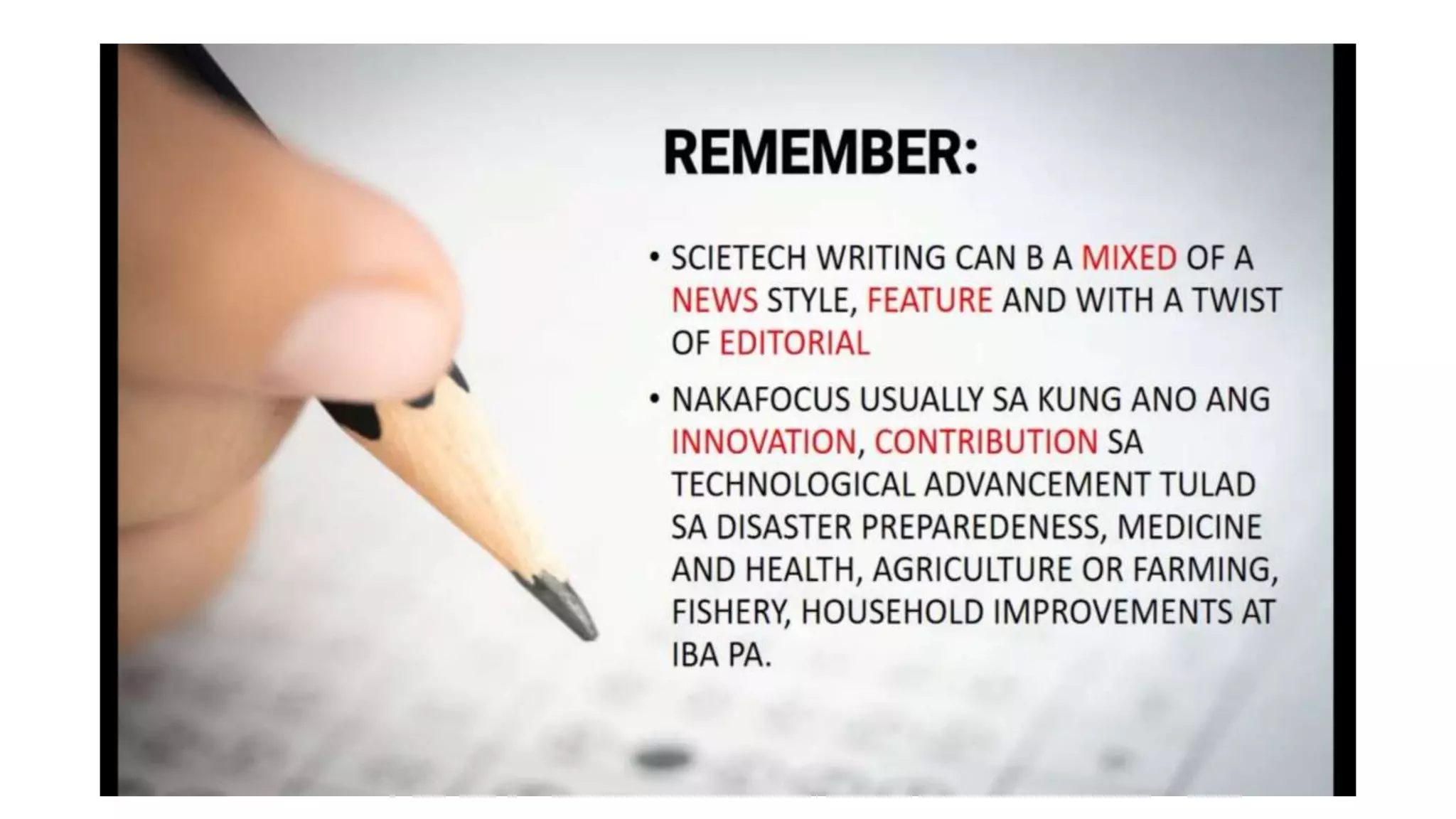
•combination of news or news
feature and commentary (editorial)
•has paragraphs with at least two
long sentences or three short
sentences
•its first paragraph forms the gist of
the article
•contains elaborated facts
•its headline is similar to feature
and editorial, catchy and
intriguing.
•its length is about two pages
•headline must be reflected in the
first to third paragraph
•contains more than three sources
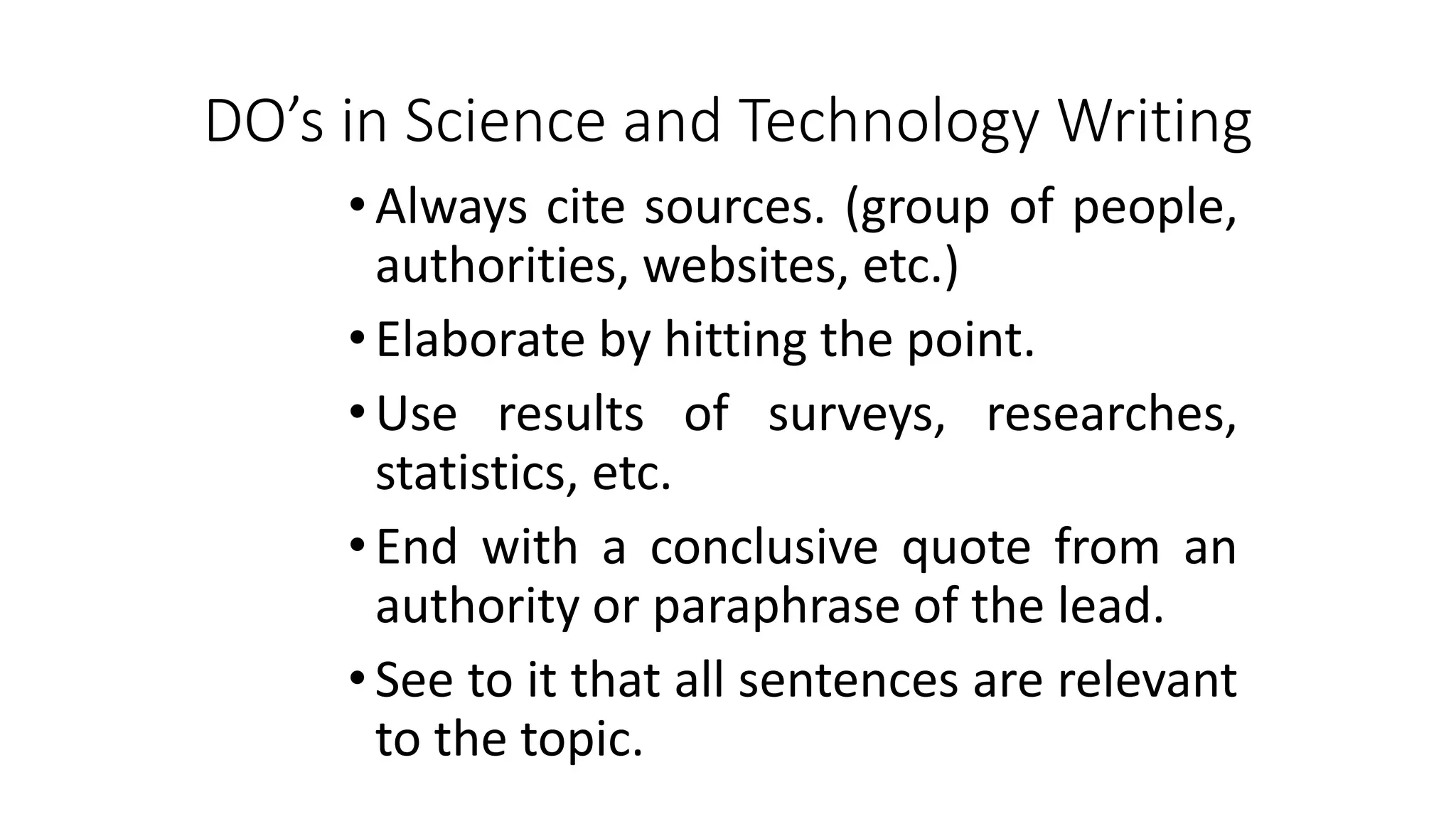
DO’s in Science and Technology Writing
•Always cite sources. (group of people,
authorities, websites, etc.)
•Elaborate by hitting the point.
•Use results of surveys, researches,
statistics, etc.
•End with a conclusive quote from an
authority or paraphrase of the lead.
•See to it that all sentences are relevant
to the topic.
•Spell out acronyms the first time you
mention it.
•Use third person point of view.
•Vary the verbs.
•Make sure that one-sentence
paragraph is really striking.
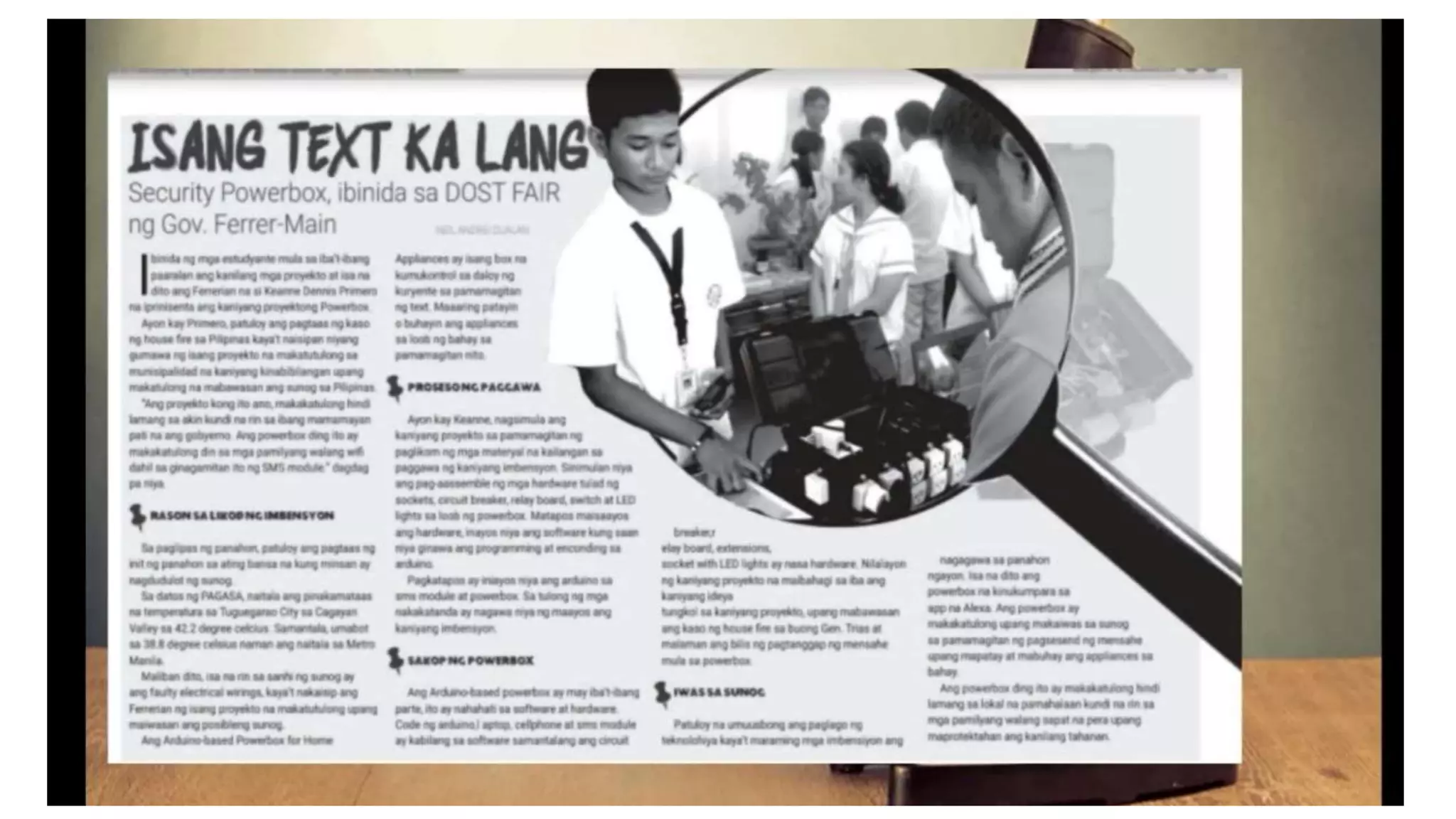
•Analyses must be based on facts.

•Relate abstract facts to the reader’s
daily life.
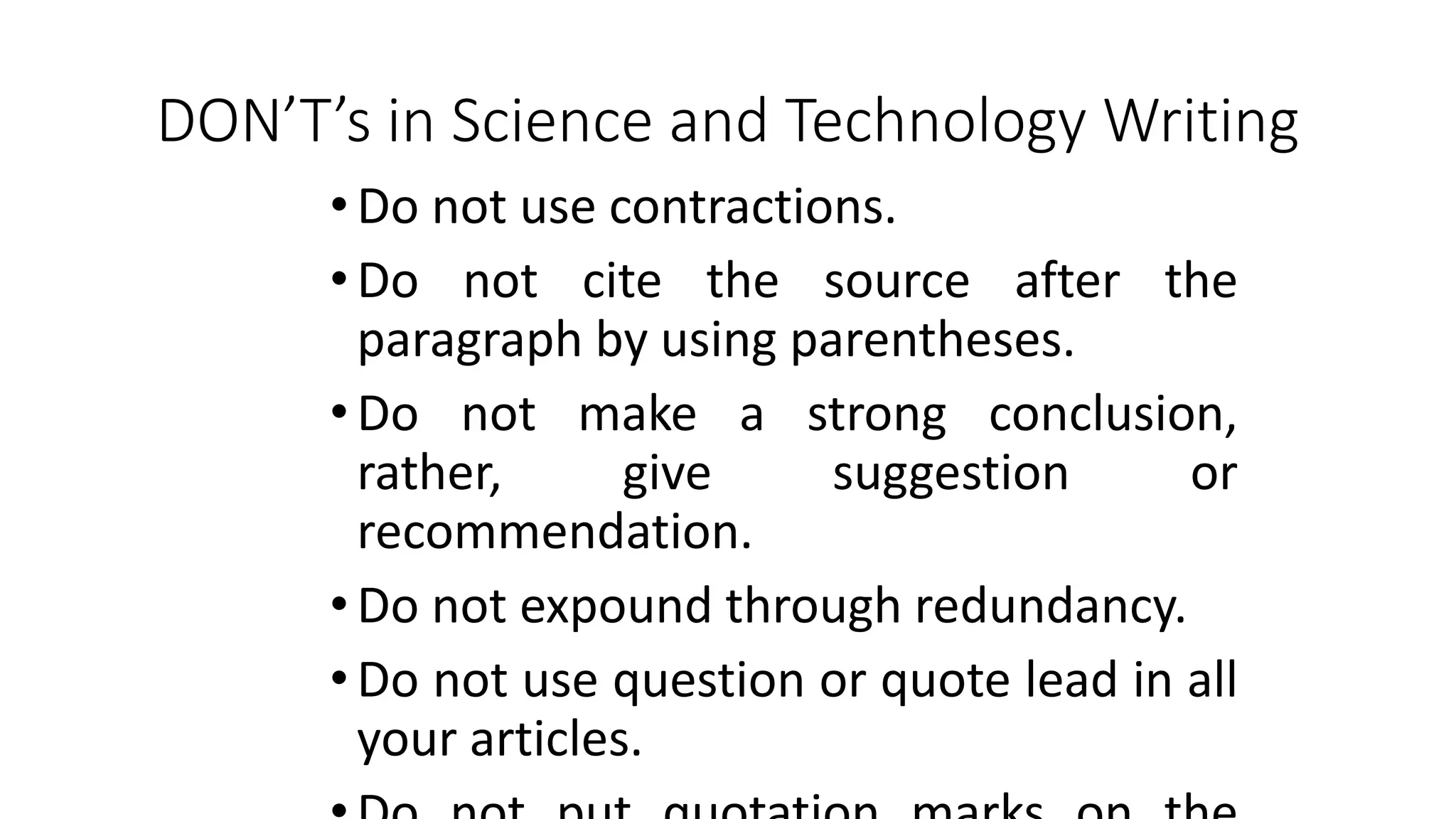
DON’T’s in Science and Technology Writing
•Do not use contractions.
•Do not cite the source after the
paragraph by using parentheses.
•Do not make a strong conclusion,
rather, give suggestion or
recommendation.
•Do not expound through redundancy.
•Do not use question or quote lead in all
your articles.
COMMON VERBS USED
• verify
• clarify
• inform
• report
• confirm
• state
• collaborate
• validate
• substantiate
 explain
 say
 recall
 believe
 note
 write
 conclude
 point out
 recommend
 suggest
 warn
 experiment
 test
 prove
 examine
 evaluate
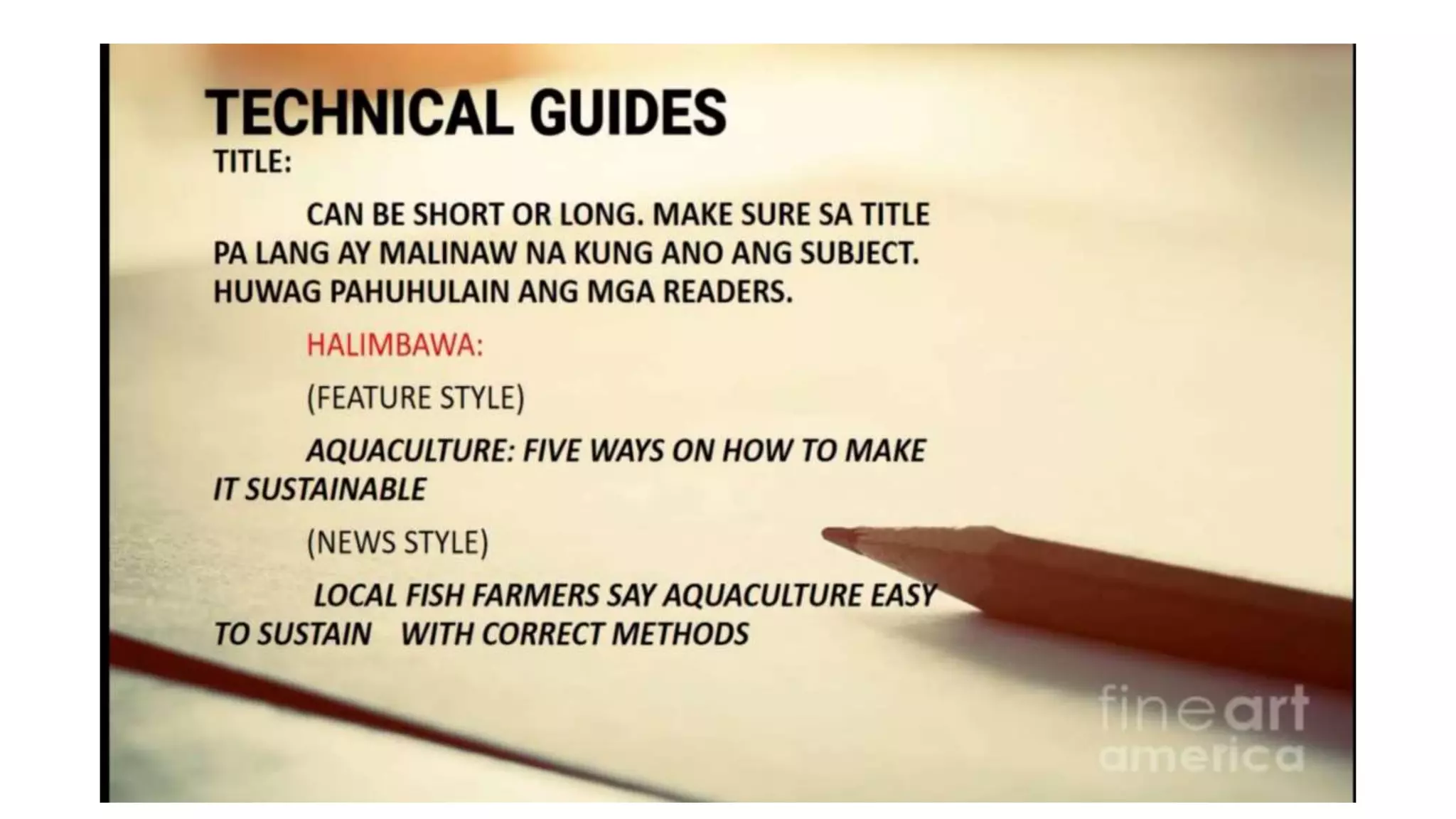
Sample Headlines:
• Coconut: Country’s Tree of Life
• Medicinal Marijuana: No or Go?
• Typhoon Yolanda, Not Man-made?
• Bee Venom: Aid for AIDS
• The Sagging Condition of Banana Industry
• Seemingly Inescapable Storm Surge
• There is money in organic fertilizer
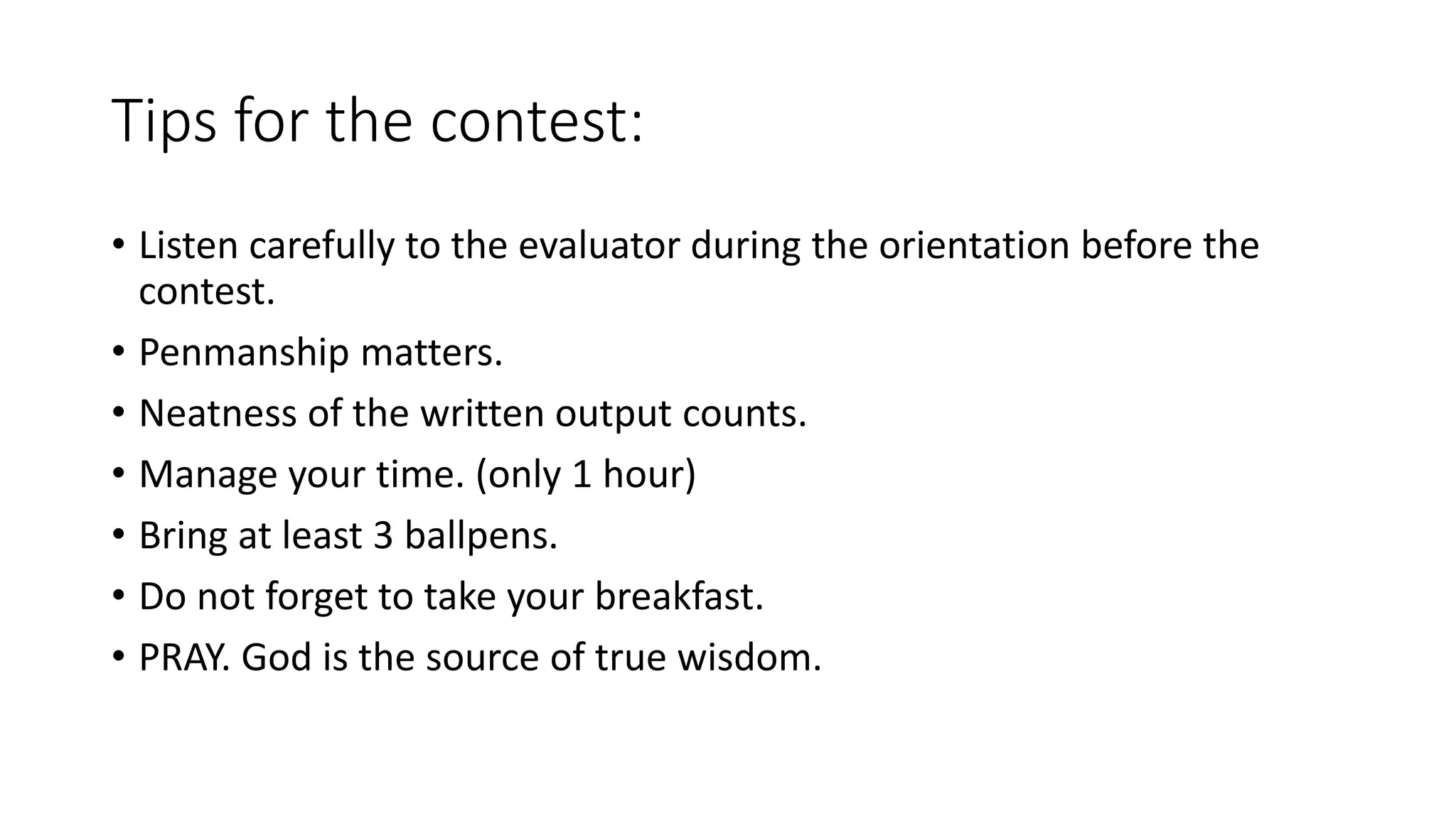
Tips for the contest:
• Listen carefully to the evaluator during the orientation before the
contest.
• Penmanship matters.
• Neatness of the written output counts.
• Manage your time. (only 1 hour)
• Bring at least 3 ballpens.
• Do not forget to take your breakfast.
• PRAY. God is the source of true wisdom.
REFERENCES
• SLIDES FROM :
1. RAPHY ABANG (KCNHS SPA)
2. SIR NAN DELA CRUZ
3. FLORIDA D. SAJOR( Master Teacher II
Koronadal City Division)
!
SULAT TIME!
SCI TECH.pptx

SCI TECH.pptx

  • 1.
    MARKY MARK M.AJERO TEACHER I
  • 2.
    Lecture Overview ❑ Whatis SCIETECH Writing ❑ DO’s and DON’T in SCIETECH Writing ❑ Techical Guides in SCIETECH Writing ❑ SCIETECH Writing
  • 3.
    TRUE OR FALSE 1.ScieTech writing is intended only for those audiences who love science. 2.ScieTech writing uses third person point of view. 3. ScieTech wiriting can also be done through infographics. 4.In using references, you can cite the source after the paragraph by using parentheses. 5. Science writing and news writing are the same. 6. Word contraction is useful in ScieTech Writing. 7. ScieTech article can be written using news writing, feature writing or editorial writing styles.
  • 4.
    SCIENCE JOURNALISM •refers tonews, interpretations, and features of science and technology •covers the principles of standard journalism, except that the subject is science. •reports about what scientists do to promote science. •acts as bridge between ordinary people and science.
  • 5.
    REGIONAL TRAINING OFTRAINERS IN CAMPUS JOURNALISM SOCCSKSARGEN REGION What is Science Writing? ⚫ It is communicating scientific concepts effectively to a target audience ⚫ Depending on the audience, it can be a news article, a feature story, a comic strip, a technical report, etc.—It could be anything! ⚫ The common denominator is that science writing is “writing about science” ⚫ All science writing is evidence-based
  • 6.
    FEATURES OF SCIENCEAND TECHNOLOGY ARTICLE •combination of news or news feature and commentary (editorial) •has paragraphs with at least two long sentences or three short sentences •its first paragraph forms the gist of the article •contains elaborated facts
  • 7.
    •its headline issimilar to feature and editorial, catchy and intriguing. •its length is about two pages •headline must be reflected in the first to third paragraph •contains more than three sources
  • 19.
    DO’s in Scienceand Technology Writing •Always cite sources. (group of people, authorities, websites, etc.) •Elaborate by hitting the point. •Use results of surveys, researches, statistics, etc. •End with a conclusive quote from an authority or paraphrase of the lead. •See to it that all sentences are relevant to the topic.
  • 20.
    •Spell out acronymsthe first time you mention it. •Use third person point of view. •Vary the verbs. •Make sure that one-sentence paragraph is really striking. •Analyses must be based on facts. •Relate abstract facts to the reader’s daily life.
  • 21.
    DON’T’s in Scienceand Technology Writing •Do not use contractions. •Do not cite the source after the paragraph by using parentheses. •Do not make a strong conclusion, rather, give suggestion or recommendation. •Do not expound through redundancy. •Do not use question or quote lead in all your articles.
  • 24.
    COMMON VERBS USED •verify • clarify • inform • report • confirm • state • collaborate • validate • substantiate  explain  say  recall  believe  note  write  conclude  point out  recommend  suggest  warn  experiment  test  prove  examine  evaluate
  • 26.
    Sample Headlines: • Coconut:Country’s Tree of Life • Medicinal Marijuana: No or Go? • Typhoon Yolanda, Not Man-made? • Bee Venom: Aid for AIDS • The Sagging Condition of Banana Industry • Seemingly Inescapable Storm Surge • There is money in organic fertilizer
  • 40.
    Tips for thecontest: • Listen carefully to the evaluator during the orientation before the contest. • Penmanship matters. • Neatness of the written output counts. • Manage your time. (only 1 hour) • Bring at least 3 ballpens. • Do not forget to take your breakfast. • PRAY. God is the source of true wisdom.
  • 42.
    REFERENCES • SLIDES FROM: 1. RAPHY ABANG (KCNHS SPA) 2. SIR NAN DELA CRUZ 3. FLORIDA D. SAJOR( Master Teacher II Koronadal City Division)
  • 43.
  • 44.