Tribal South Gujarat Region,
          Netrang
Back Ground of the Area…..

         Majority area is rainfed

         Average land holding (< 1 ha.)

         Traditional Farming

         Limited knowledge of agriculture

         Migration
Objectives of the Programme…..

       To ensure food security & reduce distress
        migration related issues;

       To increase net income of farmers;

       To optimize input cost and increase
        productivity;

       To decrease risk through agriculture
        diversification;
AKRSP (I)’s Experience in SRI.....
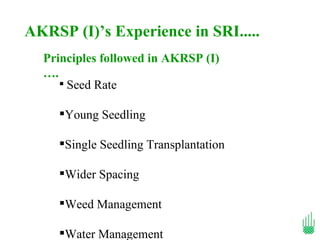
  Principles followed in AKRSP (I)
  ….
      Seed Rate

     Young Seedling

     Single Seedling Transplantation

     Wider Spacing

     Weed Management

     Water Management
AKRSP (I)’s Experience in SRI.....
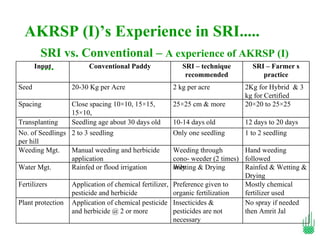
        SRI vs. Conventional – A experience of AKRSP (I)
         ….
       Input            Conventional Paddy             SRI – technique         SRI – Farmer s
                                                        recommended               practice
Seed               20-30 Kg per Acre                2 kg per acre           2Kg for Hybrid & 3
                                                                            kg for Certified
Spacing            Close spacing 10×10, 15×15,      25×25 cm & more         20×20 to 25×25
                   15×10,
Transplanting      Seedling age about 30 days old   10-14 days old          12 days to 20 days
No. of Seedlings 2 to 3 seedling                    Only one seedling       1 to 2 seedling
per hill
Weeding Mgt.     Manual weeding and herbicide          Weeding through        Hand weeding
                 application                           cono- weeder (2 times) followed
Water Mgt.       Rainfed or flood irrigation           Wetting & Drying
                                                       only                   Rainfed & Wetting &
                                                                              Drying
Fertilizers        Application of chemical fertilizer, Preference given to    Mostly chemical
                   pesticide and herbicide             organic fertilization  fertilizer used
Plant protection   Application of chemical pesticide Insecticides &           No spray if needed
                   and herbicide @ 2 or more           pesticides are not     then Amrit Jal
                                                       necessary
AKRSP (I)’s Experience in SRI.....
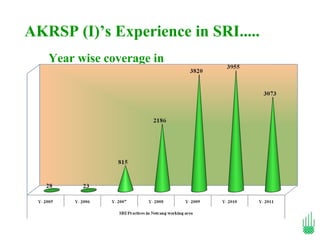
   Year wise coverage in
   Acre…
AKRSP (I)’s Experience in SRI.....
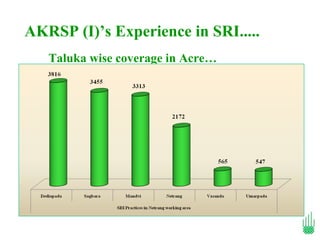
   Taluka wise coverage in Acre…
AKRSP (I)’s Experience in SRI.....
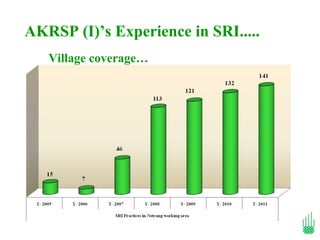
   Village coverage…
AKRSP (I)’s Experience in SRI.....
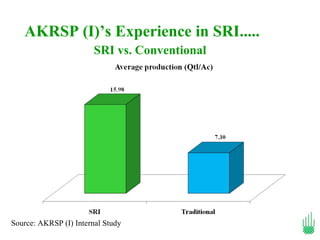
                        SRI vs. Conventional


Source: AKRSP (I) Internal Study
AKRSP (I)’s Experience in SRI.....
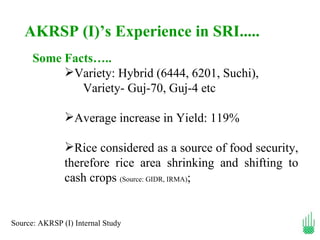
      Some Facts…..
           Variety: Hybrid (6444, 6201, Suchi),
              Variety- Guj-70, Guj-4 etc

               Average increase in Yield: 119%

               Rice considered as a source of food security,
               therefore rice area shrinking and shifting to
               cash crops (Source: GIDR, IRMA);


Source: AKRSP (I) Internal Study
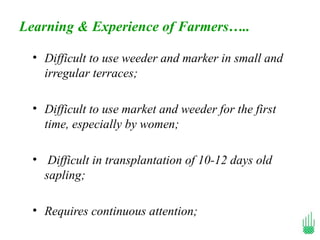
Learning & Experience of Farmers…..

  • Difficult to use weeder and marker in small and
    irregular terraces;

  • Difficult to use market and weeder for the first
    time, especially by women;

  • Difficult in transplantation of 10-12 days old
    sapling;

  • Requires continuous attention;
WAY FORWARD…..
Promotion of sustainable mode of paddy cultivation
through SRI;

Promotion of SRI technique all over Gujarat by
forming consortium of the partners organization;

Promotion of SRI technique in Ragi (Dangs distinct)

Integrated approach to reduces the climatic effects;

Value Chain Development for backward & forward
linkage of of farm produce like Rice, Ragi etc;
o u
      k Y
   a n
T h

Akrspi gujarat

  • 1.
    Tribal South GujaratRegion, Netrang
  • 2.
    Back Ground ofthe Area…..  Majority area is rainfed  Average land holding (< 1 ha.)  Traditional Farming  Limited knowledge of agriculture  Migration
  • 3.
    Objectives of theProgramme…..  To ensure food security & reduce distress migration related issues;  To increase net income of farmers;  To optimize input cost and increase productivity;  To decrease risk through agriculture diversification;
  • 4.
    AKRSP (I)’s Experiencein SRI..... Principles followed in AKRSP (I) ….  Seed Rate Young Seedling Single Seedling Transplantation Wider Spacing Weed Management Water Management
  • 5.
    AKRSP (I)’s Experiencein SRI..... SRI vs. Conventional – A experience of AKRSP (I) …. Input Conventional Paddy SRI – technique SRI – Farmer s recommended practice Seed 20-30 Kg per Acre 2 kg per acre 2Kg for Hybrid & 3 kg for Certified Spacing Close spacing 10×10, 15×15, 25×25 cm & more 20×20 to 25×25 15×10, Transplanting Seedling age about 30 days old 10-14 days old 12 days to 20 days No. of Seedlings 2 to 3 seedling Only one seedling 1 to 2 seedling per hill Weeding Mgt. Manual weeding and herbicide Weeding through Hand weeding application cono- weeder (2 times) followed Water Mgt. Rainfed or flood irrigation Wetting & Drying only Rainfed & Wetting & Drying Fertilizers Application of chemical fertilizer, Preference given to Mostly chemical pesticide and herbicide organic fertilization fertilizer used Plant protection Application of chemical pesticide Insecticides & No spray if needed and herbicide @ 2 or more pesticides are not then Amrit Jal necessary
  • 6.
    AKRSP (I)’s Experiencein SRI..... Year wise coverage in Acre…
  • 7.
    AKRSP (I)’s Experiencein SRI..... Taluka wise coverage in Acre…
  • 8.
    AKRSP (I)’s Experiencein SRI..... Village coverage…
  • 9.
    AKRSP (I)’s Experiencein SRI..... SRI vs. Conventional Source: AKRSP (I) Internal Study
  • 10.
    AKRSP (I)’s Experiencein SRI..... Some Facts….. Variety: Hybrid (6444, 6201, Suchi), Variety- Guj-70, Guj-4 etc Average increase in Yield: 119% Rice considered as a source of food security, therefore rice area shrinking and shifting to cash crops (Source: GIDR, IRMA); Source: AKRSP (I) Internal Study
  • 11.
    Learning & Experienceof Farmers….. • Difficult to use weeder and marker in small and irregular terraces; • Difficult to use market and weeder for the first time, especially by women; • Difficult in transplantation of 10-12 days old sapling; • Requires continuous attention;
  • 12.
    WAY FORWARD….. Promotion ofsustainable mode of paddy cultivation through SRI; Promotion of SRI technique all over Gujarat by forming consortium of the partners organization; Promotion of SRI technique in Ragi (Dangs distinct) Integrated approach to reduces the climatic effects; Value Chain Development for backward & forward linkage of of farm produce like Rice, Ragi etc;
  • 13.
    o u k Y a n T h