School Oral Health Program
Maine CDC/DHHS
Oral Health Program
Nicole M. Breton RDH, BS
School Oral Health Program
A Healthy Smile For ME
School Oral Health Program
 Tooth decay is the most common
chronic childhood disease.
 5 times more common than asthma.
 7 times more common than hayfever.
 52 million school hours missed annually
because of oral problems
Surgeon General’s Report
2000
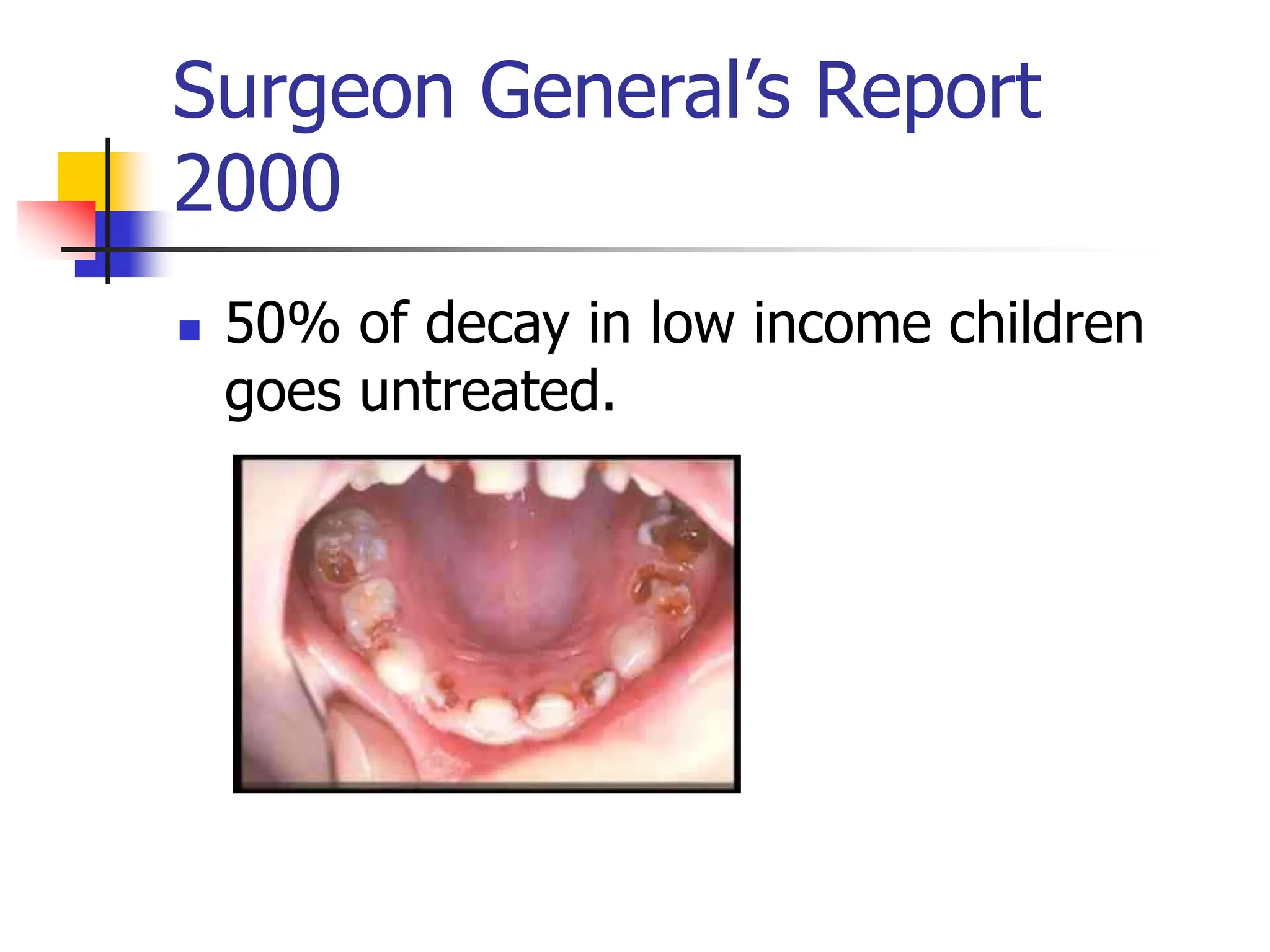
 50% of decay in low income children
goes untreated.
School Oral Health Program
“What amounts to a silent epidemic of
dental and oral diseases is affecting
some population groups. This burden of
disease restricts activities in schools,
work and home and often significantly
diminishes the quality of life.”
Surgeon General David Satcher, PH.D,
M.D
School Oral Health Program
 Poor oral health and untreated infections can
have a significant impact on school aged
children.
 Children have trouble eating and sleeping,
and can experience speech impairments,
trouble focusing and low self esteem
 Dental disease can greatly reduce a child’s
capacity to succeed in the educational
environment.
School Oral Health Program
Prevention and Education
 Children are often unable to verbalize
their dental pain
 Teachers may notice a child who is
having difficulty attending to tasks or
who is demonstrating the effects of pain
(anxiety, fatigue, irritability, depression
and withdrawal from normal activities)
School Oral Health Program
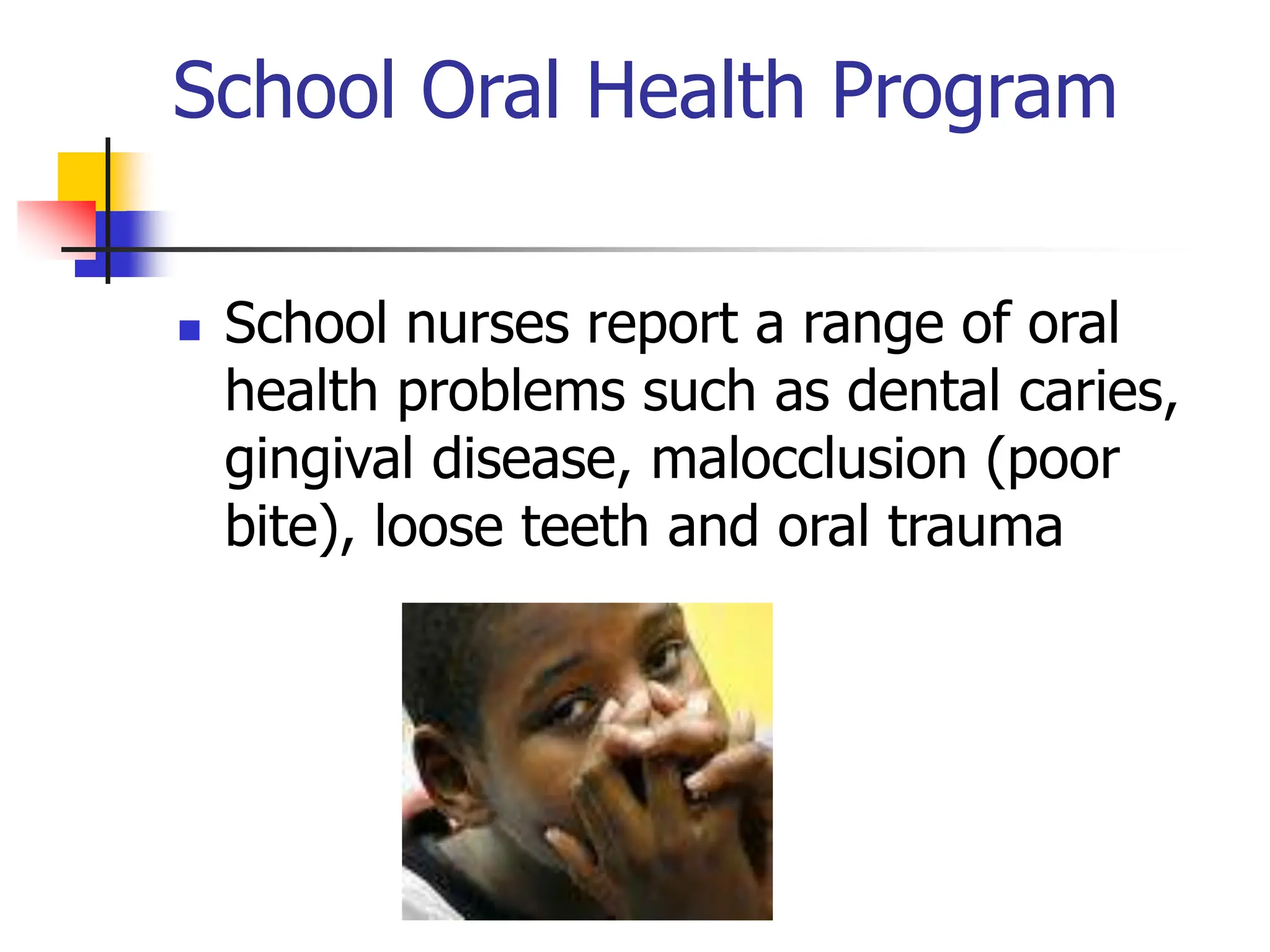
 School nurses report a range of oral
health problems such as dental caries,
gingival disease, malocclusion (poor
bite), loose teeth and oral trauma
School Oral Health Program
 Children who are missing teeth have to
limit their food choices because of
chewing problems, which may result in
nutritionally inadequate diets
 Inadequate nutrition during childhood
can have a detrimental effect on
children’s cognitive development and
productivity in adulthood
School Oral Health Program
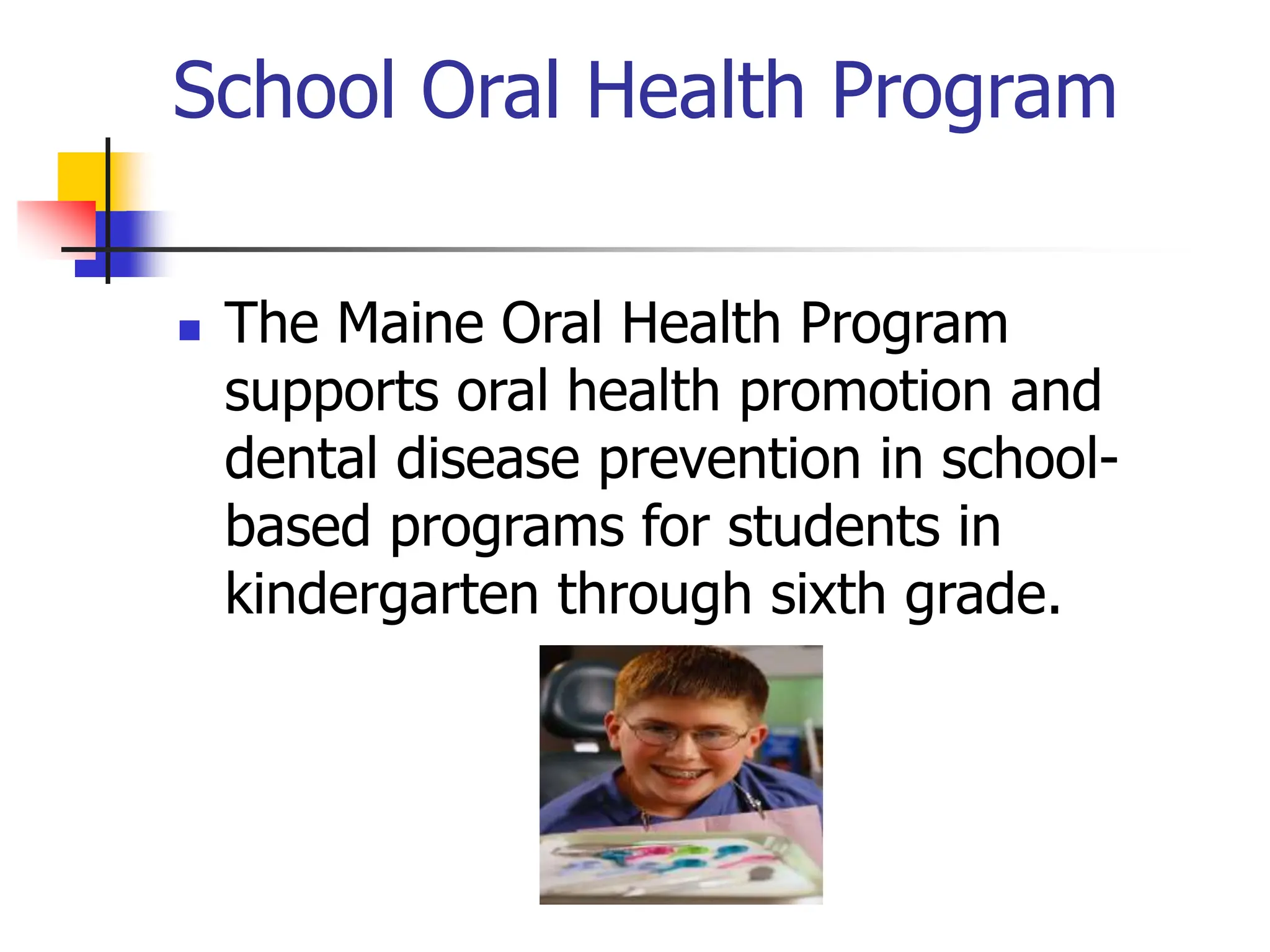
 The Maine Oral Health Program
supports oral health promotion and
dental disease prevention in school-
based programs for students in
kindergarten through sixth grade.
School Oral Health Program
 The Maine Oral Health Programs
currently funds 240 schools throughout
Maine with small grants to promote oral
health education and provide a weekly
fluoride mouthrinse.
 Some schools also receive additional
grant money to provide dental sealants
to second graders.
School Oral Health Program
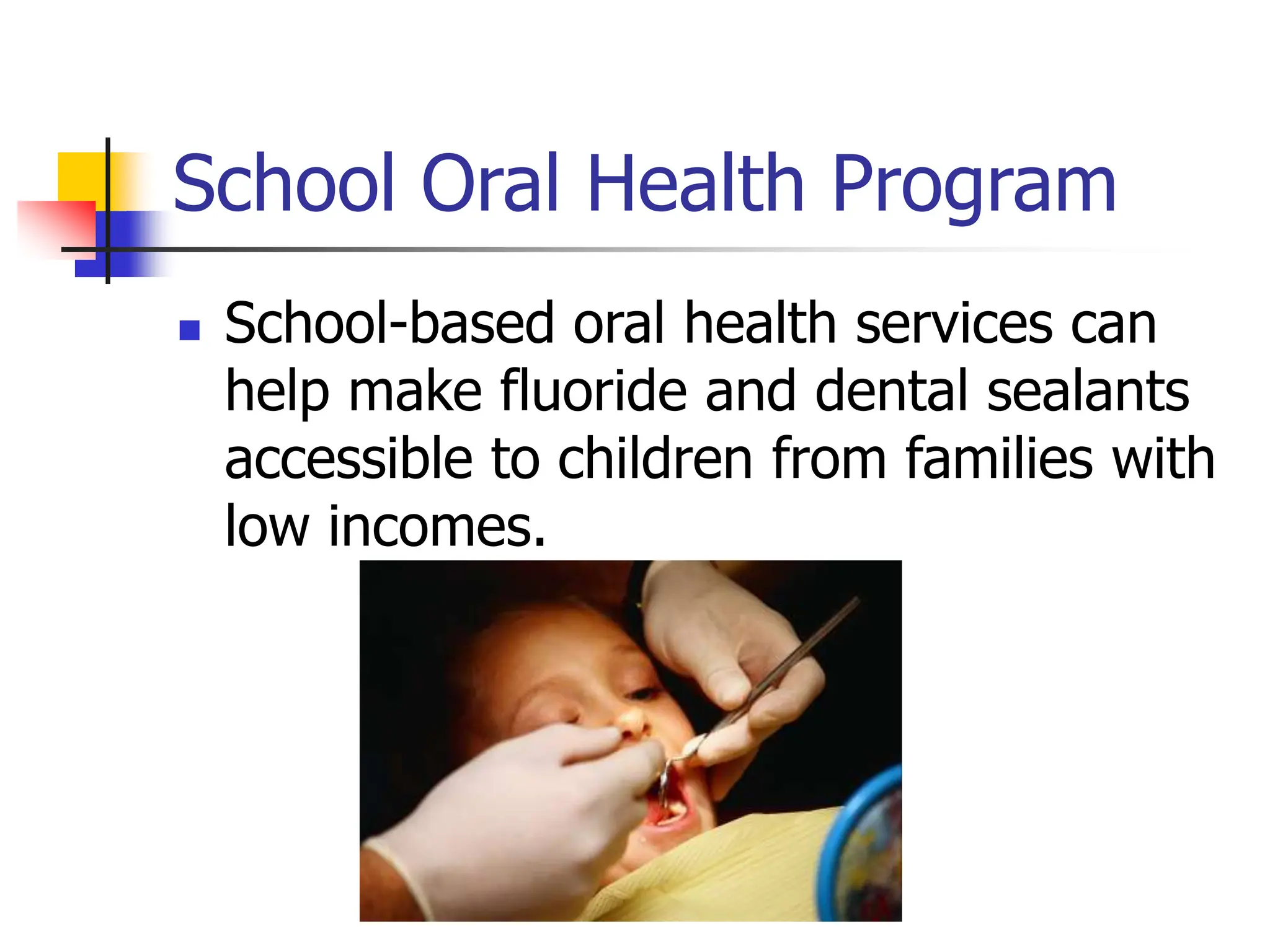
 School-based oral health services can
help make fluoride and dental sealants
accessible to children from families with
low incomes.
School Oral Health Program
 Fluoride is a natural compound that is
found in groundwater, soil and plants.
 Fluoride benefits can be obtained in two
ways.
 Systemically: drinking water and
supplements.
 Topically: mouthrinses, gels and
varnishes.
School Oral Health Program
 Fluoride is “nature’s way of preventing
tooth decay.”
 Fluoride protects teeth from tooth
decay and help remineralize weak areas
of enamel.
School Oral Health Program
The importance of fluoride mouthrinse:
 It is an effective way to reduce decay at
no cost to parents.
 The cost per child is about $2.50 for the
school year.
 Fluoride has been proven to be a safe,
inexpensive way of preventing tooth
decay.
School Oral Health Program
 Is fluoride mouth rinse safe?
 Yes! The Food and Drug Administration
has approved the 0.2% weekly sodium
fluoride mouthrinse as a safe and
effective means of preventing tooth
decay.
School Oral Health Program
 The weekly fluoride mouth rinse can only be
administered with parental or guardian
permission.
 The weekly fluoride rinse is always done
under direct supervision of someone who has
had fluoride training.
 The fluoride mouth rinse is not swallowed.
 There are no known adverse effects
associated with this procedure.
Access and Barriers to Dental
Services
 Lack of or insufficient dental insurance
 Limited income
 Lack of transportation
 Lack of education of the importance of oral
health
 Low dentist to patient ratio (geographic)
 Dentists not participating with MaineCare
 Low MaineCare reimbursement rates for
dental services; broken appointments
School Oral Health Program
 Oral health education is a key
component in the School Oral Health
Program
 The Oral Health Program will assist
school administrators in proper
curriculum, activities and technical
assistance
School Oral Health Program
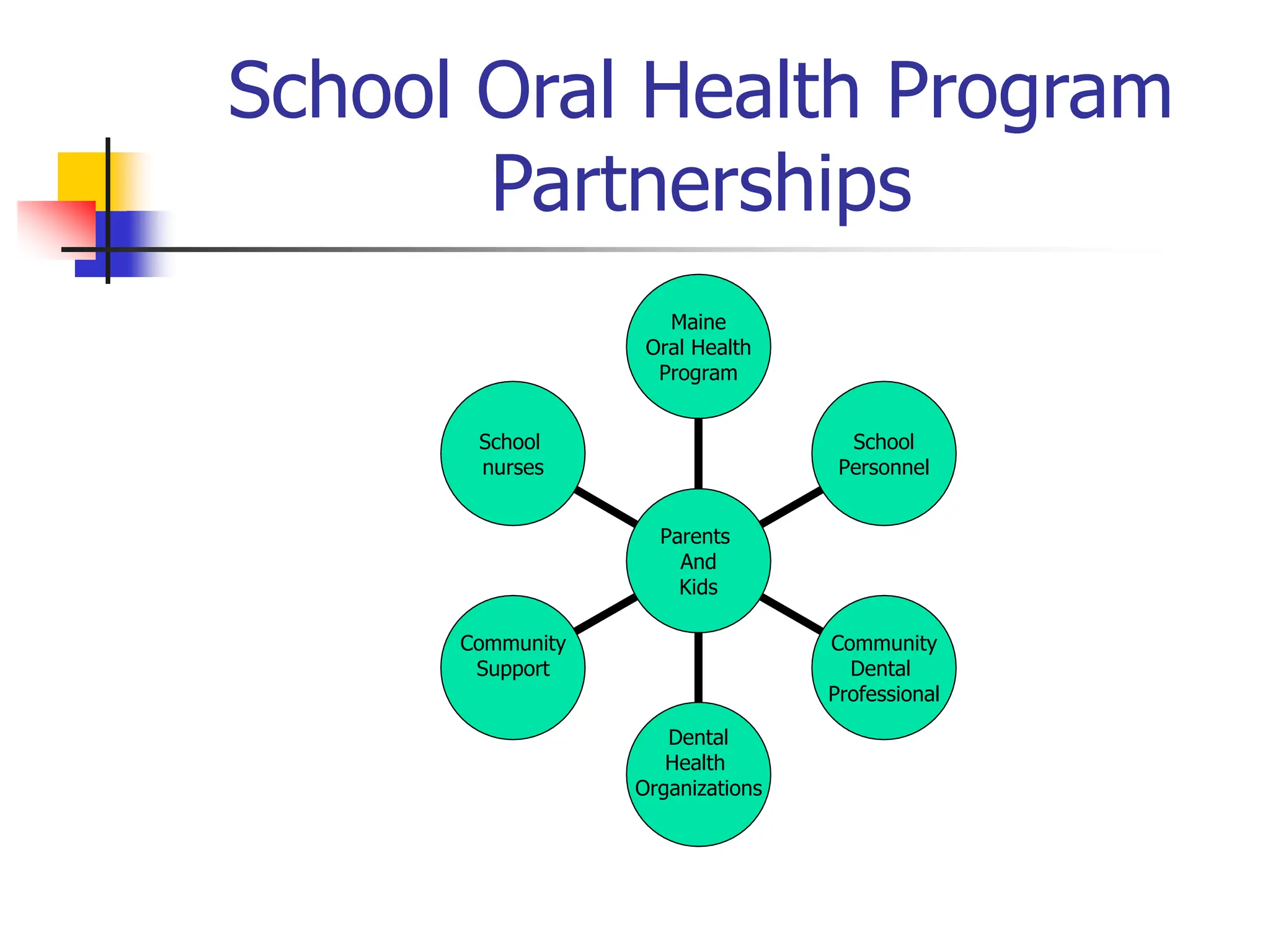
Partnerships
School
nurses
Community
Support
Dental
Health
Organizations
Community
Dental
Professional
School
Personnel
Maine
Oral Health
Program
Parents
And
Kids
School Oral Health Program
Partnerships
 The Oral Health Program needs support
from school personnel, administrators
and educators to promote the program.
 School nurses work very hard
implementing oral health into their daily
schedules.
School Oral Health Program
“ You cannot educate a child who is not
healthy, and you cannot keep a child
healthy who is not educated.”
~ Jocelyn Elders, Former US Surgeon
General
School Oral Health Program
For more information on Oral Health
please contact
The Maine Oral Health Program
Maine CDC/ DHHS
287-3121
School Oral Health Program
References
 Office of Disease Prevention and Promotion. 2000. Healthy People 2010. In
office of Disease Prevention and Health Promotion. [Web site]. Cited January
15,2001; available at
www.healthypeople.gov/Document/HTML/Volume2/21Oral.htm.
 U.S General Accounting Office.2000.Oral Health:2000Dental Disease is a Chronic
Problem Among Low- Income and Vulnerable Populations. Washington, DC:U.S
General Accounting Office.
 Ramage S.2000. The impact of dental disease on school performance: The view
of the school nurse. Journal of the Southeastern Society of Pediatric
Dentistry6(2):26
 Schechter N.2000. The impact of acute and chronic dental pain on child
development. Journal of the Southeastern Society of Pediatric Dentistry6(2):16.
 Peterson J, Niessen L, Nana Lopez GM.1999. Texas public school nurses’
assessment of children’s oral health status. Journal of School Health69(2):69-72.
School Oral Health Program
References
 Center on Hunger, Poverty, and Nutrition Policy.1994.Statement on the link
between Nutrition and Cognitive Development in Children. Medford, MA:Tufts
University, Center on Hunger, Poverty, and Nutrition Policy.
 National Institutes of Dental and Craniofacial Research 2000. The Surgeon
General’s Report on Oral Health. In National Institute of Dental and Craniofacial
Research [Website}. Cited January 15,2001; available at
www.nidcr.nih.gov/sgr/oralhealth.asp.
 Photo Credits:
www.ada.org
www.googlefreetooth pictures.com

school-dental health program.ppt

  • 1.
    School Oral HealthProgram Maine CDC/DHHS Oral Health Program Nicole M. Breton RDH, BS
  • 2.
    School Oral HealthProgram A Healthy Smile For ME
  • 3.
    School Oral HealthProgram  Tooth decay is the most common chronic childhood disease.  5 times more common than asthma.  7 times more common than hayfever.  52 million school hours missed annually because of oral problems
  • 4.
    Surgeon General’s Report 2000 50% of decay in low income children goes untreated.
  • 5.
    School Oral HealthProgram “What amounts to a silent epidemic of dental and oral diseases is affecting some population groups. This burden of disease restricts activities in schools, work and home and often significantly diminishes the quality of life.” Surgeon General David Satcher, PH.D, M.D
  • 6.
    School Oral HealthProgram  Poor oral health and untreated infections can have a significant impact on school aged children.  Children have trouble eating and sleeping, and can experience speech impairments, trouble focusing and low self esteem  Dental disease can greatly reduce a child’s capacity to succeed in the educational environment.
  • 7.
    School Oral HealthProgram Prevention and Education  Children are often unable to verbalize their dental pain  Teachers may notice a child who is having difficulty attending to tasks or who is demonstrating the effects of pain (anxiety, fatigue, irritability, depression and withdrawal from normal activities)
  • 8.
    School Oral HealthProgram  School nurses report a range of oral health problems such as dental caries, gingival disease, malocclusion (poor bite), loose teeth and oral trauma
  • 9.
    School Oral HealthProgram  Children who are missing teeth have to limit their food choices because of chewing problems, which may result in nutritionally inadequate diets  Inadequate nutrition during childhood can have a detrimental effect on children’s cognitive development and productivity in adulthood
  • 10.
    School Oral HealthProgram  The Maine Oral Health Program supports oral health promotion and dental disease prevention in school- based programs for students in kindergarten through sixth grade.
  • 11.
    School Oral HealthProgram  The Maine Oral Health Programs currently funds 240 schools throughout Maine with small grants to promote oral health education and provide a weekly fluoride mouthrinse.  Some schools also receive additional grant money to provide dental sealants to second graders.
  • 12.
    School Oral HealthProgram  School-based oral health services can help make fluoride and dental sealants accessible to children from families with low incomes.
  • 13.
    School Oral HealthProgram  Fluoride is a natural compound that is found in groundwater, soil and plants.  Fluoride benefits can be obtained in two ways.  Systemically: drinking water and supplements.  Topically: mouthrinses, gels and varnishes.
  • 14.
    School Oral HealthProgram  Fluoride is “nature’s way of preventing tooth decay.”  Fluoride protects teeth from tooth decay and help remineralize weak areas of enamel.
  • 15.
  • 16.
    School Oral HealthProgram The importance of fluoride mouthrinse:  It is an effective way to reduce decay at no cost to parents.  The cost per child is about $2.50 for the school year.  Fluoride has been proven to be a safe, inexpensive way of preventing tooth decay.
  • 17.
    School Oral HealthProgram  Is fluoride mouth rinse safe?  Yes! The Food and Drug Administration has approved the 0.2% weekly sodium fluoride mouthrinse as a safe and effective means of preventing tooth decay.
  • 18.
    School Oral HealthProgram  The weekly fluoride mouth rinse can only be administered with parental or guardian permission.  The weekly fluoride rinse is always done under direct supervision of someone who has had fluoride training.  The fluoride mouth rinse is not swallowed.  There are no known adverse effects associated with this procedure.
  • 19.
    Access and Barriersto Dental Services  Lack of or insufficient dental insurance  Limited income  Lack of transportation  Lack of education of the importance of oral health  Low dentist to patient ratio (geographic)  Dentists not participating with MaineCare  Low MaineCare reimbursement rates for dental services; broken appointments
  • 20.
    School Oral HealthProgram  Oral health education is a key component in the School Oral Health Program  The Oral Health Program will assist school administrators in proper curriculum, activities and technical assistance
  • 21.
    School Oral HealthProgram Partnerships School nurses Community Support Dental Health Organizations Community Dental Professional School Personnel Maine Oral Health Program Parents And Kids
  • 22.
    School Oral HealthProgram Partnerships  The Oral Health Program needs support from school personnel, administrators and educators to promote the program.  School nurses work very hard implementing oral health into their daily schedules.
  • 23.
    School Oral HealthProgram “ You cannot educate a child who is not healthy, and you cannot keep a child healthy who is not educated.” ~ Jocelyn Elders, Former US Surgeon General
  • 24.
    School Oral HealthProgram For more information on Oral Health please contact The Maine Oral Health Program Maine CDC/ DHHS 287-3121
  • 25.
    School Oral HealthProgram References  Office of Disease Prevention and Promotion. 2000. Healthy People 2010. In office of Disease Prevention and Health Promotion. [Web site]. Cited January 15,2001; available at www.healthypeople.gov/Document/HTML/Volume2/21Oral.htm.  U.S General Accounting Office.2000.Oral Health:2000Dental Disease is a Chronic Problem Among Low- Income and Vulnerable Populations. Washington, DC:U.S General Accounting Office.  Ramage S.2000. The impact of dental disease on school performance: The view of the school nurse. Journal of the Southeastern Society of Pediatric Dentistry6(2):26  Schechter N.2000. The impact of acute and chronic dental pain on child development. Journal of the Southeastern Society of Pediatric Dentistry6(2):16.  Peterson J, Niessen L, Nana Lopez GM.1999. Texas public school nurses’ assessment of children’s oral health status. Journal of School Health69(2):69-72.
  • 26.
    School Oral HealthProgram References  Center on Hunger, Poverty, and Nutrition Policy.1994.Statement on the link between Nutrition and Cognitive Development in Children. Medford, MA:Tufts University, Center on Hunger, Poverty, and Nutrition Policy.  National Institutes of Dental and Craniofacial Research 2000. The Surgeon General’s Report on Oral Health. In National Institute of Dental and Craniofacial Research [Website}. Cited January 15,2001; available at www.nidcr.nih.gov/sgr/oralhealth.asp.  Photo Credits: www.ada.org www.googlefreetooth pictures.com