
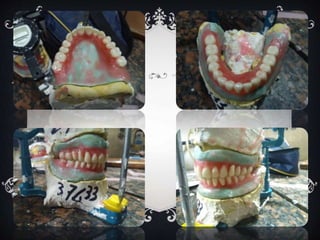

CASE REPORT
Complete denture
INTRODUCTION
 Patients with complete edentulous for both maxillary and
mandibular arches are very common, and refer to clinic to
restore the function (mastication, speech) and esthetics.
 The vertical dimension is reduced due to loss of teeth and
the lips and cheeks are not supported.
CASE PRESENTATION
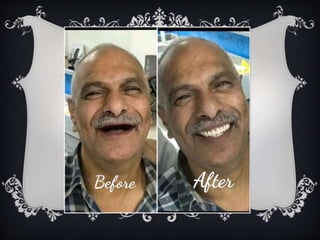
 Edentulous patient 60 yrs. old referred to clinic
complaining that he does not have teeth and he finds
difficulty to masticate the food, and speech pronounce, bad
esthetic and psychologically effected .
 He asked to solve those problems with the suitable
treatment, so after examination we found that the possible
treatment is construction of complete denture.
DIAGNOSIS AND TREATMENT PLAN
 By asking the pt. about his history we found he is diabetic
patient.
 Extra oral examination shows that his vertical dimension is low
due to loss of teeth with no other findings.
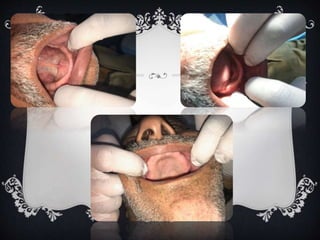
 Intra oral examination shows well developed ridges with no
excessive resorption in both upper and lower arches, proper depth
of vestibule which is needed for retention and stability.
 Maxillary tuberosity is slightly large so there is no need for
surgical intervention but just relieving from denture.
CLINICAL PROCEDURES
1- Primary impression:
Using suitable size of stock tray (upper size 2 with no
modification by wax and lower size 3 with adding 3 mm of
wax over all borders).
Impression material:
Irreversible hydrocolloid impression material (ALGINATE).
CLINICAL PROCEDURES
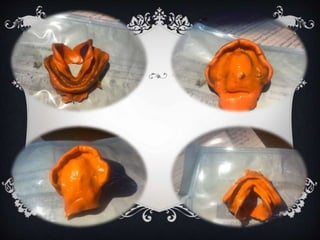
2-Final impression:
By special tray.
Using rubber base.
Border molding is done by using medium bodied rubber base, and
the secondary impression is done by light bodied rubber base on
overall.
CLINICAL PROCEDURES
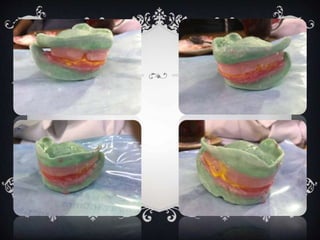
 After sending the 2nd impression to the lab and the occlusal rims is
made, the next step is bite registration.
 Bite registration is done firstly by inserting the upper occlusal rim
only and see parallelism of anterior segment with inter-pupillary line
and the posterior segment with ala-tragus line, and seeing 2mm of wax
appear while the lip is relaxed, and instruct the patient to say “m”
several times and measure the length from the tip of the nose to tip of
the chin 3 or 4 times to record vertical dimension of rest.
CLINICAL PROCEDURES
 The second step in bite registration is inserting the lower occlusal rim in
patient’s mouth while the upper is persist in mouth, then remove from lower
wax till the both occlusal rims are fitted together, then measure from tip of
nose to tip of chin to record the vertical dimension of occlusion.
 VDO must be less than VDR by 2-4 mm.
 Last step is making a V-shaped notch on upper rim in premolar-molar
area in both sides and then add 2-4 mm of soft wax on lower rim then instruct
the patient to bite properly. In all these steps the pt. must be relaxed and in
upright position.
CLINICAL PROCEDURES
 After bite recording the next step is try-in stage:
 In try-in stage you should check the retention and stability
and extension of borders (it should be 2mm shorter than the
full depth of vestibules).
 Checking the occlusion is most important and done by
selective grinding to relieve the any premature contact.
CLINICAL PROCEDURES
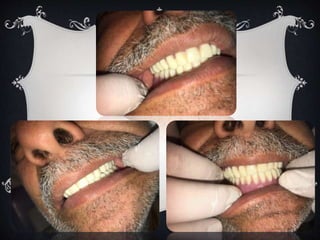
 After try-in, the last stage is delivery:
 In delivery you should check retention, stability,
support, extension of borders and occlusion.
 In occlusion the teeth must be in contact in both centric
and eccentric relation to held the denture in position.
 Selective grinding is done to remove any premature
contacts.
CLINICAL PROCEDURES
Post insertion care:
After delivery you should instruct the patient to eat soft
food and remove the denture during night and keep it
in water to allow tissues regain and wash it and instruct
the patient to read a book loudly to improve letters
specially the letters “S,F,V,SH and TH”.
THANK YOU

Case presentation case report complete denture

  • 1.
  • 2.
    INTRODUCTION  Patients withcomplete edentulous for both maxillary and mandibular arches are very common, and refer to clinic to restore the function (mastication, speech) and esthetics.  The vertical dimension is reduced due to loss of teeth and the lips and cheeks are not supported.
  • 3.
  • 4.
     Edentulous patient60 yrs. old referred to clinic complaining that he does not have teeth and he finds difficulty to masticate the food, and speech pronounce, bad esthetic and psychologically effected .  He asked to solve those problems with the suitable treatment, so after examination we found that the possible treatment is construction of complete denture.
  • 5.
    DIAGNOSIS AND TREATMENTPLAN  By asking the pt. about his history we found he is diabetic patient.  Extra oral examination shows that his vertical dimension is low due to loss of teeth with no other findings.  Intra oral examination shows well developed ridges with no excessive resorption in both upper and lower arches, proper depth of vestibule which is needed for retention and stability.  Maxillary tuberosity is slightly large so there is no need for surgical intervention but just relieving from denture.
  • 7.
    CLINICAL PROCEDURES 1- Primaryimpression: Using suitable size of stock tray (upper size 2 with no modification by wax and lower size 3 with adding 3 mm of wax over all borders). Impression material: Irreversible hydrocolloid impression material (ALGINATE).
  • 8.
    CLINICAL PROCEDURES 2-Final impression: Byspecial tray. Using rubber base. Border molding is done by using medium bodied rubber base, and the secondary impression is done by light bodied rubber base on overall.
  • 10.
    CLINICAL PROCEDURES  Aftersending the 2nd impression to the lab and the occlusal rims is made, the next step is bite registration.  Bite registration is done firstly by inserting the upper occlusal rim only and see parallelism of anterior segment with inter-pupillary line and the posterior segment with ala-tragus line, and seeing 2mm of wax appear while the lip is relaxed, and instruct the patient to say “m” several times and measure the length from the tip of the nose to tip of the chin 3 or 4 times to record vertical dimension of rest.
  • 11.
    CLINICAL PROCEDURES  Thesecond step in bite registration is inserting the lower occlusal rim in patient’s mouth while the upper is persist in mouth, then remove from lower wax till the both occlusal rims are fitted together, then measure from tip of nose to tip of chin to record the vertical dimension of occlusion.  VDO must be less than VDR by 2-4 mm.  Last step is making a V-shaped notch on upper rim in premolar-molar area in both sides and then add 2-4 mm of soft wax on lower rim then instruct the patient to bite properly. In all these steps the pt. must be relaxed and in upright position.
  • 13.
    CLINICAL PROCEDURES  Afterbite recording the next step is try-in stage:  In try-in stage you should check the retention and stability and extension of borders (it should be 2mm shorter than the full depth of vestibules).  Checking the occlusion is most important and done by selective grinding to relieve the any premature contact.
  • 15.
    CLINICAL PROCEDURES  Aftertry-in, the last stage is delivery:  In delivery you should check retention, stability, support, extension of borders and occlusion.  In occlusion the teeth must be in contact in both centric and eccentric relation to held the denture in position.  Selective grinding is done to remove any premature contacts.
  • 16.
    CLINICAL PROCEDURES Post insertioncare: After delivery you should instruct the patient to eat soft food and remove the denture during night and keep it in water to allow tissues regain and wash it and instruct the patient to read a book loudly to improve letters specially the letters “S,F,V,SH and TH”.
  • 20.