Provided by: Dr. Mitra Mesgar
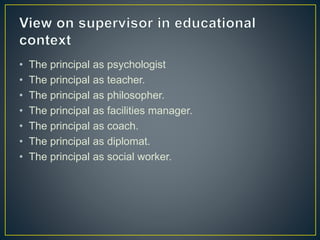
• The principal as psychologist
• The principal as teacher.
• The principal as philosopher.
• The principal as facilities manager.
• The principal as coach.
• The principal as diplomat.
• The principal as social worker.
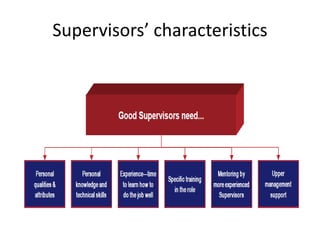
Supervisors’ characteristics
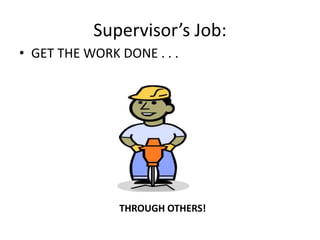
Supervisor’s Job:
• GET THE WORK DONE . . .
THROUGH OTHERS!
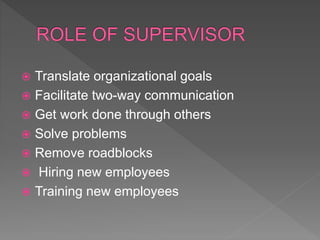
 Translate organizational goals
 Facilitate two-way communication
 Get work done through others
 Solve problems
 Remove roadblocks
 Hiring new employees
 Training new employees
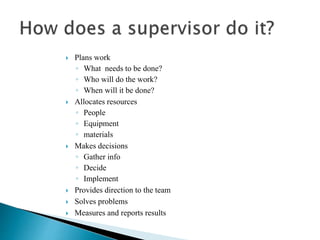
 Plans work
◦ What needs to be done?
◦ Who will do the work?
◦ When will it be done?
 Allocates resources
◦ People
◦ Equipment
◦ materials
 Makes decisions
◦ Gather info
◦ Decide
◦ Implement
 Provides direction to the team
 Solves problems
 Measures and reports results

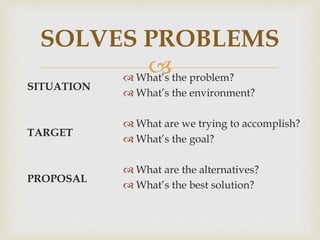
SOLVES PROBLEMS
SITUATION
TARGET
PROPOSAL
 What’s the problem?
 What’s the environment?
 What are we trying to accomplish?
 What’s the goal?
 What are the alternatives?
 What’s the best solution?
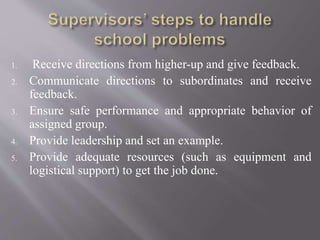
1. Receive directions from higher-up and give feedback.
2. Communicate directions to subordinates and receive
feedback.
3. Ensure safe performance and appropriate behavior of
assigned group.
4. Provide leadership and set an example.
5. Provide adequate resources (such as equipment and
logistical support) to get the job done.
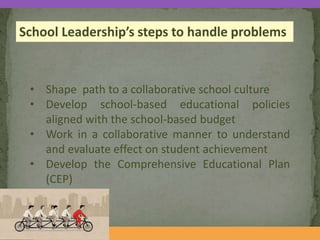
School Leadership’s steps to handle problems
• Shape path to a collaborative school culture
• Develop school-based educational policies
aligned with the school-based budget
• Work in a collaborative manner to understand
and evaluate effect on student achievement
• Develop the Comprehensive Educational Plan
(CEP)
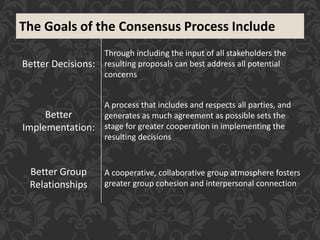
The Goals of the Consensus Process Include
Better Decisions:
Through including the input of all stakeholders the
resulting proposals can best address all potential
concerns
Better
Implementation:
A process that includes and respects all parties, and
generates as much agreement as possible sets the
stage for greater cooperation in implementing the
resulting decisions
Better Group
Relationships
A cooperative, collaborative group atmosphere fosters
greater group cohesion and interpersonal connection
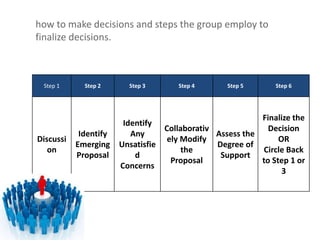
how to make decisions and steps the group employ to
finalize decisions.
Step 1 Step 2 Step 3 Step 4 Step 5 Step 6
Discussi
on
Identify
Emerging
Proposal
Identify
Any
Unsatisfie
d
Concerns
Collaborativ
ely Modify
the
Proposal
Assess the
Degree of
Support
Finalize the
Decision
OR
Circle Back
to Step 1 or
3
*
SUPPORTING A GRIEVING EMPLOYEE
 How managers can support a grieving employee:
Your caring support can set an example for other employees. It can be
helpful during the healing process.
 Stay in touch with your employee, who has not yet returned to
work. Connection with work may help the employee maintain some
sense of their normal daily life.
 Acknowledge the loss. “I am sorry for your loss.” “I can’t
imagine how difficult this is for you.” Avoid saying “This is God’s
will” “I know just how you feel” “You can always get another dog,
pet or child” “God never gives us more than we can handle.” It is
important to listen and take your cue from the grieving employee.
Expect to hear repetition of the story.
*Supervisor’s activity
Managers need to be aware of the delicate balance between, the
employee’s need for support, the need to maintain a productive
work environment, and the manager’s personal grief reaction.
 Educate oneself about the variety of events that can trigger grief.
Some of these include the loss of a job, a family member, death of a
pet, miscarriage, divorce, critical health concerns, a major disaster
or any significant life transition.

School leadership

  • 1.
    Provided by: Dr.Mitra Mesgar
  • 2.
    • The principalas psychologist • The principal as teacher. • The principal as philosopher. • The principal as facilities manager. • The principal as coach. • The principal as diplomat. • The principal as social worker.
  • 3.
  • 4.
    Supervisor’s Job: • GETTHE WORK DONE . . . THROUGH OTHERS!
  • 5.
     Translate organizationalgoals  Facilitate two-way communication  Get work done through others  Solve problems  Remove roadblocks  Hiring new employees  Training new employees
  • 6.
     Plans work ◦What needs to be done? ◦ Who will do the work? ◦ When will it be done?  Allocates resources ◦ People ◦ Equipment ◦ materials  Makes decisions ◦ Gather info ◦ Decide ◦ Implement  Provides direction to the team  Solves problems  Measures and reports results
  • 7.
     SOLVES PROBLEMS SITUATION TARGET PROPOSAL  What’sthe problem?  What’s the environment?  What are we trying to accomplish?  What’s the goal?  What are the alternatives?  What’s the best solution?
  • 8.
    1. Receive directionsfrom higher-up and give feedback. 2. Communicate directions to subordinates and receive feedback. 3. Ensure safe performance and appropriate behavior of assigned group. 4. Provide leadership and set an example. 5. Provide adequate resources (such as equipment and logistical support) to get the job done.
  • 9.
    School Leadership’s stepsto handle problems • Shape path to a collaborative school culture • Develop school-based educational policies aligned with the school-based budget • Work in a collaborative manner to understand and evaluate effect on student achievement • Develop the Comprehensive Educational Plan (CEP)
  • 10.
    The Goals ofthe Consensus Process Include Better Decisions: Through including the input of all stakeholders the resulting proposals can best address all potential concerns Better Implementation: A process that includes and respects all parties, and generates as much agreement as possible sets the stage for greater cooperation in implementing the resulting decisions Better Group Relationships A cooperative, collaborative group atmosphere fosters greater group cohesion and interpersonal connection
  • 11.
    how to makedecisions and steps the group employ to finalize decisions. Step 1 Step 2 Step 3 Step 4 Step 5 Step 6 Discussi on Identify Emerging Proposal Identify Any Unsatisfie d Concerns Collaborativ ely Modify the Proposal Assess the Degree of Support Finalize the Decision OR Circle Back to Step 1 or 3
  • 12.
    * SUPPORTING A GRIEVINGEMPLOYEE  How managers can support a grieving employee: Your caring support can set an example for other employees. It can be helpful during the healing process.  Stay in touch with your employee, who has not yet returned to work. Connection with work may help the employee maintain some sense of their normal daily life.  Acknowledge the loss. “I am sorry for your loss.” “I can’t imagine how difficult this is for you.” Avoid saying “This is God’s will” “I know just how you feel” “You can always get another dog, pet or child” “God never gives us more than we can handle.” It is important to listen and take your cue from the grieving employee. Expect to hear repetition of the story.
  • 13.
    *Supervisor’s activity Managers needto be aware of the delicate balance between, the employee’s need for support, the need to maintain a productive work environment, and the manager’s personal grief reaction.  Educate oneself about the variety of events that can trigger grief. Some of these include the loss of a job, a family member, death of a pet, miscarriage, divorce, critical health concerns, a major disaster or any significant life transition.