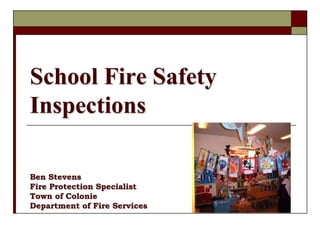
School Fire Safety
Inspections

Ben Stevens
Fire Protection Specialist
Town of Colonie
Department of Fire Services
Objective
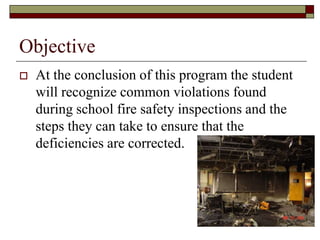
   At the conclusion of this program the student
    will recognize common violations found
    during school fire safety inspections and the
    steps they can take to ensure that the
    deficiencies are corrected.
Fire Safety Inspections
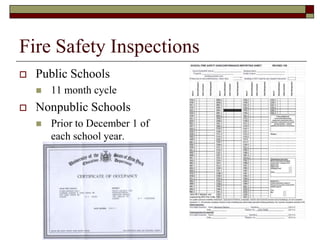
   Required annually by NYSED for school to
    obtain & maintain a Certificate of Occupancy
       8 NYCRR 155.8 Fire and building safety
        inspections
   Conducted by code enforcement official or
    code compliance technician certified by State
    Fire Administrator
       State Ed will not allow school district employees who are
        codes certified to conduct inspections in their own district
Fire Safety Inspections
   Public Schools
       11 month cycle
   Nonpublic Schools
       Prior to December 1 of
        each school year.
Authority Having Jurisdiction
   NYSED is the AHJ for public schools
       Any questions or concerns should be directed to
        the Education Department’s Office of Facilities
        Planning Fire Safety Unit
           518-474-3906


   Private Schools are the local code
    enforcement officers responsibility
Fires in schools
   Lake View School
       Collinwood (Cleveland) Oh.
       March 4, 1908
       172 students, 2 teachers and 1 rescuer died
   New London Texas
       March 8, 1937
       Explosion & fire in school due to
        gas leak in heating system
       500 people mostly students died
Fires in schools
   Our Lady of Angels School
       Chicago Il.
       December 1, 1958
       92 students and 3 nuns died
Fires in schools
   In the United States, an average of 6,650 structure
    fires occur annually in educational institutions where
    students attend during the day only.
   These fires are responsible for approximately 90
    injuries, fewer than 5 fatalities, and $90 million
    dollars in property loss.
   In New York State during the period 2000 to 2004,
    six public school buildings sustained fire damage in
    excess of $27 million dollars.
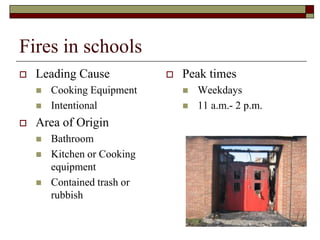
Fires in schools
   Leading Cause               Peak times
       Cooking Equipment           Weekdays
       Intentional                 11 a.m.- 2 p.m.
   Area of Origin
       Bathroom
       Kitchen or Cooking
        equipment
       Contained trash or
        rubbish
Fire chief: Locked doors trapped
          students during blaze
   While some of the 20 to 30 boys managed to flee the dormitories
    without incident, many were left banging on locked or otherwise
    obstructed doors near the school entrance. One door had a broken
    push bar; one was padlocked at the base; and two other doors were
    locked from the outside. The boys banged on the two sets of
    double doors until a man with a key appeared, unlocked a door and
    let the students out.

   The fire chief, however, stood behind his comments that his
    firefighters found students pounding on the door trying to escape
    the burning two-story building, which includes dormitories, and
    that the locked doors endangered not only the students but also the
    firefighters responding to what's being called arson.
Lack of reporting
   Only a small percentage of fire incidents in
    schools are reported to the fire department.
   EVERY school fire shall be reported to the
    fire department no matter how small.
               FC401.3 Emergency forces notification. In the event
                an unwanted fire occurs on a property, the owner or
                occupant shall immediately report such condition to the
                fire department. Building employees and tenants shall
                implement the appropriate emergency plans and
                procedures. No person shall, by verbal or written
                directive, require any delay in the reporting of a fire to
                the fire department.
Blocked Emergency EXIT doors &
Windows


   Emergency rescue                FC1027.2 Reliability. Required
    windows are free of              exit accesses, exits or exit
                                     discharges shall be continuously
    obstructing bars, screens,       maintained free from
    grills or classroom              obstructions or impediments to
    equipment….                      full instant use in the case of fire
                                     or other emergency…
Camouflaged Emergency EXIT doors


   FC1027.4 Furnishings and decorations. Furnishings, decorations or
    other objects shall not be placed so as to obstruct exits, access thereto,
    egress therefrom, or visibility thereof. Hangings and draperies shall not be
    placed over exit doors or otherwise be located to conceal or obstruct an
    exit. Mirrors shall not be placed on exit doors. Mirrors shall not be placed
    in or adjacent to any exit in such a manner as to confuse the direction of
    exit.
Electromagnetic Locks
                    Not permitted by State
                     Education Dept.
                        Electric strike with
                         mechanical override is
                         permitted.
Snow piled behind
Emergency EXIT doors
             FC1027.3 Obstructions.
              A means of egress shall
              be free from obstructions
              that would prevent its
              use, including the
              accumulation of snow
              and ice.
Combustible storage in hallways


   Storage of teacher supplies not permitted outside of
    classrooms.
   Only students’ personal belongings are allowed in
    cubbies.
   Waste containers not permitted in exit corridors or
    stairway landings.
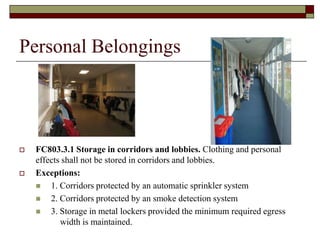
Personal Belongings


   FC803.3.1 Storage in corridors and lobbies. Clothing and personal
    effects shall not be stored in corridors and lobbies.
   Exceptions:
       1. Corridors protected by an automatic sprinkler system
       2. Corridors protected by an smoke detection system
       3. Storage in metal lockers provided the minimum required egress
           width is maintained.
Combustible artwork in hallways
   No More than 20% of wall area
       FCNYS 803.3.2
Items placed in hallways obstructing
egress


                FC1027.4 Furnishings and decorations.
                Furnishings, decorations or other objects shall
                not be placed so as to obstruct exits, access
                thereto, egress there from, or visibility thereof.
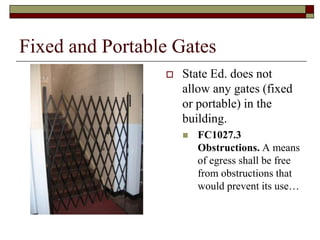
Fixed and Portable Gates
                    State Ed. does not
                     allow any gates (fixed
                     or portable) in the
                     building.
                        FC1027.3
                         Obstructions. A means
                         of egress shall be free
                         from obstructions that
                         would prevent its use…
Fixed and Portable Gates
Fire doors wedged open


   Doors with closers are not rendered inoperable by removal of
    the closer or the installation of any non-automatic hold open
    device
       PMC703.2 Opening protectives. Required opening protectives shall
        be maintained in an operative condition. All fire and smokestop doors
        shall be maintained in operable condition. Fire doors and smoke
        barrier doors shall not be blocked or obstructed or otherwise made
        inoperable.
Extension cords & Multi-plug
adapters
   FCNYS 605.4 & 605.5
       Allowed with restrictions


                             Town of Colonie
                        Department of Fire Services
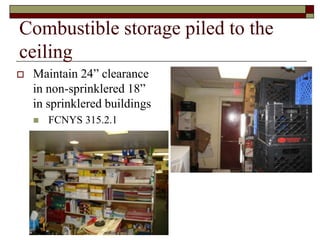
Combustible storage piled to the
ceiling
   Maintain 24” clearance
    in non-sprinklered 18”
    in sprinklered buildings
       FCNYS 315.2.1
Fire Alarm Systems


   FC901.6 Inspection, testing and
    maintenance. Fire detection, alarm and
    extinguishing systems shall be maintained in
    an operative condition at all times, and shall
    be replaced or repaired where defective.
Fueled Equipment
                      FC313.1 Fueled
                       equipment. Fueled
                       equipment, including
                       but not limited to
                       motorcycles, mopeds,
                       lawn-care equipment
                       and portable cooking
                       equipment, shall not be
                       stored, operated or
                       repaired within a
                       building.
Orderly storage in building
                                                 Storage in storerooms
                                                  and classroom areas is
                                                  orderly and restricted
                                                  to items of obvious
                                                  value and usefulness.


FC315.2 Storage in buildings. Storage of
combustible materials in buildings shall be
orderly…
Clearance to Equipment


   FC605.3 Working space and clearance. A
    working space of not less than 30 inches in
    width, 36 inches in depth and 78 inches in
    height shall be provided in front of electrical
    service equipment.
Combustible storage
   Space under stairs and
    landings is not used for
    storage unless
    separated by a 2 hour
    fire rated construction
       FC315.2.2 Means of
        egress. Combustible
        materials shall not be
        stored in exits or exit
        enclosures.
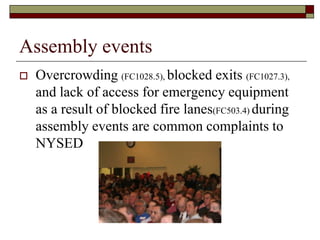
Assembly events
   Overcrowding (FC1028.5), blocked exits (FC1027.3),
    and lack of access for emergency equipment
    as a result of blocked fire lanes(FC503.4) during
    assembly events are common complaints to
    NYSED
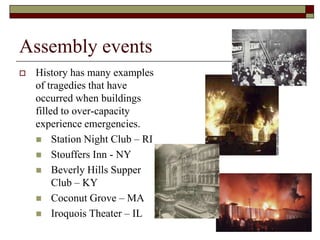
Assembly events
   History has many examples
    of tragedies that have
    occurred when buildings
    filled to over-capacity
    experience emergencies.
     Station Night Club – RI
     Stouffers Inn - NY
     Beverly Hills Supper
         Club – KY
     Coconut Grove – MA
     Iroquois Theater – IL
Assembly events
   The first smell of smoke or the failure of the
    lighting system causes immediate panic.
       Blocked exits and obstructions in corridors such
        as tables and chairs cause confusion and further
        panic.
       Experience has shown that in these terrible
        tragedies, victims rarely die from the actual
        effects of fire, but instead from smoke inhalation
        or trampling during the confusion.
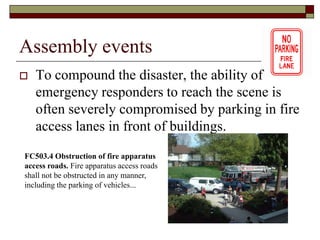
Assembly events
   To compound the disaster, the ability of
    emergency responders to reach the scene is
    often severely compromised by parking in fire
    access lanes in front of buildings.
FC503.4 Obstruction of fire apparatus
access roads. Fire apparatus access roads
shall not be obstructed in any manner,
including the parking of vehicles...
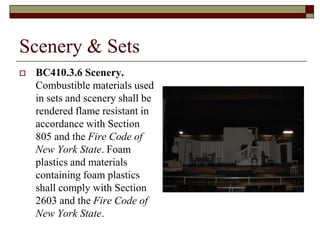
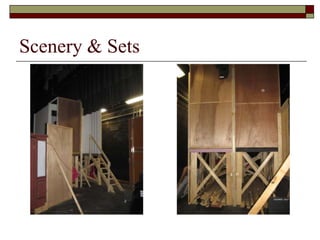
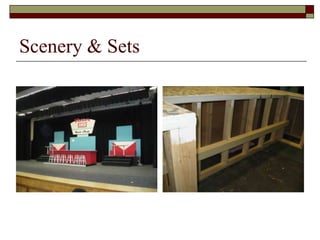
Scenery & Sets
   BC410.3.6 Scenery.
    Combustible materials used
    in sets and scenery shall be
    rendered flame resistant in
    accordance with Section
    805 and the Fire Code of
    New York State. Foam
    plastics and materials
    containing foam plastics
    shall comply with Section
    2603 and the Fire Code of
    New York State.
Scenery & Sets
   Wood Construction      Anything that is
    and flammable           constructed of
    decorations not         flammable materials
    permitted.              must be flame treated.
                               FC805.1 General. In
                                occupancies of Groups A, E, I
                                and R-1 and dormitories in
                                Group R-2, curtains, draperies,
                                hangings and other decorative
                                materials suspended from walls
                                or ceilings shall be flame
                                resistant in accordance with
                                Section 805.2 and NFPA 701 or
                                be noncombustible.
Scenery & Sets
Scenery & Sets
Safe Design & Construction
   The New York State Fire & Building Codes
    contain provisions for the maintenance and
    safe operation of buildings.
   Constructing a safe building does no good if
    the features that provide that safety are
    ignored or intentionally disabled by the
    building occupants.
Safe Design & Construction
   Principals need to understand that the state
    code holds the building operator responsible
    for any violations of the safety provisions of
    the code.
What can you do?
   Ensure school staff knows the school’s fire protection
    system.
       They should be familiar with the type of fire protection systems are in
        the school.
       Know the location of pull stations and fire extinguishers and whether
        you school is protected by fire sprinklers.
What can you do?
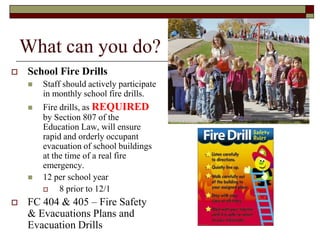
   School Fire Drills
       Staff should actively participate
        in monthly school fire drills.
       Fire drills, as REQUIRED
        by Section 807 of the
        Education Law, will ensure
        rapid and orderly occupant
        evacuation of school buildings
        at the time of a real fire
        emergency.
       12 per school year
            8 prior to 12/1
   FC 404 & 405 – Fire Safety
    & Evacuations Plans and
    Evacuation Drills
What can you do?
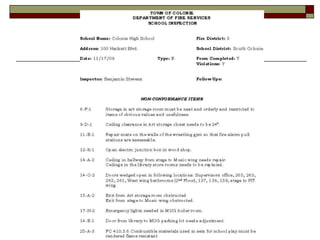
   Provide a list of the violations.
       The report can be used by school staff for self-
        education and self-evaluation on a regular basis to
        identify and correct unsafe conditions which may
        develop at any time.
           Used in this manner, minimum safety standards can
            be met and maintained on a continuing basis.
What can you do?
   Awareness of, and concern for fire and life
    safety
       It must come from the demonstrated attitude of
        the school board and top school administrators.
       When these individuals refuse to tolerate unsafe
        practices or conditions, and insist on a continuing
        program for fire safety in the schools, building
        administrators, their staff and students will follow
        their lead.
What can you do?
   Awareness of, and concern for fire and life
    safety cont.
       A developed concern & daily observance of
        building conditions should help to eliminate
        unsafe conditions such as:
           Exits blocked with furniture or supplies
           Combustible displays in exits
           Poor housekeeping practices
           FC406 Employee Training & Response Procedures
What can you do?
   Awareness of, and concern for fire and life
    safety cont.
       When all building occupants are alert for fire
        hazards, and act to correct hazards as soon as they
        are discovered, a higher level of fire and life
        safety can be maintained throughout the year.
                    FC907.1 FIRE ALARM AND
                    DETECTION SYSTEMS. This section
                    covers the application, installation,
                    performance and maintenance of fire
                    alarm systems and their components in
                    new and existing buildings and structures.
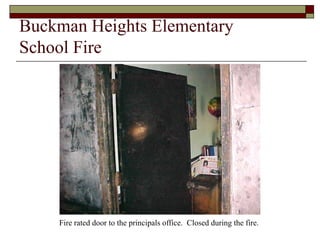
Buckman Heights Elementary
School Fire


    Fire rated door to the principals office. Closed during the fire.
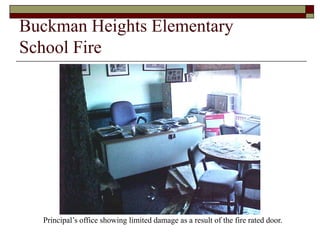
Buckman Heights Elementary
School Fire


  Principal’s office showing limited damage as a result of the fire rated door.
Buckman Heights Elementary
School Fire


  Office supply storage door. Fire rated door left open the night of the fire.
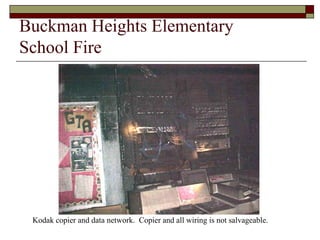
Buckman Heights Elementary
School Fire


 Kodak copier and data network. Copier and all wiring is not salvageable.
School Fire Safety Inspections

School Fire Safety Inspections

  • 1.
    School Fire Safety Inspections BenStevens Fire Protection Specialist Town of Colonie Department of Fire Services
  • 2.
    Objective  At the conclusion of this program the student will recognize common violations found during school fire safety inspections and the steps they can take to ensure that the deficiencies are corrected.
  • 3.
    Fire Safety Inspections  Required annually by NYSED for school to obtain & maintain a Certificate of Occupancy  8 NYCRR 155.8 Fire and building safety inspections  Conducted by code enforcement official or code compliance technician certified by State Fire Administrator  State Ed will not allow school district employees who are codes certified to conduct inspections in their own district
  • 4.
    Fire Safety Inspections  Public Schools  11 month cycle  Nonpublic Schools  Prior to December 1 of each school year.
  • 5.
    Authority Having Jurisdiction  NYSED is the AHJ for public schools  Any questions or concerns should be directed to the Education Department’s Office of Facilities Planning Fire Safety Unit  518-474-3906  Private Schools are the local code enforcement officers responsibility
  • 6.
    Fires in schools  Lake View School  Collinwood (Cleveland) Oh.  March 4, 1908  172 students, 2 teachers and 1 rescuer died  New London Texas  March 8, 1937  Explosion & fire in school due to gas leak in heating system  500 people mostly students died
  • 7.
    Fires in schools  Our Lady of Angels School  Chicago Il.  December 1, 1958  92 students and 3 nuns died
  • 8.
    Fires in schools  In the United States, an average of 6,650 structure fires occur annually in educational institutions where students attend during the day only.  These fires are responsible for approximately 90 injuries, fewer than 5 fatalities, and $90 million dollars in property loss.  In New York State during the period 2000 to 2004, six public school buildings sustained fire damage in excess of $27 million dollars.
  • 9.
    Fires in schools  Leading Cause  Peak times  Cooking Equipment  Weekdays  Intentional  11 a.m.- 2 p.m.  Area of Origin  Bathroom  Kitchen or Cooking equipment  Contained trash or rubbish
  • 10.
    Fire chief: Lockeddoors trapped students during blaze  While some of the 20 to 30 boys managed to flee the dormitories without incident, many were left banging on locked or otherwise obstructed doors near the school entrance. One door had a broken push bar; one was padlocked at the base; and two other doors were locked from the outside. The boys banged on the two sets of double doors until a man with a key appeared, unlocked a door and let the students out.  The fire chief, however, stood behind his comments that his firefighters found students pounding on the door trying to escape the burning two-story building, which includes dormitories, and that the locked doors endangered not only the students but also the firefighters responding to what's being called arson.
  • 11.
    Lack of reporting  Only a small percentage of fire incidents in schools are reported to the fire department.  EVERY school fire shall be reported to the fire department no matter how small.  FC401.3 Emergency forces notification. In the event an unwanted fire occurs on a property, the owner or occupant shall immediately report such condition to the fire department. Building employees and tenants shall implement the appropriate emergency plans and procedures. No person shall, by verbal or written directive, require any delay in the reporting of a fire to the fire department.
  • 12.
    Blocked Emergency EXITdoors & Windows  Emergency rescue  FC1027.2 Reliability. Required windows are free of exit accesses, exits or exit discharges shall be continuously obstructing bars, screens, maintained free from grills or classroom obstructions or impediments to equipment…. full instant use in the case of fire or other emergency…
  • 13.
    Camouflaged Emergency EXITdoors  FC1027.4 Furnishings and decorations. Furnishings, decorations or other objects shall not be placed so as to obstruct exits, access thereto, egress therefrom, or visibility thereof. Hangings and draperies shall not be placed over exit doors or otherwise be located to conceal or obstruct an exit. Mirrors shall not be placed on exit doors. Mirrors shall not be placed in or adjacent to any exit in such a manner as to confuse the direction of exit.
  • 14.
    Electromagnetic Locks  Not permitted by State Education Dept.  Electric strike with mechanical override is permitted.
  • 15.
    Snow piled behind EmergencyEXIT doors  FC1027.3 Obstructions. A means of egress shall be free from obstructions that would prevent its use, including the accumulation of snow and ice.
  • 16.
    Combustible storage inhallways  Storage of teacher supplies not permitted outside of classrooms.  Only students’ personal belongings are allowed in cubbies.  Waste containers not permitted in exit corridors or stairway landings.
  • 17.
    Personal Belongings  FC803.3.1 Storage in corridors and lobbies. Clothing and personal effects shall not be stored in corridors and lobbies.  Exceptions:  1. Corridors protected by an automatic sprinkler system  2. Corridors protected by an smoke detection system  3. Storage in metal lockers provided the minimum required egress width is maintained.
  • 18.
    Combustible artwork inhallways  No More than 20% of wall area  FCNYS 803.3.2
  • 19.
    Items placed inhallways obstructing egress FC1027.4 Furnishings and decorations. Furnishings, decorations or other objects shall not be placed so as to obstruct exits, access thereto, egress there from, or visibility thereof.
  • 20.
    Fixed and PortableGates  State Ed. does not allow any gates (fixed or portable) in the building.  FC1027.3 Obstructions. A means of egress shall be free from obstructions that would prevent its use…
  • 21.
  • 22.
    Fire doors wedgedopen  Doors with closers are not rendered inoperable by removal of the closer or the installation of any non-automatic hold open device  PMC703.2 Opening protectives. Required opening protectives shall be maintained in an operative condition. All fire and smokestop doors shall be maintained in operable condition. Fire doors and smoke barrier doors shall not be blocked or obstructed or otherwise made inoperable.
  • 24.
    Extension cords &Multi-plug adapters  FCNYS 605.4 & 605.5  Allowed with restrictions Town of Colonie Department of Fire Services
  • 25.
    Combustible storage piledto the ceiling  Maintain 24” clearance in non-sprinklered 18” in sprinklered buildings  FCNYS 315.2.1
  • 26.
    Fire Alarm Systems  FC901.6 Inspection, testing and maintenance. Fire detection, alarm and extinguishing systems shall be maintained in an operative condition at all times, and shall be replaced or repaired where defective.
  • 27.
    Fueled Equipment  FC313.1 Fueled equipment. Fueled equipment, including but not limited to motorcycles, mopeds, lawn-care equipment and portable cooking equipment, shall not be stored, operated or repaired within a building.
  • 28.
    Orderly storage inbuilding  Storage in storerooms and classroom areas is orderly and restricted to items of obvious value and usefulness. FC315.2 Storage in buildings. Storage of combustible materials in buildings shall be orderly…
  • 29.
    Clearance to Equipment  FC605.3 Working space and clearance. A working space of not less than 30 inches in width, 36 inches in depth and 78 inches in height shall be provided in front of electrical service equipment.
  • 30.
    Combustible storage  Space under stairs and landings is not used for storage unless separated by a 2 hour fire rated construction  FC315.2.2 Means of egress. Combustible materials shall not be stored in exits or exit enclosures.
  • 31.
    Assembly events  Overcrowding (FC1028.5), blocked exits (FC1027.3), and lack of access for emergency equipment as a result of blocked fire lanes(FC503.4) during assembly events are common complaints to NYSED
  • 32.
    Assembly events  History has many examples of tragedies that have occurred when buildings filled to over-capacity experience emergencies.  Station Night Club – RI  Stouffers Inn - NY  Beverly Hills Supper Club – KY  Coconut Grove – MA  Iroquois Theater – IL
  • 33.
    Assembly events  The first smell of smoke or the failure of the lighting system causes immediate panic.  Blocked exits and obstructions in corridors such as tables and chairs cause confusion and further panic.  Experience has shown that in these terrible tragedies, victims rarely die from the actual effects of fire, but instead from smoke inhalation or trampling during the confusion.
  • 34.
    Assembly events  To compound the disaster, the ability of emergency responders to reach the scene is often severely compromised by parking in fire access lanes in front of buildings. FC503.4 Obstruction of fire apparatus access roads. Fire apparatus access roads shall not be obstructed in any manner, including the parking of vehicles...
  • 35.
    Scenery & Sets  BC410.3.6 Scenery. Combustible materials used in sets and scenery shall be rendered flame resistant in accordance with Section 805 and the Fire Code of New York State. Foam plastics and materials containing foam plastics shall comply with Section 2603 and the Fire Code of New York State.
  • 36.
    Scenery & Sets  Wood Construction  Anything that is and flammable constructed of decorations not flammable materials permitted. must be flame treated.  FC805.1 General. In occupancies of Groups A, E, I and R-1 and dormitories in Group R-2, curtains, draperies, hangings and other decorative materials suspended from walls or ceilings shall be flame resistant in accordance with Section 805.2 and NFPA 701 or be noncombustible.
  • 37.
  • 38.
  • 39.
    Safe Design &Construction  The New York State Fire & Building Codes contain provisions for the maintenance and safe operation of buildings.  Constructing a safe building does no good if the features that provide that safety are ignored or intentionally disabled by the building occupants.
  • 40.
    Safe Design &Construction  Principals need to understand that the state code holds the building operator responsible for any violations of the safety provisions of the code.
  • 41.
    What can youdo?  Ensure school staff knows the school’s fire protection system.  They should be familiar with the type of fire protection systems are in the school.  Know the location of pull stations and fire extinguishers and whether you school is protected by fire sprinklers.
  • 42.
    What can youdo?  School Fire Drills  Staff should actively participate in monthly school fire drills.  Fire drills, as REQUIRED by Section 807 of the Education Law, will ensure rapid and orderly occupant evacuation of school buildings at the time of a real fire emergency.  12 per school year  8 prior to 12/1  FC 404 & 405 – Fire Safety & Evacuations Plans and Evacuation Drills
  • 43.
    What can youdo?  Provide a list of the violations.  The report can be used by school staff for self- education and self-evaluation on a regular basis to identify and correct unsafe conditions which may develop at any time.  Used in this manner, minimum safety standards can be met and maintained on a continuing basis.
  • 45.
    What can youdo?  Awareness of, and concern for fire and life safety  It must come from the demonstrated attitude of the school board and top school administrators.  When these individuals refuse to tolerate unsafe practices or conditions, and insist on a continuing program for fire safety in the schools, building administrators, their staff and students will follow their lead.
  • 46.
    What can youdo?  Awareness of, and concern for fire and life safety cont.  A developed concern & daily observance of building conditions should help to eliminate unsafe conditions such as:  Exits blocked with furniture or supplies  Combustible displays in exits  Poor housekeeping practices  FC406 Employee Training & Response Procedures
  • 47.
    What can youdo?  Awareness of, and concern for fire and life safety cont.  When all building occupants are alert for fire hazards, and act to correct hazards as soon as they are discovered, a higher level of fire and life safety can be maintained throughout the year. FC907.1 FIRE ALARM AND DETECTION SYSTEMS. This section covers the application, installation, performance and maintenance of fire alarm systems and their components in new and existing buildings and structures.
  • 48.
    Buckman Heights Elementary SchoolFire Fire rated door to the principals office. Closed during the fire.
  • 49.
    Buckman Heights Elementary SchoolFire Principal’s office showing limited damage as a result of the fire rated door.
  • 50.
    Buckman Heights Elementary SchoolFire Office supply storage door. Fire rated door left open the night of the fire.
  • 51.
    Buckman Heights Elementary SchoolFire Kodak copier and data network. Copier and all wiring is not salvageable.