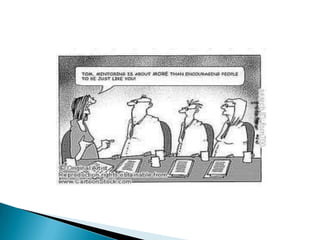
Mentoring is a developmental
partnership through which one person
shares knowledge, skills, information
and perspective to foster the personal
and professional growth of someone
else. We all have a need for insight that
is outside of our normal life and
educational experience. The power of
mentoring is that it creates a one-of-a-
kind opportunity for collaboration, goal
achievement and problem-solving.
Who has a
mentoring
program in place
now?
 Some   do

   Some don’t
Wrong … you
all do!

You just don’t
know it.
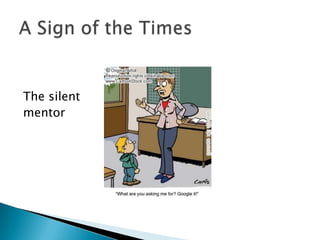
The silent
mentor
GO BERSERK

Meaning: Go crazy or to act with reckless
abandon.

 Origin: Viking warriors were incredibly wild
and ferocious in battle, probably because
they ate hallucinogenic mushrooms in
prebattle ceremonies. They charged their
enemies recklessly, wearing nothing more
than bearskin, which in Old Norse was
pronounced "berserkr" or "bear-sark."
 When a new employee starts and
 receives very little training, he
 needs to go to someone for help
 and guidance, you just better
 hope it’s not the wrong someone.

 Somaybe it’s time to develop a
 sound mentoring program!
Gone are the days when assigning an
informal buddy to mentor a new employee
meant going out to lunch. These buddies
generally had no mentor training and they
were clueless about their responsibilities.
When making every employee successful
as soon as possible became the new norm,
formal organization needs from a mentor
grew. A formal mentor relationship can
jump start the learning curve and help a
new employee succeed.
Use a Formal Mentor Process
With a formal mentor process, a body of
knowledge and other cultural teachings are
an expectation of the mentor relationship.
You will also find that a small component of
the mentor relationship is evaluative in
nature. In the sense that your organization
is expecting employees who mentor to
assess the new employee’s fit within the
culture of the organization, the role
evaluates the new employee.
 Dowe really have time for
 such a formal process?

 Sounds
       pretty time
 consuming!

 Besideswhat kind of
 mentoring do facilities
 staff need?
The Informal Mentor
Employees also seek an informal
mentor for each area of
expertise the employee wishes
to develop or explore. The
person in this mentor role is
purely a teacher with no
assessment responsibilities.
Problem with the informal approach:


Little or no control of who the
employee seeks out and what
kind of advise he gets.
CHARLEY HORSE

Meaning: A muscle cramp.

 Origin: In 1640, Charles I of England
expanded the London police force. The
new recruits were nicknamed "Charleys."
There wasn't enough money to provide the
new police with horses so they patrolled
on foot. They joked that their sore feet and
legs came from riding "Charley's horse."
What options do we
have?
 So   let’s find a happy medium.

 Onethat’s not too time
 consuming or involved.

 KISS   Method.
I prefer a
Formal Method
      of
   Coaching
Coaching employees is not a loss of power; it is
 a process of communicating with and
 engaging employees so problems can be
 solved creatively; it involves recognizing
 people for their individual contributions for
 the good of all. Employee coaching truly
 promotes a productive environment for an
 organization's team members, removing
 traditional barriers and boundaries to
 collaboration. This new environment
 emphasizes both individual and team
 achievement of a common organizational
 goal.
The coaching leadership style builds personal and
team morale, fostering a partnership where
employees feel like they are genuinely contributing
to the success of the organization. It is for this
reason alone that coaching should become a
proactive process for top level managers. Building
authentic relationships and collaborating with
employees -- the essence of coaching -- is an
investment in the long-term health of your
business. Just as important as capital technology
and marketing strategies, coaching will benefit the
organization in countless ways as employees
increase their productivity and the quality of their
efforts.
Coaching employees facilitates effective
communication at all levels of an organization and
provides a channel for feedback and productive
dialogue. People learn how they can personally
support the organization and gain this
understanding in a positive way. Too often,
managers alone define mission statements and
organizational objectives, solve problems, and
dictate solutions in a vacuum. Without being asked
for their input, employees are prone to get lost in
the shuffle. In a coaching environment, leaders and
employees collaborate to do the following:
Coaching does have its challenges; it is not
an automatic technique that works every
time, but a process and an investment.
Using effective coaching techniques,
managers can build a successful
organization based on the strengths and
relationships of one of its every members.
The ability to coach others will truly be one
of the most important top-level leadership
skills of the future. Top-tier managers must
spearhead the effort, becoming beacons of
light for middle-level and front-line leaders
to follow.
Myth #1:

"Custodians and
maintenance workers
don't need professional
development or
mentoring."
Custodian and maintenance employees are
"guardians of the school environment" for
students, staff and the community. Their
workloads continue to grow as new
technology and equipment require specific
skills, increased duties, and responsibilities.
One of the most important responsibilities
is to insure the proper indoor air quality,
uniform temperatures, and proper
ventilation. And often, with little, if any,
specific or meaningful training, the
custodian must also deal with dangerous
materials such as laboratory spills, toxic
materials, asbestos, lead and even bed
bugs.
Custodial staff need
professional development
and a solid mentoring
program to ensure they
perform to the highest level.
Myth #2:

“Anyone can clean a
school."
“School custodians play an important
role in providing a properly
maintained physical plant for today’s
student. They need to be current
with all applicable laws and
regulations affecting student and
staff health and safety i.e.: green
cleaning, asbestos, lead, mercury,
pcb’s, bed bugs, lock-out tag-out,
etc.
They are also need to be computer
literate-- having to control the
buildings' new computerized heating
and cooling system from a laptop and
desktop computer. Some need to hold
state certification in both commercial
pesticide application and asbestos
abatement, as well as a basic boiler
operator's license. To maintain
certification, many must take yearly
refresher courses.
Myth #3:

“There is no relation between
student achievement and work
performed by the school
facilities staff."
 Severalstudies have indicated
 that a clean, well-maintained,
 and safe school building plays
 an important role in the
 students’ individual school
 achievements.
Yes, we do need to
mentor/coach our staff.
CAUGHT RED-HANDED

Meaning: Caught in the act.

 Origin: For hundreds of years, stealing
and butchering another person's
livestock was a common crime. But it
was hard to prove unless the thief was
caught with a dead animal ... and blood
on his hands
Keys to a Successful
 Mentoring Program
•Align the coaching program structure to
desired learning outcomes
•Provide training to new participants specific to
their roles
•Effectively match the right mentors to mentees
•Monitor participation and engagement
•Coach and guide mentors and mentees
throughout their experience
•Work together to develop
goals and objectives
•Give and receive constructive
feedback
•Recognize success and effort
•Share information
A) Align coaching structure
to desired learning
outcomes
Having a program in place that does not
 address the needs of the employees and the
 district will result in a waste of time.

One area that needs to be covered is the
 importance of cleaning and it’s benefits:

i.e.: Coach explains to a new employee the
 reason for properly cleaning the restroom, so
 they understand how to prevent the spread of
 germs and bacteria, keeping the children safe.
B) Provide training to new
 staff members specific to
 their roles
Once the importance of the job is shared, then
 provide the training.

The coach should demonstrate how the district
 expects the restroom to be cleaned. Everyone
 must be on the same page.

The staff member should feel comfortable
 approaching his coach for advice and
 constructive criticism.
C) Match the right coach
 to the mentee.
Attributes of a Coach

•Wants to coach another employee and is committed to the employee’s
growth and development and cultural integration.

•Has the job content knowledge necessary to effectively teach a new employee
significant job knowledge.

• Demonstrates honesty, integrity, and both respect and responsibility for
stewardship.

•Demonstrates effective communication skills, both verbally and nonverbally.

• Is willing to help develop another employee through guidance, feedback
and, occasionally, an insistence on a particular level of performance or
appropriate direction.
•Has enough emotional intelligence to be aware of their personal
emotions and is sensitive to the emotions and feelings of the
employee they are mentoring.
Would you pick this
person as a mentor or
coach?
   Union Official
   Custodian with high absenteeism rate
   Relative of the mentee
   10 year staff member with good
    evaluations, but keeps to himself
   The one everyone likes but is a gossip
    hound
   Someone who takes a long lunch and
    extended breaks
D) Monitor participation
and engagement.
You, as the administrator, need a method in
 place to monitor the coaching program.

Hold regular meetings with coaches to get
 their feedback on the mentee and discuss
 pros and cons.
SPEAK OF THE DEVIL
Meaning: Someone appears after you
mention them.
Origin: People once believed that you
could actually summon the Devil by
saying his name.
How To Coach a Problem
Employee
Fortunately for
management, problem
employees are not the
norm.

Occasionally, however, a
newly-hired employee is
not as they seemed to be
in an interview.
Firing an employee for initial problems is not
in anyone's best interest, as it then reopens
the hiring process and takes more of your
time and the time of the human resource
staff. You may find the "problem employee"
is not a problem at all, but is having a
difficult time with learning the new job and
after providing some coaching, that same
employee could end up as your star
employee. The key is to offer some help so
they can improve. Also be very watchful on
their progress or lack of, and keep accurate
documents.
The employee is
habitually tardy
You can excuse employees for being late
occasionally. Habitual tardiness should not be
tolerated, especially for new employees.
Continual tardiness is a sign of being
unprofessional. If you have to report at exactly 9
am, the employee should be in at 9. If the
employee shows signs of improvement, you can
just let it pass, but emphasize the importance of
timeliness. If the employee makes no attempt to
be on time, then you need to talk with the
employee and find out why this is happening so
often. It could be as simple as the employee
having transportation problems which should be
resolved in the near future.
Understanding why the employee is late
is important. Be proactive to work through
this difficulty if you feel you have an
employee with potential. Of course, after
talking with/coaching the employee, you
are still noticing tardiness, you will have to
reprimand him and tell him that further
offenses could cost his job. Make sure he
understands he is a part of a team and is
important to the overall operation of the
school.
The employee has a negative attitude
Negative attitudes can be contagious and could
further affect your staff. A negative employee tends
to find fault with numerous people and school
events. This is a difficult area to mentor as it
normally is not a single offense, but rather a
personality trait. This is a situation where, as a
coach, you will need to be aware so the employee
doesn't have the opportunity to affect the staff as a
whole. The most important part of coaching a
negative attitude is keeping factual records and not
hearsay; most often the information is found
through gossip and the coach must be mindful not
to use gossip as facts to mentor an employee.
   Remind the individual he is part of a team.

   Discuss the important role the individual
    plays in the overall operation of the
    school.

   Ensure the staff member knows the impact
    of even the smallest of jobs does affect
    the school population.

   Make sure they understand their work is
    appreciated and noticed.
The employee is too aggressive
Usually, these employees are not new, but senior
staff members who have not been promoted due to
attitude problem. They do well in their own work,
but cannot work well with others. They use their
seniority as an excuse to act as a boss. Sometimes,
they even feel superior to their boss and think they
can do whatever they want and walk away
unblemished. Typically, this is when management
steps in to assist. This type of employee is going to
need several sessions of mentoring before seeing
that their aggressiveness is providing unneeded
stress to other employees. When coaching, be able
to provide specific examples of times you or
someone in a parallel or supervisory position to you,
has witnessed this aggressiveness first hand.
It’s RAINING CATS AND DOGS

Meaning: Torrential rain.

 Origin: In the days before garbage
collection, people tossed their trash in the
gutter - including deceased housepets -
and it just lay there. When it rained really
hard, the garbage, including the bodies of
dead cats and dogs, went floating down the
street.
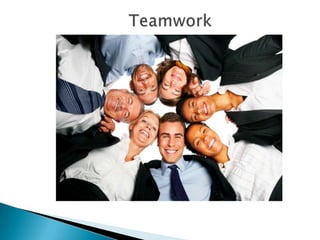
   Creates a team effort.
   Staff retention.
   Trained professionals on staff available for
    promotions.
   Keeping staff involved and increasing
    awareness.
   Staff functions to a higher level.
   Pride in work.
   Staff feels appreciated.
   Assignments are completed to the same
    standard at every school.
True or False?

 If you have a mentoring
program in place, there is no
need to conduct training
sessions.
False


Mentoring compliments a good
training and in-service
program.
“To mentor or not to
      mentor?”

    That is the
     question.



Recently Hired Cleaner
 Groundskeeperwho is not
performing according to
time standards specific to
his job tasks
Head Custodian whose staff
is complaining he/she yells
at them, uses inappropriate
language and has “favorites”
who get special treatment
Mentoring does not take the place of:

   Training
   In-service
   Inspections
   Evaluations
   Discipline
YOU'RE NO SPRING CHICKEN

Meaning: You're not young anymore; you're past
your prime.

Origin: Until recent generations, there were no
incubators and few warm hen houses. That
meant chicks couldn't be raised during winter.
New England growers found that those born in
the spring brought premium prices in the
summer market places. When these Yankee
traders tried to pass off old birds as part of the
spring crop, smart buyers would protest that the
bird was "no spring chicken."
Questions?
Mentoring & Coaching

Mentoring & Coaching

  • 5.
    Mentoring is adevelopmental partnership through which one person shares knowledge, skills, information and perspective to foster the personal and professional growth of someone else. We all have a need for insight that is outside of our normal life and educational experience. The power of mentoring is that it creates a one-of-a- kind opportunity for collaboration, goal achievement and problem-solving.
  • 6.
  • 7.
     Some do  Some don’t
  • 8.
    Wrong … you alldo! You just don’t know it.
  • 9.
  • 10.
    GO BERSERK Meaning: Gocrazy or to act with reckless abandon. Origin: Viking warriors were incredibly wild and ferocious in battle, probably because they ate hallucinogenic mushrooms in prebattle ceremonies. They charged their enemies recklessly, wearing nothing more than bearskin, which in Old Norse was pronounced "berserkr" or "bear-sark."
  • 11.
     When anew employee starts and receives very little training, he needs to go to someone for help and guidance, you just better hope it’s not the wrong someone.  Somaybe it’s time to develop a sound mentoring program!
  • 12.
    Gone are thedays when assigning an informal buddy to mentor a new employee meant going out to lunch. These buddies generally had no mentor training and they were clueless about their responsibilities. When making every employee successful as soon as possible became the new norm, formal organization needs from a mentor grew. A formal mentor relationship can jump start the learning curve and help a new employee succeed.
  • 13.
    Use a FormalMentor Process
  • 14.
    With a formalmentor process, a body of knowledge and other cultural teachings are an expectation of the mentor relationship. You will also find that a small component of the mentor relationship is evaluative in nature. In the sense that your organization is expecting employees who mentor to assess the new employee’s fit within the culture of the organization, the role evaluates the new employee.
  • 15.
     Dowe reallyhave time for such a formal process?  Sounds pretty time consuming!  Besideswhat kind of mentoring do facilities staff need?
  • 16.
  • 17.
    Employees also seekan informal mentor for each area of expertise the employee wishes to develop or explore. The person in this mentor role is purely a teacher with no assessment responsibilities.
  • 19.
    Problem with theinformal approach: Little or no control of who the employee seeks out and what kind of advise he gets.
  • 20.
    CHARLEY HORSE Meaning: Amuscle cramp. Origin: In 1640, Charles I of England expanded the London police force. The new recruits were nicknamed "Charleys." There wasn't enough money to provide the new police with horses so they patrolled on foot. They joked that their sore feet and legs came from riding "Charley's horse."
  • 21.
  • 22.
     So let’s find a happy medium.  Onethat’s not too time consuming or involved.  KISS Method.
  • 23.
    I prefer a FormalMethod of Coaching
  • 24.
    Coaching employees isnot a loss of power; it is a process of communicating with and engaging employees so problems can be solved creatively; it involves recognizing people for their individual contributions for the good of all. Employee coaching truly promotes a productive environment for an organization's team members, removing traditional barriers and boundaries to collaboration. This new environment emphasizes both individual and team achievement of a common organizational goal.
  • 25.
    The coaching leadershipstyle builds personal and team morale, fostering a partnership where employees feel like they are genuinely contributing to the success of the organization. It is for this reason alone that coaching should become a proactive process for top level managers. Building authentic relationships and collaborating with employees -- the essence of coaching -- is an investment in the long-term health of your business. Just as important as capital technology and marketing strategies, coaching will benefit the organization in countless ways as employees increase their productivity and the quality of their efforts.
  • 26.
    Coaching employees facilitateseffective communication at all levels of an organization and provides a channel for feedback and productive dialogue. People learn how they can personally support the organization and gain this understanding in a positive way. Too often, managers alone define mission statements and organizational objectives, solve problems, and dictate solutions in a vacuum. Without being asked for their input, employees are prone to get lost in the shuffle. In a coaching environment, leaders and employees collaborate to do the following:
  • 27.
    Coaching does haveits challenges; it is not an automatic technique that works every time, but a process and an investment. Using effective coaching techniques, managers can build a successful organization based on the strengths and relationships of one of its every members. The ability to coach others will truly be one of the most important top-level leadership skills of the future. Top-tier managers must spearhead the effort, becoming beacons of light for middle-level and front-line leaders to follow.
  • 30.
    Myth #1: "Custodians and maintenanceworkers don't need professional development or mentoring."
  • 31.
    Custodian and maintenanceemployees are "guardians of the school environment" for students, staff and the community. Their workloads continue to grow as new technology and equipment require specific skills, increased duties, and responsibilities. One of the most important responsibilities is to insure the proper indoor air quality, uniform temperatures, and proper ventilation. And often, with little, if any, specific or meaningful training, the custodian must also deal with dangerous materials such as laboratory spills, toxic materials, asbestos, lead and even bed bugs.
  • 32.
    Custodial staff need professionaldevelopment and a solid mentoring program to ensure they perform to the highest level.
  • 33.
    Myth #2: “Anyone canclean a school."
  • 34.
    “School custodians playan important role in providing a properly maintained physical plant for today’s student. They need to be current with all applicable laws and regulations affecting student and staff health and safety i.e.: green cleaning, asbestos, lead, mercury, pcb’s, bed bugs, lock-out tag-out, etc.
  • 35.
    They are alsoneed to be computer literate-- having to control the buildings' new computerized heating and cooling system from a laptop and desktop computer. Some need to hold state certification in both commercial pesticide application and asbestos abatement, as well as a basic boiler operator's license. To maintain certification, many must take yearly refresher courses.
  • 36.
    Myth #3: “There isno relation between student achievement and work performed by the school facilities staff."
  • 37.
     Severalstudies haveindicated that a clean, well-maintained, and safe school building plays an important role in the students’ individual school achievements.
  • 38.
    Yes, we doneed to mentor/coach our staff.
  • 39.
    CAUGHT RED-HANDED Meaning: Caughtin the act. Origin: For hundreds of years, stealing and butchering another person's livestock was a common crime. But it was hard to prove unless the thief was caught with a dead animal ... and blood on his hands
  • 40.
    Keys to aSuccessful Mentoring Program
  • 41.
    •Align the coachingprogram structure to desired learning outcomes •Provide training to new participants specific to their roles •Effectively match the right mentors to mentees •Monitor participation and engagement •Coach and guide mentors and mentees throughout their experience
  • 42.
    •Work together todevelop goals and objectives •Give and receive constructive feedback •Recognize success and effort •Share information
  • 43.
    A) Align coachingstructure to desired learning outcomes
  • 44.
    Having a programin place that does not address the needs of the employees and the district will result in a waste of time. One area that needs to be covered is the importance of cleaning and it’s benefits: i.e.: Coach explains to a new employee the reason for properly cleaning the restroom, so they understand how to prevent the spread of germs and bacteria, keeping the children safe.
  • 45.
    B) Provide trainingto new staff members specific to their roles
  • 46.
    Once the importanceof the job is shared, then provide the training. The coach should demonstrate how the district expects the restroom to be cleaned. Everyone must be on the same page. The staff member should feel comfortable approaching his coach for advice and constructive criticism.
  • 47.
    C) Match theright coach to the mentee.
  • 48.
    Attributes of aCoach •Wants to coach another employee and is committed to the employee’s growth and development and cultural integration. •Has the job content knowledge necessary to effectively teach a new employee significant job knowledge. • Demonstrates honesty, integrity, and both respect and responsibility for stewardship. •Demonstrates effective communication skills, both verbally and nonverbally. • Is willing to help develop another employee through guidance, feedback and, occasionally, an insistence on a particular level of performance or appropriate direction. •Has enough emotional intelligence to be aware of their personal emotions and is sensitive to the emotions and feelings of the employee they are mentoring.
  • 49.
    Would you pickthis person as a mentor or coach?
  • 50.
    Union Official  Custodian with high absenteeism rate  Relative of the mentee  10 year staff member with good evaluations, but keeps to himself  The one everyone likes but is a gossip hound  Someone who takes a long lunch and extended breaks
  • 51.
  • 52.
    You, as theadministrator, need a method in place to monitor the coaching program. Hold regular meetings with coaches to get their feedback on the mentee and discuss pros and cons.
  • 53.
    SPEAK OF THEDEVIL Meaning: Someone appears after you mention them. Origin: People once believed that you could actually summon the Devil by saying his name.
  • 54.
    How To Coacha Problem Employee
  • 55.
    Fortunately for management, problem employeesare not the norm. Occasionally, however, a newly-hired employee is not as they seemed to be in an interview.
  • 56.
    Firing an employeefor initial problems is not in anyone's best interest, as it then reopens the hiring process and takes more of your time and the time of the human resource staff. You may find the "problem employee" is not a problem at all, but is having a difficult time with learning the new job and after providing some coaching, that same employee could end up as your star employee. The key is to offer some help so they can improve. Also be very watchful on their progress or lack of, and keep accurate documents.
  • 57.
  • 58.
    You can excuseemployees for being late occasionally. Habitual tardiness should not be tolerated, especially for new employees. Continual tardiness is a sign of being unprofessional. If you have to report at exactly 9 am, the employee should be in at 9. If the employee shows signs of improvement, you can just let it pass, but emphasize the importance of timeliness. If the employee makes no attempt to be on time, then you need to talk with the employee and find out why this is happening so often. It could be as simple as the employee having transportation problems which should be resolved in the near future.
  • 59.
    Understanding why theemployee is late is important. Be proactive to work through this difficulty if you feel you have an employee with potential. Of course, after talking with/coaching the employee, you are still noticing tardiness, you will have to reprimand him and tell him that further offenses could cost his job. Make sure he understands he is a part of a team and is important to the overall operation of the school.
  • 60.
    The employee hasa negative attitude
  • 61.
    Negative attitudes canbe contagious and could further affect your staff. A negative employee tends to find fault with numerous people and school events. This is a difficult area to mentor as it normally is not a single offense, but rather a personality trait. This is a situation where, as a coach, you will need to be aware so the employee doesn't have the opportunity to affect the staff as a whole. The most important part of coaching a negative attitude is keeping factual records and not hearsay; most often the information is found through gossip and the coach must be mindful not to use gossip as facts to mentor an employee.
  • 62.
    Remind the individual he is part of a team.  Discuss the important role the individual plays in the overall operation of the school.  Ensure the staff member knows the impact of even the smallest of jobs does affect the school population.  Make sure they understand their work is appreciated and noticed.
  • 63.
    The employee istoo aggressive
  • 64.
    Usually, these employeesare not new, but senior staff members who have not been promoted due to attitude problem. They do well in their own work, but cannot work well with others. They use their seniority as an excuse to act as a boss. Sometimes, they even feel superior to their boss and think they can do whatever they want and walk away unblemished. Typically, this is when management steps in to assist. This type of employee is going to need several sessions of mentoring before seeing that their aggressiveness is providing unneeded stress to other employees. When coaching, be able to provide specific examples of times you or someone in a parallel or supervisory position to you, has witnessed this aggressiveness first hand.
  • 65.
    It’s RAINING CATSAND DOGS Meaning: Torrential rain. Origin: In the days before garbage collection, people tossed their trash in the gutter - including deceased housepets - and it just lay there. When it rained really hard, the garbage, including the bodies of dead cats and dogs, went floating down the street.
  • 66.
    Creates a team effort.  Staff retention.  Trained professionals on staff available for promotions.  Keeping staff involved and increasing awareness.  Staff functions to a higher level.  Pride in work.  Staff feels appreciated.  Assignments are completed to the same standard at every school.
  • 67.
    True or False? If you have a mentoring program in place, there is no need to conduct training sessions.
  • 68.
    False Mentoring compliments agood training and in-service program.
  • 69.
    “To mentor ornot to mentor?” That is the question.
  • 70.
  • 71.
     Groundskeeperwho isnot performing according to time standards specific to his job tasks
  • 72.
    Head Custodian whosestaff is complaining he/she yells at them, uses inappropriate language and has “favorites” who get special treatment
  • 73.
    Mentoring does nottake the place of:  Training  In-service  Inspections  Evaluations  Discipline
  • 74.
    YOU'RE NO SPRINGCHICKEN Meaning: You're not young anymore; you're past your prime. Origin: Until recent generations, there were no incubators and few warm hen houses. That meant chicks couldn't be raised during winter. New England growers found that those born in the spring brought premium prices in the summer market places. When these Yankee traders tried to pass off old birds as part of the spring crop, smart buyers would protest that the bird was "no spring chicken."
  • 75.