D. PRE-FIRE PLANNING AND FIRE
SUPPRESSION STRATEGIES
Cabral, Marvin C.
PRE-FIRE PLANNING
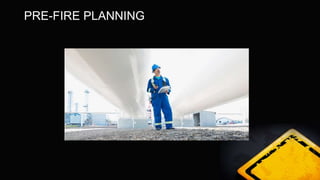
PRE-FIRE PLANNING
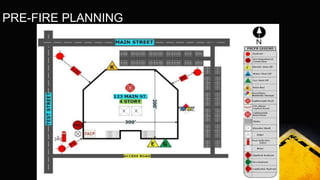
A pre-fire plan provides emergency services with information about your property so a
more efficient and effective operation can be conducted, meaning less damage to your
property and a better chance of a successful rescue. This document captures building
characteristics, occupancy, protective features and hazards.
PRE-FIRE PLANNING
RA 9514 (The Fire Code of the Philippines revised 2019)
CHAPTER 2. FIRE SAFETY IN BUILDINGS, STRUCTURES AND FACILITIES
• J. Required Fire Safety Programs/Measures
1. All occupants or lessees of buildings, structures or facilities shall organize themselves, and
develop and implement fire safety programs to include among others, fire prevention in the
premises, notification of the BFP on the existence of fire, evacuation of persons and initial
firefighting. The building owner shall take the initiative of formulating the fire safety program
for his/her building and of organizing the occupants to implement the programs.
2. In buildings, leased to and used by one (1) or several companies or persons, the
management of each company or each person shall be responsible for fire safety measures
within the leased or occupied areas. The building owner shall be responsible for the common
areas in the building such as the means of egress, utilities and building services equipment or
systems.
PRE-FIRE PLANNING
RA 9514 (The Fire Code of the Philippines revised 2019)
CHAPTER 2. FIRE SAFETY IN BUILDINGS, STRUCTURES AND FACILITIES
• J. Required Fire Safety Programs/Measures
– 3. In building structures or facilities, such as condominium and the like, where some units
of the building are not yet sold, the provisions of para 2 above shall apply. When all
condominium units have been sold, responsibility for fire safety measures in the common
areas such as the means of egress, utilities, building equipment/system and the building as
a whole, shall devolve jointly upon all individual unit owners, occupants and building
administrators.
PRE-FIRE PLANNING
RA 9514 (The Fire Code of the Philippines revised 2019)
CHAPTER 2. FIRE SAFETY IN BUILDINGS, STRUCTURES AND FACILITIES
– L. Construction and Repair Operations
• 1. New Construction
a. No building or structure under construction shall be occupied in whole or in part until all required
means of egress required for the part to be occupied are completed, inspected and approved for
occupancy
b. Adequate escape facilities shall be maintained at all times in buildings under construction for the use of
construction workers. These facilities shall consist of doors, walkways, stairs, ramps, fire escapes, or
other arrangements in accordance with the general guidelines of RA 9514 and its RIRR in so far as they
can be reasonably applied to buildings under construction .
• 2. Repairs or Alterations
a. Existing buildings may be occupied during repairs or alterations provided that all existing fire protection
systems/devices are continuously maintained or, in lieu thereof, other measures are taken to provide
equivalent safety.
b. Flammable or explosive substances or equipment necessary for the repair or alteration of a building or
structure may be introduced therein while it is occupied, only if the conditions of use and the safeguards
provided will not create any additional danger or impair the use of the means of egress.
PRE-FIRE PLANNING
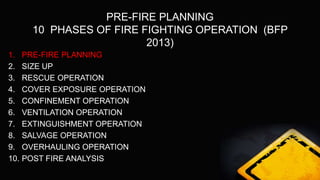
10 PHASES OF FIRE FIGHTING OPERATION (BFP
2013)
1. PRE-FIRE PLANNING
2. SIZE UP
3. RESCUE OPERATION
4. COVER EXPOSURE OPERATION
5. CONFINEMENT OPERATION
6. VENTILATION OPERATION
7. EXTINGUISHMENT OPERATION
8. SALVAGE OPERATION
9. OVERHAULING OPERATION
10. POST FIRE ANALYSIS
PRE-FIRE PLANNING
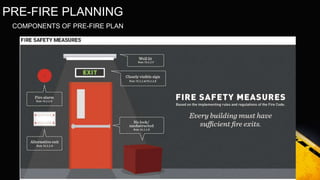
COMPONENTS OF PRE-FIRE PLAN
PRE-FIRE PLANNING
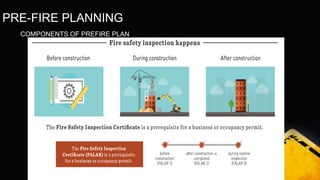
COMPONENTS OF PREFIRE PLAN
PRE-FIRE PLANNING
Fire risk assessment
The ‘five steps’ approach
• Identify fire hazards
• Identify the location of people at significant risk in case of fire
• Evaluate the risks
• Record findings and action taken
• Keep assessment under review
PRE-FIRE PLANNING
RISK MANAGEMENT PLANNING
COMPONENTS OF PREFIRE PLAN
– Critical Infrastructure And Construction Information
– Have A Paper Copy
– Plan For Every Building
PRE-FIRE PLANNING
COMPONENTS OF PREFIRE PLAN
• The information included is based on each occupancy and its unique hazards.
– Company name, address, and driving directions
– Occupancy Classifications (such as property use, i.e. residential, commercial, etc.)
– Access Code for gates/doors, Knox Box location (optional)
– Aerial photos of the site
– Number of stories, building length and width, site plan, floor plans
– Building construction and materials
– Hazardous materials present and location
– Water supply information
– Defensible space around the building, including turn-around capability
– Location of both fire alarm systems and fire protection systems (sprinklers, etc.)
PRE-FIRE PLANNING
COMPONENTS OF PREFIRE PLAN
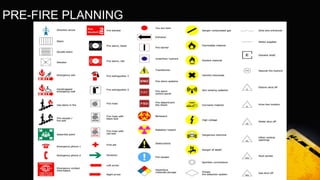
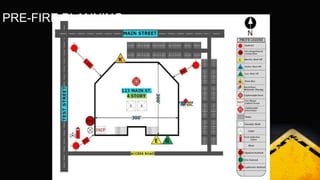
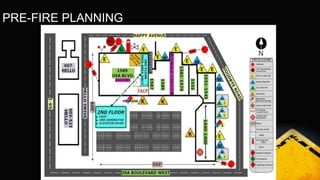
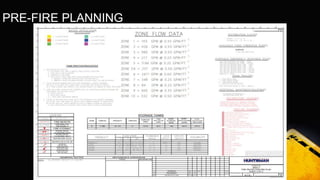
Samples of Finished Pre-Fire Plan Document:
PRE-FIRE PLANNING
PRE-FIRE PLANNING
PRE-FIRE PLANNING
PRE-FIRE PLANNING
PRE-FIRE PLANNING
PRE-FIRE PLANNING
PRE-FIRE PLANNING
PRE-FIRE PLANNING
Fire Suppression Strategies
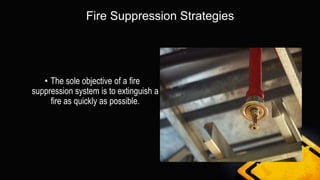
• The sole objective of a fire
suppression system is to extinguish a
fire as quickly as possible.
Fire Suppression Strategies
Based on NFPA 1001 Standard
• Refers to all the tactics and tasks that are performed on the fire scene to achieve the
final goal of extinguishing the fire.
Fire Suppression Strategies
Fire Suppression System
• A fire suppression system is an integral part of any fire protection infrastructure.
• ‘Fire suppression’ is a collective term for any engineering group of units that are designed to put out a
fire.
–water,
–foam or
–chemical compounds.
Fire Suppression Strategies
• Fire Sprinkler System
• Fire Suppression System
Fire Suppression Strategies
BENEFITS OF FIRE SUPPRESSION SYSTEMS
- Quick Response
- Minimal Damage
- Protect Lives
- Tested and Ensured
Fire Suppression Strategies
• The Traditional and Automatic Fire
Suppression Systems
Fire Suppression Strategies
Different types of fire Suppression Systems
–Gas Systems
–Wet chemical foam Systems
–Water Mist Systems
–Foam Deluge Systems
–Pneumatic Heat Detection Tubes
Fire Suppression Strategies
Different types of fire Suppression Systems
–Automatic Fire Detection And Suppression
–Kitchen Hood Fire Suppression
–FM200 Fire Suppression System
Fire Suppression Strategies
Some of the Industries that must use a Fire Suppression Systems
–Industrial and Manufacturing
–Warehousing and Storage
–Data Centers and Server Rooms
–Educational Institutions
Fire Suppression Strategies
Some of the Industries that must use a Fire Suppression Systems
–Industrial and Manufacturing
–Warehousing and Storage
–Data Centers and Server Rooms
–Educational Institutions
Water Sprinkler Simulation
Gas Systems
Pneumatic Heat Detection
Foam Deluge System
Wet Chemical System
THANK YOU!

Pre Fire Planning.pptx

  • 1.
    D. PRE-FIRE PLANNINGAND FIRE SUPPRESSION STRATEGIES Cabral, Marvin C.
  • 2.
  • 3.
    PRE-FIRE PLANNING A pre-fireplan provides emergency services with information about your property so a more efficient and effective operation can be conducted, meaning less damage to your property and a better chance of a successful rescue. This document captures building characteristics, occupancy, protective features and hazards.
  • 4.
    PRE-FIRE PLANNING RA 9514(The Fire Code of the Philippines revised 2019) CHAPTER 2. FIRE SAFETY IN BUILDINGS, STRUCTURES AND FACILITIES • J. Required Fire Safety Programs/Measures 1. All occupants or lessees of buildings, structures or facilities shall organize themselves, and develop and implement fire safety programs to include among others, fire prevention in the premises, notification of the BFP on the existence of fire, evacuation of persons and initial firefighting. The building owner shall take the initiative of formulating the fire safety program for his/her building and of organizing the occupants to implement the programs. 2. In buildings, leased to and used by one (1) or several companies or persons, the management of each company or each person shall be responsible for fire safety measures within the leased or occupied areas. The building owner shall be responsible for the common areas in the building such as the means of egress, utilities and building services equipment or systems.
  • 5.
    PRE-FIRE PLANNING RA 9514(The Fire Code of the Philippines revised 2019) CHAPTER 2. FIRE SAFETY IN BUILDINGS, STRUCTURES AND FACILITIES • J. Required Fire Safety Programs/Measures – 3. In building structures or facilities, such as condominium and the like, where some units of the building are not yet sold, the provisions of para 2 above shall apply. When all condominium units have been sold, responsibility for fire safety measures in the common areas such as the means of egress, utilities, building equipment/system and the building as a whole, shall devolve jointly upon all individual unit owners, occupants and building administrators.
  • 6.
    PRE-FIRE PLANNING RA 9514(The Fire Code of the Philippines revised 2019) CHAPTER 2. FIRE SAFETY IN BUILDINGS, STRUCTURES AND FACILITIES – L. Construction and Repair Operations • 1. New Construction a. No building or structure under construction shall be occupied in whole or in part until all required means of egress required for the part to be occupied are completed, inspected and approved for occupancy b. Adequate escape facilities shall be maintained at all times in buildings under construction for the use of construction workers. These facilities shall consist of doors, walkways, stairs, ramps, fire escapes, or other arrangements in accordance with the general guidelines of RA 9514 and its RIRR in so far as they can be reasonably applied to buildings under construction . • 2. Repairs or Alterations a. Existing buildings may be occupied during repairs or alterations provided that all existing fire protection systems/devices are continuously maintained or, in lieu thereof, other measures are taken to provide equivalent safety. b. Flammable or explosive substances or equipment necessary for the repair or alteration of a building or structure may be introduced therein while it is occupied, only if the conditions of use and the safeguards provided will not create any additional danger or impair the use of the means of egress.
  • 7.
    PRE-FIRE PLANNING 10 PHASESOF FIRE FIGHTING OPERATION (BFP 2013) 1. PRE-FIRE PLANNING 2. SIZE UP 3. RESCUE OPERATION 4. COVER EXPOSURE OPERATION 5. CONFINEMENT OPERATION 6. VENTILATION OPERATION 7. EXTINGUISHMENT OPERATION 8. SALVAGE OPERATION 9. OVERHAULING OPERATION 10. POST FIRE ANALYSIS
  • 8.
  • 9.
  • 10.
    PRE-FIRE PLANNING Fire riskassessment The ‘five steps’ approach • Identify fire hazards • Identify the location of people at significant risk in case of fire • Evaluate the risks • Record findings and action taken • Keep assessment under review
  • 11.
    PRE-FIRE PLANNING RISK MANAGEMENTPLANNING COMPONENTS OF PREFIRE PLAN – Critical Infrastructure And Construction Information – Have A Paper Copy – Plan For Every Building
  • 12.
    PRE-FIRE PLANNING COMPONENTS OFPREFIRE PLAN • The information included is based on each occupancy and its unique hazards. – Company name, address, and driving directions – Occupancy Classifications (such as property use, i.e. residential, commercial, etc.) – Access Code for gates/doors, Knox Box location (optional) – Aerial photos of the site – Number of stories, building length and width, site plan, floor plans – Building construction and materials – Hazardous materials present and location – Water supply information – Defensible space around the building, including turn-around capability – Location of both fire alarm systems and fire protection systems (sprinklers, etc.)
  • 13.
    PRE-FIRE PLANNING COMPONENTS OFPREFIRE PLAN Samples of Finished Pre-Fire Plan Document:
  • 14.
  • 15.
  • 16.
  • 17.
  • 18.
  • 19.
  • 20.
  • 21.
  • 22.
    Fire Suppression Strategies •The sole objective of a fire suppression system is to extinguish a fire as quickly as possible.
  • 23.
    Fire Suppression Strategies Basedon NFPA 1001 Standard • Refers to all the tactics and tasks that are performed on the fire scene to achieve the final goal of extinguishing the fire.
  • 24.
    Fire Suppression Strategies FireSuppression System • A fire suppression system is an integral part of any fire protection infrastructure. • ‘Fire suppression’ is a collective term for any engineering group of units that are designed to put out a fire. –water, –foam or –chemical compounds.
  • 25.
    Fire Suppression Strategies •Fire Sprinkler System • Fire Suppression System
  • 26.
    Fire Suppression Strategies BENEFITSOF FIRE SUPPRESSION SYSTEMS - Quick Response - Minimal Damage - Protect Lives - Tested and Ensured
  • 27.
    Fire Suppression Strategies •The Traditional and Automatic Fire Suppression Systems
  • 28.
    Fire Suppression Strategies Differenttypes of fire Suppression Systems –Gas Systems –Wet chemical foam Systems –Water Mist Systems –Foam Deluge Systems –Pneumatic Heat Detection Tubes
  • 29.
    Fire Suppression Strategies Differenttypes of fire Suppression Systems –Automatic Fire Detection And Suppression –Kitchen Hood Fire Suppression –FM200 Fire Suppression System
  • 30.
    Fire Suppression Strategies Someof the Industries that must use a Fire Suppression Systems –Industrial and Manufacturing –Warehousing and Storage –Data Centers and Server Rooms –Educational Institutions
  • 31.
    Fire Suppression Strategies Someof the Industries that must use a Fire Suppression Systems –Industrial and Manufacturing –Warehousing and Storage –Data Centers and Server Rooms –Educational Institutions
  • 32.
  • 33.
  • 34.
  • 35.
  • 36.
  • 37.