David De Roure
Digital Scholarship
Intersection, Automation, and
Scholarly Social Machines
Oxford e-Research Centre
Alan Turing Institute
@dder
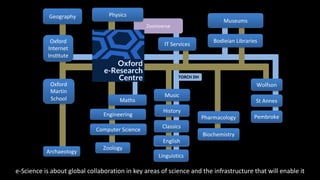
TORCH DH
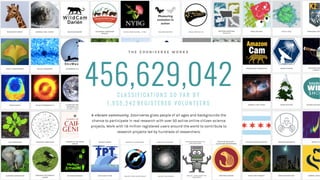
Zooniverse
Linguistics
English
Oxford
Martin
School
IT Services
Geography Physics
Computer Science
Maths
History
Oxford
Internet
InsBtute
Music
Archaeology
Classics
Zoology
Museums
Wolfson
Bodleian Libraries
Pharmacology
Biochemistry
St Annes
PembrokeEngineering
e-Science is about global collaboration in key areas of science and the infrastructure that will enable it
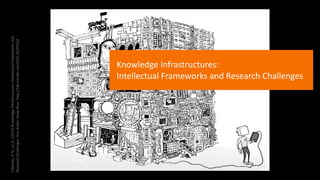
Edwards,P.N.,etal.(2013)KnowledgeInfrastructures:IntellectualFrameworksand
ResearchChallenges.AnnArbor:DeepBlue.http://hdl.handle.net/2027.42/97552
Knowledge Infrastructures:
Intellectual Frameworks and Research Challenges
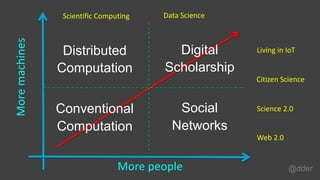
Digital
Scholarship
Social
Networks
More people
Moremachines
Distributed
Computation
Conventional
Computation
Science 2.0
Data Science
Citizen Science
Scientific Computing
Living in IoT
Web 2.0
@dder
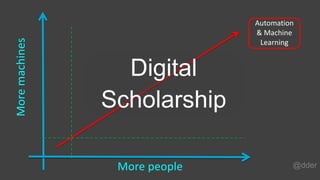
More people
Moremachines Automation
& Machine
Learning
@dder
Digital
Scholarship
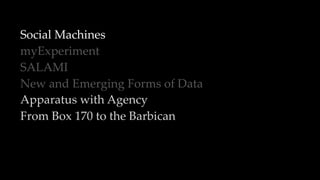
Social Machines
myExperiment
SALAMI
New and Emerging Forms of Data
Apparatus with Agency
From Box 170 to the Barbican
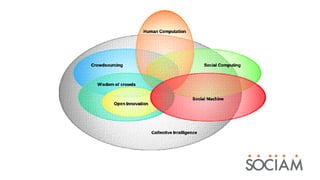
Social Machines
“Real life is and must be full of all kinds of social
constraint – the very processes from which society
arises. Computers can help if we use them to create
abstract social machines on the Web: processes in
which the people do the creative work and the
machine does the administration... The stage is set
for an evolutionary growth of new social engines.
The ability to create new forms of social process
would be given to the world at large, and
development would be rapid.”
Berners-Lee, Weaving the Web, 1999 (pp. 172–175)
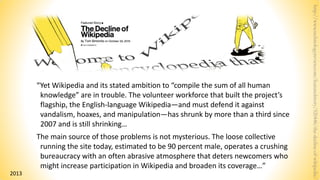
“Yet Wikipedia and its stated ambition to “compile the sum of all human
knowledge” are in trouble. The volunteer workforce that built the project’s
flagship, the English-language Wikipedia—and must defend it against
vandalism, hoaxes, and manipulation—has shrunk by more than a third since
2007 and is still shrinking…
The main source of those problems is not mysterious. The loose collective
running the site today, estimated to be 90 percent male, operates a crushing
bureaucracy with an often abrasive atmosphere that deters newcomers who
might increase participation in Wikipedia and broaden its coverage…”
http://www.technologyreview.com/featuredstory/520446/the-decline-of-wikipedia/
2013
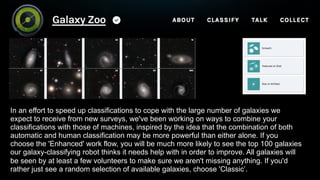
In an effort to speed up classifications to cope with the large number of galaxies we
expect to receive from new surveys, we've been working on ways to combine your
classifications with those of machines, inspired by the idea that the combination of both
automatic and human classification may be more powerful than either alone. If you
choose the 'Enhanced' work flow, you will be much more likely to see the top 100 galaxies
our galaxy-classifying robot thinks it needs help with in order to improve. All galaxies will
be seen by at least a few volunteers to make sure we aren't missing anything. If you'd
rather just see a random selection of available galaxies, choose 'Classic’.
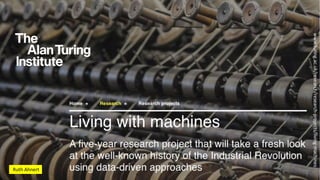
Ruth Ahnert
www.turing.ac.uk/research/research-projects/living-machines
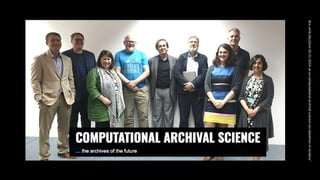
dcic.umd.edu/june-20-21-2019-uk-us-computational-archival-science-cas-datathon-in-london/
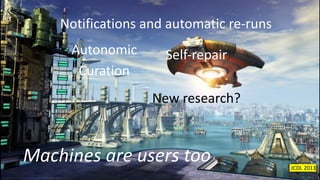
Notifications and automatic re-runs
Machines are users too
Autonomic
Curation
Self-repair
New research?
JCDL 2013
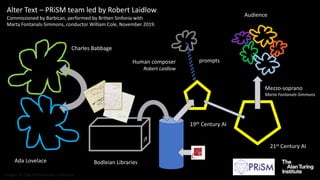
Ada Lovelace
Charles Babbage
Bodleian Libraries
19th Century AI
21st Century AI
Audience
Human composer
Robert Laidlow
Alter Text – PRiSM team led by Robert Laidlow
Commissioned by Barbican, performed by Britten Sinfonia with
Marta Fontanals-Simmons, conductor William Cole, November 2019.
Mezzo-soprano
Marta Fontanals-Simmons
prompts
Images © Clay Mathematics Institute
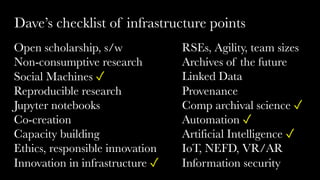
Open scholarship, s/w
Non-consumptive research
Social Machines ✓
Reproducible research
Jupyter notebooks
Co-creation
Capacity building
Ethics, responsible innovation
Innovation in infrastructure ✓
RSEs, Agility, team sizes
Archives of the future
Linked Data
Provenance
Comp archival science ✓
Automation ✓
Artificial Intelligence ✓
IoT, NEFD, VR/AR
Information security
Dave’s checklist of infrastructure points
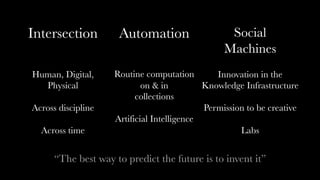
Intersection
Human, Digital,
Physical
Across discipline
Across time
Automation
Routine computation
on & in
collections
Artificial Intelligence
Social
Machines
Innovation in the
Knowledge Infrastructure
Permission to be creative
Labs
“The best way to predict the future is to invent it”
Thanks to
Ruth Ahnert
Eirini Goudarouli
Rob Laidlow
Grant Miller
Pip Willcox

Digital Research Infrastructure