INSTITUTO DE FORMACIÓN DOCENTE CONTINUA
LENGUAS VIVAS BARILOCHE (A-052)
Profesorado de Inglés – Opción pedagógica a distancia
Subject : Práctica Docente III - 2020
Tutor: Aurelia Velázquez
Students: Iannaci, Mariela and Schneider, Vanesa.
Instruction:
In pairs, suggest different ways of adapting the activities taken from WETZ, Ben
(2016) English Plus 1. Student´s Book. Second Edition. Oxford University Press.
Remember you may differentiate
· the content/topic
· the process/activities
· the product (outcome)
· by manipulating the environment or through accommodating individual
learning styles, e.g. using laptops, computers, recording in different ways, visual
resources.
Describe activities thoroughly and include supporting materials you would
implement. Go back to the tips in this document and to the materials you have
consulted in Didactics.
You should include both names in your assignment, but upload it individually.
Deadline: April 27, 2020
In order to promote diversity and inclusion, we have thought of the possibility of having a
student with dyslexia. Therefore, we have adapted the following activities which have been
taken from WETZ, Ben (2016) English plus 1. Student´s Book. Second Edition. Oxford
University Press.
❖ First activity chosen: Activity 1, page 17.
In this activity, students are taught the comparative form of different kinds of adjectives: short,
long, regular and irregular adjectives. These forms are all different. Furthermore, the
comparative form of short adjectives varyvaries depending on the letter they end with. As it is
too much information for a student with dyslexia, we have decided to adapt this activity in
different ways:
Firstly, we have adapted its content since we will only teach him/her the comparative form of
long adjectives. We will keep teaching the same topic, comparative adjectives, but we will
adapt the content of the activity in order to help him/her understand it better. We have read in
the document called “A Great Challenge” provided in Práactica Docente III 1
that it is
advisable to teach students with dyslexia easier and simpler structures first . For this reason,
we have chosen we have chosen long adjectives since they have the same form as in Spanish.
➢ This is the adapted version of the activity:
In the first place, we will introduce the topic to all students, using the same context. As this
activity has no context, we have decided to create one, since a context will be beneficial to all
the students in the class. To do so, we will say to the students “Imagine that your mobile phone
has broken down. So you decide to ask a friend to help you to buy a new one”. To do so, we
will provide students with four adjectives to describe cell phones: expensive - modern -
beautiful - compact.
1
Taken from UNIT 2 - Práctica Docente III. “A great Challenge”, page 2.
Comentado [A1]: In fact, it is related to the previous activity
on the simple pages.
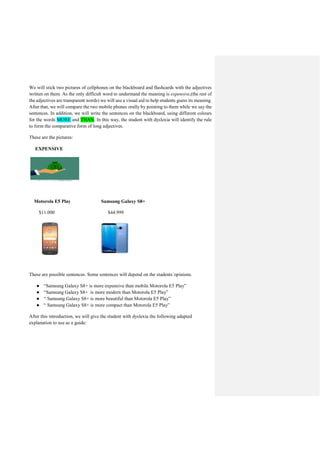
We will stick two pictures of cellphones on the blackboard and flashcards with the adjectives
written on them. As the only difficult word to understand the meaning is expensive,(the rest of
the adjectives are transparent words) we will use a visual aid to help students guess its meaning.
After that, we will compare the two mobile phones orally by pointing to them while we say the
sentences. In addition, we will write the sentences on the blackboard, using different colours
for the words MORE and THAN. In this way, the student with dyslexia will identify the rule
to form the comparative form of long adjectives.
These are the pictures:
EXPENSIVE
Motorola E5 Play Samsung Galaxy S8+
$11.000 $44.999
These are possible sentences. Some sentences will depend on the students´opinions.
● “Samsung Galaxy S8+ is more expensive than mobile Motorola E5 Play”
● “Samsung Galaxy S8+ is more modern than Motorola E5 Play”
● “ Samsung Galaxy S8+ is more beautiful than Motorola E5 Play”
● “ Samsung Galaxy S8+ is more compact than Motorola E5 Play”
After this introduction, we will give the student with dyslexia the following adapted
explanation to use as a guide:
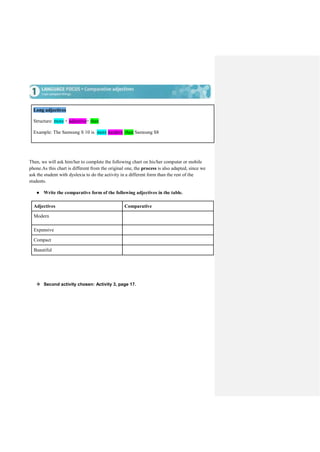
Long adjectives
Structure: more + adjective+ than
Example: The Samsung S 10 is more modern than Samsung S8
Then, we will ask him/her to complete the following chart on his/her computer or mobile
phone.As this chart is different from the original one, the process is also adapted, since we
ask the student with dyslexia to do the activity in a different form than the rest of the
students.
● Write the comparative form of the following adjectives in the table.
Adjectives Comparative
Modern
Expensive
Compact
Beautiful
 Second activity chosen: Activity 3, page 17.
We will tell all students that now they have bought a new mobile phone, they will go to a
restaurant to celebrate.
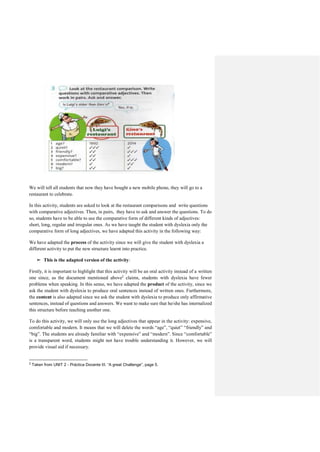
In this activity, students are asked to look at the restaurant comparisons and write questions
with comparative adjectives. Then, in pairs, they have to ask and answer the questions. To do
so, students have to be able to use the comparative form of different kinds of adjectives:
short, long, regular and irregular ones. As we have taught the student with dyslexia only the
comparative form of long adjectives, we have adapted this activity in the following way:
We have adapted the process of the activity since we will give the student with dyslexia a
different activity to put the new structure learnt into practice.
➢ This is the adapted version of the activity:
Firstly, it is important to highlight that this activity will be an oral activity instead of a written
one since, as the document mentioned above2
claims, students with dyslexia have fewer
problems when speaking. In this sense, we have adapted the product of the activity, since we
ask the student with dyslexia to produce oral sentences instead of written ones. Furthermore,
the content is also adapted since we ask the student with dyslexia to produce only affirmative
sentences, instead of questions and answers. We want to make sure that he/she has internalized
this structure before teaching another one.
To do this activity, we will only use the long adjectives that appear in the activity: expensive,
comfortable and modern. It means that we will delete the words “age”, “quiet” “friendly” and
“big”. The students are already familiar with “expensive” and “modern”. Since “comfortable”
is a transparent word, students might not have trouble understanding it. However, we will
provide visual aid if necessary.
2
Taken from UNIT 2 - Práctica Docente III. “A great Challenge”, page 5.
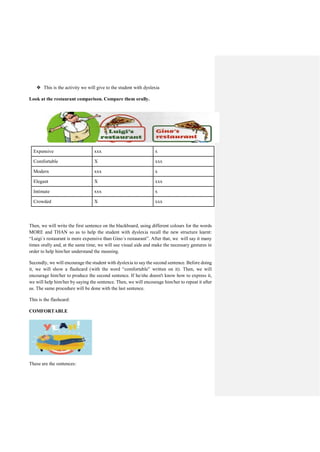
❖ This is the activity we will give to the student with dyslexia
Look at the restaurant comparison. Compare them orally.
Expensive xxx x
Comfortable X xxx
Modern xxx x
Elegant X xxx
Intimate xxx x
Crowded X xxx
Then, we will write the first sentence on the blackboard, using different colours for the words
MORE and THAN so as to help the student with dyslexia recall the new structure learnt:
“Luigi´s restaurant is more expensive than Gino´s restaurant”. After that, we will say it many
times orally and, at the same time, we will use visual aids and make the necessary gestures in
order to help him/her understand the meaning.
Secondly, we will encourage the student with dyslexia to say the second sentence. Before doing
it, we will show a flashcard (with the word “comfortable” written on it). Then, we will
encourage him/her to produce the second sentence. If he/she doesn't know how to express it,
we will help him/her by saying the sentence. Then, we will encourage him/her to repeat it after
us. The same procedure will be done with the last sentence.
This is the flashcard:
COMFORTABLE
These are the sentences:
● “Gino´s restaurant is more comfortable than Luigi´s restaurant.”
● “Luiggi´s restaurant is more modern than Gino´s restaurant” Comentado [A2]: Interesting ideas! Well done!

Schneider iannaci assignment unit 2_ special needs- pass

  • 1.
    INSTITUTO DE FORMACIÓNDOCENTE CONTINUA LENGUAS VIVAS BARILOCHE (A-052) Profesorado de Inglés – Opción pedagógica a distancia Subject : Práctica Docente III - 2020 Tutor: Aurelia Velázquez Students: Iannaci, Mariela and Schneider, Vanesa. Instruction: In pairs, suggest different ways of adapting the activities taken from WETZ, Ben (2016) English Plus 1. Student´s Book. Second Edition. Oxford University Press. Remember you may differentiate · the content/topic · the process/activities · the product (outcome) · by manipulating the environment or through accommodating individual learning styles, e.g. using laptops, computers, recording in different ways, visual resources. Describe activities thoroughly and include supporting materials you would implement. Go back to the tips in this document and to the materials you have consulted in Didactics. You should include both names in your assignment, but upload it individually. Deadline: April 27, 2020
  • 2.
    In order topromote diversity and inclusion, we have thought of the possibility of having a student with dyslexia. Therefore, we have adapted the following activities which have been taken from WETZ, Ben (2016) English plus 1. Student´s Book. Second Edition. Oxford University Press. ❖ First activity chosen: Activity 1, page 17. In this activity, students are taught the comparative form of different kinds of adjectives: short, long, regular and irregular adjectives. These forms are all different. Furthermore, the comparative form of short adjectives varyvaries depending on the letter they end with. As it is too much information for a student with dyslexia, we have decided to adapt this activity in different ways: Firstly, we have adapted its content since we will only teach him/her the comparative form of long adjectives. We will keep teaching the same topic, comparative adjectives, but we will adapt the content of the activity in order to help him/her understand it better. We have read in the document called “A Great Challenge” provided in Práactica Docente III 1 that it is advisable to teach students with dyslexia easier and simpler structures first . For this reason, we have chosen we have chosen long adjectives since they have the same form as in Spanish. ➢ This is the adapted version of the activity: In the first place, we will introduce the topic to all students, using the same context. As this activity has no context, we have decided to create one, since a context will be beneficial to all the students in the class. To do so, we will say to the students “Imagine that your mobile phone has broken down. So you decide to ask a friend to help you to buy a new one”. To do so, we will provide students with four adjectives to describe cell phones: expensive - modern - beautiful - compact. 1 Taken from UNIT 2 - Práctica Docente III. “A great Challenge”, page 2. Comentado [A1]: In fact, it is related to the previous activity on the simple pages.
  • 3.
    We will sticktwo pictures of cellphones on the blackboard and flashcards with the adjectives written on them. As the only difficult word to understand the meaning is expensive,(the rest of the adjectives are transparent words) we will use a visual aid to help students guess its meaning. After that, we will compare the two mobile phones orally by pointing to them while we say the sentences. In addition, we will write the sentences on the blackboard, using different colours for the words MORE and THAN. In this way, the student with dyslexia will identify the rule to form the comparative form of long adjectives. These are the pictures: EXPENSIVE Motorola E5 Play Samsung Galaxy S8+ $11.000 $44.999 These are possible sentences. Some sentences will depend on the students´opinions. ● “Samsung Galaxy S8+ is more expensive than mobile Motorola E5 Play” ● “Samsung Galaxy S8+ is more modern than Motorola E5 Play” ● “ Samsung Galaxy S8+ is more beautiful than Motorola E5 Play” ● “ Samsung Galaxy S8+ is more compact than Motorola E5 Play” After this introduction, we will give the student with dyslexia the following adapted explanation to use as a guide:
  • 4.
    Long adjectives Structure: more+ adjective+ than Example: The Samsung S 10 is more modern than Samsung S8 Then, we will ask him/her to complete the following chart on his/her computer or mobile phone.As this chart is different from the original one, the process is also adapted, since we ask the student with dyslexia to do the activity in a different form than the rest of the students. ● Write the comparative form of the following adjectives in the table. Adjectives Comparative Modern Expensive Compact Beautiful  Second activity chosen: Activity 3, page 17.
  • 5.
    We will tellall students that now they have bought a new mobile phone, they will go to a restaurant to celebrate. In this activity, students are asked to look at the restaurant comparisons and write questions with comparative adjectives. Then, in pairs, they have to ask and answer the questions. To do so, students have to be able to use the comparative form of different kinds of adjectives: short, long, regular and irregular ones. As we have taught the student with dyslexia only the comparative form of long adjectives, we have adapted this activity in the following way: We have adapted the process of the activity since we will give the student with dyslexia a different activity to put the new structure learnt into practice. ➢ This is the adapted version of the activity: Firstly, it is important to highlight that this activity will be an oral activity instead of a written one since, as the document mentioned above2 claims, students with dyslexia have fewer problems when speaking. In this sense, we have adapted the product of the activity, since we ask the student with dyslexia to produce oral sentences instead of written ones. Furthermore, the content is also adapted since we ask the student with dyslexia to produce only affirmative sentences, instead of questions and answers. We want to make sure that he/she has internalized this structure before teaching another one. To do this activity, we will only use the long adjectives that appear in the activity: expensive, comfortable and modern. It means that we will delete the words “age”, “quiet” “friendly” and “big”. The students are already familiar with “expensive” and “modern”. Since “comfortable” is a transparent word, students might not have trouble understanding it. However, we will provide visual aid if necessary. 2 Taken from UNIT 2 - Práctica Docente III. “A great Challenge”, page 5.
  • 6.
    ❖ This isthe activity we will give to the student with dyslexia Look at the restaurant comparison. Compare them orally. Expensive xxx x Comfortable X xxx Modern xxx x Elegant X xxx Intimate xxx x Crowded X xxx Then, we will write the first sentence on the blackboard, using different colours for the words MORE and THAN so as to help the student with dyslexia recall the new structure learnt: “Luigi´s restaurant is more expensive than Gino´s restaurant”. After that, we will say it many times orally and, at the same time, we will use visual aids and make the necessary gestures in order to help him/her understand the meaning. Secondly, we will encourage the student with dyslexia to say the second sentence. Before doing it, we will show a flashcard (with the word “comfortable” written on it). Then, we will encourage him/her to produce the second sentence. If he/she doesn't know how to express it, we will help him/her by saying the sentence. Then, we will encourage him/her to repeat it after us. The same procedure will be done with the last sentence. This is the flashcard: COMFORTABLE These are the sentences:
  • 7.
    ● “Gino´s restaurantis more comfortable than Luigi´s restaurant.” ● “Luiggi´s restaurant is more modern than Gino´s restaurant” Comentado [A2]: Interesting ideas! Well done!