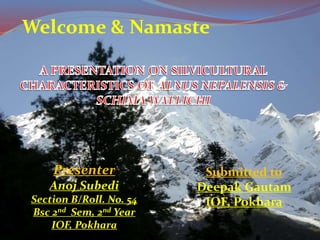
Presenter
Anoj Subedi
Section B/Roll. No. 54
Bsc 2nd Sem, 2nd Year
IOF, Pokhara
Welcome & Namaste
Submitted to
Deepak Gautam
IOF, Pokhara
INTRODUCTION
 Forests play a vital role in maintaining ecological
balance and economic development. Nepal has a very
diverse flora with 35 forest types.
 These forest types are categorized in ten major
groups:-Tropical(upto 1000m), Subtropical broad-
leaved, Subtropical pine(1000-2000m), Lower
temperate broad-leaved, Lower temperate mixed
broad-leaved, Upper temperate broad-leaved,
Upper temperate mixed broad-leaved,Temperate
coniferous (2000-2700m) Sub-alpine(3000-
4200m), and Alpine scrub forests(4200-5000m)
Silviculture
(Latin silvi- (forest) + culture (as in growing)
It is the practice of controlling the
establishment, growth, composition, health, and
quality of forests to meet diverse needs and values.
Silvicultural characteristics
It defines the life history, growth,
behavior and ecology of a tree species.
1.Alnus nepalensis
INTRODUCTION
Family: Betulaceae
Scientific name : Alnus nepalensis
Common name : Alder
Local name : Utis
Natural occurrence: It occurs between 500-2700m, mostly
above 900m. At lower altitude, it prefers moist sites and
shady aspects. It occurs in Himalayan moist temperate
forest.
Formula!
1. Fire
hardy/resis
tance
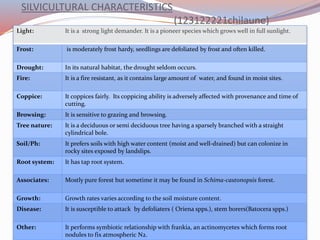
SILVICULTURAL CHARACTERISTICS
(123122221chilaune)
Light: It is a strong light demander. It is a pioneer species which grows well in full sunlight.
Frost: is moderately frost hardy, seedlings are defoliated by frost and often killed.
Drought: In its natural habitat, the drought seldom occurs.
Fire: It is a fire resistant, as it contains large amount of water, and found in moist sites.
Coppice: It coppices fairly. Its coppicing ability is adversely affected with provenance and time of
cutting.
Browsing: It is sensitive to grazing and browsing.
Tree nature: It is a deciduous or semi deciduous tree having a sparsely branched with a straight
cylindrical bole.
Soil/Ph: It prefers soils with high water content (moist and well-drained) but can colonize in
rocky sites exposed by landslips.
Root system: It has tap root system.
Associates: Mostly pure forest but sometime it may be found in Schima-castonopsis forest.
Growth: Growth rates varies according to the soil moisture content.
Disease: It is susceptible to attack by defoliaters ( Oriena spps.), stem borers(Batocera spps.)
Other: It performs symbiotic relationship with frankia, an actinomycetes which forms root
nodules to fix atmospheric N2.
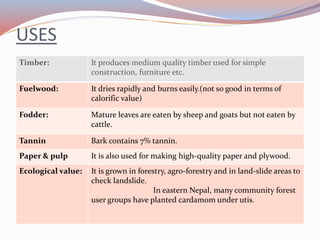
USES
Timber: It produces medium quality timber used for simple
construction, furniture etc.
Fuelwood: It dries rapidly and burns easily.(not so good in terms of
calorific value)
Fodder: Mature leaves are eaten by sheep and goats but not eaten by
cattle.
Tannin Bark contains 7% tannin.
Paper & pulp It is also used for making high-quality paper and plywood.
Ecological value: It is grown in forestry, agro-forestry and in land-slide areas to
check landslide.
In eastern Nepal, many community forest
user groups have planted cardamom under utis.
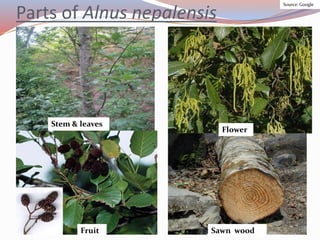
Parts of Alnus nepalensis
Stem & leaves
Flower
Fruit Sawn wood
Source: Google
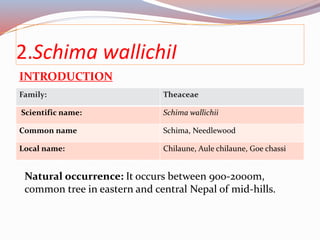
2.Schima wallichiI
INTRODUCTION
Family: Theaceae
Scientific name: Schima wallichii
Common name Schima, Needlewood
Local name: Chilaune, Aule chilaune, Goe chassi
Natural occurrence: It occurs between 900-2000m,
common tree in eastern and central Nepal of mid-hills.
Formula!
1. Fire
hardy/resis
tance
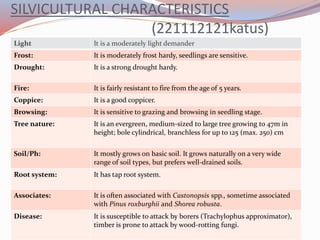
SILVICULTURAL CHARACTERISTICS
(221112121katus)
Light It is a moderately light demander.
Frost: It is moderately frost hardy, seedlings are sensitive.
Drought: It is a strong drought hardy.
Fire: It is fairly resistant to fire from the age of 5 years.
Coppice: It is a good coppicer.
Browsing: It is sensitive to grazing and browsing in seedling stage.
Tree nature: It is an evergreen, medium-sized to large tree growing to 47m in
height; bole cylindrical, branchless for up to 125 (max. 250) cm
Soil/Ph: It mostly grows on basic soil. It grows naturally on a very wide
range of soil types, but prefers well-drained soils.
Root system: It has tap root system.
Associates: It is often associated with Castonopsis spp., sometime associated
with Pinus roxburghii and Shorea robusta.
Disease: It is susceptible to attack by borers (Trachylophus approximator),
timber is prone to attack by wood-rotting fungi.
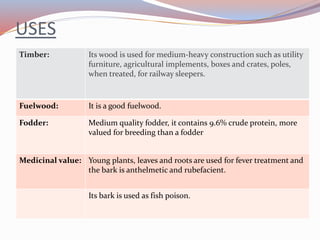
USES
Timber: Its wood is used for medium-heavy construction such as utility
furniture, agricultural implements, boxes and crates, poles,
when treated, for railway sleepers.
Fuelwood: It is a good fuelwood.
Fodder: Medium quality fodder, it contains 9.6% crude protein, more
valued for breeding than a fodder
Medicinal value: Young plants, leaves and roots are used for fever treatment and
the bark is anthelmetic and rubefacient.
Its bark is used as fish poison.
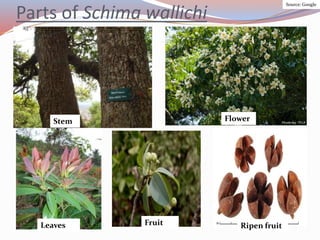
Parts of Schima wallichi
Flower
Stem Flower
Leaves Fruit Ripen fruit
Source: Google
References
 http://www.slideshare.net
 https://en.wikipedia.org/wiki/Alnus_nepalensis
 https://en.wikipedia.org/wiki/Schima wallichi
 A Compendium of Tree Species of Nepal by R.B.
Thakur & N.K. Phulara
Any Queries, Comments & Suggestions
are Heartily Welcomed !

Schima wallichii

  • 1.
    Presenter Anoj Subedi Section B/Roll.No. 54 Bsc 2nd Sem, 2nd Year IOF, Pokhara Welcome & Namaste Submitted to Deepak Gautam IOF, Pokhara
  • 2.
    INTRODUCTION  Forests playa vital role in maintaining ecological balance and economic development. Nepal has a very diverse flora with 35 forest types.  These forest types are categorized in ten major groups:-Tropical(upto 1000m), Subtropical broad- leaved, Subtropical pine(1000-2000m), Lower temperate broad-leaved, Lower temperate mixed broad-leaved, Upper temperate broad-leaved, Upper temperate mixed broad-leaved,Temperate coniferous (2000-2700m) Sub-alpine(3000- 4200m), and Alpine scrub forests(4200-5000m)
  • 3.
    Silviculture (Latin silvi- (forest)+ culture (as in growing) It is the practice of controlling the establishment, growth, composition, health, and quality of forests to meet diverse needs and values. Silvicultural characteristics It defines the life history, growth, behavior and ecology of a tree species.
  • 4.
    1.Alnus nepalensis INTRODUCTION Family: Betulaceae Scientificname : Alnus nepalensis Common name : Alder Local name : Utis Natural occurrence: It occurs between 500-2700m, mostly above 900m. At lower altitude, it prefers moist sites and shady aspects. It occurs in Himalayan moist temperate forest.
  • 5.
  • 6.
    SILVICULTURAL CHARACTERISTICS (123122221chilaune) Light: Itis a strong light demander. It is a pioneer species which grows well in full sunlight. Frost: is moderately frost hardy, seedlings are defoliated by frost and often killed. Drought: In its natural habitat, the drought seldom occurs. Fire: It is a fire resistant, as it contains large amount of water, and found in moist sites. Coppice: It coppices fairly. Its coppicing ability is adversely affected with provenance and time of cutting. Browsing: It is sensitive to grazing and browsing. Tree nature: It is a deciduous or semi deciduous tree having a sparsely branched with a straight cylindrical bole. Soil/Ph: It prefers soils with high water content (moist and well-drained) but can colonize in rocky sites exposed by landslips. Root system: It has tap root system. Associates: Mostly pure forest but sometime it may be found in Schima-castonopsis forest. Growth: Growth rates varies according to the soil moisture content. Disease: It is susceptible to attack by defoliaters ( Oriena spps.), stem borers(Batocera spps.) Other: It performs symbiotic relationship with frankia, an actinomycetes which forms root nodules to fix atmospheric N2.
  • 7.
    USES Timber: It producesmedium quality timber used for simple construction, furniture etc. Fuelwood: It dries rapidly and burns easily.(not so good in terms of calorific value) Fodder: Mature leaves are eaten by sheep and goats but not eaten by cattle. Tannin Bark contains 7% tannin. Paper & pulp It is also used for making high-quality paper and plywood. Ecological value: It is grown in forestry, agro-forestry and in land-slide areas to check landslide. In eastern Nepal, many community forest user groups have planted cardamom under utis.
  • 8.
    Parts of Alnusnepalensis Stem & leaves Flower Fruit Sawn wood Source: Google
  • 9.
    2.Schima wallichiI INTRODUCTION Family: Theaceae Scientificname: Schima wallichii Common name Schima, Needlewood Local name: Chilaune, Aule chilaune, Goe chassi Natural occurrence: It occurs between 900-2000m, common tree in eastern and central Nepal of mid-hills.
  • 10.
  • 11.
    SILVICULTURAL CHARACTERISTICS (221112121katus) Light Itis a moderately light demander. Frost: It is moderately frost hardy, seedlings are sensitive. Drought: It is a strong drought hardy. Fire: It is fairly resistant to fire from the age of 5 years. Coppice: It is a good coppicer. Browsing: It is sensitive to grazing and browsing in seedling stage. Tree nature: It is an evergreen, medium-sized to large tree growing to 47m in height; bole cylindrical, branchless for up to 125 (max. 250) cm Soil/Ph: It mostly grows on basic soil. It grows naturally on a very wide range of soil types, but prefers well-drained soils. Root system: It has tap root system. Associates: It is often associated with Castonopsis spp., sometime associated with Pinus roxburghii and Shorea robusta. Disease: It is susceptible to attack by borers (Trachylophus approximator), timber is prone to attack by wood-rotting fungi.
  • 12.
    USES Timber: Its woodis used for medium-heavy construction such as utility furniture, agricultural implements, boxes and crates, poles, when treated, for railway sleepers. Fuelwood: It is a good fuelwood. Fodder: Medium quality fodder, it contains 9.6% crude protein, more valued for breeding than a fodder Medicinal value: Young plants, leaves and roots are used for fever treatment and the bark is anthelmetic and rubefacient. Its bark is used as fish poison.
  • 13.
    Parts of Schimawallichi Flower Stem Flower Leaves Fruit Ripen fruit Source: Google
  • 14.
    References  http://www.slideshare.net  https://en.wikipedia.org/wiki/Alnus_nepalensis https://en.wikipedia.org/wiki/Schima wallichi  A Compendium of Tree Species of Nepal by R.B. Thakur & N.K. Phulara
  • 15.
    Any Queries, Comments& Suggestions are Heartily Welcomed !