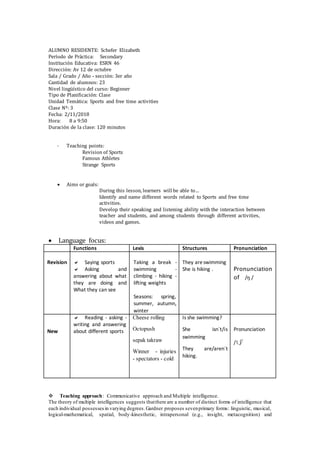
ALUMNO RESIDENTE: Schefer Elizabeth
Período de Práctica: Secondary
Institución Educativa: ESRN 46
Dirección: Av 12 de octubre
Sala / Grado / Año - sección: 3er año
Cantidad de alumnos: 23
Nivel lingüístico del curso: Beginner
Tipo de Planificación: Clase
Unidad Temática: Sports and free time activities
Clase Nº: 3
Fecha: 2/11/2018
Hora: 8 a 9:50
Duración de la clase: 120 minutos
· Teaching points:
Revision of Sports
Famous Athletes
Strange Sports

 Aims or goals: 
During this lesson, learners will be able to…
Identify and name different words related to Sports and free time
activities.
Develop their speaking and listening ability with the interaction between
teacher and students, and among students through different activities,
videos and games.
 Language focus:
Functions Lexis Structures Pronunciation
Revision  Saying sports
 Asking and
answering about what
they are doing and
What they can see
Taking a break -
swimming -
climbing - hiking -
lifting weights
Seasons: spring,
summer, autumn,
winter
They areswimming
She is hiking . Pronunciation
of /ŋ /
New
 Reading - asking -
writing and answering
about different sports
Cheese rolling
Octopush
sepak takraw
Winner - injuries
- spectators - cold
Is she swimming?
She isn´t/is
swimming
They are/aren´t
hiking.
Pronunciation
/tʃ/
 Teaching approach: Communicative approach and Multiple intelligence.
The theory of multiple intelligences suggests thatthere are a number of distinct forms of intelligence that
each individual possessesin varying degrees.Gardner proposes sevenprimary forms: linguistic, musical,
logical-mathematical, spatial, body-kinesthetic, intrapersonal (e.g., insight, metacognition) and
interpersonal (e.g., social skills)
 Integration of skills:What skills will be integrated and how?
Speaking and listening skills are integrated, through different activities. Writing and reading- the students
are invited to complete charts and write about what they are doing.
 Materials and resources: video “Culture Close-up by Pearson - pictures - computer- photocopies
- poster-markers.
 Pedagogical use of ICT in class or at home: I will use the computer to reproduce the songs and
videos.
 Seating arrangement: The group will be sitting on their chairs. Students will play and move into
the classroom.
 Assessment: what will be assessed and how:
I will check that they understand the new target language through getting the students to talk
about what they can do.Grammar and vocabulary will be assessed through writing activities and games.
Routine:(2 minutes)
I will great the students:Hello” How are you today? Are you Ok? “They will answer saying “I´m ok”
or “I´m fine, thanks”. Them I will write the date on the board.
Warm up: (10 minutes)
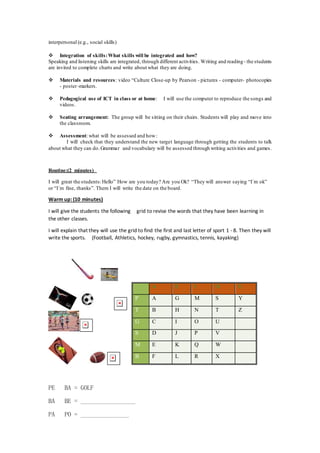
I will give the students the following grid to revise the words that they have been learning in
the other classes.
I will explain that they will use the grid to find the first and last letter of sport 1 - 8. Then they will
write the sports. (Football, Athletics, hockey, rugby, gymnastics, tennis, kayaking)
PE BA = GOLF
BA BE = _________________
PA PO = _______________
A E I O U
P A G M S Y
T B H N T Z
G C I O U
S D J P V
M E K Q W
B F L R X
TE PU = _______________
BI PU= ________________
PE PO = _______________
ME TI = ________________
SO BE = ________________
Transition: Transition: Great! You know a lot of words!! Now you are going to read a text about a
person who is a famous athlete.
Activity: 35 minutes
Pre-reading activity:
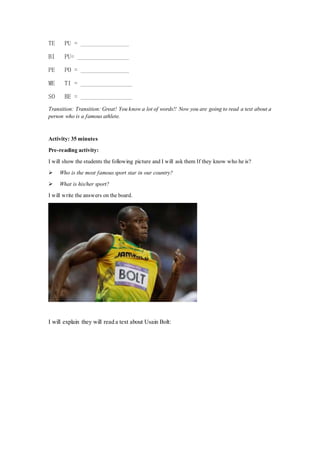
I will show the students the following picture and I will ask them If they know who he is?
 Who is the most famous sport star in our country?
 What is his/her sport?
I will write the answers on the board.
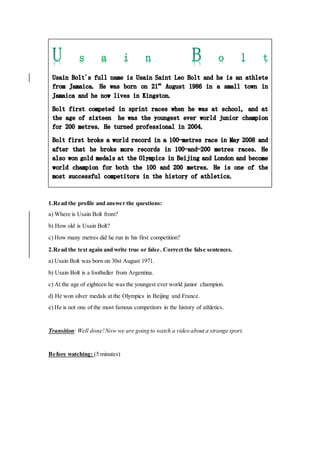
I will explain they will read a text about Usain Bolt:
1.Read the profile and answer the questions:
a) Where is Usain Bolt from?
b) How old is Usain Bolt?
c) How many metres did he run in his first competition?
2.Read the text again and write true or false. Correct the false sentences.
a) Usain Bolt was born on 30st August 1971.
b) Usain Bolt is a footballer from Argentina.
c) At the age of eighteen he was the youngest ever world junior champion.
d) He won silver medals at the Olympics in Beijing and France.
e) He is not one of the most famous competitors in the history of athletics.
Transition: Well done!Now we are going to watch a video about a strange sport.
Before watching: (5 minutes)
I will show the students a picture
Do you know what the names of these sports are?
I will stick the piece of papers under the picture to help the students with the name of these
sports.
Cheese rolling octopush sepak takraw
While watching:
Cheese-Rolling Races - YouTube [360p].mp4
I will give the students the following photocopies. We will read allow the sentences. Then I
will show them the video. Afterthat, I will encourage the students to complete the task. Finally,
I will show one more time the video to check their answers.
Activity: (20 minutes)
Fill in the blanks. Use the words in the box. Watch the video and check you answer.
Winner - injuries - spectators - cold
a) The first ___________ of the day is Craig Brown.
b) One year, one of the cheeses went into the ____________.
c) It is not just spectators who get injured - competitors do as well, especially when it is
________ or there hasn´t been much rain.
d) Cheese-rolling spectator: “It is when the ground is really hard. That is when the
___________ are going to happen.
Transition:Well done children!The next activity is about some questions and you are going to
work in small groups.
After Watching:
I will ask the students to make groups of two or three students. They will talk about the
questions. When they finish they will compare the answer with the rest of the class. (I will give
them a piece of paper to write their answers)
Activity ( 10 minutes)
Why do you think people join the cheese-rolling race?
Do they want the cheese?
Do they want to have fun?
Are they crazy?
Activity (20 minutes) ( we didn´t do this activity thelast class)
I will ask them to make groups of 5 students and I will bring some magazines about sports,
scissors, glue and markers)
They will prepare a poster with typical sports in Argentina. They will write 4 o 5 sentences like
this one:
They are playing football. Or they are playing tennis.etc
Transition: Ok You work very hard,nowis time to play!Are you ready?
Activity 5 (10 minutes)
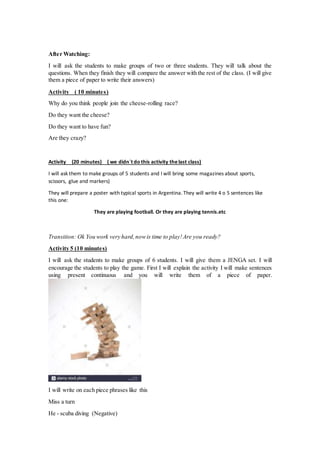
I will ask the students to make groups of 6 students. I will give them a JENGA set. I will
encourage the students to play the game. First I will explain the activity I will make sentences
using present continuous and you will write them of a piece of paper.
I will write on each piece phrases like this
Miss a turn
He - scuba diving (Negative)
They - hiking - (affirmative)
The students will make sentences in affirmative and negative.
Great children!!! You work very hard today!!!
See you next Friday!! Have a nice weekend!!
Lesson plan
component
Excellent
5
Very Good
4
Good
3
Acceptable
2
Below
Standard
1
Visual organization x
Coherence and
sequencing
X
Variety of resources –
Learning styles
X
Stages and activities x
Teaching strategies X
Language accuracy X
Observations
Great ideas! Exploit resources to the full.

Schefer tpd - lesson plan 3 - secondary - passed

  • 1.
    ALUMNO RESIDENTE: ScheferElizabeth Período de Práctica: Secondary Institución Educativa: ESRN 46 Dirección: Av 12 de octubre Sala / Grado / Año - sección: 3er año Cantidad de alumnos: 23 Nivel lingüístico del curso: Beginner Tipo de Planificación: Clase Unidad Temática: Sports and free time activities Clase Nº: 3 Fecha: 2/11/2018 Hora: 8 a 9:50 Duración de la clase: 120 minutos · Teaching points: Revision of Sports Famous Athletes Strange Sports   Aims or goals:  During this lesson, learners will be able to… Identify and name different words related to Sports and free time activities. Develop their speaking and listening ability with the interaction between teacher and students, and among students through different activities, videos and games.  Language focus: Functions Lexis Structures Pronunciation Revision  Saying sports  Asking and answering about what they are doing and What they can see Taking a break - swimming - climbing - hiking - lifting weights Seasons: spring, summer, autumn, winter They areswimming She is hiking . Pronunciation of /ŋ / New  Reading - asking - writing and answering about different sports Cheese rolling Octopush sepak takraw Winner - injuries - spectators - cold Is she swimming? She isn´t/is swimming They are/aren´t hiking. Pronunciation /tʃ/  Teaching approach: Communicative approach and Multiple intelligence. The theory of multiple intelligences suggests thatthere are a number of distinct forms of intelligence that each individual possessesin varying degrees.Gardner proposes sevenprimary forms: linguistic, musical, logical-mathematical, spatial, body-kinesthetic, intrapersonal (e.g., insight, metacognition) and
  • 2.
    interpersonal (e.g., socialskills)  Integration of skills:What skills will be integrated and how? Speaking and listening skills are integrated, through different activities. Writing and reading- the students are invited to complete charts and write about what they are doing.  Materials and resources: video “Culture Close-up by Pearson - pictures - computer- photocopies - poster-markers.  Pedagogical use of ICT in class or at home: I will use the computer to reproduce the songs and videos.  Seating arrangement: The group will be sitting on their chairs. Students will play and move into the classroom.  Assessment: what will be assessed and how: I will check that they understand the new target language through getting the students to talk about what they can do.Grammar and vocabulary will be assessed through writing activities and games. Routine:(2 minutes) I will great the students:Hello” How are you today? Are you Ok? “They will answer saying “I´m ok” or “I´m fine, thanks”. Them I will write the date on the board. Warm up: (10 minutes) I will give the students the following grid to revise the words that they have been learning in the other classes. I will explain that they will use the grid to find the first and last letter of sport 1 - 8. Then they will write the sports. (Football, Athletics, hockey, rugby, gymnastics, tennis, kayaking) PE BA = GOLF BA BE = _________________ PA PO = _______________ A E I O U P A G M S Y T B H N T Z G C I O U S D J P V M E K Q W B F L R X
  • 3.
    TE PU =_______________ BI PU= ________________ PE PO = _______________ ME TI = ________________ SO BE = ________________ Transition: Transition: Great! You know a lot of words!! Now you are going to read a text about a person who is a famous athlete. Activity: 35 minutes Pre-reading activity: I will show the students the following picture and I will ask them If they know who he is?  Who is the most famous sport star in our country?  What is his/her sport? I will write the answers on the board. I will explain they will read a text about Usain Bolt:
  • 4.
    1.Read the profileand answer the questions: a) Where is Usain Bolt from? b) How old is Usain Bolt? c) How many metres did he run in his first competition? 2.Read the text again and write true or false. Correct the false sentences. a) Usain Bolt was born on 30st August 1971. b) Usain Bolt is a footballer from Argentina. c) At the age of eighteen he was the youngest ever world junior champion. d) He won silver medals at the Olympics in Beijing and France. e) He is not one of the most famous competitors in the history of athletics. Transition: Well done!Now we are going to watch a video about a strange sport. Before watching: (5 minutes)
  • 5.
    I will showthe students a picture Do you know what the names of these sports are? I will stick the piece of papers under the picture to help the students with the name of these sports. Cheese rolling octopush sepak takraw While watching: Cheese-Rolling Races - YouTube [360p].mp4 I will give the students the following photocopies. We will read allow the sentences. Then I will show them the video. Afterthat, I will encourage the students to complete the task. Finally, I will show one more time the video to check their answers. Activity: (20 minutes) Fill in the blanks. Use the words in the box. Watch the video and check you answer. Winner - injuries - spectators - cold a) The first ___________ of the day is Craig Brown. b) One year, one of the cheeses went into the ____________. c) It is not just spectators who get injured - competitors do as well, especially when it is ________ or there hasn´t been much rain. d) Cheese-rolling spectator: “It is when the ground is really hard. That is when the ___________ are going to happen. Transition:Well done children!The next activity is about some questions and you are going to work in small groups.
  • 6.
    After Watching: I willask the students to make groups of two or three students. They will talk about the questions. When they finish they will compare the answer with the rest of the class. (I will give them a piece of paper to write their answers) Activity ( 10 minutes) Why do you think people join the cheese-rolling race? Do they want the cheese? Do they want to have fun? Are they crazy? Activity (20 minutes) ( we didn´t do this activity thelast class) I will ask them to make groups of 5 students and I will bring some magazines about sports, scissors, glue and markers) They will prepare a poster with typical sports in Argentina. They will write 4 o 5 sentences like this one: They are playing football. Or they are playing tennis.etc Transition: Ok You work very hard,nowis time to play!Are you ready? Activity 5 (10 minutes) I will ask the students to make groups of 6 students. I will give them a JENGA set. I will encourage the students to play the game. First I will explain the activity I will make sentences using present continuous and you will write them of a piece of paper. I will write on each piece phrases like this Miss a turn He - scuba diving (Negative)
  • 7.
    They - hiking- (affirmative) The students will make sentences in affirmative and negative. Great children!!! You work very hard today!!! See you next Friday!! Have a nice weekend!! Lesson plan component Excellent 5 Very Good 4 Good 3 Acceptable 2 Below Standard 1 Visual organization x Coherence and sequencing X Variety of resources – Learning styles X Stages and activities x Teaching strategies X Language accuracy X Observations Great ideas! Exploit resources to the full.