1
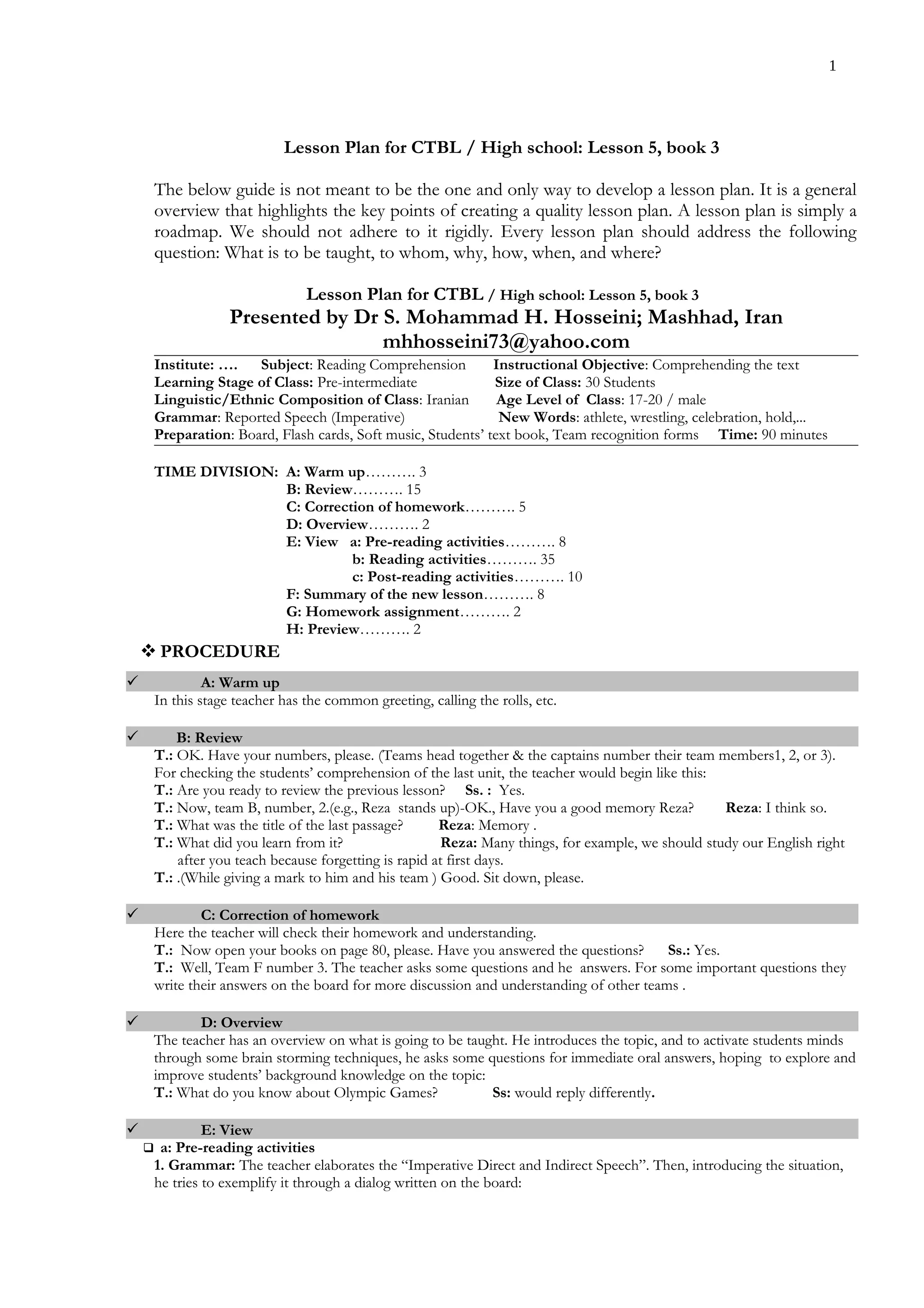
Lesson Plan for CTBL / High school: Lesson 5, book 3
The below guide is not meant to be the one and only way to develop a lesson plan. It is a general
overview that highlights the key points of creating a quality lesson plan. A lesson plan is simply a
roadmap. We should not adhere to it rigidly. Every lesson plan should address the following
question: What is to be taught, to whom, why, how, when, and where?
Lesson Plan for CTBL / High school: Lesson 5, book 3
Presented by Dr S. Mohammad H. Hosseini; Mashhad, Iran
mhhosseini73@yahoo.com
Institute: …. Subject: Reading Comprehension Instructional Objective: Comprehending the text
Learning Stage of Class: Pre-intermediate Size of Class: 30 Students
Linguistic/Ethnic Composition of Class: Iranian Age Level of Class: 17-20 / male
Grammar: Reported Speech (Imperative) New Words: athlete, wrestling, celebration, hold,...
Preparation: Board, Flash cards, Soft music, Students’ text book, Team recognition forms Time: 90 minutes
TIME DIVISION: A: Warm up………. 3
B: Review………. 15
C: Correction of homework………. 5
D: Overview………. 2
E: View a: Pre-reading activities………. 8
b: Reading activities………. 35
c: Post-reading activities………. 10
F: Summary of the new lesson………. 8
G: Homework assignment………. 2
H: Preview………. 2
 PROCEDURE
 A: Warm up
In this stage teacher has the common greeting, calling the rolls, etc.
 B: Review
T.: OK. Have your numbers, please. (Teams head together & the captains number their team members1, 2, or 3).
For checking the students’ comprehension of the last unit, the teacher would begin like this:
T.: Are you ready to review the previous lesson? Ss. : Yes.
T.: Now, team B, number, 2.(e.g., Reza stands up)-OK., Have you a good memory Reza? Reza: I think so.
T.: What was the title of the last passage? Reza: Memory .
T.: What did you learn from it? Reza: Many things, for example, we should study our English right
after you teach because forgetting is rapid at first days.
T.: .(While giving a mark to him and his team ) Good. Sit down, please.
 C: Correction of homework
Here the teacher will check their homework and understanding.
T.: Now open your books on page 80, please. Have you answered the questions? Ss.: Yes.
T.: Well, Team F number 3. The teacher asks some questions and he answers. For some important questions they
write their answers on the board for more discussion and understanding of other teams .
 D: Overview
The teacher has an overview on what is going to be taught. He introduces the topic, and to activate students minds
through some brain storming techniques, he asks some questions for immediate oral answers, hoping to explore and
improve students’ background knowledge on the topic:
T.: What do you know about Olympic Games? Ss: would reply differently.
 E: View
 a: Pre-reading activities
1. Grammar: The teacher elaborates the “Imperative Direct and Indirect Speech”. Then, introducing the situation,
he tries to exemplify it through a dialog written on the board:
2
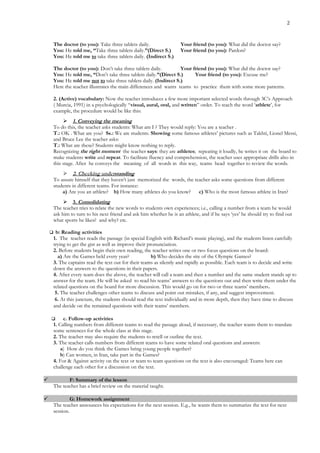
The doctor (to you): Take three tablets daily. Your friend (to you): What did the doctor say?
You: He told me, “Take three tablets daily.”(Direct S.) Your friend (to you): Pardon?
You: He told me to take three tablets daily. (Indirect S.)
The doctor (to you): Don’t take three tablets daily. Your friend (to you): What did the doctor say?
You: He told me, “Don’t take three tablets daily.”(Direct S.) Your friend (to you): Excuse me?
You: He told me not to take three tablets daily. (Indirect S.)
Here the teacher illustrates the main differences and wants teams to practice them with some more patterns.
2. (Active) vocabulary: Now the teacher introduces a few more important selected words through 3C’s Approach
( Murcia, 1991) in a psychologically “visual, aural, oral, and written” order. To teach the word ‘athlete’, for
example, the procedure would be like this:
 1. Conveying the meaning
To do this, the teacher asks students: What am I ? They would reply: You are a teacher .
T.: OK . What are you? Ss.: We are students. Showing some famous athletes’ pictures such as Takhti, Lionel Messi,
and Bruce Lee the teacher asks:
T.: What are these? Students might know nothing to reply.
Recognizing the right moment the teacher says: they are athletes; repeating it loudly, he writes it on the board to
make students write and repeat. To facilitate fluency and comprehension, the teacher uses appropriate drills also in
this stage. After he conveys the meaning of all words in this way, teams head together to review the words.
 2. Checking understanding
To assure himself that they haven’t just memorized the words, the teacher asks some questions from different
students in different teams. For instance:
a) Are you an athlete? b) How many athletes do you know? c) Who is the most famous athlete in Iran?
 3. Consolidating
The teacher tries to relate the new words to students own experiences; i.e., calling a number from a team he would
ask him to turn to his next friend and ask him whether he is an athlete, and if he says ‘yes’ he should try to find out
what sports he likes? and why? etc.
 b: Reading activities
1. The teacher reads the passage (in special English with Richard’s music playing), and the students listen carefully
trying to get the gist as well as improve their pronunciation.
2. Before students begin their own reading, the teacher writes one or two focus questions on the board:
a) Are the Games held every year? b) Who decides the site of the Olympic Games?
3. The captains read the text out for their teams as silently and rapidly as possible. Each team is to decide and write
down the answers to the questions in their papers.
4. After every team does the above, the teacher will call a team and then a number and the same student stands up to
answer for the team. He will be asked to read his teams’ answers to the questions out and then write them under the
related questions on the board for more discussion. This would go on for two or three teams’ members.
5. The teacher challenges other teams to discuss and point out mistakes, if any, and suggest improvement.
6. At this juncture, the students should read the text individually and in more depth, then they have time to discuss
and decide on the remained questions with their teams’ members.
 c. Follow-up activities
1. Calling numbers from different teams to read the passage aloud, if necessary, the teacher wants them to translate
some sentences for the whole class at this stage.
2. The teacher may also require the students to retell or outline the text.
3. The teacher calls numbers from different teams to have some related oral questions and answers:
a) How do you think the Games bring young people together?
b) Can women, in Iran, take part in the Games?
4. For & Against activity on the text or team to team questions on the text is also encouraged: Teams here can
challenge each other for a discussion on the text.
 F: Summary of the lesson
The teacher has a brief review on the material taught.
 G: Homework assignment
The teacher announces his expectations for the next session. E.g., he wants them to summarize the text for next
session.
3
 H: Preview
T.: Next text is about the roots of words. E.g., the word ‘orange’ in English comes from ‘narange’ in Persian.
♦ NOTE: In this kind of classes the teacher monitors students’ interaction for learning by
systematically observing each team. Doing so, we not only have the opportunity to know our students better,
but also with the explanations students give to each other we have a window into their minds that allows us
to see what they do and what they do not understand. While rounding about we also intervene whenever it is
necessary to motivate them and also teach them some facilitative learning strategies or even social skills. Such
situations provide us the opportunity to collect data for whole class processing.
=====================

Sample Lesson Plan by Dr Seyed Mohammad Hassan Hosseini

  • 1.
    1 Lesson Plan forCTBL / High school: Lesson 5, book 3 The below guide is not meant to be the one and only way to develop a lesson plan. It is a general overview that highlights the key points of creating a quality lesson plan. A lesson plan is simply a roadmap. We should not adhere to it rigidly. Every lesson plan should address the following question: What is to be taught, to whom, why, how, when, and where? Lesson Plan for CTBL / High school: Lesson 5, book 3 Presented by Dr S. Mohammad H. Hosseini; Mashhad, Iran mhhosseini73@yahoo.com Institute: …. Subject: Reading Comprehension Instructional Objective: Comprehending the text Learning Stage of Class: Pre-intermediate Size of Class: 30 Students Linguistic/Ethnic Composition of Class: Iranian Age Level of Class: 17-20 / male Grammar: Reported Speech (Imperative) New Words: athlete, wrestling, celebration, hold,... Preparation: Board, Flash cards, Soft music, Students’ text book, Team recognition forms Time: 90 minutes TIME DIVISION: A: Warm up………. 3 B: Review………. 15 C: Correction of homework………. 5 D: Overview………. 2 E: View a: Pre-reading activities………. 8 b: Reading activities………. 35 c: Post-reading activities………. 10 F: Summary of the new lesson………. 8 G: Homework assignment………. 2 H: Preview………. 2  PROCEDURE  A: Warm up In this stage teacher has the common greeting, calling the rolls, etc.  B: Review T.: OK. Have your numbers, please. (Teams head together & the captains number their team members1, 2, or 3). For checking the students’ comprehension of the last unit, the teacher would begin like this: T.: Are you ready to review the previous lesson? Ss. : Yes. T.: Now, team B, number, 2.(e.g., Reza stands up)-OK., Have you a good memory Reza? Reza: I think so. T.: What was the title of the last passage? Reza: Memory . T.: What did you learn from it? Reza: Many things, for example, we should study our English right after you teach because forgetting is rapid at first days. T.: .(While giving a mark to him and his team ) Good. Sit down, please.  C: Correction of homework Here the teacher will check their homework and understanding. T.: Now open your books on page 80, please. Have you answered the questions? Ss.: Yes. T.: Well, Team F number 3. The teacher asks some questions and he answers. For some important questions they write their answers on the board for more discussion and understanding of other teams .  D: Overview The teacher has an overview on what is going to be taught. He introduces the topic, and to activate students minds through some brain storming techniques, he asks some questions for immediate oral answers, hoping to explore and improve students’ background knowledge on the topic: T.: What do you know about Olympic Games? Ss: would reply differently.  E: View  a: Pre-reading activities 1. Grammar: The teacher elaborates the “Imperative Direct and Indirect Speech”. Then, introducing the situation, he tries to exemplify it through a dialog written on the board:
  • 2.
    2 The doctor (toyou): Take three tablets daily. Your friend (to you): What did the doctor say? You: He told me, “Take three tablets daily.”(Direct S.) Your friend (to you): Pardon? You: He told me to take three tablets daily. (Indirect S.) The doctor (to you): Don’t take three tablets daily. Your friend (to you): What did the doctor say? You: He told me, “Don’t take three tablets daily.”(Direct S.) Your friend (to you): Excuse me? You: He told me not to take three tablets daily. (Indirect S.) Here the teacher illustrates the main differences and wants teams to practice them with some more patterns. 2. (Active) vocabulary: Now the teacher introduces a few more important selected words through 3C’s Approach ( Murcia, 1991) in a psychologically “visual, aural, oral, and written” order. To teach the word ‘athlete’, for example, the procedure would be like this:  1. Conveying the meaning To do this, the teacher asks students: What am I ? They would reply: You are a teacher . T.: OK . What are you? Ss.: We are students. Showing some famous athletes’ pictures such as Takhti, Lionel Messi, and Bruce Lee the teacher asks: T.: What are these? Students might know nothing to reply. Recognizing the right moment the teacher says: they are athletes; repeating it loudly, he writes it on the board to make students write and repeat. To facilitate fluency and comprehension, the teacher uses appropriate drills also in this stage. After he conveys the meaning of all words in this way, teams head together to review the words.  2. Checking understanding To assure himself that they haven’t just memorized the words, the teacher asks some questions from different students in different teams. For instance: a) Are you an athlete? b) How many athletes do you know? c) Who is the most famous athlete in Iran?  3. Consolidating The teacher tries to relate the new words to students own experiences; i.e., calling a number from a team he would ask him to turn to his next friend and ask him whether he is an athlete, and if he says ‘yes’ he should try to find out what sports he likes? and why? etc.  b: Reading activities 1. The teacher reads the passage (in special English with Richard’s music playing), and the students listen carefully trying to get the gist as well as improve their pronunciation. 2. Before students begin their own reading, the teacher writes one or two focus questions on the board: a) Are the Games held every year? b) Who decides the site of the Olympic Games? 3. The captains read the text out for their teams as silently and rapidly as possible. Each team is to decide and write down the answers to the questions in their papers. 4. After every team does the above, the teacher will call a team and then a number and the same student stands up to answer for the team. He will be asked to read his teams’ answers to the questions out and then write them under the related questions on the board for more discussion. This would go on for two or three teams’ members. 5. The teacher challenges other teams to discuss and point out mistakes, if any, and suggest improvement. 6. At this juncture, the students should read the text individually and in more depth, then they have time to discuss and decide on the remained questions with their teams’ members.  c. Follow-up activities 1. Calling numbers from different teams to read the passage aloud, if necessary, the teacher wants them to translate some sentences for the whole class at this stage. 2. The teacher may also require the students to retell or outline the text. 3. The teacher calls numbers from different teams to have some related oral questions and answers: a) How do you think the Games bring young people together? b) Can women, in Iran, take part in the Games? 4. For & Against activity on the text or team to team questions on the text is also encouraged: Teams here can challenge each other for a discussion on the text.  F: Summary of the lesson The teacher has a brief review on the material taught.  G: Homework assignment The teacher announces his expectations for the next session. E.g., he wants them to summarize the text for next session.
  • 3.
    3  H: Preview T.:Next text is about the roots of words. E.g., the word ‘orange’ in English comes from ‘narange’ in Persian. ♦ NOTE: In this kind of classes the teacher monitors students’ interaction for learning by systematically observing each team. Doing so, we not only have the opportunity to know our students better, but also with the explanations students give to each other we have a window into their minds that allows us to see what they do and what they do not understand. While rounding about we also intervene whenever it is necessary to motivate them and also teach them some facilitative learning strategies or even social skills. Such situations provide us the opportunity to collect data for whole class processing. =====================