Scheduling
BBM 8th Sem
By: Er. Sudarshan Sharma
PROJECT SCHEDULE
• In project management, a schedule is a listing of
a project milestone activities, and deliverables,
usually intended start and finish dates.
PROJECT SCHEDULE
• PROJECT SCHEDULE IS THE CORE OF THE PROJECT PLAN.
• It is used to commit people to the project and show the organization how the work
will be performed.
• Schedules are used to communicate final deadlines and, in some cases, to determine
resource needs. They are also used as a kind of checklist to make sure that every task
necessary is performed.
• In other words, the project schedule is the means by which the project manager
brings the team and the project under control.
BUILDING THE PROJECT SCHEDULE
• Before a project schedule can be created, the
project manager must have a work breakdown
structure (WBS)
BUILDING THE PROJECT SCHEDULE
• Allocate Resources to the task
• identify the resources required to perform each of the tasks.
• Resources are not only persons
• If one resource has been assigned to multiple project special care needs to be
done
• Senior team members are scarce; they can’t be assigned every task, and some
tasks are too difficult to assign to junior people at all.
• it requires the project manager to know the team for effective resource
assignment
• There are two useful and well-known principles to remember
when considering how people work on projects.
• First, Parkinson’s Law states, “Work expands so as to fill the
time available for its completion.”
• And second, as Fred Brooks, “Nine women cannot have a
baby in one month”
BUILDING THE PROJECT SCHEDULE
• Identify dependencies
• Once resources are allocated, the next step in creating a project
schedule is to identify dependencies between tasks.
• A task has a dependency if it involves an activity, resource, or
work product that is subsequently required by another task
• If Wideband Delphi is used to generate estimates, many of these
dependencies will already be represented in the assumptions
BUILDING THE PROJECT SCHEDULE
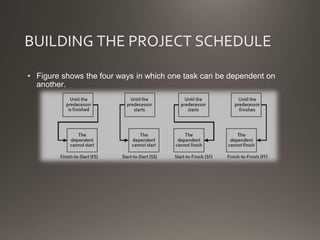
• Figure shows the four ways in which one task can be dependent on
another.
BUILDING THE PROJECT SCHEDULE
• There are many reasons why one task may be dependent on another
• The most common is the causal relationship:
• the dependent task relies on a work product generated by the
predecessor.
• For eg. Testing cannot be done before coding
• Another reason is, one task shares the same resource:
• There are couple of software in the market to manage dependencies
BUILDING THE PROJECT SCHEDULE
• Create the schedule
• There are two methods
• Gantt Chart
• Network Diagraming methods
• CPM
• PERT
• There are couple of software in the market to create schedules
• Trello
• Asana
• Slack
• Zira
BUILDING THE PROJECT SCHEDULE
• Reconcile the schedule with organizations need
• If the scheduled date does not fit with the needs of the organization or the project
stakeholders, the project manager should first go back to the resource list to see if
the tasks can be reallocated more efficiently
• One way to do this is to look for large gaps in the schedule; sometimes a small shift or swap
in resources can close those gaps.
• Another way to deal with a schedule that runs past a non-negotiable due date is to add or
rearrange resources (if available).
• It may be possible to return to the assumptions generated during the estimation session.
• project manager to revisit the project’s scope, which will have to be adjusted to allow for a
phased release: some features will have to be broken into phases, while others may be cut
out entirely.
• For this, revise the vision and scope document and go through its review
process all over again

4.1 Scheduling.ppt

  • 1.
    Scheduling BBM 8th Sem By:Er. Sudarshan Sharma
  • 2.
    PROJECT SCHEDULE • Inproject management, a schedule is a listing of a project milestone activities, and deliverables, usually intended start and finish dates.
  • 3.
    PROJECT SCHEDULE • PROJECTSCHEDULE IS THE CORE OF THE PROJECT PLAN. • It is used to commit people to the project and show the organization how the work will be performed. • Schedules are used to communicate final deadlines and, in some cases, to determine resource needs. They are also used as a kind of checklist to make sure that every task necessary is performed. • In other words, the project schedule is the means by which the project manager brings the team and the project under control.
  • 4.
    BUILDING THE PROJECTSCHEDULE • Before a project schedule can be created, the project manager must have a work breakdown structure (WBS)
  • 5.
    BUILDING THE PROJECTSCHEDULE • Allocate Resources to the task • identify the resources required to perform each of the tasks. • Resources are not only persons • If one resource has been assigned to multiple project special care needs to be done • Senior team members are scarce; they can’t be assigned every task, and some tasks are too difficult to assign to junior people at all. • it requires the project manager to know the team for effective resource assignment • There are two useful and well-known principles to remember when considering how people work on projects. • First, Parkinson’s Law states, “Work expands so as to fill the time available for its completion.” • And second, as Fred Brooks, “Nine women cannot have a baby in one month”
  • 6.
    BUILDING THE PROJECTSCHEDULE • Identify dependencies • Once resources are allocated, the next step in creating a project schedule is to identify dependencies between tasks. • A task has a dependency if it involves an activity, resource, or work product that is subsequently required by another task • If Wideband Delphi is used to generate estimates, many of these dependencies will already be represented in the assumptions
  • 7.
    BUILDING THE PROJECTSCHEDULE • Figure shows the four ways in which one task can be dependent on another.
  • 8.
    BUILDING THE PROJECTSCHEDULE • There are many reasons why one task may be dependent on another • The most common is the causal relationship: • the dependent task relies on a work product generated by the predecessor. • For eg. Testing cannot be done before coding • Another reason is, one task shares the same resource: • There are couple of software in the market to manage dependencies
  • 9.
    BUILDING THE PROJECTSCHEDULE • Create the schedule • There are two methods • Gantt Chart • Network Diagraming methods • CPM • PERT • There are couple of software in the market to create schedules • Trello • Asana • Slack • Zira
  • 10.
    BUILDING THE PROJECTSCHEDULE • Reconcile the schedule with organizations need • If the scheduled date does not fit with the needs of the organization or the project stakeholders, the project manager should first go back to the resource list to see if the tasks can be reallocated more efficiently • One way to do this is to look for large gaps in the schedule; sometimes a small shift or swap in resources can close those gaps. • Another way to deal with a schedule that runs past a non-negotiable due date is to add or rearrange resources (if available). • It may be possible to return to the assumptions generated during the estimation session. • project manager to revisit the project’s scope, which will have to be adjusted to allow for a phased release: some features will have to be broken into phases, while others may be cut out entirely. • For this, revise the vision and scope document and go through its review process all over again