9.1 Scene Perception
PSYC 579 Topic Presentation,
University of British Columbia
Diliara Nasirova
School of Interactive Art and Technology,
Simon Fraser University
March 23, 2011
2
Outline
1.  Introduction to Scene Perception
2.  Theories of Scene Perception
■  Coherence Theory
■  Virtual Representation
■  Triadic Architecture
3.  Application to visual design
■  Visual Transitions
■  Attentional Coercion
Diliara Nasirova | PSYC 579 | March 23, 2011
3
Introduction
Scene Perception
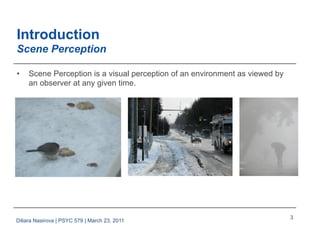
•  Scene Perception is a visual perception of an environment as viewed by
an observer at any given time.
Diliara Nasirova | PSYC 579 | March 23, 2011
4
Introduction
Belief about vision
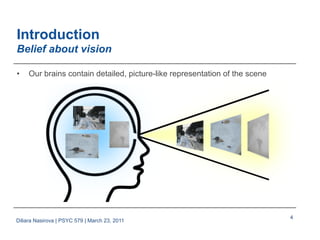
•  Our brains contain detailed, picture-like representation of the scene
Diliara Nasirova | PSYC 579 | March 23, 2011
5
Introduction
Phenomena against the belief
•  Inattentional Blindness:
•  The failure to notice the presence
of unattended stimuli, even when
they are presented within an
observer’s field of view
•  Change Blindness:
•  The failure to see changes even
when they are large, anticipated
and repeatedly made if they are
made during a visual disturbance
Diliara Nasirova | PSYC 579 | March 23, 2011
Simons and Chabris (1999) “Gorillas in Our Midst:
Sustained Inattentional Blindness for Dynamic Events”
6
Introduction
Phenomena against the belief
•  Inattentional Blindness:
•  The failure to notice the presence
of unattended stimuli, even when
they are presented within an
observer’s field of view
•  Change Blindness:
•  The failure to see changes even
when they are large, anticipated
and repeatedly made if they are
made during a visual disturbance
Diliara Nasirova | PSYC 579 | March 23, 2011
Rensink RA (2002). Internal vs. external information in
visual perception.
7
Introduction
Change Blindness demo
Diliara Nasirova | PSYC 579 | March 23, 2011
http://www.cs.ubc.ca/~rensink/flicker/download/Harborside.mov
8
Introduction
Change Blindness demo
Diliara Nasirova | PSYC 579 | March 23, 2011
http://www.cs.ubc.ca/~rensink/flicker/download/Harborside.mov
9
Introduction
Change Blindness demo
Diliara Nasirova | PSYC 579 | March 23, 2011
http://www.cs.ubc.ca/~rensink/flicker/download/Harborside.mov
10
Introduction
Change Blindness demo
Diliara Nasirova | PSYC 579 | March 23, 2011
http://www.cs.ubc.ca/~rensink/flicker/download/Harborside.mov
11
Introduction
If a visual buffer existed…
Diliara Nasirova | PSYC 579 | March 23, 2011
12
Introduction
If there is no buffer…
Diliara Nasirova | PSYC 579 | March 23, 2011
1.  How is it possible to see change at all?
2.  How might human vision operate?
13
Theories of Scene Perception
Coherence theory
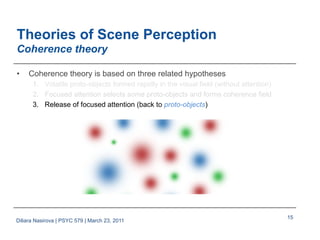
•  Coherence theory is based on three related hypotheses
1.  Volatile proto-objects formed rapidly in the visual field (without attention)
2.  Focused attention selects some proto-objects and forms coherence field
3.  Release of focused attention (back to proto-objects)
Diliara Nasirova | PSYC 579 | March 23, 2011
14
Theories of Scene Perception
Coherence theory
•  Coherence theory is based on three related hypotheses
1.  Volatile proto-objects formed rapidly in the visual field (without attention)
2. Focused attention selects some proto-objects and forms coherence field
3. Release of focused attention (back to proto-objects)
Diliara Nasirova | PSYC 579 | March 23, 2011
15
Theories of Scene Perception
Coherence theory
•  Coherence theory is based on three related hypotheses
1.  Volatile proto-objects formed rapidly in the visual field (without attention)
2.  Focused attention selects some proto-objects and forms coherence field
3.  Release of focused attention (back to proto-objects)
Diliara Nasirova | PSYC 579 | March 23, 2011
16
Theories of Scene Perception
Coherence theory
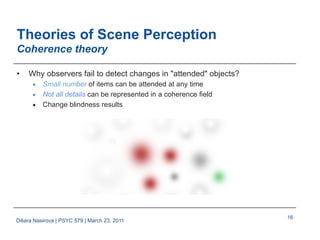
•  Why observers fail to detect changes in "attended" objects?
■  Small number of items can be attended at any time
■  Not all details can be represented in a coherence field
■  Change blindness results
Diliara Nasirova | PSYC 579 | March 23, 2011
Theories of Scene Perception
Coherence theory
•  Counterintuitive implications:
■  Only a few items can be
represented
■  The representation details is
limited
•  Why do we not notice these
limitations?
Diliara Nasirova | PSYC 579 | March 23, 2011
Rensink RA (2000a). The dynamic representation of scenes.
18
Theories of Scene Perception
Virtual Representation
Diliara Nasirova | PSYC 579 | March 23, 2011
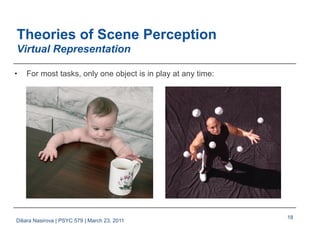
•  For most tasks, only one object is in play at any time:
19
Theories of Scene Perception
Virtual Representation
Diliara Nasirova | PSYC 579 | March 23, 2011
•  Idea of virtual representation:
■  Create a coherent, detailed
representation only of a few objects
needed for the task at hand
■  Details about any object should be
available on request
•  Provide large savings in computational
resources: memory & processing time
20
Theories of Scene Perception
Virtual Representation
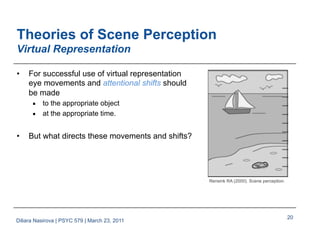
•  For successful use of virtual representation
eye movements and attentional shifts should
be made
■  to the appropriate object
■  at the appropriate time.
•  But what directs these movements and shifts?
Diliara Nasirova | PSYC 579 | March 23, 2011
Rensink RA (2000). Scene perception.
21
Theories of Scene Perception
Triadic Architecture
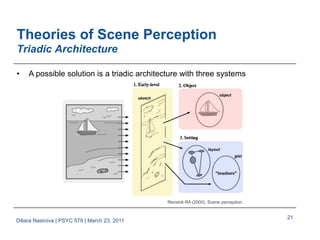
•  A possible solution is a triadic architecture with three systems
Diliara Nasirova | PSYC 579 | March 23, 2011
Rensink RA (2000). Scene perception.
layout
gist
object
sketch
22
Theories of Scene Perception
Triadic Architecture
Diliara Nasirova | PSYC 579 | March 23, 2011
Rensink RA (2002). Internal vs. external information in visual perception.
23
Theories of Scene Perception
Triadic Architecture
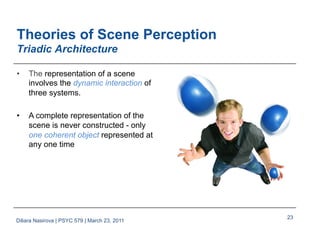
•  The representation of a scene
involves the dynamic interaction of
three systems.
•  A complete representation of the
scene is never constructed - only
one coherent object represented at
any one time
Diliara Nasirova | PSYC 579 | March 23, 2011
24
Application to Visual Design
Visual Transitions
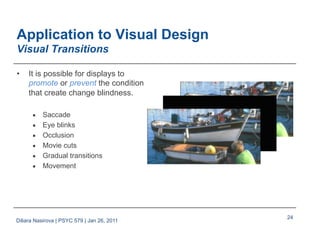
•  It is possible for displays to
promote or prevent the conditions
that create change blindness.
■  Saccade
■  Eye blinks
■  Occlusion
■  Movie cuts
■  Gradual transitions
■  Movement
Diliara Nasirova | PSYC 579 | Jan 26, 2011
25
Application to Visual Design
Visual Transitions
Diliara Nasirova | PSYC 579 | Jan 26, 2011
•  Design of displays robust to change
blindness:
■  Minimizing saccades (important
information close together)
■  Minimizing number of dynamic
events in the background &
foreground
26
Application to Visual Design
Visual Transitions
•  Change Detection in 3D
Parametric Systems:
Human-Centered Interfaces
for Change Visualization
1. Change blindness
2. On model (A) and
on periphery (B)
visualizations
3. Combined views.
Diliara Nasirova | PSYC 579 | March 23, 2011
http://www.bentley.com/
27
Application to Visual Design
Visual Transitions
•  Change Detection in 3D
Parametric Systems:
Human-Centered Interfaces
for Change Visualization
1. Change blindness
2. On model (A) and
on periphery (B)
visualizations
3. Combined views.
Diliara Nasirova | PSYC 579 | March 23, 2011
28
29
Diliara Nasirova | PSYC 579 | March 23, 2011
30
31
Application to Visual Design
Attention Coercion
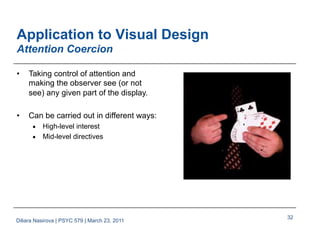
•  Taking control of attention and
making the observer see (or not
see) any given part of the display.
•  Can be carried out in different ways:
■  High-level interest
Diliara Nasirova | PSYC 579 | March 23, 2011
32
Application to Visual Design
Attention Coercion
Diliara Nasirova | PSYC 579 | March 23, 2011
•  Taking control of attention and
making the observer see (or not
see) any given part of the display.
•  Can be carried out in different ways:
■  High-level interest
■  Mid-level directives
33
Application to Visual Design
Attention Coercion
Diliara Nasirova | PSYC 579 | March 23, 2011
•  Taking control of attention and
making the observer see (or not
see) any given part of the display.
•  Can be carried out in different ways:
■  High-level interest
■  Mid-level directives
■  Low-level salience
34
Conclusion
Diliara Nasirova | PSYC 579 | March 23, 2011
1.  Change blindness is very general
phenomenon.
2.  Only one coherent object can be
attended at a time.
3.  The perception of a scene is inherently
dynamic.
35
Questions?
•  Thank you…
Diliara Nasirova | PSYC 579 | March 23, 2011
36
References
1.  Rensink RA (2002). Internal vs. external information in visual perception.
Proceedings of the Second International Symposium on Smart Graphics: 63-70.
[Smart Graphics 2; Hawthorne, NY, USA.]
2.  Rensink RA (2000). Scene perception. In AE Kazdin (ed.), Encyclopedia of
Psychology, vol. 7. (pp. 151-155). New York: Oxford University Press.
3.  Rensink RA (2000a). The dynamic representation of scenes. In DJ Simons (ed.)
Change Blindness and Visual Memory (pp. 17-42). London: Psychology Press.
4.  Varakin DA, Levin DT, and Fidler R (2008). Unseen and unaware: implications of
recent research on failures of visual awareness for human-computer interface
design. Hum.-Comput. Interact., 19:389–422
Diliara Nasirova | PSYC 579 | March 23, 2011

Scene perception

  • 1.
    9.1 Scene Perception PSYC579 Topic Presentation, University of British Columbia Diliara Nasirova School of Interactive Art and Technology, Simon Fraser University March 23, 2011
  • 2.
    2 Outline 1.  Introduction toScene Perception 2.  Theories of Scene Perception ■  Coherence Theory ■  Virtual Representation ■  Triadic Architecture 3.  Application to visual design ■  Visual Transitions ■  Attentional Coercion Diliara Nasirova | PSYC 579 | March 23, 2011
  • 3.
    3 Introduction Scene Perception •  ScenePerception is a visual perception of an environment as viewed by an observer at any given time. Diliara Nasirova | PSYC 579 | March 23, 2011
  • 4.
    4 Introduction Belief about vision • Our brains contain detailed, picture-like representation of the scene Diliara Nasirova | PSYC 579 | March 23, 2011
  • 5.
    5 Introduction Phenomena against thebelief •  Inattentional Blindness: •  The failure to notice the presence of unattended stimuli, even when they are presented within an observer’s field of view •  Change Blindness: •  The failure to see changes even when they are large, anticipated and repeatedly made if they are made during a visual disturbance Diliara Nasirova | PSYC 579 | March 23, 2011 Simons and Chabris (1999) “Gorillas in Our Midst: Sustained Inattentional Blindness for Dynamic Events”
  • 6.
    6 Introduction Phenomena against thebelief •  Inattentional Blindness: •  The failure to notice the presence of unattended stimuli, even when they are presented within an observer’s field of view •  Change Blindness: •  The failure to see changes even when they are large, anticipated and repeatedly made if they are made during a visual disturbance Diliara Nasirova | PSYC 579 | March 23, 2011 Rensink RA (2002). Internal vs. external information in visual perception.
  • 7.
    7 Introduction Change Blindness demo DiliaraNasirova | PSYC 579 | March 23, 2011 http://www.cs.ubc.ca/~rensink/flicker/download/Harborside.mov
  • 8.
    8 Introduction Change Blindness demo DiliaraNasirova | PSYC 579 | March 23, 2011 http://www.cs.ubc.ca/~rensink/flicker/download/Harborside.mov
  • 9.
    9 Introduction Change Blindness demo DiliaraNasirova | PSYC 579 | March 23, 2011 http://www.cs.ubc.ca/~rensink/flicker/download/Harborside.mov
  • 10.
    10 Introduction Change Blindness demo DiliaraNasirova | PSYC 579 | March 23, 2011 http://www.cs.ubc.ca/~rensink/flicker/download/Harborside.mov
  • 11.
    11 Introduction If a visualbuffer existed… Diliara Nasirova | PSYC 579 | March 23, 2011
  • 12.
    12 Introduction If there isno buffer… Diliara Nasirova | PSYC 579 | March 23, 2011 1.  How is it possible to see change at all? 2.  How might human vision operate?
  • 13.
    13 Theories of ScenePerception Coherence theory •  Coherence theory is based on three related hypotheses 1.  Volatile proto-objects formed rapidly in the visual field (without attention) 2.  Focused attention selects some proto-objects and forms coherence field 3.  Release of focused attention (back to proto-objects) Diliara Nasirova | PSYC 579 | March 23, 2011
  • 14.
    14 Theories of ScenePerception Coherence theory •  Coherence theory is based on three related hypotheses 1.  Volatile proto-objects formed rapidly in the visual field (without attention) 2. Focused attention selects some proto-objects and forms coherence field 3. Release of focused attention (back to proto-objects) Diliara Nasirova | PSYC 579 | March 23, 2011
  • 15.
    15 Theories of ScenePerception Coherence theory •  Coherence theory is based on three related hypotheses 1.  Volatile proto-objects formed rapidly in the visual field (without attention) 2.  Focused attention selects some proto-objects and forms coherence field 3.  Release of focused attention (back to proto-objects) Diliara Nasirova | PSYC 579 | March 23, 2011
  • 16.
    16 Theories of ScenePerception Coherence theory •  Why observers fail to detect changes in "attended" objects? ■  Small number of items can be attended at any time ■  Not all details can be represented in a coherence field ■  Change blindness results Diliara Nasirova | PSYC 579 | March 23, 2011
  • 17.
    Theories of ScenePerception Coherence theory •  Counterintuitive implications: ■  Only a few items can be represented ■  The representation details is limited •  Why do we not notice these limitations? Diliara Nasirova | PSYC 579 | March 23, 2011 Rensink RA (2000a). The dynamic representation of scenes.
  • 18.
    18 Theories of ScenePerception Virtual Representation Diliara Nasirova | PSYC 579 | March 23, 2011 •  For most tasks, only one object is in play at any time:
  • 19.
    19 Theories of ScenePerception Virtual Representation Diliara Nasirova | PSYC 579 | March 23, 2011 •  Idea of virtual representation: ■  Create a coherent, detailed representation only of a few objects needed for the task at hand ■  Details about any object should be available on request •  Provide large savings in computational resources: memory & processing time
  • 20.
    20 Theories of ScenePerception Virtual Representation •  For successful use of virtual representation eye movements and attentional shifts should be made ■  to the appropriate object ■  at the appropriate time. •  But what directs these movements and shifts? Diliara Nasirova | PSYC 579 | March 23, 2011 Rensink RA (2000). Scene perception.
  • 21.
    21 Theories of ScenePerception Triadic Architecture •  A possible solution is a triadic architecture with three systems Diliara Nasirova | PSYC 579 | March 23, 2011 Rensink RA (2000). Scene perception. layout gist object sketch
  • 22.
    22 Theories of ScenePerception Triadic Architecture Diliara Nasirova | PSYC 579 | March 23, 2011 Rensink RA (2002). Internal vs. external information in visual perception.
  • 23.
    23 Theories of ScenePerception Triadic Architecture •  The representation of a scene involves the dynamic interaction of three systems. •  A complete representation of the scene is never constructed - only one coherent object represented at any one time Diliara Nasirova | PSYC 579 | March 23, 2011
  • 24.
    24 Application to VisualDesign Visual Transitions •  It is possible for displays to promote or prevent the conditions that create change blindness. ■  Saccade ■  Eye blinks ■  Occlusion ■  Movie cuts ■  Gradual transitions ■  Movement Diliara Nasirova | PSYC 579 | Jan 26, 2011
  • 25.
    25 Application to VisualDesign Visual Transitions Diliara Nasirova | PSYC 579 | Jan 26, 2011 •  Design of displays robust to change blindness: ■  Minimizing saccades (important information close together) ■  Minimizing number of dynamic events in the background & foreground
  • 26.
    26 Application to VisualDesign Visual Transitions •  Change Detection in 3D Parametric Systems: Human-Centered Interfaces for Change Visualization 1. Change blindness 2. On model (A) and on periphery (B) visualizations 3. Combined views. Diliara Nasirova | PSYC 579 | March 23, 2011 http://www.bentley.com/
  • 27.
    27 Application to VisualDesign Visual Transitions •  Change Detection in 3D Parametric Systems: Human-Centered Interfaces for Change Visualization 1. Change blindness 2. On model (A) and on periphery (B) visualizations 3. Combined views. Diliara Nasirova | PSYC 579 | March 23, 2011
  • 28.
  • 29.
    29 Diliara Nasirova |PSYC 579 | March 23, 2011
  • 30.
  • 31.
    31 Application to VisualDesign Attention Coercion •  Taking control of attention and making the observer see (or not see) any given part of the display. •  Can be carried out in different ways: ■  High-level interest Diliara Nasirova | PSYC 579 | March 23, 2011
  • 32.
    32 Application to VisualDesign Attention Coercion Diliara Nasirova | PSYC 579 | March 23, 2011 •  Taking control of attention and making the observer see (or not see) any given part of the display. •  Can be carried out in different ways: ■  High-level interest ■  Mid-level directives
  • 33.
    33 Application to VisualDesign Attention Coercion Diliara Nasirova | PSYC 579 | March 23, 2011 •  Taking control of attention and making the observer see (or not see) any given part of the display. •  Can be carried out in different ways: ■  High-level interest ■  Mid-level directives ■  Low-level salience
  • 34.
    34 Conclusion Diliara Nasirova |PSYC 579 | March 23, 2011 1.  Change blindness is very general phenomenon. 2.  Only one coherent object can be attended at a time. 3.  The perception of a scene is inherently dynamic.
  • 35.
    35 Questions? •  Thank you… DiliaraNasirova | PSYC 579 | March 23, 2011
  • 36.
    36 References 1.  Rensink RA(2002). Internal vs. external information in visual perception. Proceedings of the Second International Symposium on Smart Graphics: 63-70. [Smart Graphics 2; Hawthorne, NY, USA.] 2.  Rensink RA (2000). Scene perception. In AE Kazdin (ed.), Encyclopedia of Psychology, vol. 7. (pp. 151-155). New York: Oxford University Press. 3.  Rensink RA (2000a). The dynamic representation of scenes. In DJ Simons (ed.) Change Blindness and Visual Memory (pp. 17-42). London: Psychology Press. 4.  Varakin DA, Levin DT, and Fidler R (2008). Unseen and unaware: implications of recent research on failures of visual awareness for human-computer interface design. Hum.-Comput. Interact., 19:389–422 Diliara Nasirova | PSYC 579 | March 23, 2011